


You're probably looking at a dashboard that says paid search closed the sale. The report gives full credit to the branded Google click that happened five minutes before purchase. But you know that's not the full story.
The customer may have first seen a TikTok video, clicked a Meta retargeting ad later, read an email, visited the site twice, and only then searched your brand name. Last-click reporting makes the closing touch look like the hero. In practice, it often just captures the final handoff.
That gap is where attribution modeling becomes useful. Not because it gives you perfect truth. It doesn't. But it gives you a better operating system for budget decisions than pretending every conversion came from the last touchpoint alone.
A common pattern shows up when teams start scaling spend. Lower-funnel channels look amazing in the dashboard. Brand search, retargeting, and direct traffic appear to carry the account. Upper-funnel channels look weaker, even when they're doing the work of creating demand.
That leads to bad decisions fast. Teams cut prospecting because last-click says it's inefficient. Then retargeting volume softens, branded search weakens, and the account starts living off a shrinking pool of people who already know the brand.
I've seen this happen most often when a manager inherits a mixed-channel program and trusts the platform default too quickly. One report says Google Ads is winning. Another says Meta assists but doesn't close. Email looks inconsistent. Organic content seems hard to justify. None of those conclusions are safe without asking how conversion credit is being assigned.
If your measurement system rewards only the channel nearest the checkout, your budget will drift toward channels that harvest demand rather than create it.
That doesn't mean last-click is useless. It can still help with tactical optimization, especially when you're judging what tends to close short buying cycles. The problem starts when teams use it as the only truth across the whole funnel.
What marketers really need is a way to assign value across the customer journey. Not perfectly, because that's rarely possible. But consistently enough to answer practical questions:
Attribution modeling exists to make those decisions less arbitrary. Done well, it helps you spend with more confidence. Done badly, it gives false precision and encourages budget cuts in the wrong places.
Think of attribution like a soccer match. The striker scores, so everyone remembers the final kick. But the defender who won the ball, the midfielder who advanced it, and the winger who made the assist all contributed to the goal. Marketing works the same way.
A conversion usually isn't the result of one touch. It's the result of a sequence. Some channels introduce the brand. Others build trust. Others create urgency. Attribution modeling is the method marketers use to assign credit across that sequence instead of giving everything to a single interaction.
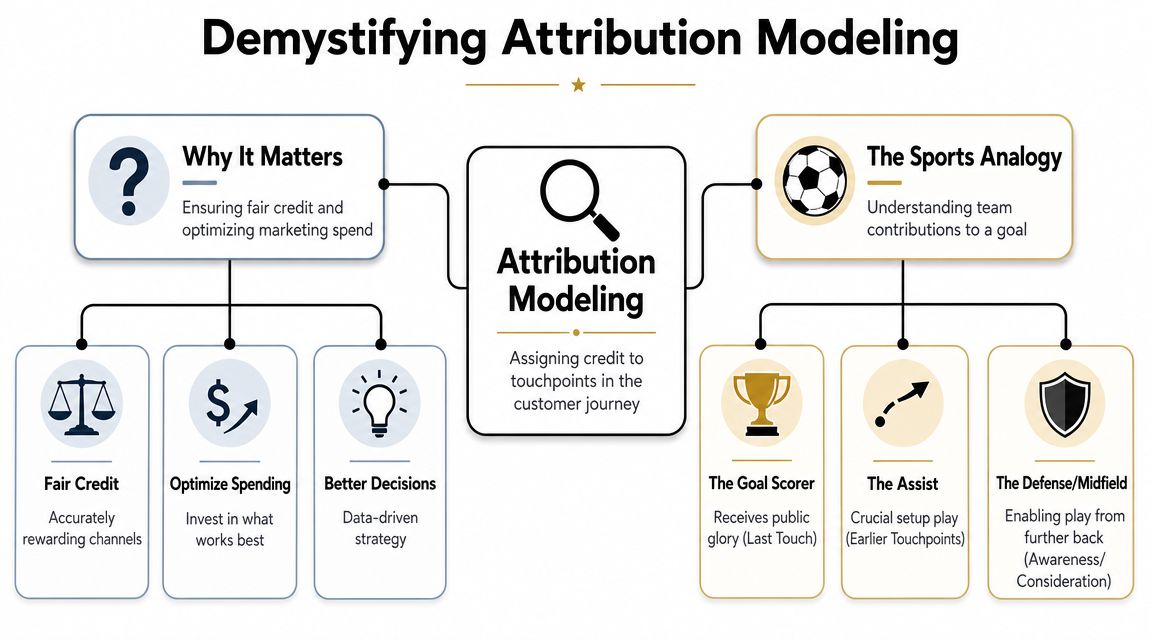
Attribution modeling is a credit-allocation framework for the customer journey. It distributes conversion value across touchpoints such as search, social, email, and other interactions, based on the rules or modeling approach you choose.
That phrase matters: credit-allocation. Attribution is not the same as proof. It tells you how credit is assigned inside a measurement framework. It does not automatically tell you what caused the conversion.
If you manage budget, attribution changes what looks profitable.
A first-touch model will make discovery channels look stronger. A last-touch model will usually favor closing channels. A multi-touch model spreads value across more of the funnel. A data-driven model tries to estimate contribution from patterns in path data rather than applying a fixed rule.
That's why two smart marketers can look at the same campaign set and reach different conclusions. They may not be disagreeing about performance. They may be using different attribution logic.
Attribution didn't start with modern ad platforms. According to the history of attribution in marketing measurement), the discipline emerged formally in the 1950s through the unified measurement model, which introduced a person-centric way to understand how people move toward conversion. Over time, the field expanded from simple single-touch rules to multi-touch and algorithmic methods, reflecting the shift from rule-based reporting to probability-based measurement as journeys became more fragmented across channels.
That evolution matters because today's marketer isn't evaluating one ad and one purchase path. You're dealing with search, paid social, email, CRM activity, landing pages, and often offline actions too. Without attribution modeling, every report turns into a fight over who gets the win.
A team launches Meta prospecting, Google Search, email, and retargeting at the same time. Sales rise. Last-click reporting says branded search won. Meta claims view-through impact. Email looks efficient because it touched many returning visitors near purchase. This is the situation attribution models are trying to organize.
Each model answers a different operational question. None of them gives objective truth. In 2026, the job is to choose a model that fits your buying cycle, your tracking setup in GA4, and the level of identity resolution you can support through server-side tagging and consent limits.
First-touch attribution assigns all credit to the first recorded interaction. Use it to judge which channels are introducing new demand, especially if leadership is pressuring the team to cut awareness spend because it looks weak in closing reports. The trade-off is obvious. It ignores what happened after the first visit, so it is a poor model for budget decisions in nurture-heavy funnels.
Last-touch attribution assigns all credit to the final interaction before conversion. It remains useful because it is easy to explain, easy to find in platform reporting, and often good enough for short weekly optimization cycles. It also pushes too much value toward retargeting, branded search, affiliate coupon traffic, and bottom-funnel email. That bias gets expensive fast if you use it as your only budget view.
Linear attribution splits credit evenly across every touchpoint. That makes it a solid baseline model when a team needs a shared starting point and does not yet trust more advanced setups. It also treats a casual blog visit and a high-intent pricing-page return as equal, which rarely matches how people buy.
Time-decay attribution gives more weight to touches that happened closer to conversion. This can fit businesses where recency usually matters, such as repeat-purchase DTC or lead gen programs with active sales follow-up. It still tends to under-credit the channel that created demand in the first place, so teams often pair it with a top-of-funnel view instead of using it alone.
Position-based attribution, often called U-shaped, gives most of the credit to the first and last touches, then spreads the rest across the middle. It is one of the more practical choices for teams that need to protect acquisition channels while still rewarding the channels that help close. For many accounts, this is easier to defend in budget reviews than a pure first-touch or last-touch model.
W-shaped attribution gives priority to three milestone moments in the journey, then distributes the remaining credit across the other touches. Amplitude's attribution model framework guide explains this structure well. It is most useful when your funnel has clearly defined stages, such as first visit, lead capture, and qualified opportunity. If those stages are messy in your CRM or not mapped cleanly into GA4, W-shaped reporting will look better on paper than it performs in practice.
Practical rule: pick a model your team can implement cleanly and explain under pressure. A simpler model with clean inputs is more useful than an advanced one built on broken event mapping.
Data-driven attribution uses observed path patterns instead of a fixed credit rule. That sounds better, and sometimes it is. It can surface channel interaction effects that rule-based models miss.
It also has hard requirements. Data-driven attribution gets weaker when GA4 is missing key events, when UTMs are inconsistent, when server-side tagging is only partially configured, or when offline steps never make it back into the measurement stack. Privacy controls add another constraint. Shorter lookback windows, consent loss, and weaker user stitching reduce the amount of path data the model can learn from.
For that reason, data-driven attribution is usually best treated as a decision aid, not a final judge. Teams that need help setting up clean tracking, naming conventions, and channel governance often get better results by bringing in paid media specialists before they trust a modeled view with budget allocation.
| Model | How It Works | Pros | Cons | Best For |
|---|---|---|---|---|
| First Touch | Assigns all credit to the first interaction | Shows which channels start journeys | Ignores consideration and closing activity | Awareness analysis and net-new demand questions |
| Last Touch | Assigns all credit to the final interaction | Simple, accessible, fast for campaign optimization | Overvalues closing channels | Short buying cycles and tactical execution |
| Linear | Splits credit evenly across all touches | Good baseline and easy to explain | Assumes every touch matters equally | Teams building an initial cross-channel view |
| Time Decay | Gives more credit to touches closer to conversion | Reflects recency and active nurture | Can hide upper-funnel impact | Repeat purchase, lead nurture, and shorter sales cycles |
| Position-Based | Gives the first and last touches most of the credit | Balances discovery and conversion influence | Still based on assumptions, not observed lift | Brands protecting prospecting while tracking closers |
| W-Shaped | Prioritizes three funnel milestones and spreads the rest across other touches | Useful for stage-based funnels | Depends on clean stage definitions and CRM alignment | SaaS and lead-gen programs with formal handoffs |
| Data-Driven | Uses modeled path analysis to estimate contribution | Can reflect channel interaction patterns | Needs strong implementation and enough usable path data | Mature teams with reliable tracking and identity coverage |
A single permanent model rarely holds up across every decision. Smart teams use a small set of models for different jobs.
A practical setup often looks like this:
That approach fits how teams work in GA4. One model for reporting. Another for budget protection. A third for strategic review. The mistake is not using a simple model. The mistake is using one narrow view for every budget decision.
A marketing manager pulls last-click numbers on Monday, sees branded search and email closing nearly every sale, and starts cutting paid social, creators, and upper-funnel video. Three weeks later, demand softens, retargeting gets more expensive, and new customer mix gets worse. The model did its job. The team used it for the wrong decision.
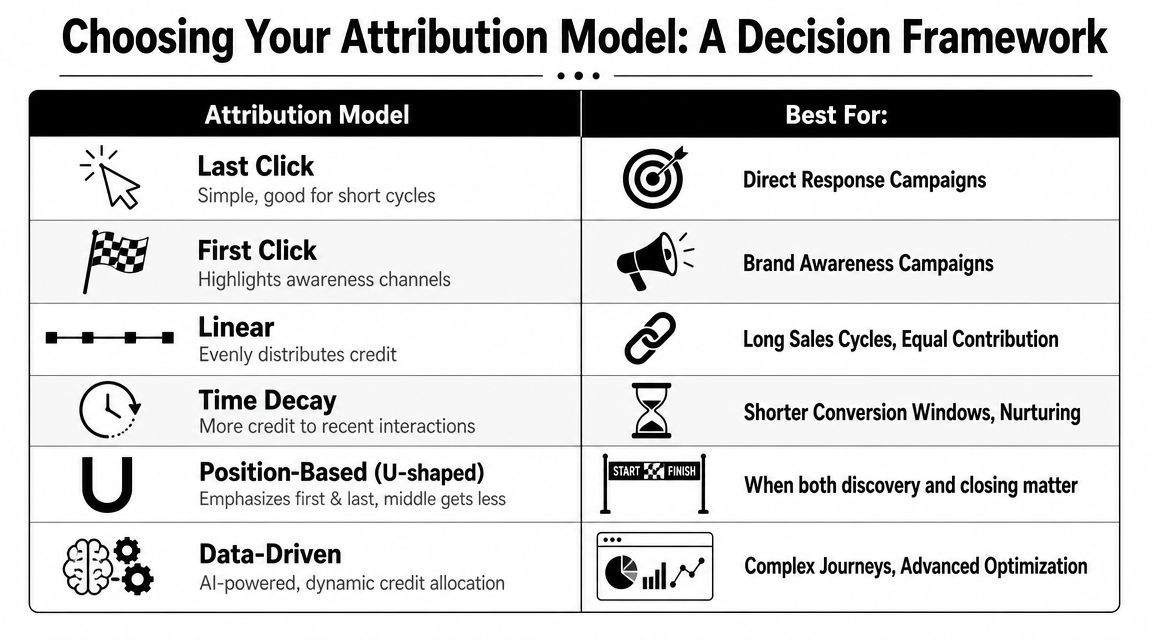
Choosing a model starts with the business question, not the reporting feature. In practice, the right choice depends on sales cycle length, channel mix, CRM maturity, and how much tracking loss your setup can tolerate inside GA4 and privacy-driven measurement limits. A model should help you protect the budget that creates demand, identify the channels that close it, and give operators a view they can act on every week.
Use a simpler model if the job is fast optimization. Use a broader model if the job is budget allocation across the full journey.
A DTC brand usually needs two answers at once. Which campaigns are driving purchases now, and which channels are filling the pipeline for next month? If the path is short and conversion happens in a few visits, last-touch or time-decay can work for weekly pacing. If the brand is spending on creators, Meta prospecting, YouTube, or content, a position-based view usually gives a fairer read on contribution before finance cuts the channels that introduce new customers.
A SaaS company has a different constraint set. The path often runs through multiple sessions, hand-raisers, sales touches, and CRM stages. A model that spreads credit across meaningful interactions is usually more useful because marketing needs to see influence before closed-won. W-shaped often works well when lead, opportunity, and close stages are defined cleanly. Data-driven can be useful too, but only if event tracking, CRM syncing, consent handling, and identity stitching are good enough to trust the paths.
An agency needs a model that is analytically sound and easy to defend in client conversations. Clients still compare your attribution view against platform-reported ROAS, and those numbers will not match. Good agencies set expectations early, show multiple attribution views side by side, and explain what each one is for. If your team needs stronger interpretation across accounts, experienced paid media specialists can help translate model differences into budget calls clients will approve.
A 2026 attribution setup is shaped by more than model logic. GA4 has real limits. Privacy controls reduce observable user paths. Server-side tagging improves control and data quality in many setups, but it does not restore perfect visibility or fix weak event design.
That changes the model choice.
If tracking is patchy, complex models can create false confidence. If your CRM stages are inconsistent, W-shaped reporting will look precise while hiding garbage inputs. If your channel taxonomy is messy, every model will inherit the same classification problem. Teams waste money when they choose the most advanced model available instead of the most reliable model their measurement setup can support.
That framing makes selection easier:
Attribution allocates credit. It does not prove causality. A channel can appear on a high share of converting paths and still be less incremental than the report suggests.
The best model for your business is usually not one permanent answer. It is a working setup tied to business goals, implemented within GA4 and CRM constraints, and reviewed often enough to catch when the customer journey changes.
You launch a budget shift on Monday because paid search looks like the clear winner in GA4. By Friday, pipeline quality is down, branded search is soaking up credit it did not create, and the team is arguing over whether the model is wrong. In practice, the setup was wrong. The tracking, conversion rules, and reporting windows did not match how the business acquires customers.
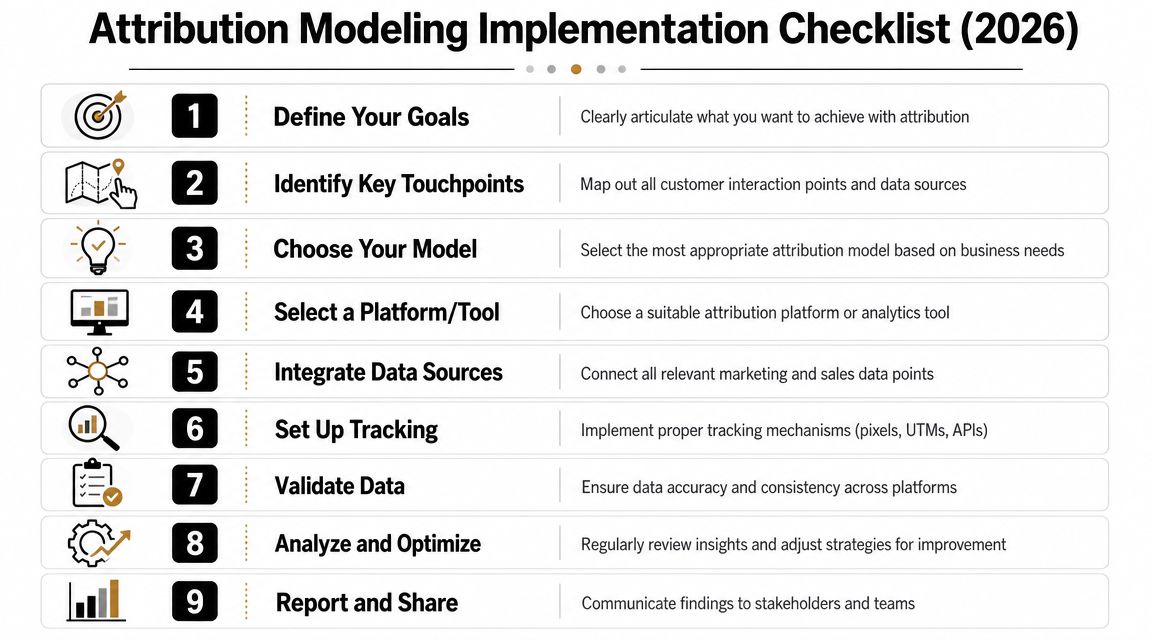
A usable attribution setup for 2026 has to survive three realities. GA4 has limits. Privacy controls reduce observable user paths. Server-side tagging improves control, but it does not repair weak strategy or bad taxonomy. Teams that accept those constraints early usually build reporting they can use in practice.
Attribution breaks long before the model breaks.
If UTMs are inconsistent, the CRM receives partial source data, or conversion events fire differently across sites and landing pages, the report will still look clean. The budget decisions will not be. Standardize naming conventions across paid media, lifecycle, analytics, and sales ops. Then lock them down in documentation and QA, not in tribal knowledge.
Define conversions at the business level, not the platform level. For DTC, that usually means purchase plus a small set of pre-purchase actions worth watching. For SaaS, it often means qualified lead, booked demo, pipeline creation, and closed-won in the CRM. Agencies need one more layer. They need a version that is strict enough for internal optimization and simple enough to explain to clients without overselling certainty.
Server-side tagging earns its keep here because it gives your team more control over data collection, identity handling, and event routing. It also creates more implementation work. If consent logic, event mapping, and downstream destinations are not tested carefully, server-side moves the mess to a different container.
Model debates get too much attention. Window and scope mistakes waste more money.
A short lookback window can strip credit from upper-funnel touches that matter in SaaS or considered DTC purchases. A long one can keep stale interactions alive long after they stopped influencing the sale. The same issue shows up in scope. Session-level and user-level views answer different questions, and teams often compare them as if they are interchangeable.
GA4 forces trade-offs here, so choose based on the decision you need to make. If the team is managing weekly media pacing, a tighter window may be more useful. If leadership wants to understand how content and paid social support pipeline over time, a longer view tied to CRM milestones is usually more honest.
Start with one decision
Tie attribution to a real operating question such as budget allocation, prospecting efficiency, sales handoff quality, or retention marketing. Vague reporting goals produce vague setups.
Map the journey by business model
DTC, SaaS, and agency reporting needs are different. DTC usually needs visibility into discovery, remarketing, and purchase. SaaS needs lead stages and offline sales activity. Agencies need account-level consistency across multiple client setups.
Audit GA4 before choosing a model
Check source and medium values, primary conversion events, channel grouping rules, cross-domain behavior, and duplicate firing. If those basics fail QA, stop there and fix them first.
Connect CRM and offline outcomes
Longer sales cycles need more than GA4 conversion events. Import lead qualification, opportunity stages, revenue, and closed-won status where possible so attribution reflects commercial outcomes, not just form fills.
Set the lookback window to match buying behavior
Short purchase cycles usually need tighter windows to reduce noise. Longer B2B journeys often need more time so early education and lead capture do not disappear from the record.
Choose a primary model and a check model
Use one model for routine reporting and a second model to pressure-test major decisions. For example, a team might review monthly performance in a position-based view, then compare against last-touch before changing spend.
Make consent and privacy part of implementation
Configure consent mode, retention settings, and regional requirements early. Privacy work changes what you can measure, how long you can keep it, and which paths remain visible.
Review paths, not just channel tables
Conversion path reports often expose tagging gaps, branded search inflation, and retargeting that appears stronger because it arrives late. A few path reviews each month catch issues summary dashboards miss.
Validate against finance, sales, and experiments
If attribution says one thing while sales feedback, margin data, or holdout tests say another, investigate before reallocating spend. Attribution should support decisions, not overrule every other signal.
Teams that want a practical benchmark can review real attribution and media performance case study examples and compare them against their own setup choices.
Good attribution in 2026 comes from disciplined setup, realistic expectations, and regular QA. The model matters, but only after the measurement foundation is strong enough to support it.
The easiest way to understand attribution modeling is to look at how the same journey appears under different business contexts.

A customer discovers a skincare brand through a TikTok creator mention. A day later, they click a paid social retargeting ad. Later that week, they open an email featuring reviews and eventually purchase after a branded search.
Last-touch says branded search closed the sale. First-touch says TikTok created it. Position-based gives both discovery and closing a larger share, while still acknowledging the middle touches. For a DTC team, that difference changes whether prospecting content gets protected or cut.
The practical takeaway is simple. If the brand only trusts last-touch, branded search and retargeting will look stronger than they are as demand creators.
A prospect sees a LinkedIn thought leadership post, reads a blog article, downloads a whitepaper, joins a webinar, and finally requests a demo after a sales email follow-up.
A single-touch model strips out most of the story. A linear model gives all major stages some visibility. A W-shaped approach can be even more useful if the company has defined milestones like lead capture, qualification, and demo request.
For SaaS, attribution matters most when marketing and sales both influence the outcome. If your reports stop at form fills, you'll miss how channel value changes after the lead enters the pipeline.
An agency runs YouTube, Meta, search, and email for a client that keeps asking why YouTube rarely appears as the last click. This is the classic reporting trap.
The agency can use multi-touch reporting to show that upper-funnel media appears earlier in converting paths, supports branded search volume, and improves the quality of traffic later captured by search and remarketing. A strong case study library also helps agencies explain performance in a way clients understand, especially when the client is over-focused on last-click ROAS.
The model you choose changes which channel gets blamed, which channel gets funded, and which channel gets turned off first.
That's why attribution shouldn't sit with analytics alone. It needs media, CRM, and leadership involved, because each team interprets the same path through a different lens.
The tool stack for attribution has improved, but tools still don't make judgment calls for you. GA4 often serves as a starting point. Ad platforms provide their own view of contribution. Some brands layer in warehouse reporting, CRM attribution, or specialized measurement tools.
That's helpful, but the hard part isn't access to dashboards. The hard part is interpretation. Someone has to decide which model is appropriate, which lookback window matches the cycle, how to reconcile platform data with CRM outcomes, and when to distrust a report that looks too clean.
At that point, you usually need specialists who understand both buying and measurement. Not just dashboard users. Operators who can connect attribution output to bid strategy, creative testing, and budget movement. Teams hiring experienced performance marketers often get more value from attribution because someone is finally responsible for turning reports into action instead of just circulating screenshots.
The win isn't more reporting. It's better decisions made faster, with fewer blind spots.
Attribution modeling usually works at the touchpoint or user-path level. Marketing mix modeling is broader and more top-down. In practice, attribution helps with channel and campaign decisions inside digital journeys, while marketing mix modeling is often used to understand contribution across channels at a higher planning level, including cases where user-level tracking is incomplete.
There isn't a universal number worth citing here from the verified material, so the safe answer is practical rather than numeric. You need enough clean conversion and path data for the model to find stable patterns. If your volume is low, your channel tagging is inconsistent, or your CRM outcomes aren't connected, rule-based models are often easier to interpret and trust.
You can still use it, but you should trust it differently. As third-party cookies fade, user-level path stitching has become less reliable. Google is moving toward privacy-preserving approaches such as Privacy Sandbox, and GA4 uses consent-aware modeling. That's why many teams now rely on blended measurement using CRM data, incrementality tests, and modeled conversions rather than depending on a single attribution view, as explained in this overview of privacy changes and attribution modeling.
Usually, no. A primary model for reporting is useful. A secondary model for validation is smarter. Teams get into trouble when they force one model to answer every question from awareness through closed revenue.
If attribution is driving budget decisions and you need people who can build, interpret, and operationalize it, HireMediaBuyers.com helps companies find vetted media buyers and paid ads specialists fast. Whether you need someone to clean up GA4 reporting, connect paid media to CRM outcomes, or run a more disciplined performance program across Meta, Google, LinkedIn, TikTok, and beyond, it's a practical place to find talent that can turn measurement into action.


