

You opened Ads Manager, saw clicks, impressions, maybe a decent-looking CTR, and still had that ugly little thought: “Why does revenue feel allergic to this account?”
I know the feeling. The dashboard says activity. Your bank account says theater.
Most founders don't need another “how Facebook ads work” article. You need a hiring filter. Because the expensive part usually isn't the ad spend. It's the wrong person managing it while sounding confident on Zoom.
A real Facebook Ads Specialist, or more accurately a Meta Ads specialist, should act like an operator tied to revenue. Not a button-pusher who knows where the green button lives. If you hire well, paid social becomes a system. If you hire badly, you buy yourself a weekly performance review where everyone nods politely at graphs.
This usually starts the same way.
A founder hires a freelancer who talks fast, knows the lingo, and promises to “scale aggressively.” Two months later, the account has fresh creatives, a few new campaigns, and a beautifully formatted report full of reach, clicks, and engagement. Sales are flat. Leads are junk. Nobody can explain why.
Or you go the agency route. You get a kickoff call, a strategy deck, and then silence broken only by invoices. Your account becomes one of many. You ask why performance dropped and get some variation of “the algorithm is volatile right now.” Convenient. Also useless.
Practical rule: If someone can't connect ad spend to business outcomes in plain English, they're not a specialist. They're a narrator.
This role matters because Meta is not some side channel anymore. In 2025, Meta scaled to 3.07 billion monthly active users, with estimated ad reach at about 74.3% of MAUs, and average global CPMs around $10 to $15, with some premium verticals hitting $20+, according to these Meta advertising benchmarks. That scale is exactly why this hire matters so much. The platform is big enough to make you money fast, and sloppy enough to let an amateur burn it fast too.
The mistake isn't hiring for “Facebook ads.” The mistake is hiring for output instead of judgment.
You don't need someone who can launch campaigns. Lots of people can do that by Sunday evening and a YouTube playlist later.
You need someone who can answer questions like:
That's the whole game.
Not definitions. Not fluffy best practices. Not motivational marketing soup.
This is the founder's hiring playbook for spotting a Facebook Ads Specialist who can drive revenue, challenge your assumptions, and save you from funding another educational experiment with your own ad budget. Toot, toot.
If your mental image is someone tweaking interests and hitting “Publish,” let's fix that.
A real Facebook Ads Specialist does four jobs at once. Strategist. Analyst. Creative partner. Technician. If one of those is missing, performance eventually falls over.
Also, small but important correction. The market still searches for “Facebook Ads Specialist,” but the actual role has widened. The term Meta Ads specialist fits better because the work now spans Facebook, Instagram, Messenger, and Audience Network, as noted in this guide to hiring a Meta Ads expert.
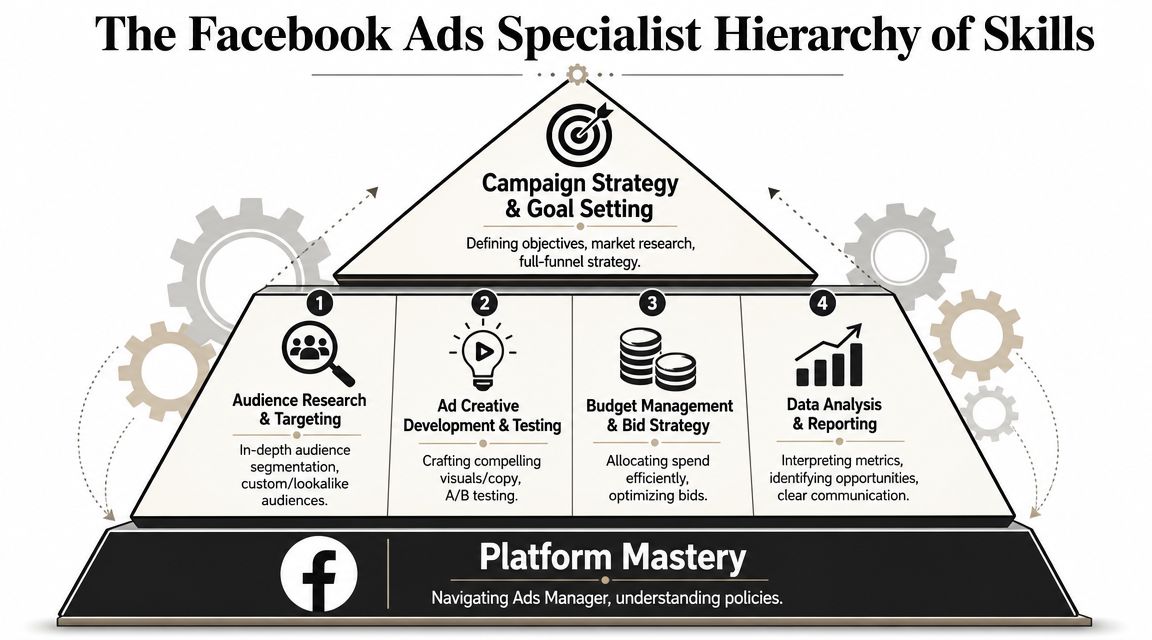
A strong hire starts with business goals, not ad formats.
They should know whether your account needs prospecting, retargeting, lead generation, direct response sales, or a fuller funnel. They should ask about margins, sales cycle, offer strength, conversion bottlenecks, and customer quality before they touch audience settings.
If they jump straight into campaign setup without understanding the business model, you're hiring a mechanic who never opens the hood.
This person should live inside patterns, not surface numbers.
They need to read performance data and decide what deserves a test, what deserves patience, and what deserves a quiet funeral. A useful specialist doesn't merely report outcomes. They isolate causes. Audience mismatch. Creative fatigue. Attribution confusion. Budget fragmentation. Placement problems.
That's the difference between “we saw a drop” and “this is why it dropped.”
Paid social is not just targeting anymore. Creative carries a lot of the load.
Good specialists know how to brief creators, judge hooks, compare ad angles, and tell you why one message lands while another dies on arrival. They don't need to be your copywriter and designer in one body, but they do need taste, pattern recognition, and enough conviction to say, “This creative is weak. Don't ship it.”
Then there's the unglamorous part. The part that saves money.
They should know Ads Manager cold. They should understand tracking, event setup, budget controls, automated rules, and the mechanics that connect spend to outcomes across placements. Such complexities often lead amateurs to wave their hands and call things “glitches.”
The person you want can move from campaign structure to creative diagnosis to tracking cleanup without sounding lost.
Ask a candidate what they do all day.
If the answer sounds like platform activity, that's a warning. If it sounds like they manage measurement, experimentation, creative iteration, and budget allocation around business goals, you're talking to someone more interesting.
The Ads Manager interface is entry-level stuff. Hiring on that alone is how founders end up paying for activity instead of progress.
The people worth your money combine platform competence with commercial judgment. One keeps the account from breaking. The other keeps your budget from drifting into campaigns that look busy and produce nothing useful.
This work is dull right up until it burns a month of spend.
A hire should be fully comfortable inside Meta Ads Manager, understand Facebook Pixel or conversion tracking, know how to set up automated rules, and run clean A/B tests tied to a real decision. Specialists who can handle testing, budgets, and tracking issues are better positioned to improve performance, according to this breakdown of Facebook ads expertise.
Here's the baseline I'd expect without excuses:
The act of hiring presents increased difficulty. Simultaneously, a definitive separation becomes apparent.
A strong Facebook Ads Specialist understands more than campaign setup. They can read your offer, margins, sales cycle, funnel friction, and creative limitations, then build a media plan around those facts. That is the person who helps you grow. The rest just keep the dashboard warm.
Here is the split that matters:
| Skill | What a weak hire does | What a strong hire does |
|---|---|---|
| Offer mapping | Sends traffic to the existing page and calls it a funnel | Challenges the offer, path to purchase, and conversion bottlenecks |
| Audience thinking | Chooses a few interests and waits | Builds tests around buyer intent, awareness level, and stage of demand |
| Creative judgment | Asks for “fresh creatives” with no direction | Identifies the missing hook, objection, or angle and briefs around it |
| Budget logic | Spreads spend thinly to keep everything alive | Pushes budget toward proven signal and cuts dead weight fast |
Listen to the language.
Weak candidates hide behind platform terms. Strong candidates talk like operators. They say, “The offer is too cold for this audience,” or “You have enough click volume, but the conversion path is leaking after the landing page.” That answer saves you time because it points to a fix, not a report.
Founder filter: Hire the candidate who presses on your funnel, margins, sales handoff, and customer quality. If they never make you a little uncomfortable, they probably are not good enough.
Plenty of people can keep campaigns running. Very few can tell you whether the machine deserves more budget in the first place. That is the bar.
You sit through the monthly call. The specialist is cheerful. The slides look polished. CTR is up, CPM is down, engagement looks healthy, and everyone acts like progress happened.
Then you check Shopify, Stripe, or your CRM. Revenue is flat. Lead quality got worse. Your cost to acquire a customer still makes the math ugly.
That is the trap.
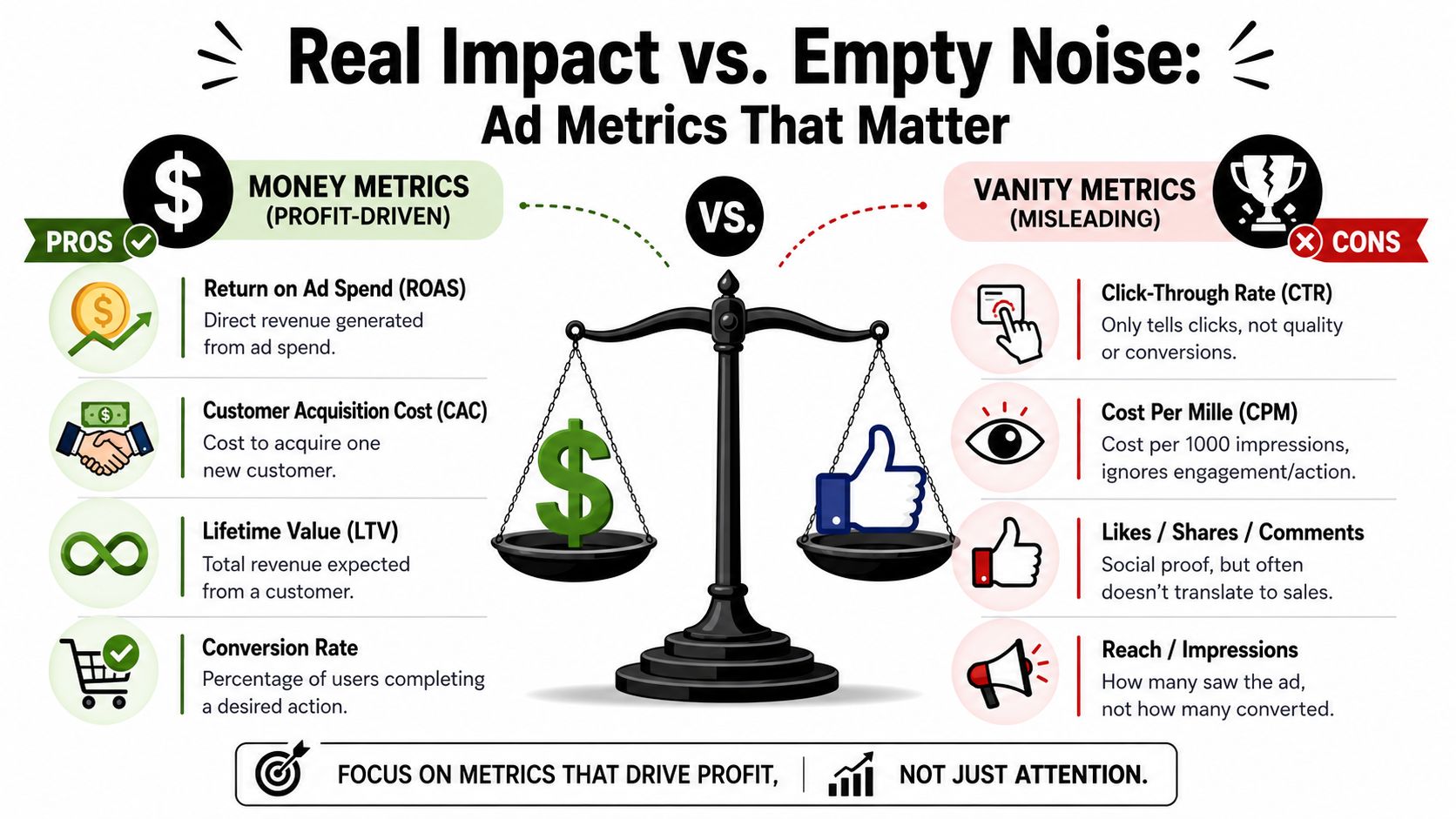
Weak media buyers report activity. Strong ones report business outcomes. If a candidate cannot connect spend to contribution margin, payback period, and customer quality, they are managing a dashboard, not growth.
An experienced operator treats CPA and ROAS as decision-making metrics, then works backward through the causes. Attribution gaps, creative fatigue, audience saturation, broken tracking, weak landing pages, and bad offer-market fit all show up there first, as explained in this Meta ads expert guide.
Keep the scorecard short.
For ecommerce, I care about blended economics as much as in-platform results. For lead gen, I care about qualified pipeline and close rate, not raw form volume. That distinction matters when you hire. Plenty of candidates can make Meta report a lower cost per lead. Far fewer can get you more deals.
CTR, CPM, reach, video views, likes, shares, comments. These are supporting diagnostics, not success metrics.
A cheap CPM can mean your targeting is broad and your traffic is weak. A high CTR can mean your ad made a promise the landing page could not keep. Video views are nice if you sell applause.
Founders get burned when those numbers lead the conversation.
Ask the candidate to show you a real client report. If you need examples of how serious buyers present performance to clients, start there and compare the framing.
Then look at page one.
A real pro starts with revenue, CPA, ROAS, qualified leads, or pipeline contribution. They explain what changed, why it changed, and what they are doing next. A pretender opens with reach charts and engagement trends because they need somewhere to hide.
My rule is simple. If business outcomes are buried halfway through the deck, the operator is buried halfway through the funnel too.
Forget “Tell me about yourself.” That question has launched a thousand polished non-answers.
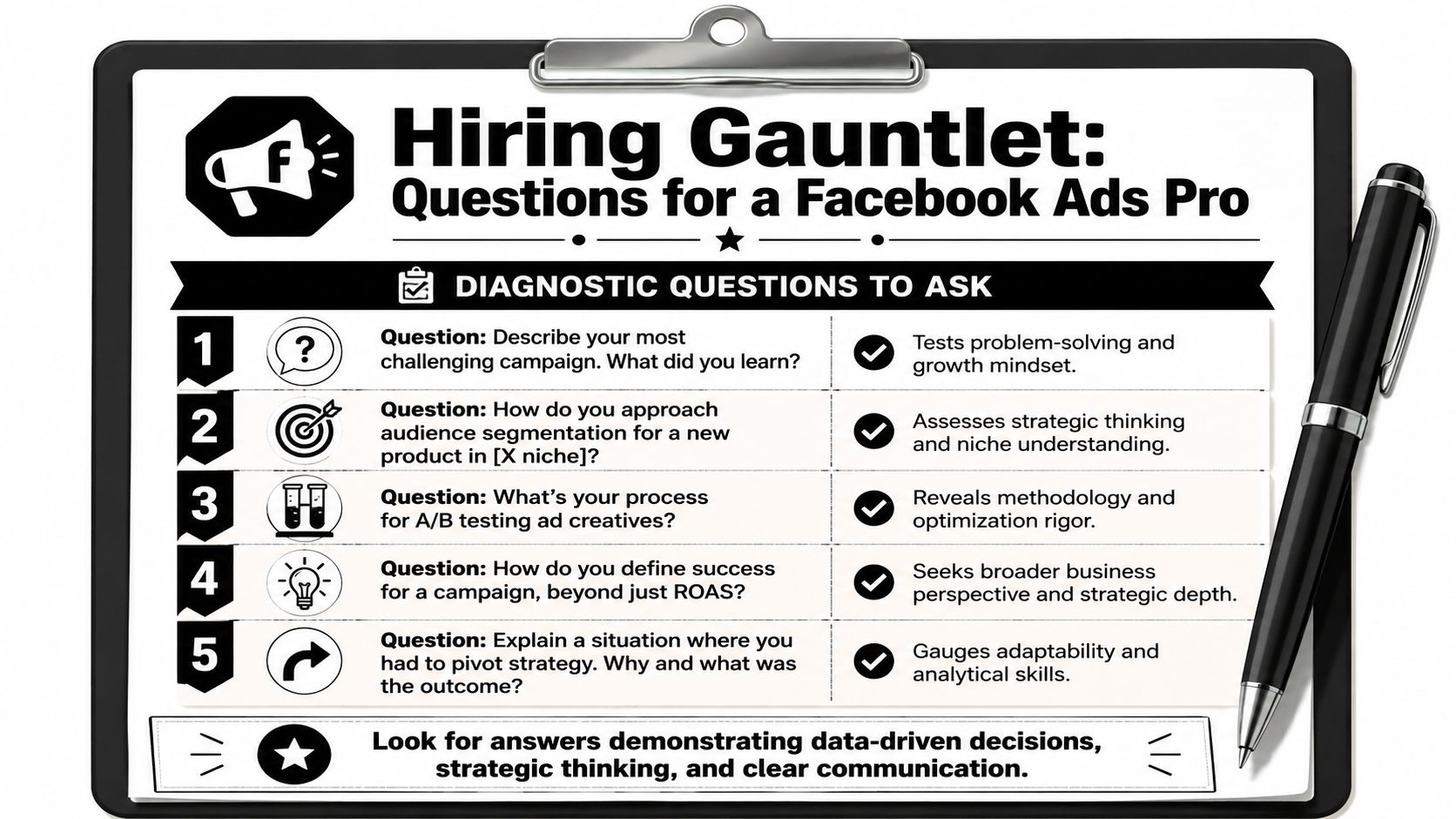
Run an interview that forces the candidate to think out loud. You're not checking whether they know terms. You're checking whether they can diagnose, prioritize, and communicate like an owner.
Start with this one.
“Our main campaign tanked yesterday. Walk me through your first 24 hours.”
A good answer should include some mix of checking tracking integrity, verifying whether the drop is isolated or broader, reviewing creative fatigue, comparing audience and placement behavior, and making measured changes instead of flailing.
A bad answer sounds like superstition. “Meta's been weird lately.” Thanks, wizard.
This one is sneakily powerful because it exposes whether the candidate has a process or just vibes.
Recent practitioner guidance recommends mining ads manager results, reviews, post-purchase surveys, and comments to identify only about 5 to 10 mass-market desires for an audience, then testing those systematically, as outlined in this practitioner video on ad angles.
So ask:
If they say they just “brainstorm hooks,” I'd keep moving.
Try a few of these:
“What do you look at first when ROAS drops but CTR stays healthy?”
You want someone who considers conversion issues, landing page friction, tracking gaps, and audience quality before panicking.
“When would you stop testing audiences and focus on creative instead?”
This reveals whether they understand where the greatest influence is.
“How do you decide budget allocation across campaigns?”
Strong candidates talk about signal, business priorities, and avoiding fragmented spend.
“What would you need from us before launching anything?”
Better candidates ask for margins, sales cycle context, offer history, customer feedback, and tracking access.
For examples of what credible talent evaluation can look like in the wild, it's worth reviewing real client references from media buyer hiring engagements.
| Red flag | Why it matters |
|---|---|
| They promise outcomes too confidently | Serious operators know they control process, not guarantees |
| They blame the algorithm for everything | Convenient excuse. Weak diagnosis |
| They obsess over hacks | Good performance comes from systems, not magic settings |
| They don't ask about your business model | They're planning to run ads in a vacuum |
| They can't explain tradeoffs clearly | Clients don't need jargon. They need judgment |
If they never get curious about your customer, offer, margins, or funnel, they're not interviewing for your business. They're auditioning a routine.
At the end, ask this.
“What do you think is most likely broken in our acquisition system right now?”
Give them a little context and let them reason. You don't need them to be correct on every point. You need them to think sharply, ask better follow-ups, and avoid fake certainty.
That's the person worth a second conversation.
Hire the wrong way, and you pay for it twice. First in fees or salary. Then in the weeks you lose babysitting campaigns that never had a real chance.
There are three common hiring paths for a Facebook Ads Specialist. Each can work. Each can also turn into an expensive mess if it does not match the stage of your business, your budget, and how much day-to-day involvement you want.
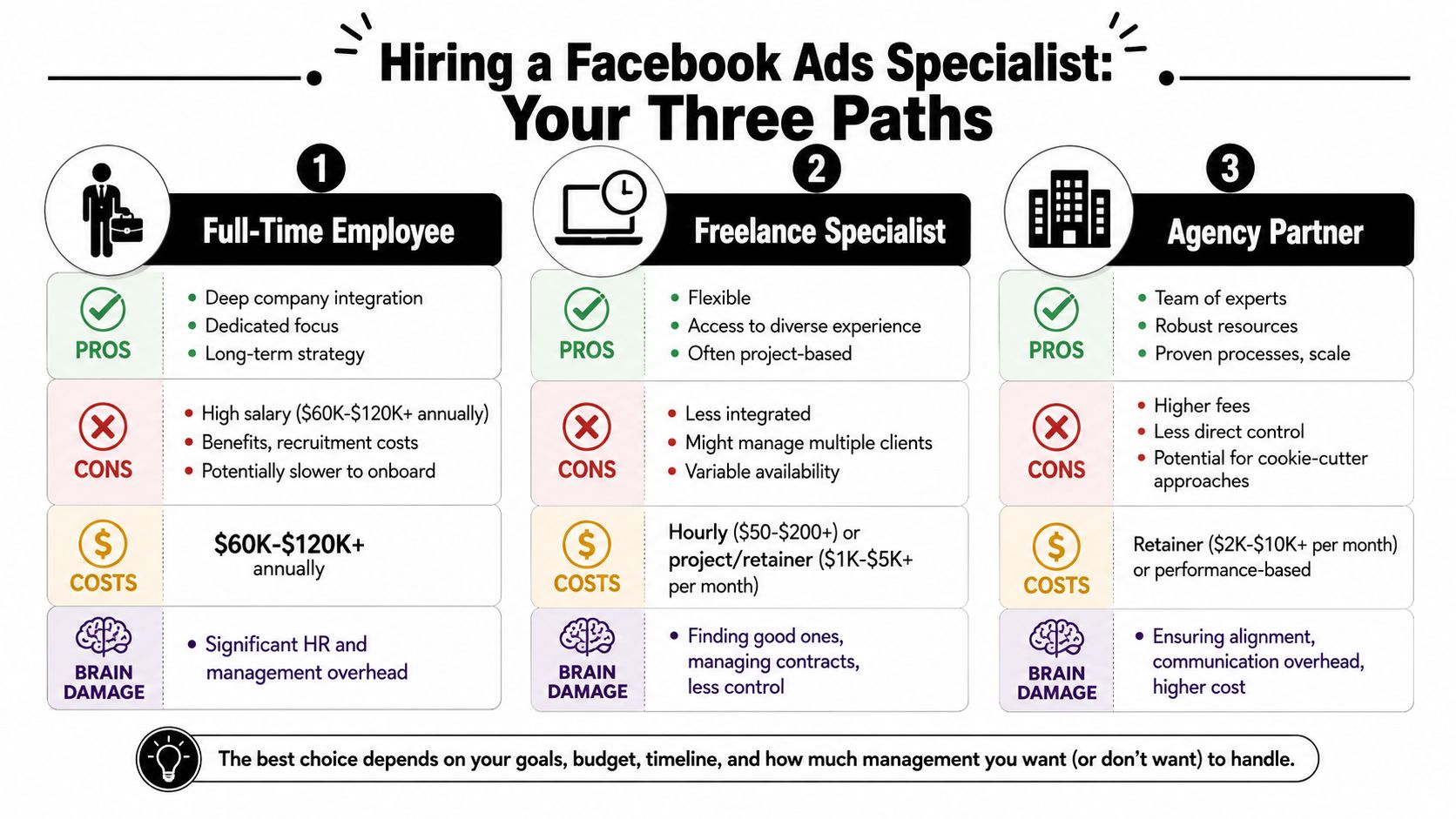
Choose this route when paid social is a core acquisition channel and you need someone inside the business every week, not dropping into Slack between other clients. A strong full-time buyer can build context fast, work closely with creative, and make smarter calls because they know your offer, margins, and sales motion.
The catch is simple. Full-time is the most expensive mistake if you get it wrong.
Salary is only part of the bill. You also pay in recruiting time, onboarding, benefits, management attention, and the opportunity cost of letting the wrong person sit on the account for three months while everyone hopes performance will improve. If your ad account is not large enough or your creative pipeline is still weak, a full-time specialist is usually overkill.
This is the fastest option. It is often the right call when you need a sharp operator to clean up tracking, rebuild a broken account, launch a new offer, or cover a gap before making a permanent hire.
It is also the easiest place to get fooled.
Freelancers range from excellent specialists to people who recycle the same playbook across ten accounts and call it strategy. Some are great at short bursts and bad at ownership. Some disappear during launches. Some look senior until you ask how they would handle falling conversion rates with stable click-through rate and rising frequency. That is why this model only works if your vetting is tight and your scope is painfully clear.
This sits between the first two options. You still get flexibility, but you do not have to spend your week sorting through polished resumes and shaky operators.
That filtering matters more than founders want to admit. Good platforms save time because they narrow the field before you start interviewing. If you are open to remote talent outside your local market, this offshore hiring guide for media buyers is a useful breakdown of cost, communication, and coverage tradeoffs. HireMediaBuyers.com is one example in this category. It connects companies with pre-vetted paid ads talent for part-time and full-time remote roles.
The expensive mistake is not picking the "wrong" model on paper. It is picking a model your team cannot support, then acting surprised when the specialist underperforms.
By this point, the pattern is probably clear. Hiring a strong Facebook Ads Specialist is not hard because the role is mysterious. It's hard because too many candidates can talk just well enough to pass a lazy interview.
And a proper interview process isn't light work. You need a sharp brief, a real scorecard, scenario questions, reference checks, technical screening, and enough business context to know whether the person thinks commercially. That's a lot to stack on top of running the company you already have.
If you want to shorten that slog, this hiring timeline for paid media roles lays out what a faster process can look like when the sourcing and vetting piece is already handled.
My advice is simple. Stop hiring for platform familiarity. Start hiring for judgment, diagnosis, communication, and creative intelligence. That person can help you scale. The rest will happily spend your money while explaining why the graph is “directionally positive.”
You've seen enough of those meetings already.
If you want a shortcut, HireMediaBuyers.com is built for companies that need pre-vetted media buyers and paid ads specialists without running the whole hiring circus themselves.


