

Most advice on client references is backwards.
You'll hear that references are the final polish step. A quick sanity check. A formality before the offer. That's nonsense. If you treat client references like a ceremonial box to tick, you're not vetting. You're collecting permission slips.
I learned that the expensive way. The “great resume, smooth interview, glowing references, messy reality” way. The candidate looked sharp, sounded strategic, and came with people ready to say lovely things. Then the work started. Reporting was fuzzy. Media buying decisions were reactive. Communication got weird the moment results dipped. The references weren't false. They were curated. That's the trap.
Good hiring doesn't come from asking whether someone was “great.” Bad hires often sound great in carefully stage-managed conversations. Good hiring comes from forensic reference auditing. You're not looking for compliments. You're looking for evidence. Especially with remote media buyers, where polished presentation can hide sloppy execution for far too long.
Most client references are useless because the candidate controls the stage.
They choose the people. They choose the timing. They often choose the project that made them look best. Then hiring managers ask softballs like “Were they good to work with?” and act surprised when the answer is yes. Of course it is. Nobody hands over the number of the client who had to clean up their broken attribution setup on a Friday night.
The whole point of client references is to reduce uncertainty before you commit. That logic mirrors how the American Statistical Association describes validation before conclusions are drawn. You verify the setup, the evidence, and whether the conclusion fits reality. That's exactly what a useful reference process should do.

A glowing reference usually tells you one of three things.
That last category causes a lot of damage. A reference says, “She was always very positive.” Translation: they didn't answer your question about performance. Or they say, “He handled the account independently.” Translation: maybe. Or maybe nobody was watching closely enough to know.
Practical rule: If a reference spends more time praising attitude than describing work, you still know almost nothing.
Most hiring teams often get lazy. They listen for reassurance instead of contradiction.
That's a mistake. You shouldn't go into a reference call hoping to be comforted. You should go in trying to break the story. I'm not saying be hostile. I'm saying be alert. If a candidate claims they turned around a weak Meta account, you need to know what was broken, what changed, how long it took to stabilize, and who owned which decisions.
Use client references like an audit, not a pep rally.
Ask yourself:
For remote media buyers, the expensive misses are predictable. Weak communication. Slow ramp-up. Poor judgment under pressure. Pretty dashboards with thin thinking underneath. If your references don't test those areas, you're wasting your own time.
If you let candidates choose every reference without constraints, you're volunteering to be misled.
Not because they're all dishonest. Because they're human. People naturally pick supporters, rescuers, and the one client who still thinks that one heroic quarter was magic. You need a balanced sample, not a fan club.
For a remote media buyer, I want a spread of contacts who saw different kinds of work.
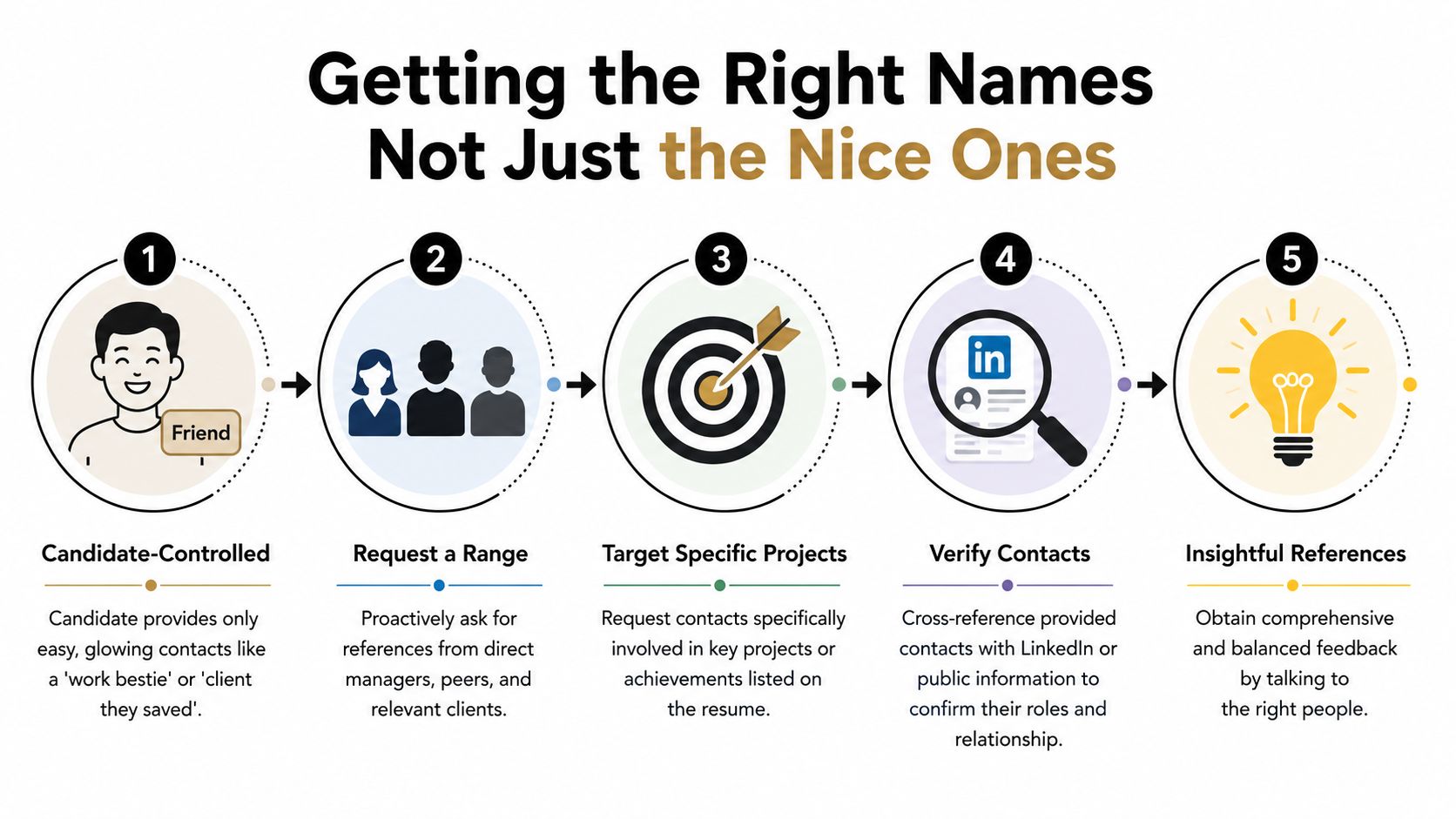
Ask for:
That mix matters more than a stack of polished testimonials. You want somebody who saw the person on a calm week, a messy week, and a “platform changed overnight and now everybody's panicking” week.
Don't ask, “Can you send some references?”
That's weak. It invites a beauty pageant. Ask like someone who has done this before.
Use this:
Hi [Candidate Name], for final-stage reference checks, please send:
- one former direct manager
- one peer or cross-functional collaborator
- one client or internal stakeholder who directly experienced your work
- one contact connected to a project or account we discussed in interviews
Please include each person's role, how you worked together, and the dates you worked together. If any of these categories overlap, that's fine, but I need coverage across management, collaboration, and performance.
That wording does two useful things. It sounds standard, and it implicitly removes their ability to hand you three best friends with job titles.
Once you get the names, check whether they make sense.
Look at LinkedIn. Compare dates. Check whether the manager managed them. Check whether the client was active during the campaign window they described. A surprising number of references are technically real but practically useless because the relationship was too short, too distant, or too flattering to tell you anything.
Use a fast screen like this:
| Check | What you're looking for |
|---|---|
| Role match | Did this person actually have the seniority to observe the work? |
| Timing match | Were they there during the project being discussed? |
| Relevance match | Does their context resemble your channel mix or business model? |
The strongest client references are recent, role-relevant, and tied to actual work. If you're hiring a remote media buyer for paid social, a glowing comment from someone who barely saw their Google Ads work three roles ago isn't a green light. It's filler.
Generic questions produce generic lies. Or worse, generic truths that are still useless.
If you ask, “Were they good?” you deserve the boring “yes” you get back. Media buying is messy, technical, political, and time-sensitive. Your client references need to test whether this person can handle all four at once.
A useful reference call is performance-specific. That matters because buyers increasingly want references that are recent, role-relevant, and specific to the actual work being hired for, especially when communication and speed-to-ramp matter in media roles, as discussed in this underserved customer-need analysis.
Managers tell you whether the candidate could operate without drama.
Ask these:
That last question matters. People dodge direct criticism. They'll often answer truthfully when you frame it around support.
Clients feel the pain first. They know whether results were explained clearly or hidden behind jargon.
Ask:
You're listening for specifics. “Great communicator” means nothing. “Explained why spend was being reallocated, what signal they were watching, and what would trigger a reversal” means something.
Ask for the moment the account got uncomfortable. That's where polished reputations usually start sweating.
Most companies tend to get lazy on this point. A TikTok specialist and a B2B Google Ads operator are not interchangeable just because both can say “CAC” with confidence.
For paid social roles, ask:
For search roles, ask:
For multi-channel buyers, ask:
Any reference can survive broad questions. Most fall apart on follow-up.
Use these relentlessly:
That last one is gold. You're giving the reference permission to stop performing.
Ask this near the end:
Was this person better at operating a healthy account or fixing a troubled one?
That split tells you a lot. Some media buyers are excellent maintainers. Others are strong troubleshooters but sloppy stewards. Neither is automatically bad. But hiring the wrong type for the job is how teams end up pretending “it's just an onboarding issue” for three miserable months.
People rarely torch a candidate outright. They leak the truth in smaller ways.
A hesitant pause. A strangely generic compliment. A long answer about personality after you asked about results. That's where the signal is. If you miss it, the problem isn't the reference. It's your listening.
The old “just trust the recommendation” approach is even shakier now. The rise of synthetic and AI-assisted social proof means you should treat references as one signal in a broader verification workflow, not as stand-alone proof, as noted in this analysis of trust and verification in stressed information environments.
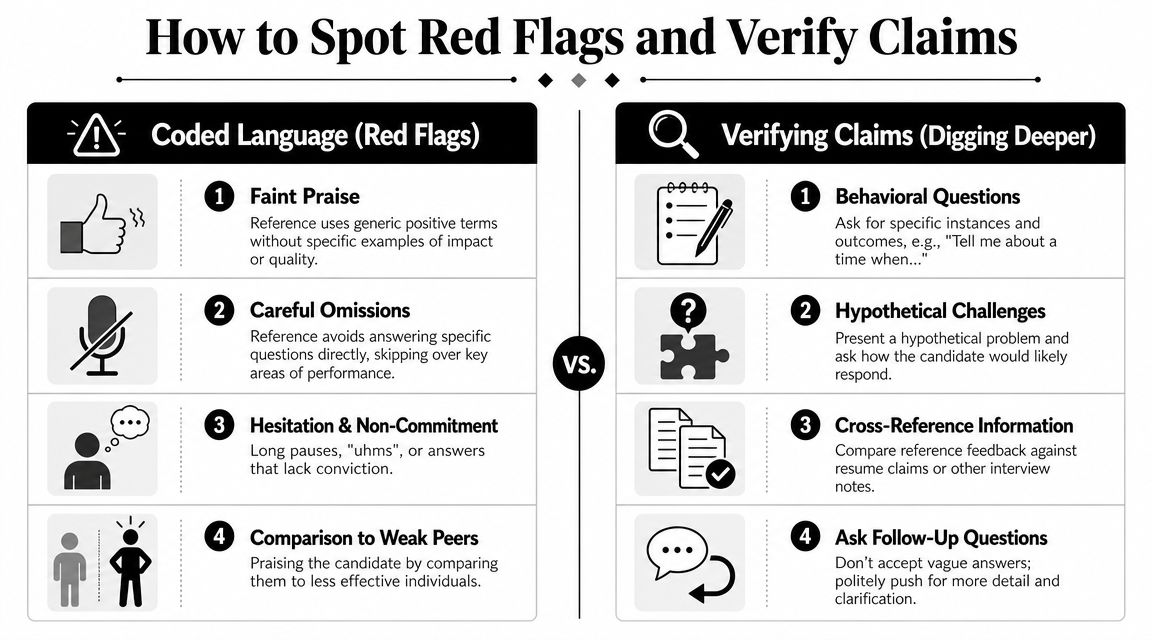
I've heard all of these. None of them are compliments.
When a reference avoids concrete examples, assume there's a reason.
A former client says, “We really liked them. Very responsive.” You ask what they were responsive about. Long pause. Then, “Mostly status updates.” That tells me communication existed, but strategic confidence may not have.
A manager says, “She did well once expectations were clear.” That sounds harmless. It often means she needed too much direction.
A peer says, “He worked hard.” Hard work is not the same as judgment. Plenty of people work hard while making the wrong decisions faster.
If nobody can describe a specific tough moment and how the candidate handled it, assume you're hearing a cleaned-up version of events.
You don't need to become paranoid. You need to become systematic.
Use this basic verification stack:
If you're hiring from a curated marketplace or exploring pre-vetted candidates, you should still do this. A platform can shorten the search, but it shouldn't replace your judgment. That's especially true when browsing a media buyer talent pool that looks strong on paper. Strong on paper has fooled plenty of smart operators.
“Good vibe” is not a hiring framework. It's a coin flip wearing a blazer.
If you want better hires, score client references the same way you score interviews and assessments. Otherwise, the loudest impression wins. Usually that means charm, confidence, or the last call you happened to have before lunch.
There's a practical reason to do this. Strong reference programs should be treated like conversion funnels, with reference-request-to-usage conversion targets in the 10 to 30% range and clear tracking of which assets influence outcomes, according to Upland's guidance on customer reference program metrics. Different context, same lesson. Track what gets used. Separate activity from impact.
For media buyers, I'd score references on five dimensions. Not ten. Not twenty. Enough to be useful, not enough to become HR cosplay.
| Dimension | Description (What to Listen For) | Score (1-5) |
|---|---|---|
| Strategic Thinking | Can they diagnose account problems, make tradeoffs, and explain why a plan changed? | 1-5 |
| Technical Execution | Did they handle platform mechanics, reporting detail, and account hygiene reliably? | 1-5 |
| Communication | Were updates clear, timely, and useful when results were good and bad? | 1-5 |
| Proactivity | Did they surface risks early, suggest next steps, and move without constant prompting? | 1-5 |
| Data Analysis | Could they interpret performance signals and distinguish noise from actionable insight? | 1-5 |
Don't leave scoring vague or people will grade based on charisma.
That scale forces discipline. A pleasant call is not a 5. A detailed account of a difficult account transition, handled with strong decision-making and clean communication, might be.
One ecstatic reference shouldn't overpower two lukewarm ones.
I'd rather hire the candidate with consistent 4s across manager, peer, and client than the candidate with one glowing superfan and two fuzzy maybes. Consistency is harder to fake. It also gives you a cleaner picture of how the person behaves across different relationships.
A simple hiring note can look like this:
That's enough to compare candidates fairly. If you want more structure, study how teams document process and signal quality in recruiting benchmark discussions. The point isn't bureaucracy. The point is remembering what happened instead of trusting your memory to behave like a database.
References should influence the decision. They shouldn't make it alone.
A strong technical test with weak references is a warning. A polished reference set with a poor skills assessment is also a warning. You're building a whole candidate picture, not crowning a winner based on whichever checkpoint felt nicest.
I treat references as a multiplier, not a substitute.
If interviews and assessments are strong, good references increase confidence. If the core evaluation is shaky, references shouldn't rescue the hire. Plenty of candidates interview well and arrive with polished supporters. That doesn't mean they can manage spend, explain variance, or keep a client calm when a campaign slides.
Use a simple decision lens:
Referral-style trust signals matter because they often correlate with longer-term value. Referred customers show 16% higher lifetime value and 37% better retention in the research cited by Rivo's referral program analysis. Hiring isn't identical to customer acquisition, but the lesson carries over. Better-vetted people tend to be easier to retain and more valuable over time.
That's why I'm happy to spend extra effort on reference auditing. The upfront work is cheaper than months of cleanup.
Use the same categories, the same question families, and the same scoring method for every finalist in the same role. That protects you from bias and from the classic founder mistake of changing standards because one candidate feels exciting.
If your hiring process is dragging, tighten the sequence instead of skipping diligence. A clean hiring timeline for media buyers should help you move fast without turning your reference checks into theater.
The best client references don't flatter the candidate. They reduce uncertainty. That's the standard.
If you want a faster path to candidates who've already been screened for real paid media work, HireMediaBuyers.com is built for exactly that. It helps teams find pre-vetted remote media buyers and paid ads specialists without spending weeks sorting through polished profiles, vague claims, and reference theater.


