

You probably don't need another article telling you a hiring timeline matters. You're already living the problem.
You need a media buyer. Not someday. Now. Your creative is ready, your landing pages are live, your CAC is wobbling, and nobody owns the account adequately to fix it. So campaigns sit half-built, budgets stay capped, and your team burns time “covering temporarily,” which is founder code for “doing two jobs badly.”
That's the cost of a slow hiring timeline. It's not an HR annoyance. It's missed pipeline, slower learning cycles, stale ad accounts, and senior people doing resume triage instead of actual work.
And yes, if you're still debating whether to keep this in-house, use a recruiter, or shortcut the whole circus, it helps to know what you're paying for. A transparent media buyer hiring cost breakdown is a better place to start than another vague promise about “top talent.”
A slow hire for a media buyer hurts differently than a slow hire for a back-office role.
When this role stays open, nobody is just “waiting.” Your team is delaying tests, underfunding winning channels, ignoring weak funnel segments, and making budget calls with stale data. In paid acquisition, lost time is lost signal. You don't get that week back.
Most companies track salary. Some track recruiter fees. Almost nobody tracks the mess in the middle.
They should.
A missing media buyer usually creates a chain reaction:
Practical rule: If a revenue-driving role is open long enough that your leadership team starts doing recruiter work, your hiring timeline is already too slow.
Companies frequently deceive themselves. They think the issue is talent scarcity alone. Sometimes it is. More often, the true issue is that the hiring process was designed for generic roles and then lazily applied to a specialist role.
A media buyer isn't just another marketer. You need someone who can read account structure, diagnose creative fatigue, spot tracking issues, manage platform nuance, and make sane decisions under budget pressure. Hiring for that with a bloated, committee-driven process is like trying to tune a race car with a procurement meeting.
You can call it due diligence if you want. I'd call it expensive procrastination.
Most companies don't have a hiring process. They have a sequence of delays disguised as professionalism.
And the standard hiring timeline is getting uglier. Stage-level hiring data shows the average process often lands around 44 to 54 days, and analysis of recruiting benchmarks found teams conduct 42% more interviews per hire than they did in 2021, which has contributed to a 24% increase in average time-to-hire (business.com on the hiring timeline).
Week one usually disappears into role definition theater. Somebody wants “senior but hands-on.” Someone else wants “strategic but scrappy.” Then finance asks whether this can be freelance, full-time, or part-time. Nobody agrees, so the brief gets rewritten three times.
Weeks two and three become resume chaos. You get applicants who've boosted a few posts, agency generalists who can talk a big game, and random marketers who once touched Ads Manager and now identify as performance experts. Your team screens, debates, and drifts.
Then interviews begin. Slowly.
A standard media buyer process often looks like this:
| Stage | What usually happens | Why it slows down |
|---|---|---|
| Role kickoff | Hiring manager rewrites the brief | Too many stakeholders, no owner |
| Screening | Resume review and first calls | Lots of applicants, weak filtering |
| Interview round one | General fit chat | Doesn't test actual channel skill |
| Interview round two | Technical conversation | Scheduled late, often with new people |
| Final round | Panel or leadership review | Calendar gridlock and repeated questions |
| Offer and checks | References, approvals, compensation | Decision drift and internal hesitation |
None of this is unusual. That's the problem.
The average hiring process isn't long because candidates are mysterious. It's long because employers keep adding friction and calling it rigor.
The nastiest part isn't any single delay. It's the compounding effect.
A couple days to review candidates. Another few days to schedule. Then someone goes out of office. Then the panel wants one more conversation “just to be safe.” By the time you're ready to move, your strongest candidate has either accepted another offer or mentally checked out.
For a media buyer, that lag is especially dumb. This is a role where competence shows up fast if you ask sharp questions, review channel-specific work, and put the right people in the room early. You do not need an interview obstacle course. You need clarity, speed, and somebody willing to make a decision.
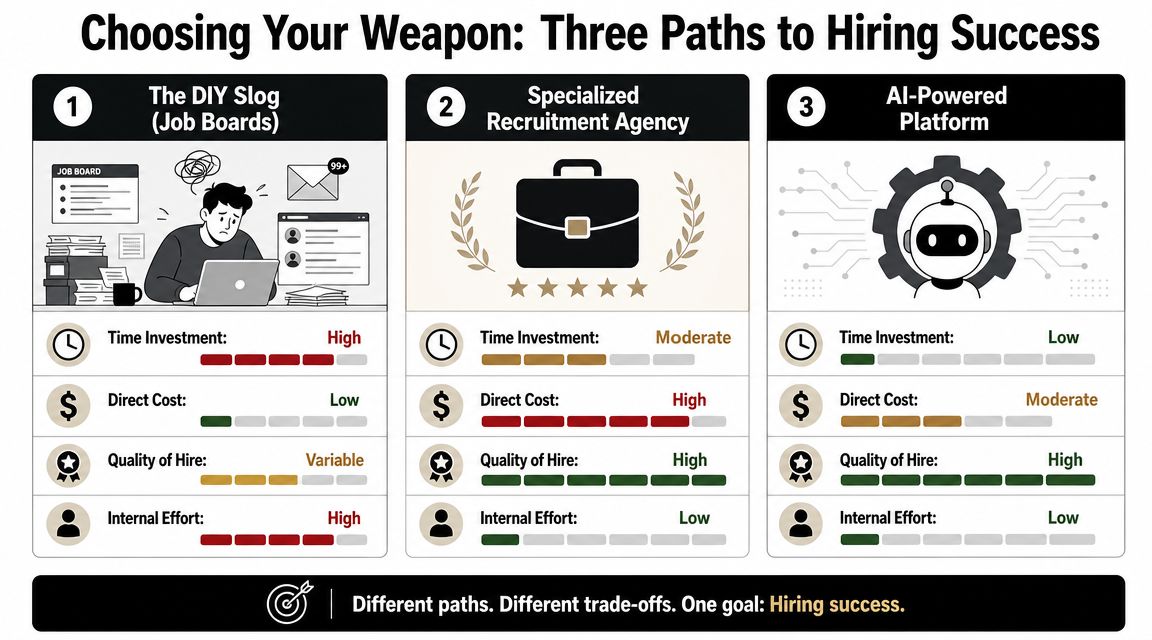
There are really three ways most companies try to hire a media buyer. One is cheap on paper and expensive in attention. One is expensive on paper and inconsistent in quality. One is built for speed.
Let's stop pretending they're interchangeable.
Job boards look efficient right up until they eat your month.
You post the role. Applications roll in. A lot of them. Then your team becomes a sorting machine. You're reading resumes, chasing missing context, comparing apples to forklifts, and hoping a decent candidate appears before your patience evaporates.
This path gets even clumsier when the talent pool is remote or global. Modern hiring isn't one office, one city, one tidy process anymore. Broader sourcing adds coordination, compliance, and reference-check complexity, which slows down DIY and recruiter-led workflows unless there's already a system built for it (Paradigm IQ on inclusive hiring and distributed pipelines).
DIY works if you enjoy turning your growth team into amateur recruiters. Most don't.
Traditional recruiters can help. They can also become high-priced middlemen who know recruitment better than they know paid media.
That distinction matters.
A recruiter who doesn't understand attribution mess, creative testing velocity, budget pacing, feed-based campaigns, or channel-specific failure modes can still send polished candidates. Polished is not the same as capable. You may save internal time upfront, then lose it all in interviews with people who sound sharp and can't steer spend.
“We need someone strategic” is how teams end up interviewing people who make beautiful slides and mediocre decisions.
This is the only path that matches the speed agile companies need.
A specialized marketplace starts from the assumption that generic sourcing is the bottleneck. So instead of opening the floodgates and hoping for miracles, it narrows the pool before you ever look. The role is already contextualized. The talent is already screened for the function. The process is built around fast matching, not administrative sprawl.
Here's the blunt version:
If you're hiring a media buyer because growth can't wait, then your hiring path shouldn't behave like growth can wait.
Most companies accept a bloated hiring timeline because they think “fast” means reckless. It doesn't. Fast means you removed junk work.
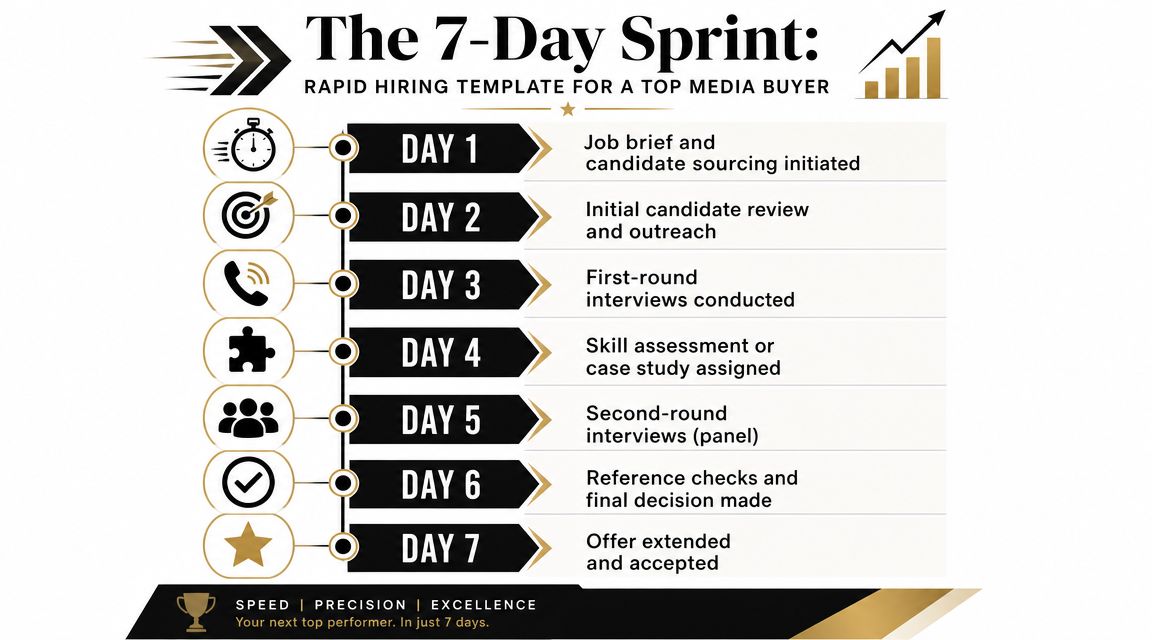
A seven-business-day sprint is realistic when the role is defined properly, the shortlist is pre-qualified, and the decision-makers are available before candidate outreach starts. That's not magic. That's operations.
Here's the version that works.
Day 1
Lock the brief. Not a vague wish list. A real brief with channels, budget range, business model, time zone needs, and success criteria. Then get a shortlist in front of the hiring manager.
Days 2 and 3
Run focused first interviews in tight blocks. Same interviewers. Same scorecard. Same core questions. If you want to browse pre-qualified candidates without waiting for a full managed search, a self-serve media buyer marketplace makes this part much cleaner.
Day 4
Hold a decision meeting. Short. Ruthless. Compare candidates against the brief, not against random feelings and somebody's “gut.”
Day 5
Make the offer. Don't “circle back next week.” Don't add a bonus round because one executive finally noticed the process exists.
Days 6 and 7
Handle paperwork, confirm start logistics, prep onboarding, and keep communication tight so nothing stalls at the finish line.
Media buying is measurable work. That's the gift.
You don't need six rounds to know whether somebody understands platform mechanics, can diagnose account issues, communicates clearly, and thinks commercially. You need a structured interview, a relevant work sample or case discussion, and decision-makers who aren't hiding behind process.
A simple sprint template looks like this:
Operator's note: If your team can launch a paid campaign in less time than it takes to schedule a second interview, the problem isn't talent supply. It's your process.
Here's the uncomfortable truth. Your hiring timeline is mostly a company habit problem.
A state hiring handbook can treat the hiring phase as a hard 30-calendar-day window for screening, interviews, and checks, which tells you something important. Process design, not just candidate supply, is a major determinant of speed (California hiring handbook guidance).
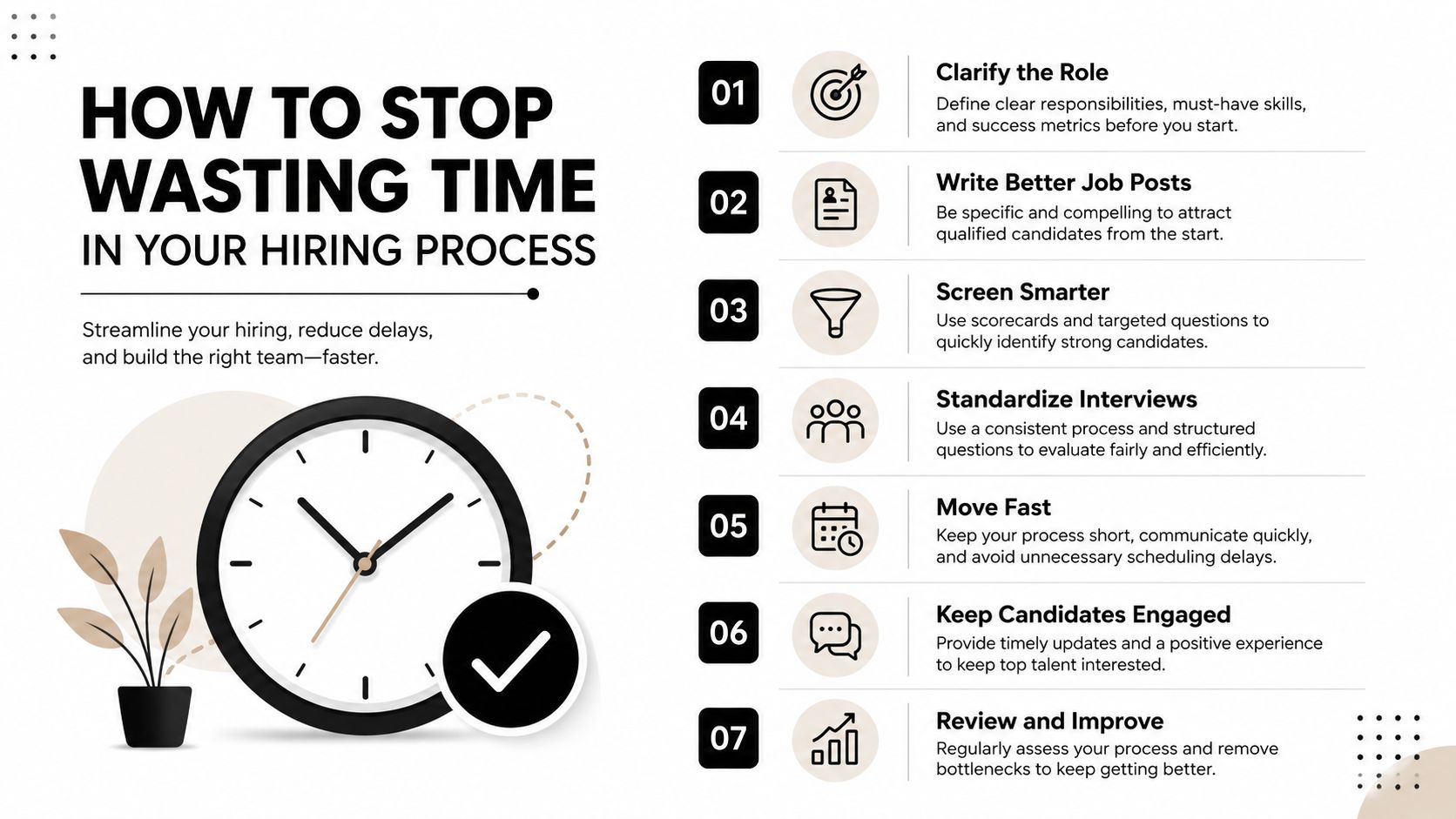
Most hiring teams act like delay is weather. It isn't. It's usually self-inflicted.
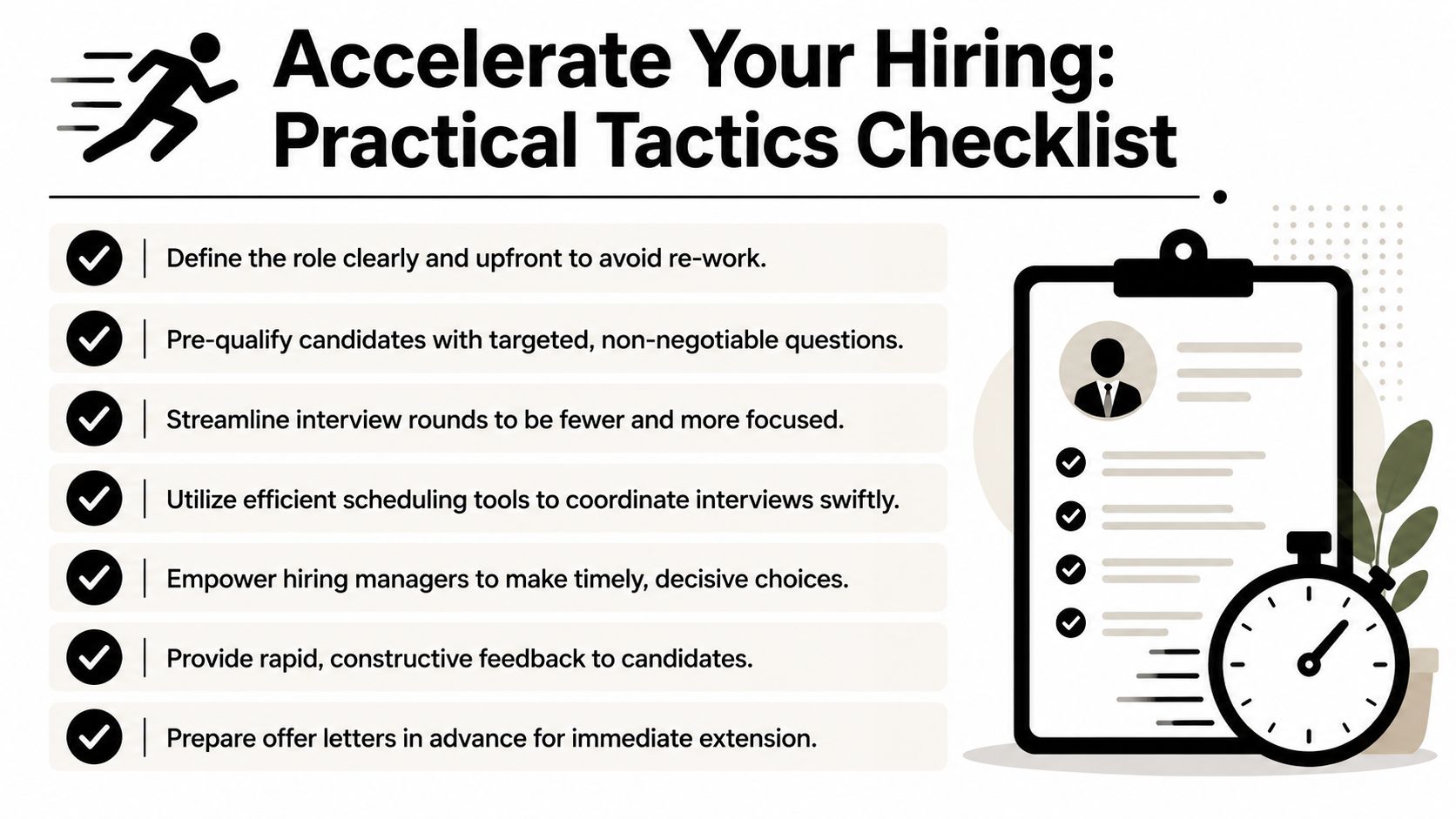
Fix the obvious stuff first:
This one burns teams constantly.
A candidate sounds confident. Another one is charming. A third has agency logos on the resume. None of that tells you whether they can improve account performance, communicate tradeoffs, or make sharp budget decisions under pressure.
Use structured prompts instead. Ask how they'd audit a struggling account. Ask how they decide when to cut spend, refresh creative, or isolate variables in testing. Ask what they'd need in the first week to take ownership cleanly.
Then score the answers the same way every time.
A messy interview process doesn't reveal judgment. It rewards the candidate who performs best in ambiguity.
You don't need to sterilize the experience. You need to remove waste.
A practical cleanup plan looks like this:
| Problem | Better move |
|---|---|
| Too many interviewers | Keep only the people who can assess skill or approve the hire |
| Slow feedback loops | Require same-day written feedback |
| Repetitive interviews | Assign each round a distinct purpose |
| Last-minute scheduling | Reserve interview blocks before sourcing |
| Offer delays | Pre-approve budget and employment terms |
If you fix these five things, your hiring timeline gets shorter fast. Not because you rushed. Because you finally stopped tripping over your own shoelaces.
A long hiring timeline isn't fate. It's usually a bad system with good branding.
And the standard approach gets even sillier when you look at the volume problem. Employers received an average of 180 applicants per hire in 2024, while only about 3 out of 100 applicants were invited to interview (MSH Talent's recruiting statistics roundup). That's not a talent strategy. That's resume landfill.
The shortcut is better filtration before your team gets involved.
If you're hiring a media buyer, the goal isn't to admire a giant top-of-funnel. The goal is to get to a credible shortlist fast, interview quickly, and make a decision before the opportunity cost gets stupid. Every day you spend screening weak-fit applicants is a day your campaigns, funnels, and growth targets sit in limbo.
That's why the smartest teams don't obsess over how to manage more applicants. They change the system so they see fewer, better ones.
And if you want to skip the generic applicant pile entirely, start with a curated media buyer talent pool built around the actual role, not broad marketing labels that mean everything and nothing.
You don't win by making hiring feel important. You win by making it move.
For a media buyer, that means:
If your business needs agility, your hiring timeline has to match it. Otherwise you're trying to scale paid acquisition with a process designed for filing cabinets and approval chains.
HireMediaBuyers.com helps companies skip the slow, noisy hiring process and start interviewing pre-vetted media buyers fast. If you want a curated shortlist in as little as 24 hours, or you'd rather browse qualified candidates on your own terms, go straight to HireMediaBuyers.com.


