

You're probably here for one of three reasons.
Your Google Ads account is chewing through budget and giving you excuses instead of revenue. Your agency keeps sending reports with rainbow charts and no clear answer. Or you hired someone who talks like a bid strategy wizard, then lights money on fire while calling it “learning.”
I've seen all three.
The hard part isn't deciding that you need a Google Ads specialist. The hard part is finding one who can do more than rename campaigns, tweak match types, and forward you a screenshot of “improving impressions.” Plenty of people can operate the dashboard. Very few can make it behave like a growth system.
That distinction matters because this isn't some niche side channel anymore. Google Ads generated $294.69 billion in advertising revenue in FY2025, with $318 billion projected for 2026, according to Google Ads market size and benchmark data. In the same benchmark set, average Google Ads click-through rate landed at 6.66%, average conversion rate at 7.52%, and average cost per lead across industries hit $70.11. Tiny account mistakes can become very expensive, very quickly.
So no, this is not a “just hire a freelancer from somewhere and hope” situation.
This is the no-BS playbook for hiring a Google Ads specialist who moves revenue, not just activity.
A messy Google Ads account has a familiar smell.
Campaigns named “Search 2 New New.” Conversions that don't match your CRM. Brand and non-brand stuffed together like a junk drawer. Broad match running wild. Someone, at some point, decided “maximize clicks” sounded smart. It wasn't.
If that's your dashboard right now, don't panic. Also don't start clicking random things like you're defusing a bomb in a movie. Most founders make it worse because they confuse motion with progress.
Ask this first: Is this account producing profitable customer acquisition, or just producing reports?
That's it. Everything else is secondary.
A good Google Ads specialist doesn't begin with cosmetic cleanup. They start by checking whether the account can be trusted at all. If tracking is broken, attribution is sloppy, or lead quality is garbage, every optimization after that is theater.
Use a simple first-pass checklist:
If your current specialist can't walk you through those points in plain English, you don't have a specialist. You have a dashboard sitter.
Practical rule: Never hire a Google Ads specialist who leads with “we'll optimize performance” before they've verified conversion tracking.
You do need context. You just don't need fantasy.
Broad-market benchmarks help you sanity-check performance. They do not replace business judgment. If your account is lagging behind the averages I mentioned above, that's a sign to investigate, not a reason to copy another company's setup blind.
A serious operator knows which numbers matter and which ones merely look busy. If you need a refresher on that, this breakdown of ad performance metrics is worth reviewing before you interview anyone.
The right hire won't promise miracles. They'll tell you what's broken, what's fixable, and what needs a quarter, not a week.
If you think a Google Ads specialist mostly picks keywords and changes bids, you're hiring for a version of the job that's gone.
The modern role is closer to a systems operator for revenue. The specialist still works inside Google Ads, sure. But the core work happens in the decisions around measurement, offer structure, funnel design, creative feedback, and budget allocation.
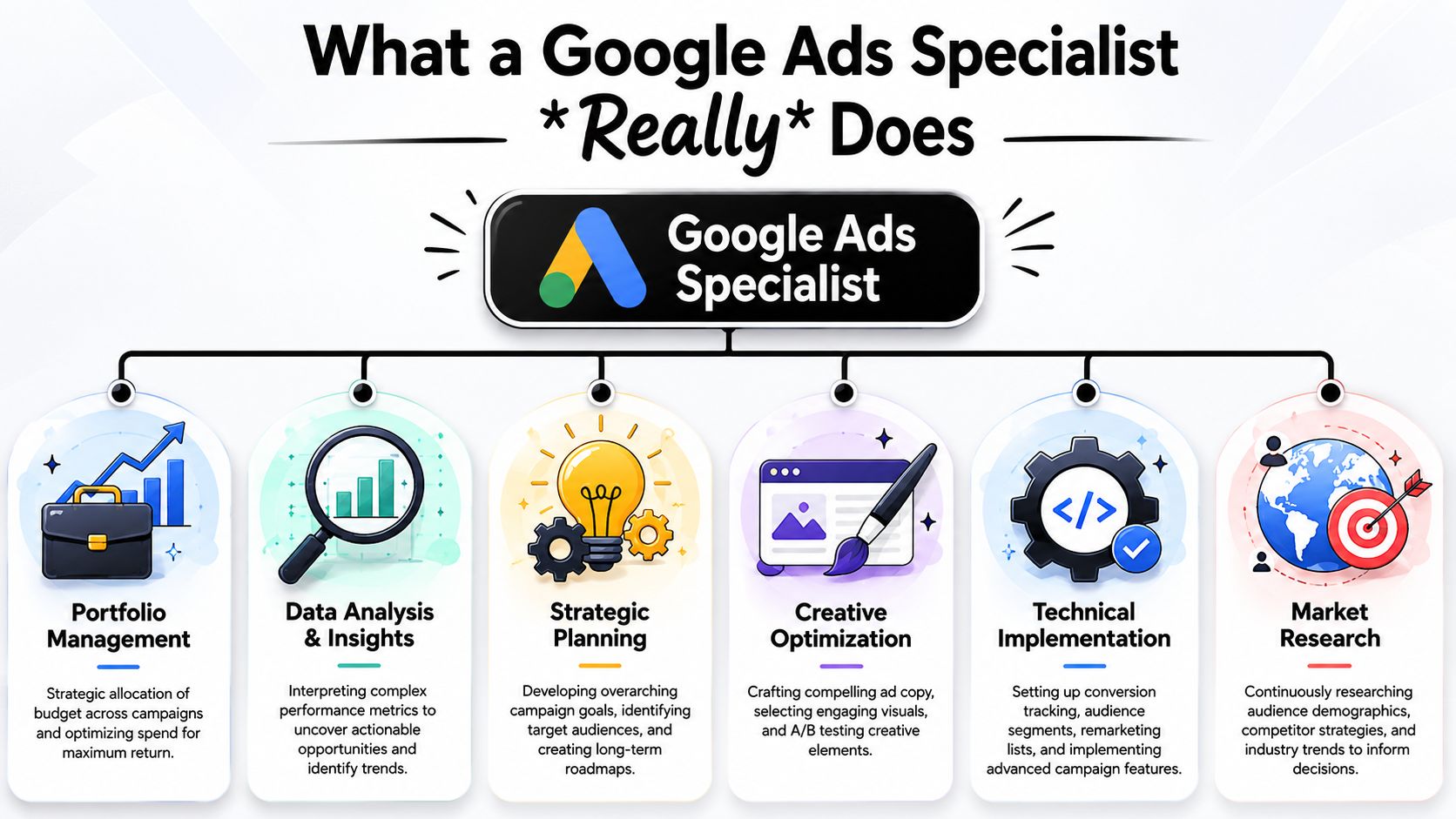
This visual sums it up well:
The old game rewarded activity. More keywords. More ads. More impressions. More knobs to turn.
That's not the job anymore.
Industry guidance now pushes advertisers to judge performance by conversion rate, cost per acquisition, and return on ad spend, not impressions. Google's own economic framing says advertisers earn about $2 for every $1 spent on Google Ads, and benchmark reporting found average conversion performance at 7.52% in 2025, with strong variation by industry such as 14.67% in automotive repair and 11.62% in physicians and surgeons, according to this Google Ads performance guide.
That shift changes who you should hire.
A weak hire manages ad objects. A strong hire manages the path from click to cash.
Here's what a real Google Ads specialist should be doing on the job:
A specialist worth hiring can explain your account like an investor explains a portfolio. Where money is going, why it's going there, and what needs to happen next.
Ask a candidate one question: “If I gave you our ad account, analytics access, and CRM tomorrow, what would you inspect first?”
If they answer with a list of platform features, keep interviewing.
If they answer with business logic, lead quality, conversion accuracy, funnel leaks, and budget concentration, you're talking to an adult.
Most hiring mistakes happen before the interview starts. The company writes one vague job description, labels it “Google Ads Specialist,” and hopes the universe delivers the right person.
It won't.
There are at least three practical levels here. If you hire the wrong one, you either overpay for simple work or under-hire for a serious growth problem. Both are expensive.
This person can keep the machine running. They can build campaigns, upload assets, monitor spend, pull reports, and handle straightforward account maintenance.
That's useful. It's also limited.
A junior is fine when you already have strategy, tracking, landing pages, and account architecture handled by someone else. They are not the person I'd trust to fix a broken funnel, diagnose lead quality issues, or challenge your assumptions.
Hire this level when you need execution support. Not rescue.
Many good businesses should start here.
A mid-level Google Ads specialist can usually manage account structure, improve targeting, tighten search terms, spot wasted spend, and make coherent recommendations. They're not just implementing tasks. They're making judgment calls.
This person should be able to tell you why a campaign is underperforming and what they'd test next. They may not be a strategic heavyweight, but they should be dangerous enough to improve a decent account.
If your business has traction and wants steadier acquisition without building a giant marketing org, this is often the sweet spot.
This is the one founders think they're hiring all the time. Usually they're not.
A senior specialist acts more like a revenue operator. They handle account direction, measurement architecture, CRM alignment, funnel diagnosis, team coordination, and testing strategy. They don't just ask whether a campaign gets conversions. They ask whether those conversions are the right ones, whether the attribution can be trusted, and where automation should or shouldn't be allowed to run.
You hire this level when spend is meaningful, sales cycles are messy, stakeholders are many, or the consequences of bad data are brutal.
Don't hire a senior strategist to babysit a tiny account with no tracking and no landing pages. That's like hiring a Formula 1 driver to deliver takeout.
You asked what to pay. Here's the plain-English version: pay for decision quality, not résumé fluff.
| Level | Experience | Core Responsibility | Annual Salary (USD) | Freelance Rate (USD/hr) |
|---|---|---|---|---|
| Junior | Early career, execution-focused | Campaign setup, reporting, routine account maintenance | Varies by market and employment model | Varies by market and scope |
| Mid-Level | Hands-on manager with optimization experience | Account improvement, search term control, testing, budget adjustments | Varies by market and employment model | Varies by market and scope |
| Senior | Strategic operator with full-funnel judgment | Measurement, account strategy, cross-functional coordination, scale decisions | Varies by market and employment model | Varies by market and scope |
I'm being intentionally blunt here. If anyone gives you a neat universal pay table without understanding your market, account complexity, sales model, and working arrangement, they're guessing.
What you should do instead:
Most job posts are nonsense because they try to hire all three levels at once.
If you need execution help, say so. If you need a fixer, say so. If you need someone who can work across Google Ads, GA4, CRM feedback loops, landing pages, and sales quality, say that too.
The sharper the problem statement, the better the candidates.
You need Google Ads help. Revenue is flat, lead quality is shaky, and the dashboard is full of activity that doesn't translate into sales. This is the point where companies make an expensive hiring mistake.
The wrong choice here doesn't just waste fees or salary. It slows decision-making, hides accountability, and keeps bad traffic running longer than it should. Your job is to pick the model that matches the problem. If you want a fuller breakdown of the tradeoffs, read this guide on agency vs in-house hiring for paid media.
Here's the practical version.
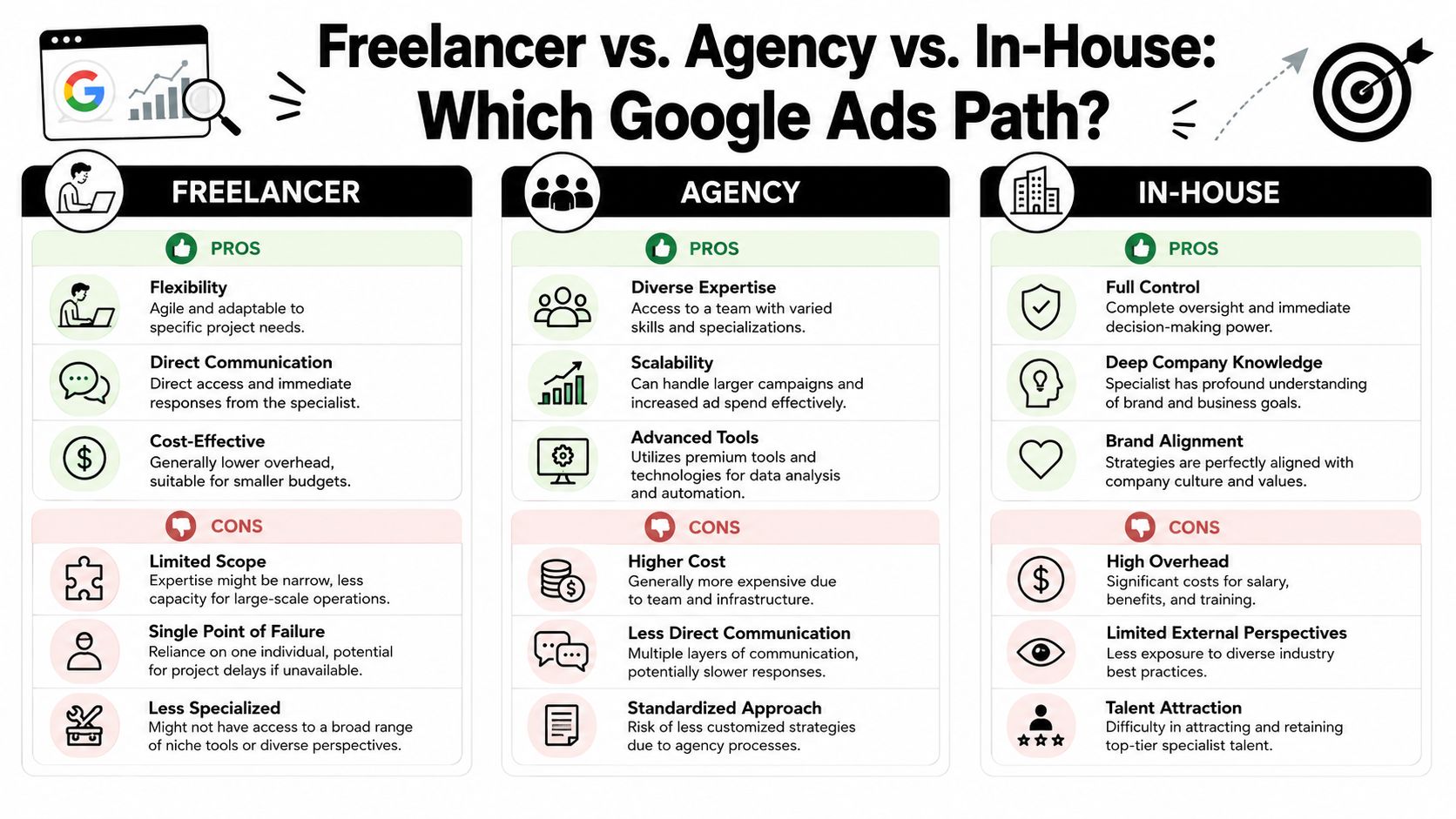
A strong freelancer gives you speed and direct access. You talk to the operator, not an account manager relaying messages after an internal meeting. That matters when you need fixes now, not next Tuesday.
The risk is concentration. One person can be excellent and still become a bottleneck. If they get buried, disappear, or only know how to manage bids inside Google Ads without handling tracking, landing pages, or lead quality, you're stuck.
Choose a freelancer when:
Pass on this option if the role needs a lot of cross-functional coordination, stakeholder management, or creative production support.
An agency makes sense when the job is wider than one media buyer. Complex accounts often need feed management, analytics support, conversion rate work, reporting, and coverage across multiple people. A good agency can provide that.
A bad agency hides weak execution behind process. You get polished decks, vague strategy language, and a junior team touching the account while the senior person shows up for the kickoff call and renewal discussion. I've seen this too many times.
Choose an agency when:
Do one thing before signing. Meet the person who will run the account and ask how many accounts they personally manage.
In-house is the right move when paid acquisition is central to growth and the business has enough volume to keep a good specialist fully occupied. The upside is context. An internal operator learns your margins, sales process, seasonality, product quirks, and the difference between a lead that looks good in the CRM and one that closes.
The downside is management load. You're not just hiring skill. You're creating a role that needs support, clean goals, access to data, and cooperation from design, dev, analytics, and sales. Without that, you end up paying for a media buyer who spends half the week patching reporting and chasing approvals.
Choose in-house when:
Small teams usually do best with a freelancer or contract specialist first. It's faster, cheaper to test, and easier to replace if the fit is wrong. Companies with messy operations and multiple moving parts can justify an agency, but only with direct operator access and clear accountability. In-house works best once paid acquisition is important enough to deserve full-time ownership and the business can support that hire properly.
There's also a middle path. Some companies use a hiring marketplace like HireMediaBuyers.com to find pre-vetted paid media talent without running a full recruiting process themselves.
Pick the model that gives you judgment, speed, and accountability. Everything else is overhead.
Resumes are marketing documents. LinkedIn profiles are theater. Certifications are nice, but they don't prove someone can handle spend, pressure, or ambiguity.
You need proof of thinking.
Good interview questions don't test memorization. They expose how the candidate reasons when the account is ugly and the clock is running.
Use questions like these:
“You inherit a struggling account. What do you inspect in the first week, and in what order?”
You want a sequence. Tracking first. Business goals second. Campaign structure, search terms, conversion quality, landing pages, and budget allocation after that. If they jump straight to ad copy tweaks, that's amateur hour.
“Tell me about a time when the platform looked healthy but the business result was weak.”
Strong candidates talk about junk leads, poor attribution, misleading conversion definitions, or sales feedback that contradicted dashboard success.
“When would you refuse to scale spend?”
This is a great filter. Adults mention unstable tracking, weak close rates, poor landing pages, low-margin offers, or unresolved query quality.
“What should never be fully delegated to automation?”
Their answer should reveal whether they understand measurement, creative strategy, offer positioning, and conversion definitions.
If a candidate can't explain tradeoffs clearly, they probably optimize by superstition.
Don't hire from conversation alone. Give them a practical task.
A simple exercise works well:
Have them deliver:
This tells you far more than “Walk me through your experience.”
Most reference checks are useless because people ask fluff questions and get fluff answers. Ask specific questions tied to accountability. This guide on checking client references is a smart template.
Use prompts like:
Listen for hesitation. It says plenty.
Some warning signs are subtle. Others hit you in the face.
Watch for candidates who:
The best hires usually sound calmer than the worst ones. Less chest-thumping. More clarity.
That's who you want.
Yes, you still need a specialist. You just don't need the same kind you needed years ago.
Google's automation has become too capable to ignore and too powerful to outsource your brain to completely. That's the tension. If someone is still selling themselves as a manual bid-adjustment hero, they're outdated.
This is the modern reality:

According to this analysis of automation and specialist value, Google has reported that advertisers using Performance Max typically see more conversions at a similar CPA versus other campaign types. That matters. It means automation is not optional background noise anymore. It's the default environment.
Automation is excellent at processing signals, adjusting bids at scale, and reacting faster than a human ever could. Let the machine do machine work.
That includes:
Trying to out-click the algorithm manually is a bad career move.
The best Google Ads specialist now acts as a system designer and measurement architect.
That means they decide:
Automation can optimize toward the wrong goal with breathtaking efficiency.
That's why weak conversion tracking is so dangerous. Feed bad signals into smart systems and they'll produce polished nonsense faster than ever. The same goes for complex sales cycles, offline closes, and lead gen setups where the cheapest lead is often the worst lead.
So yes, hire a specialist. But hire for judgment, not button-pushing.
If they can't explain incrementality, conversion quality, or the limits of automated systems, they're not future-proof. They're just standing near the future.
You found the right person. Great. Don't ruin it with lazy onboarding.
A strong Google Ads specialist cannot create clarity from thin air if you give them partial access, no business context, and a Slack message that says “please improve ROAS.” That's not onboarding. That's sabotage.
Give them the full operating picture on day one:
A specialist can't optimize in a vacuum. They need the economics, not just the login.
Don't demand miracles in week one. Do demand a disciplined first month.
A practical first-30 framework looks like this:
| Timeframe | Focus | What good looks like |
|---|---|---|
| First week | Audit and validation | Access secured, tracking checked, account risks identified |
| Second week | Prioritization | Clear action plan with quick fixes and structural improvements |
| Third week | Early changes | Waste reduced, core tests launched, reporting aligned to business goals |
| Fourth week | Review and next steps | Initial findings, unresolved blockers, next testing roadmap |
This structure does two useful things. It gives the specialist room to think, and it prevents them from hiding behind “still learning the account” for too long.
Your weekly report should be readable in a few minutes.
Ask for five things:
That's it.
A good report reduces confusion. A bad one increases your respect for pie charts and nothing else.
You also need one rule: every metric discussed must map back to business relevance. If your specialist can't connect campaign movement to qualified leads, revenue, sales pipeline, or purchase quality, they're reporting on weather.
The first month should create trust, not just activity. Clean access. Clean definitions. Clean priorities. Then scale.
If you want to skip the résumé theater and talk to pre-vetted paid media talent faster, HireMediaBuyers.com is built for that. It helps companies hire Google Ads specialists and other paid ads operators through a structured vetting process, with options for full-time or flexible remote hires. If your current hiring process feels like guesswork with a login screen, that's a more sensible place to start.


