

Most advice about agency vs in-house is built on toddler math.
It compares a salary to a retainer, nods thoughtfully, and acts like the job is done. It isn't. That's how founders end up trapped between a “full-service” agency that replies three days late and an in-house “performance expert” who knows one ad platform well enough to hurt it.
If your real goal is profitable media buying, the binary debate is a distraction. You're not choosing between two job titles. You're choosing between two operating models, two types of risk, and two very different kinds of overhead.
I've seen both fail in completely predictable ways. Agencies fail when they oversell senior attention and subtly hand your account to the bench. In-house teams fail when one person is expected to be strategist, buyer, analyst, creative reviewer, tracking fixer, and platform whisperer. That person does not exist. If they do, they're probably not taking your call.
The smarter question is simpler: who should own strategy, who should execute, and what arrangement gets results without turning your week into a calendar hostage situation?
The usual debate sounds smart and wastes time.
Founders hear one camp say, “Build in-house for control.” Another says, “Hire an agency for speed and expertise.” Both are half-right, which is often worse than being wrong. Half-right advice is how you approve a budget that looks sensible in a spreadsheet and behaves like a raccoon in your attic.
Here's the problem. Agency vs in-house is framed like a values decision. It's not. It's an operations decision.
Early on, people obsess over sticker price. Salary versus retainer. Fee versus payroll. Meanwhile, true costs sit off to the side, grinning. Recruiting time. Tool sprawl. management load. Ramp-up. Turnover. Slow approvals. Weak attribution. Rework. The hours your leadership team burns trying to “coach” marketing hires into being the savior they were never hired to be.
Practical rule: If your comparison only looks at salary versus retainer, your comparison is junk.
There's also a more annoying truth. The best answer usually isn't “agency” or “in-house.” It's ownership in-house, specialized execution outside, and zero romance about either option.
That's where most modern media buying teams end up after they've been burned once or twice. They keep strategic direction, brand judgment, and internal accountability close. Then they pull in specialists where depth matters, especially when channels change faster than job descriptions.
A quick side-by-side makes this obvious:
| Model | What it does well | Where it breaks |
|---|---|---|
| In-house | Fast internal communication, stronger brand context, direct oversight | Narrow skill coverage, hidden employment costs, slower hiring |
| Agency | Broad specialist access, faster channel expansion, process maturity | Shared attention, slower internal alignment, variable account quality |
| Hybrid | Keeps control while adding flexible expertise | Requires clear ownership and decent management discipline |
If you want the blunt version, here it is.
Stop asking which side wins the argument. Ask which structure protects ROI while reducing operational drag. That's the whole game.
The sticker price is the bait.
Founders love to compare salary to retainer because it feels clean. It is not clean. A media buyer comes with operational drag, management load, tool costs, and performance risk. If you ignore those, you are not comparing agency versus in-house. You are comparing two fantasies.
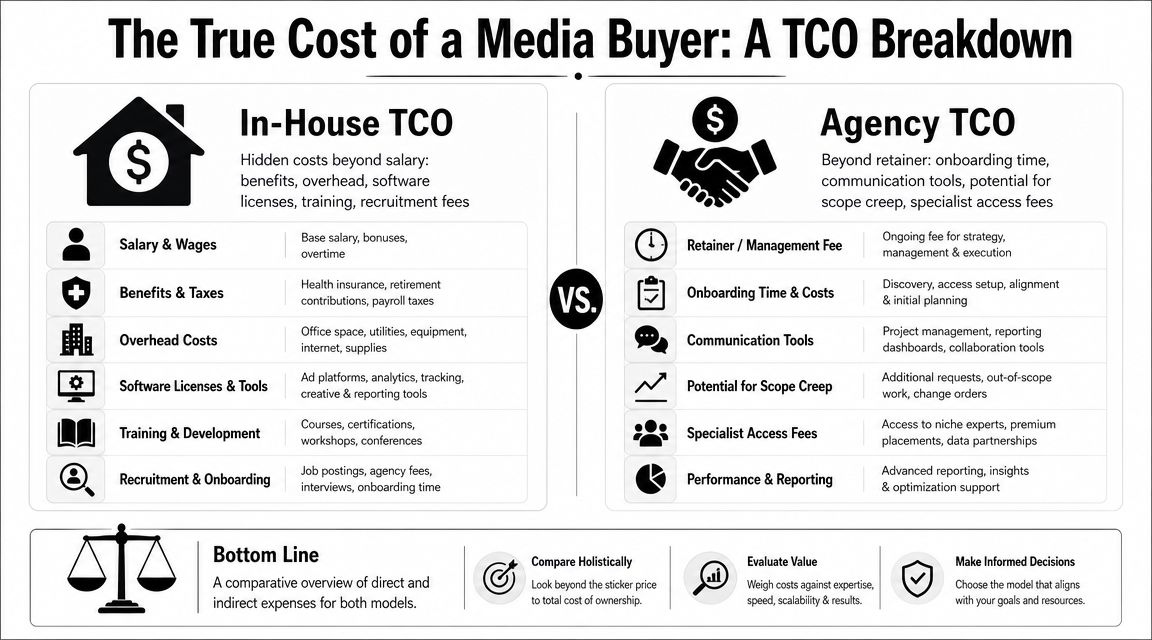
WebFX's breakdown of in-house marketing versus agency cost says internal marketing departments can run upwards of $200,000 per year, while agencies range from $20,000 to $200,000 per year depending on scope. WebFX also notes that employee overhead can add 40% to 100% of salary on average.
That is the polite math.
The bill includes recruiting, onboarding, benefits, software, training, management attention, and the cost of underperformance while you wait for someone to “ramp.” If the hire is mediocre, you do not just lose salary. You lose time, data quality, testing velocity, and trust in the channel.
TrinityP3's analysis of agency versus in-house marketing models makes the same point from the operating side. The full cost of an internal team goes well past salary, and many companies model a true employee cost at 1.4x to 1.5x salary once benefits, overhead, and healthcare are included.
Turnover makes it worse.
A paid media vacancy does not sit still like an empty seat in finance. It creates account drift, broken context, inconsistent reporting, and a fresh round of avoidable mistakes while the next person figures out what the last person was doing.
Agencies are not the cheap shortcut either. They just package the pain better.
You can get polished reporting, slow answers, junior account handling, and a scope that looks generous until you need something outside the retainer. You also pay for internal process on their side, meetings that should have been comments, and strategy theater that does nothing for tracking, feeds, creative testing, or conversion rate.
The cost tends to hide in three places:
A bad agency's waste is obvious. A bad in-house hire's waste is hidden.
That is why the agency versus in-house debate is a trap. One model buries cost in payroll. The other buries it in process. Smart teams stop arguing about labels and start asking who owns strategy, who executes well, and how fast weak performance gets corrected.
The right comparison is risk-adjusted total cost of ownership.
Ask the questions that matter:
Run the numbers that way and the answer gets clearer. Full in-house works when you need daily proximity and have the management muscle to support it. Agencies work when you need breadth and can tolerate some distance. The best ROI usually comes from a hybrid setup. Keep strategy, priorities, and accountability inside. Bring in specialist execution where depth matters and demand changes faster than headcount can keep up.
Control and speed sound like clean buying criteria. They are not. Both can turn into expensive theater if you ignore who makes decisions, who does the work, and how many people need to touch a campaign before anything changes.
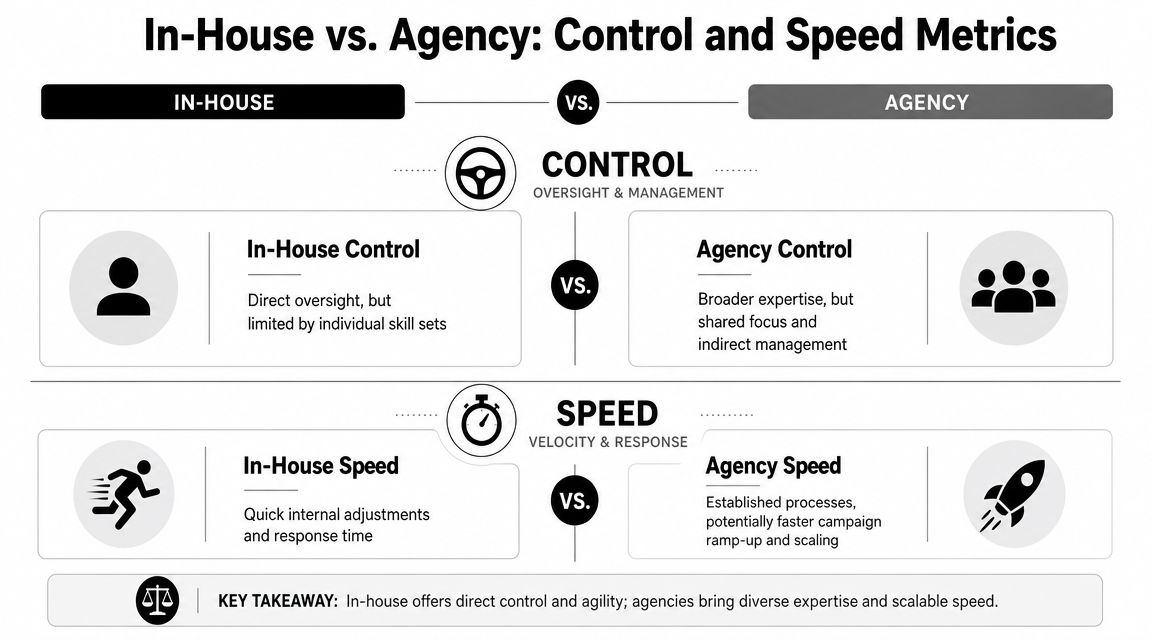
If you need same-day decisions across paid media, pricing, product, legal, and sales, in-house usually has the edge. The buyer sits in the meetings, hears the customer complaints, sees margin pressure early, and can adjust without waiting for an account call next Tuesday.
That proximity matters.
It also gets romanticized. A weak in-house operator does not give you more control. You get faster access to bad judgment, partial platform knowledge, and confident explanations for why nothing is improving. Slack access is not competence.
A decent agency can launch faster because the bench already exists. You are buying an operating system, not hiring one person and hoping they can cover strategy, trafficking, analytics, creative feedback, and reporting without dropping something expensive on the floor.
That advantage is real in the first stretch. It fades if every change needs a brief, a queue, an approval round, and a status meeting. Plenty of agencies are quick to start and slow to adapt. Plenty of internal teams are slow to start and quick once they are in rhythm. Speed depends on workflow, not branding.
Here is the cleaner comparison:
| Criterion | Winner | Why |
|---|---|---|
| Real-time decision-making | In-house | Fewer handoffs, tighter context, easier cross-functional changes |
| Initial ramp-up | Agency | Existing team, process, and channel specialists are already in place |
| Tool cost advantage | Agency | Agencies often spread platform and software costs across accounts |
| Daily business context | In-house | Closer to product changes, sales feedback, and brand nuance |
| Breadth of specialist support | Agency | Easier access to analysts, channel experts, and ad ops support |
Simplistic comparisons often fall apart. One media buyer rarely does everything well for very long.
You need campaign strategy, account structure, creative testing, landing page feedback, tracking, reporting, feed work, and channel-specific judgment. Maybe retention input too. Asking one in-house hire to own all of that is how companies end up with neat dashboards and mediocre results. Asking one agency account manager to cover all of it is not much better.
The issue is operating range.
Agencies usually have wider coverage because expertise is distributed across a team. In-house teams usually have better context because they live inside the business. The smart move is to stop treating this like a custody battle and start splitting responsibilities properly. Keep strategy, budget decisions, and business context close to the company. Bring in specialist execution where deep channel skill matters more than seat time in your Slack.
Control without range is expensive. Speed without ownership is fragile.
This part gets ignored because it is less fun than debating org charts.
A bad internal hire can hide behind jargon, claim every problem is creative, and burn months before anyone notices the pattern. A bad agency can do the same thing with prettier reporting and more polished excuses. Neither model fixes weak accountability.
The better setup is brutally clear. One internal owner is responsible for outcomes. The operator, whether internal or external, is responsible for execution. Reporting explains what changed, why it changed, and what happens next. If your team cannot answer those three questions in plain English, you do not have control. You have overhead.
Sometimes the correct answer is agency. Not “maybe agency.” Agency.
A venture-backed company chasing growth targets usually doesn't have time to build a media team from scratch. It needs execution now, not after a recruiting cycle, onboarding period, and a long internal learning curve.
An agency is the sane move when you need to test multiple acquisition paths quickly, launch in a new geography, or add specialized paid media capability without waiting for full-time hires. If you need Amazon DSP, LinkedIn lead gen, YouTube, and landing page testing all moving in the same quarter, one generalist hire won't save you.
Some businesses don't need permanent in-house capacity for every channel. They need bursts.
A DTC brand launching a new product line might need a short-window push across Meta, Google Shopping, creator whitelisting, and creative testing. A B2B SaaS company entering a new market might need fast experimentation on paid search and LinkedIn before it decides what deserves long-term ownership. In both cases, buying specialist access through an agency makes more sense than stuffing temporary needs into permanent payroll.
This is the key distinction.
Go all-in with an agency when the work needs multiple specialists at once and your internal team can't support them. That includes analytics setup, feed work, ad ops, platform-specific campaign execution, and creative iteration. You don't hire one person to mimic a whole department unless you enjoy rebuilding expectations every month.
Ask hard questions before signing:
If the agency can't explain who does the work, you're buying a promise, not a team.
A good agency is the right answer when urgency, channel breadth, and specialist execution matter more than daily internal proximity. That's not weakness. That's adult resource allocation.
Building in-house pays off when paid media is tangled up with the rest of the business every single day.
If campaigns depend on inventory swings, pricing changes, sales feedback, promo calendars, product launches, and compliance review, outside coordination becomes a tax. You wait for handoffs. You repeat context. You burn hours in status meetings just to keep campaigns aligned with decisions your internal team already made this morning.
That friction gets expensive fast.
The case gets even stronger when brand judgment matters. Regulated industries, complex products, aggressive offer testing, and messy approval chains all punish distance. An external team can still do solid work, but they will always be translating your business instead of living inside it. Translation slows reaction time. Slow reaction time wastes spend.
Build in-house when paid media is a core operating function, not a rented service.
That usually means one or two channels already drive meaningful revenue, the economics are understood, and the business needs someone close enough to challenge bad assumptions in real time. You want a buyer who sees the sales notes, hears the product complaints, knows which offer just changed, and can adjust before performance slips.
Here's where founders get burned. They hire one shiny "performance marketer" and implicitly expect an entire department.
One person is not a media team. One person is definitely not a media buyer, analyst, tracking specialist, creative strategist, reporting lead, and cross-channel operator rolled into a single salary line. That setup looks cheap on a spreadsheet and expensive in real life.
If you're building in-house, scope the role with some discipline. Start with a clear media buyer job description that spells out channel ownership, reporting expectations, creative collaboration, and decision rights. Then decide what stays internal and what still needs specialist support.
A strong in-house setup usually fits these conditions:
Build in-house for proximity, speed, and tighter business alignment. Don't do it because payroll feels more legitimate than a retainer. Bad hires hide operational drag behind job titles just as well as bad agencies hide it behind slide decks.
This is the part where the fake debate falls apart.
The best teams don't worship agencies. They don't worship headcount either. They run a hybrid model because it matches how modern media buying functions.
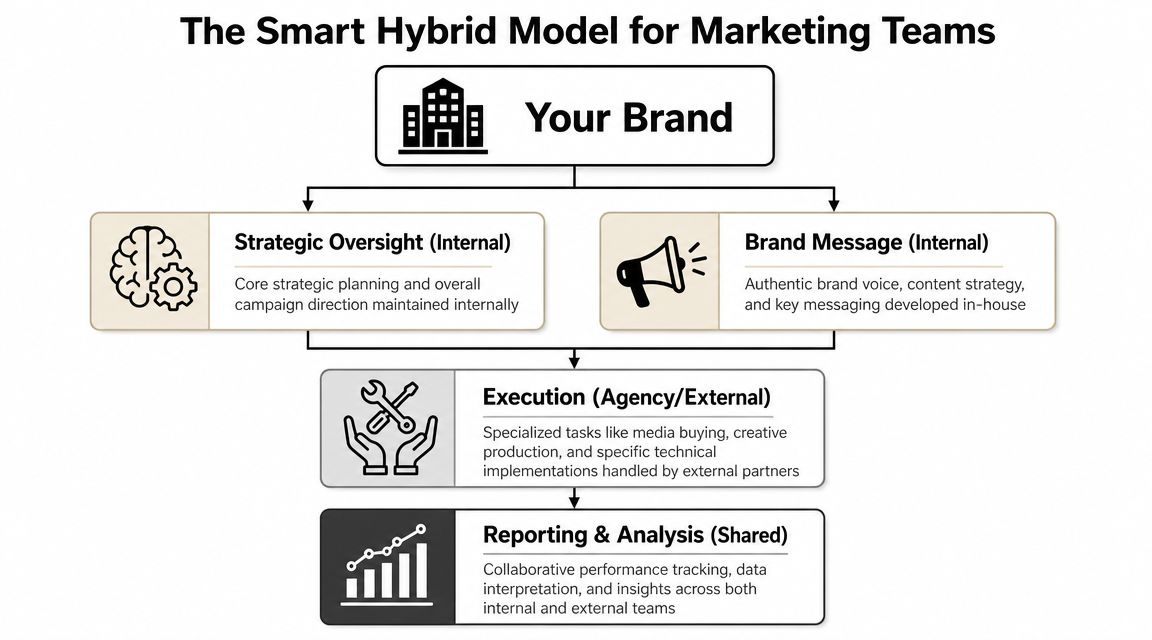
In a smart hybrid setup, the company keeps strategic oversight, brand judgment, internal alignment, and final accountability. External specialists handle the parts that need deeper platform skill or temporary extra capacity.
That means your internal lead owns priorities. Your external partners execute where specialization matters most. Paid social scaling, analytics cleanup, feed optimization, creative testing support, YouTube structure, marketplace ads. Bring in the right experts for the right window instead of pretending one permanent hire should somehow know everything.
This isn't indecision. It's better design.
There's a practical reason more teams are moving this way. According to Connective Web Design's operator-math analysis of agency versus in-house models, hybrid agency and in-house structures are often 5% to 20% lower in 3-year total cost of ownership than building an equivalent fully in-house specialist team. They can also deliver results 30% to 60% faster than staffing an entirely internal team from scratch.
That's the part people miss when they romanticize full in-house builds. You're not just paying more. You may also be moving slower.
If you want specialized execution without carrying every specialist on payroll, hybrid is the cleanest answer. It's one reason companies exploring flexible team design often look at options like offshore hiring for media buyers and paid ads support, especially when they want expertise in their time zone without inflating fixed overhead.
The smartest model is usually the one that keeps decision-making close and expertise flexible.
A good hybrid model is not vague. It has rules.
| Function | Best home |
|---|---|
| Budget ownership | In-house |
| Brand messaging and offer strategy | In-house |
| Cross-functional alignment with sales and product | In-house |
| Platform-specific execution | External specialist or agency pod |
| Deep analytics and attribution support | Shared |
| Reporting narrative and decision-making | Shared, led internally |
That structure avoids the two classic failures. One, the internal generalist who gets crushed by scope. Two, the agency relationship that turns into outsourced confusion because nobody inside owns the result.
Hybrid works because it treats media buying like a system of roles, not a single heroic hire or a magic agency retainer. That's how serious teams protect speed without losing judgment.
Once you stop treating hiring like a coin flip, the process gets simpler.
Still not easy. Simpler.

Start by defining what the person will own. One channel or several. Execution or strategy. Reporting or dashboard maintenance. Creative collaboration or pure buying. Too many teams hire a “growth marketer” and then act surprised when the role turns into a junk drawer.
Then test for real competence. Don't just ask what platforms they've touched. Ask how they diagnose a drop in conversion rate, what they'd review first in a messy account, how they separate creative fatigue from tracking issues, and what they do when internal stakeholders want changes that will likely hurt performance.
A polished profile proves almost nothing. Plenty of people can list Meta Ads, Google Ads, GA4, and funnel strategy in a neat little row. Fewer can explain what they'd do in the account on Monday morning.
Better talent processes use work samples, scenario questions, account reviews, and reference checks that go beyond “nice person, strong communicator.” If your team needs speed, pay attention to your own hiring drag. A sloppy process attracts polished talkers and bores the operators you want.
A realistic benchmark for planning is your paid media hiring timeline. If your process takes forever, your best candidates won't still be available when you finally schedule round four.
If you already know you need a hybrid model, the fastest route is usually pre-vetted specialist talent. That cuts down the most wasteful part of hiring: sorting through people who sound qualified but can't perform the work.
The best hiring channels for media buyers aren't the loudest ones. They're the ones that filter for platform competence, communication, reliability, and real execution ability. That's how you avoid spending your afternoons fact-checking resumes and pretending another “growth ninja” interview feels promising.
If you want to skip the resume roulette, HireMediaBuyers.com helps companies find pre-vetted media buyers and paid ads specialists fast. It's built for teams that need real operators, not more hiring theater.


