

You know the meeting.
It's 9:03 AM. Slack is already chirping. Your campaigns are live, budgets are moving, leads are coming in, and your best media buyer just resigned with the digital equivalent of a polite grenade. Now you're staring at a hiring process that could drag for weeks, maybe longer, while Meta, Google, and LinkedIn keep happily spending your money.
That's usually when founders and agency owners start panic-shopping for talent. Bad time to do it. Desperation makes people hire the resume that looks shiny, talks well on Zoom, and lights your ad account on fire two weeks later.
I'm pro offshore hiring. Very pro. But not the bargain-bin version. Not the “let's find the cheapest random freelancer with a Canva portfolio and a dream” version. I mean using global talent as an actual operating strategy, with standards, systems, and teeth.
Because offshore hiring isn't some quirky trend. The idea of moving work to lower-cost countries has been around for decades, and service work accelerated sharply after 2002. The Population Reference Bureau notes that economist Alan Blinder estimated about 30 million U.S. jobs were vulnerable to offshoring, including computer programmers, which tells you this stopped being a fringe tactic a long time ago (Population Reference Bureau on offshoring in U.S. labor).
The smarter question isn't whether offshore hiring works.
It's whether you're going to do it like an operator or like someone shopping blindfolded.
You didn't just lose a person. You lost momentum.
If that person owned paid social, search, reporting, creative testing, and the weird tribal knowledge of why one campaign still works despite every best practice saying it shouldn't, you've now got a hole in revenue operations. Not an HR issue. A revenue issue.
The standard U.S. hiring process for marketing roles is painfully slow. Write job post. Wait. Sort junk applications. Run first rounds. Run second rounds. Realize half the candidates were good at interviewing and bad at buying media. Start over. If you want a sobering reminder of how slow this gets, look at a typical marketing hiring timeline.
Meanwhile, the work doesn't pause.
Your client doesn't care that recruiting is hard. Your CAC doesn't take a respectful timeout. Your pipeline doesn't say, “No worries, we'll wait until you find someone local with five years of platform-specific experience and a charming personality.”
Practical rule: If one resignation can knock your team off balance, you don't have a hiring strategy. You have a dependency problem.
A lot of teams still treat offshore hiring like the emergency parachute. That's backward. It should be part of your bench before the emergency.
The best reason to hire globally isn't just cost. It's resilience. It gives you access to talent outside the tiny radius of your city, recruiter network, or overpriced local market. For U.S. marketing teams, that matters more than ever because strong paid media talent is unevenly distributed, and the best operators are usually already employed.
Here's the blunt version. If your entire talent strategy depends on one geography, one recruiter, and one salary band, you've built a brittle system.
Done right, offshore hiring gives you:
Done badly, it gives you a polite liar with strong Wi-Fi.
That's the game. The rest of this article is about separating the two.
Most companies get tangled in buzzwords before they even post the role.
So let's clean this up.
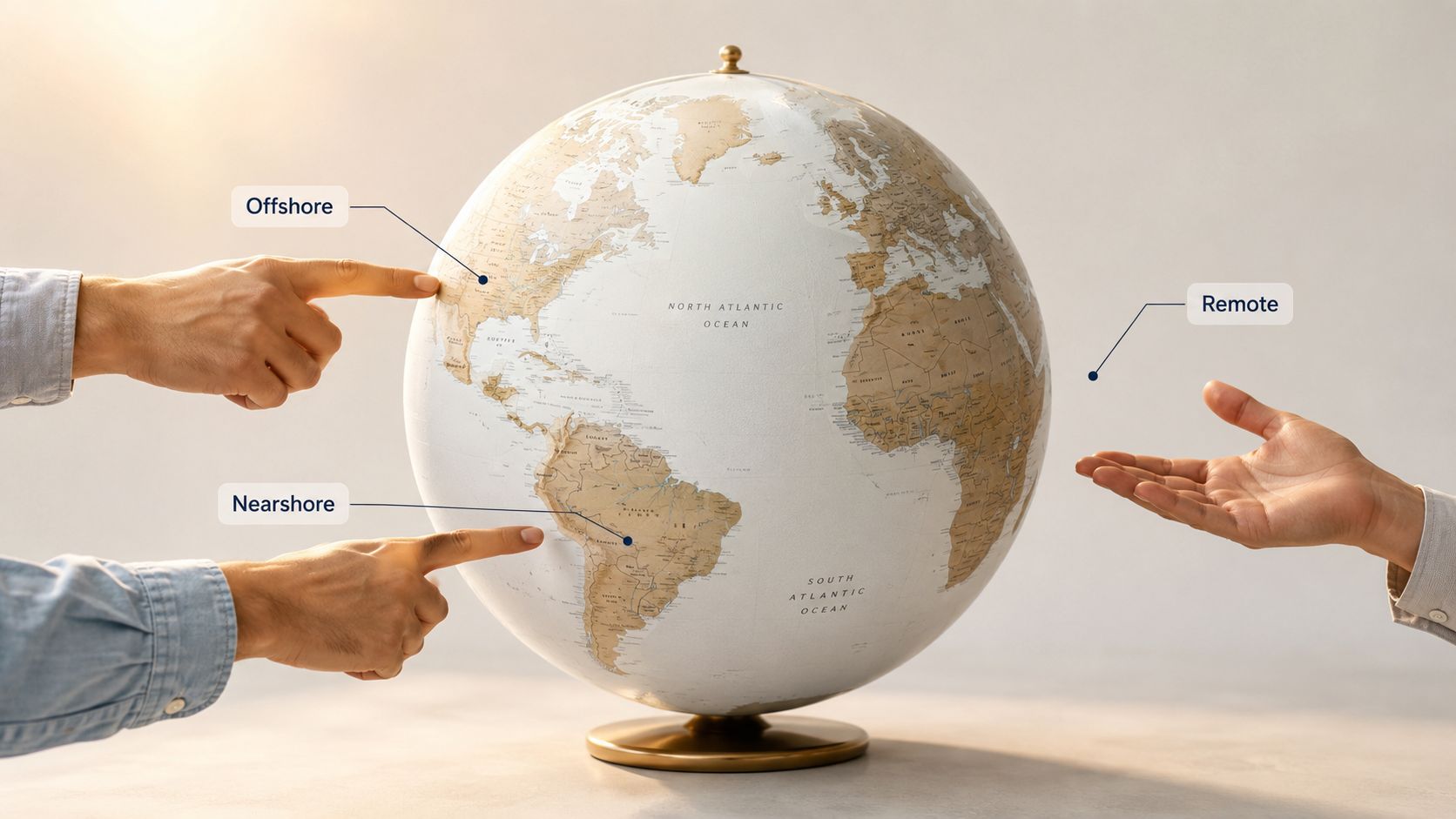
Remote means the person doesn't work in your office. That's it. Your remote media buyer could be in Denver, Bogotá, or three blocks from your HQ wearing sweatpants and ignoring your optional happy hour.
Offshore usually means the hire is in a different country, often far from your home market. Different legal environment, different payroll realities, often bigger time-zone gaps.
Nearshore is the practical cousin. Different country, but closer geographically and usually closer in working hours. For U.S. teams, that often means Latin America.
Simple version: remote is about where they work from, offshore and nearshore are about where they're based relative to you.
If you run paid acquisition, time matters. You need quick feedback on creative, fast decisions on budget shifts, and actual overlap when a campaign goes sideways. That's why I think many U.S. marketing teams over-romanticize “global” and underweight “working together without nonsense.”
Nearshore is often the sweet spot because you keep much of the cost advantage without turning every live issue into a next-day problem.
Offshore hiring doesn't fail because the talent is bad. It fails because the operating model is wrong for the work.
A copywriter with flexible deadlines can survive a wide time gap. A media buyer managing live spend across multiple accounts often can't. Not without extra process, crystal-clear ownership, and stronger communication than most companies have.
People hear offshore and picture giant call centers, scripts, handoffs, and a black-box vendor relationship. That's outdated thinking.
Modern offshore hiring, when it's done well, looks more like hiring a real team member who just happens to live somewhere else. They sit in your Slack, attend your standups, own outcomes, and know the account history. They're not “the outsourced person.” They're the buyer, strategist, analyst, or operator responsible for a function.
That distinction matters because your hiring criteria should change.
You're not buying hours. You're adding capability.
For U.S. marketing teams:
If you can't explain how the person will communicate, get paid, access data, and own results, you don't have a remote strategy. You have vibes.
Once you decide to hire globally, you get three main paths. None is perfect. One is usually a terrible fit for serious teams. One is tolerable if you enjoy administrative pain. One is the grown-up option.
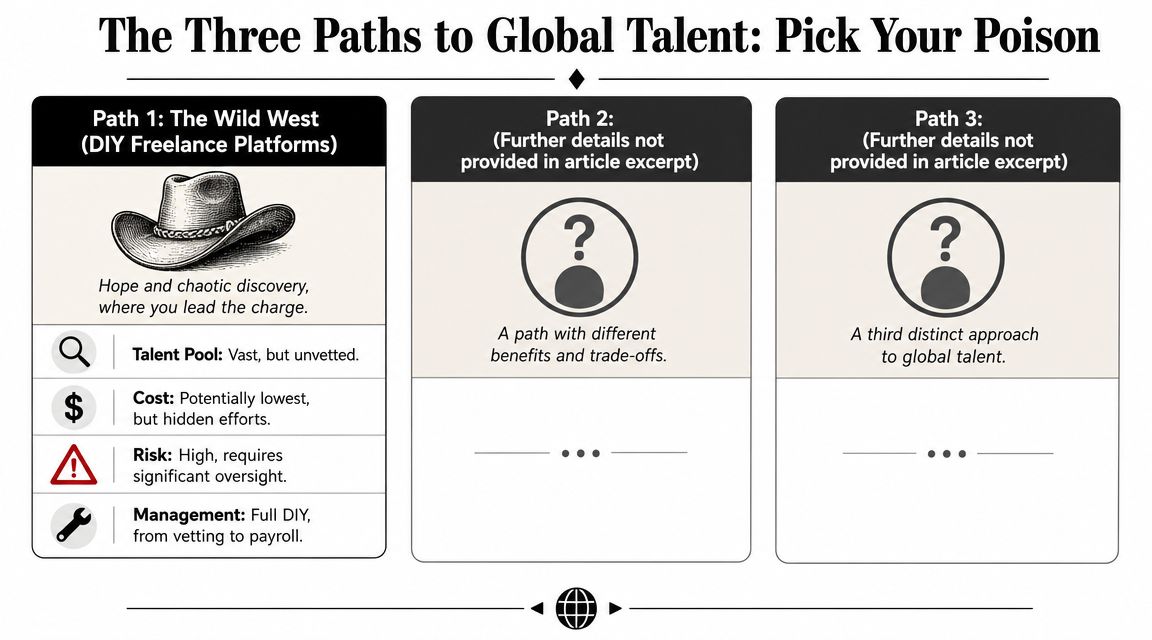
DIY freelance platforms look attractive because they feel fast. Open account. Post role. Get flooded with applications. Feel productive.
Then reality shows up.
You're sorting copy-pasted proposals, trying to decode whether “managed six-figure spend” means “I once touched an account with money in it,” and spending your afternoons running interviews you were never supposed to run. Hope you enjoy becoming a part-time recruiter, compliance coordinator, and lie detector.
DIY works if you already know exactly how to test talent, how to structure trial work, and how to handle international logistics. Such expertise is uncommon among teams.
Agencies and staffing firms can save time, but plenty of them hide the important bits. You don't always know how candidates were screened. You don't always know who keeps the margin. You often don't know whether the person pitched to you is the same caliber as the person who ends up doing the work.
And if the agency stuffs your account with whoever's available, congratulations. You outsourced the search and inherited the clean-up.
This is the model I prefer for most scaling teams. Someone else does the ugly work of sourcing, screening, checking communication skills, and filtering out the professional interviewers who can't perform.
That doesn't mean you stop vetting. It means you start from a higher-quality pool.
Founder bias: I'd rather review three strong candidates than eighty maybes and a small army of résumé fiction writers.
Here's the clean comparison.
| Model | Cost | Vetting Burden | Risk Level | Best For |
|---|---|---|---|---|
| DIY freelance platforms | Lowest apparent cost | Very high | High | Experienced operators who can vet and manage everything themselves |
| Traditional agency | Mid to high | Moderate | Moderate | Teams that want support but can tolerate opacity |
| Vetted marketplace | Moderate, usually clearer | Lower | Lower | Companies that want speed, quality, and less hiring drama |
If you're hiring for a role tied directly to spend, lead flow, or client retention, don't go full DIY unless you already have a proven hiring machine. That route is for companies with strong internal recruiters, strict assessment systems, and the patience to sift through a lot of nonsense.
If you're an agency founder, e-commerce operator, or marketing lead who needs a real person producing real results soon, use a vetted pool. It's not glamorous advice. It's just less stupid.
The cheapest candidate source is often the most expensive operating decision.
That low hourly rate can be catnip. I get it. You see a number that looks wildly lower than a U.S. salary and start mentally reallocating the savings to creative production, better tooling, or maybe replacing the espresso machine your team destroyed.
Slow down.
When companies brag about offshore hiring savings, they usually compare salary to salary. That's amateur math.
Cost includes recruiting time, onboarding drag, replacement risk, management overhead, software access, payment rails, and all the “small” frictions that somehow eat entire afternoons. Then there's the ugly stuff: classification, payroll compliance, tax exposure, local labor rules, and whether your “contractor” looks suspiciously like a full-time employee with fixed hours and a permanent seat in your org chart.
A practical gut check helps. If this person joins your standup every day, uses your tools, follows your direction, and has no real client base outside you, don't casually assume they're a freelancer just because the invoice looks convenient.
This is the blind spot that wrecks plenty of offshore hiring plans. Global rules are tightening, and countries are cracking down on employment misclassification. The headline savings disappear quickly if you structure the relationship badly. That's the central warning in this overview of offshore hiring pros, cons, and compliance risk.
And this isn't just a giant-enterprise problem. Smaller companies get sloppy because they assume nobody's looking. Then payroll gets messy, contracts get vague, and everyone acts shocked when “simple international hiring” turns into legal admin soup.
Here's the stuff teams conveniently forget to count:
If you want a cleaner way to think about this, focus on global payroll and compliance requirements before you obsess over rate cards.
The cheap hire isn't cheap if you have to babysit them, replace them, or explain their contract to a tax advisor.
If you're hiring one-off project help, you can get away with more flexibility.
If you're hiring someone who will become part of the machine, treat the legal and payroll setup like core infrastructure. Not paperwork. Infrastructure. Because that's what it is. The boring stuff is often the difference between “great decision” and “why is our finance person furious?”
Offshore hiring can absolutely save money. But only if you price the whole system, not just the person.
If you ask the internet where to hire globally, it'll hand you a giant buffet of countries and zero actual judgment. Very helpful. Like asking for restaurant advice and getting “food exists.”
So here's the opinionated version.
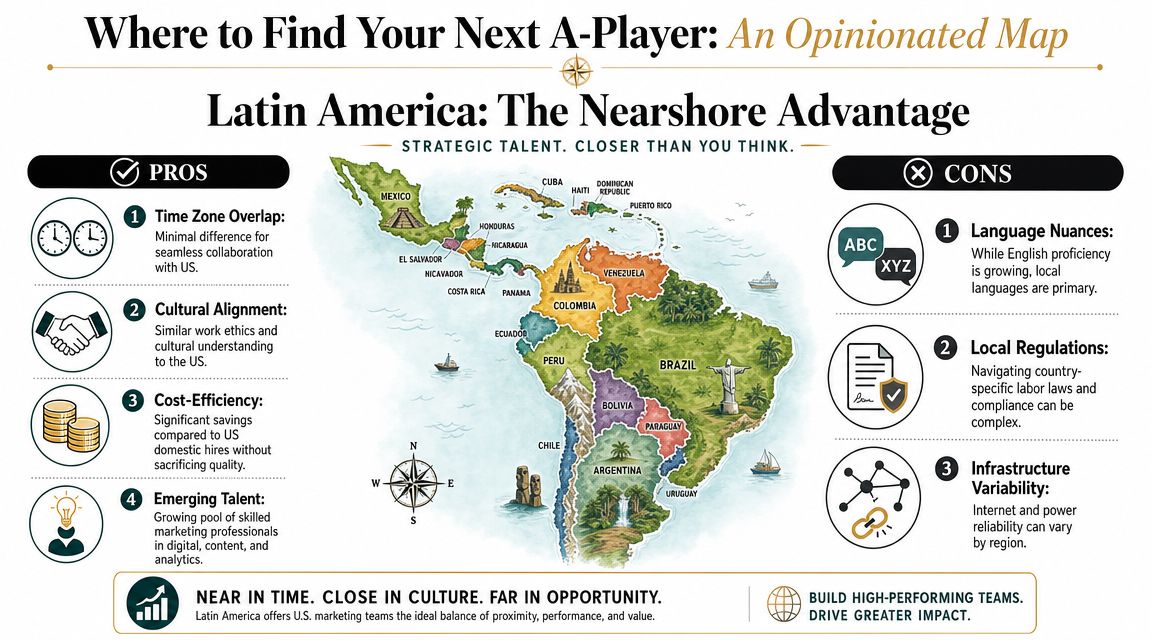
For media buying, account management, reporting, creative coordination, and growth roles that require real collaboration, Latin America is usually the best blend of practicality and upside for U.S. teams.
Why? Because marketing work is interactive. It's not just task completion. You need overlap for launches, fixes, approvals, creative feedback, and all the “quick question” moments that somehow decide whether a week goes smoothly or turns into Slack soup.
That nearshore setup solves a lot before the first interview even happens.
There's also a wider business trend behind this. Among U.S.-headquartered multinationals employing both offshore and onshore workers, offshore headcount grew 32% since 2019, versus 16.7% onshore, and highly remote-suitable roles grew 42% faster outside the U.S. than within it since 2019 (Revelio Labs analysis of offshoring remote-friendly jobs).
Latin America
Best for teams that need collaboration during U.S. business hours. Great fit for performance marketing, client services, lifecycle work, and roles where context matters as much as execution.
Eastern Europe
Strong talent. Often excellent for technical and analytical roles. The tradeoff is working-hour friction for U.S. teams, especially if your marketing org likes live collaboration.
Southeast Asia
Can be very cost-effective, especially for production-heavy support, but you need tighter process and communication standards if the work is highly strategic or U.S.-market specific.
I care less about flag-shopping and more about these factors:
Start with nearshore if the role is collaborative and revenue-linked.
That means a media buyer who needs to talk to creative, a paid search lead who works with sales, or an account strategist who joins client calls. You'll move faster, communicate better, and spend less managerial energy correcting for the clock.
If you're hiring a more independent specialist, you can widen the map. But if the role touches live spend and fast decisions, don't get cute. Pick the region that lets your team effectively work together.
Here, most offshore hiring efforts win or die.
A candidate can look polished, say all the right platform words, and still be useless when you ask them to diagnose a dropping conversion rate, argue for a budget shift, or explain why last month's “win” was probably attribution fluff. Surface-level hiring is how teams end up funding expensive mediocrity.
As offshore work gets more specialized, vetting for domain-specific skill and risk handling becomes paramount. That's obvious in high-risk industries, and the same logic applies here. If you wouldn't hire a specialized offshore engineer without checking real technical depth, don't hire a media buyer without proving they can think, communicate, and protect performance (UTM Consultants on specialized offshore skills and risk management).
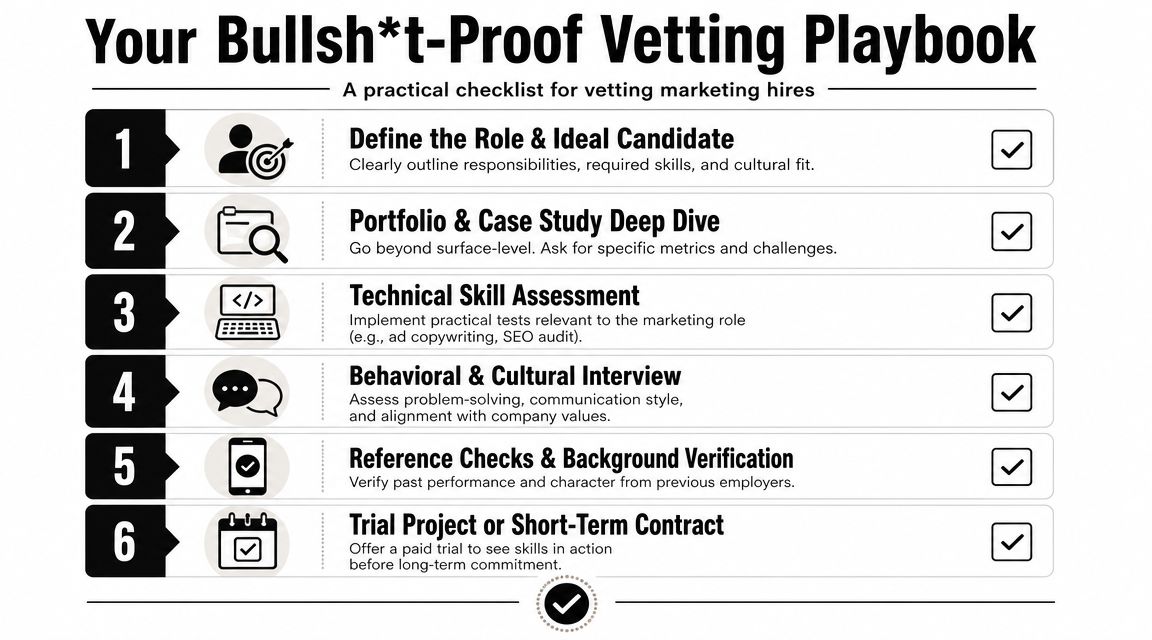
A portfolio alone tells you almost nothing. Plenty of candidates present ads, screenshots, or logos from accounts they barely touched.
What you want is proof of ownership.
Ask them what part of the machine they controlled. Did they build campaign structure? Own budget pacing? Write briefs for creative? Decide testing logic? Handle reporting? If they can't separate their contribution from the team's work, you're not looking at proof. You're looking at borrowed credibility.
Use questions that force thinking, not rehearsed answers.
A weak operator gives generic platform chatter. A strong one explains tradeoffs, sequencing, and business context.
Ask for the reasoning, not just the result. Bad hires memorize tactics. Good hires explain decisions.
Here's the baseline I'd use before making any offer:
Role scorecard
Define exactly what success looks like in the first months. Not “manage campaigns.” More like “own pacing, reporting clarity, testing cadence, and channel recommendations.”
Live work sample
Give them a realistic scenario. Not a bloated take-home built on free consulting. A focused exercise. Audit this account. Fix this reporting summary. Prioritize these campaign issues.
Technical interview
Make them walk through actual platform decisions. Meta, Google Ads, LinkedIn Campaign Manager, GA4, Looker Studio. Whatever the role really uses.
Communication screen
If they can't explain performance clearly, they can't lead an account. That's true even if they're brilliant in-platform.
Reference check
Real clients. Real managers. Ask what happened when results dipped, deadlines moved, or spend increased. If you want a useful benchmark for what strong social proof looks like, review how teams present client references and hiring trust signals.
Paid trial
Short. Focused. Time-boxed. Enough to see how they think under your workflow.
Rigorous vetting is annoying. It takes time. It requires operators who know what good looks like. Toot, toot.
But that work is still cheaper than hiring someone who burns ad spend, confuses your reporting, and forces you to redo your entire quarter with a different person.
Offshore hiring is not risky because the person lives somewhere else. It's risky when you skip the proof.
Yes, for most U.S. teams, offshore hiring is worth it.
But not if your real plan is “find someone cheap and hope for the best.” That plan deserves to fail.
The companies that get the most from offshore hiring treat it like capability expansion. They use it to build bench strength, widen access to strong operators, reduce dependency on one fragile local talent pool, and create a team that can keep moving when somebody quits or growth speeds up.
The companies that get burned usually make one of three mistakes:
That's not an offshore problem. That's operator error.
Offshore hiring is probably a fit if:
It's probably not a fit if you need constant in-person oversight, hate written communication, or expect a new hire to magically organize your company for you.
Hire globally when you know what great looks like and you're ready to support it. Don't hire globally to avoid doing the hard parts of management.
For most scaling U.S. agencies, e-commerce brands, SaaS teams, and performance-driven marketing departments, the best move is simple: use a vetted nearshore-first approach for collaborative marketing roles, and widen your search only when the role allows it.
That gives you the upside of offshore hiring without swallowing every avoidable headache.
You're not looking for the cheapest pair of hands.
You're looking for the best operator you can integrate fast, trust with budget, and keep on the field.
If you need that kind of hire without turning your week into a recruiting side quest, HireMediaBuyers.com is built for exactly that. It helps U.S. companies find pre-vetted media buyers and paid ads specialists quickly, with strong talent hubs in Latin America and support for payroll and compliance, so you can focus on performance instead of playing detective with résumés.


