


You posted a media buyer job description. Then the applications rolled in.
Half the candidates can “manage campaigns.” Terrific. So can a raccoon with admin access and a loose attitude toward budget controls. The other half say they're “data-driven,” which usually means they exported a CSV once and survived.
That's the problem. Most job descriptions don't screen for judgment. They screen for keyword stuffing.
A strong media buyer job description should do one job before the hire ever happens. It should pull in operators who can think, prioritize, communicate, and protect your ad budget like it came out of their own pocket. Everyone else should read it and close the tab.
You post the role on Monday. By Wednesday, your inbox is full of candidates who "optimize campaigns," "love data," and "work well with creative." By Friday, you realize half of them mean they know where the boost button lives.
That is what a weak job description does. It creates volume, not signal.
Here's the pattern. The post sounds polished. The resumes sound polished. The interviews sound polished. Then the person you hire can launch ads, but cannot explain budget shifts, spot creative fatigue before performance slips, or connect a targeting change to lead quality. You did not hire a media buyer. You hired a dashboard babysitter.

A vague post is comfortable for underqualified applicants because it lets them project competence onto empty phrases.
"Manage paid media campaigns" means nothing. "Monitor performance and optimize" means even less. Anyone can say yes to soft, stretchy language. The candidate worth hiring wants to know what they own, how success is judged, and what kind of commercial decisions sit on their desk. The candidate you should avoid hopes you never get that specific.
Use language that forces people to self-select out.
| Weak framing | Better framing |
|---|---|
| Manage Meta and Google campaigns | Allocate budget across channels based on performance and explain the tradeoffs |
| Monitor KPIs | Diagnose performance swings and recommend the next action clearly |
| Collaborate with creative | Turn campaign results into usable creative feedback |
| Stay organized | Control pacing, reporting, and campaign changes without constant supervision |
That shift matters because the job is not administrative. A strong media buyer handles judgment calls all week. Where should budget move? Which signals matter early, and which ones are noise? When should a campaign be fixed, and when should it be killed? A bad job description hides those questions. A good one puts them right on the table.
Practical rule: If your post could describe a junior coordinator, expect junior-coordinator applicants.
Plenty of hiring teams write role descriptions like a recycled task list from HR. That is how you end up interviewing people who can follow process but cannot protect budget.
Write the post around outcomes. Spell out what the person is expected to improve, protect, diagnose, and communicate. Make them prove they can think, not just click. If that makes weaker applicants uncomfortable, perfect. You are not writing a participation trophy. You are building a filter.
Say what good looks like in plain English. Examples help:
That kind of wording attracts operators. It repels tourists.
And yes, that is the goal. A strong media buyer job description should reduce the wrong applications before you spend a minute on screening. If your current version tries to appeal to everyone, it will. Sadly, everyone includes the exact people who will light money on fire and call it testing.
You post a vague media buyer role on Monday. By Friday, your inbox is full of applicants who “managed campaigns,” “optimized performance,” and somehow cannot explain why CAC spiked last quarter. That is not a hiring funnel. That is self-sabotage.
A strong job description filters before the first interview. It attracts operators who can own revenue and spend with adult supervision levels near zero. It also pushes away button-pushers who hide behind platform jargon and call random budget swings “testing.” Good.
The title sets the bar before anyone reads line two.
Use the title that matches the scope. “Media Buyer” works. “Performance Media Buyer” is better if the role owns acquisition targets and budget decisions. “Paid Media Specialist” fits when the role is execution-heavy and focused on digital channels.
Skip the cosplay titles. “Growth Ninja” and “Rockstar” make serious candidates roll their eyes and keep scrolling. You are hiring someone to allocate budget and judge signal quality, not headline Coachella.
The summary should answer one question fast: what problem is this person being hired to solve?
Write it like this:
We need a media buyer who can turn paid spend into profitable growth, spot performance problems early, and make clear recommendations across channel, budget, audience, and creative.
That opening does real work. It frames the role around business outcomes, decision-making, and accountability.
The body of the post should then spell out ownership across the paid media workflow. Audience research, placement selection, budget control, performance monitoring, and collaboration with creative or account teams all belong here. MultiplyMii outlines that broader scope in its digital media buying specialist job description guide. Use that idea, then tighten it to your business instead of pasting a generic wall of duties.
Great candidates want clarity. Weak candidates want room to wiggle.
A short scope block does more filtering than a bloated paragraph ever will:
Include success metrics here too. If the role owns performance, say which numbers matter and how they are judged. This guide to paid media performance metrics that actually matter helps if your team keeps stuffing every dashboard KPI into the post and calling it clarity.
Requirement lists often become a messy mix of true must-haves and empty calories. That is how companies ask for a media buyer, strategist, analyst, copywriter, designer, and part-time wizard in one hire.
Split the section into two buckets.
Founders often get sloppy. They stuff in every skill they have ever admired, then wonder why strong candidates bounce. List what the person must bring to win in your environment. Cut the fantasy requirements. Keep the filter sharp.
One last rule. Every section of the job description should help you answer a hiring question: Can this person own outcomes here, with this budget, on these channels, with this team? If a line does not help answer that, delete it.
A weak job description turns this role into button-pushing. Then you hire a campaign babysitter who can launch ads, spend your budget, and still act confused when margin disappears. Write the role around ownership instead. Good buyers own decisions, tradeoffs, and results.
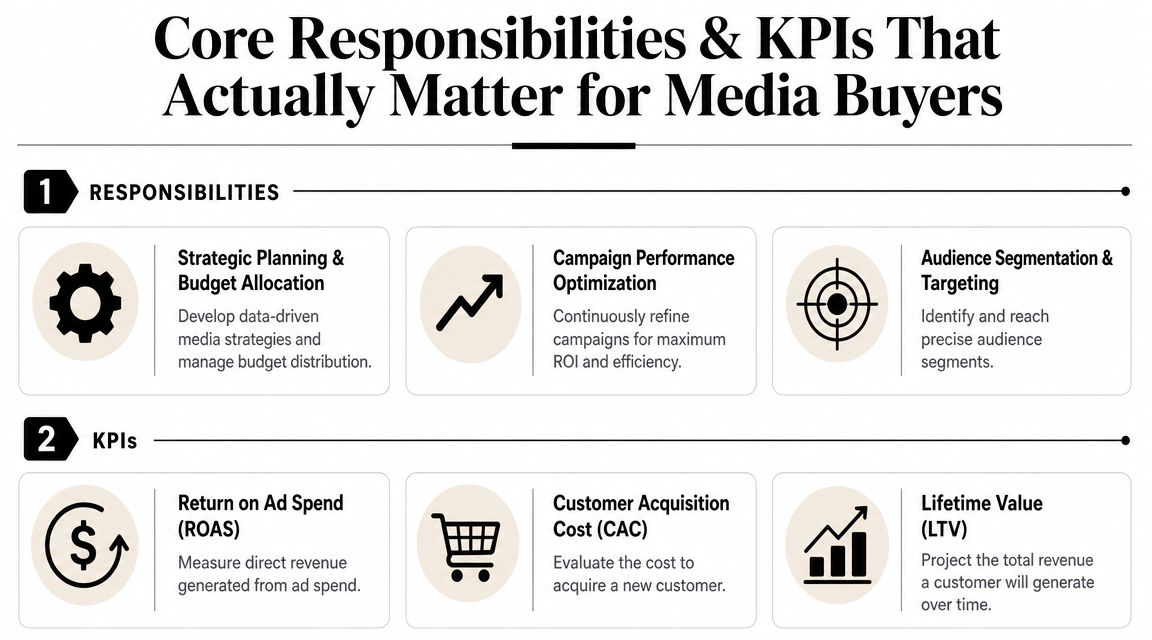
Your best candidates want to know what they will be trusted to control and how their judgment will be measured. Spell that out.
Channel strategy and budget allocation
Decide where spend goes, how much each channel gets, and what has to be true for that budget to increase.
Forecasting and pacing
Prevent overspend, spot underdelivery early, and adjust budgets before the month goes off the rails.
Audience and offer analysis
Use customer signals, past performance, and market context to choose targeting that fits the offer instead of spraying budget at broad audiences and praying.
Testing plan ownership
Build a testing roadmap for audiences, creative angles, landing pages, and offers. Random tests are not a strategy.
Performance diagnosis
Break down results by campaign, audience, placement, creative, and funnel stage. Then recommend what changes next and why.
Creative and landing page feedback
Call out weak hooks, tired angles, mismatched messaging, and conversion leaks. A strong buyer does not hide behind “traffic quality” when the page is the problem.
Reporting to decision-makers
Give founders, marketers, and clients clear updates on spend, efficiency, risk, and next moves. No dashboard theater. No metric soup.
Your KPI list should tell candidates what winning looks like in your business. That alone filters out a lot of fluff.
Use metrics like:
| KPI | Why it matters |
|---|---|
| ROAS | Measures direct revenue efficiency |
| CAC | Keeps acquisition cost tied to unit economics |
| LTV | Helps the buyer judge whether higher upfront costs still make sense |
| CPL | Useful for lead generation teams that care about cost per inquiry |
| Conversion rate | Shows whether traffic and landing page experience are doing their jobs |
| Impression share | Helps in accounts where auction visibility and coverage matter |
If you want sharper applicants, show them the ad performance metrics that tie spend to business outcomes and make it clear those are the scorecard.
A strong hire knows KPI selection has to match the business model. Ecommerce, SaaS, lead gen, and high-ticket sales do not run on the same reporting logic. Buyers who force every account into one dashboard template are telling on themselves.
Cut filler responsibilities that create noise without improving the filter.
“Manage campaigns” says nothing. “Stay on top of trends” is lazy. “Thrive in a fast-paced environment” usually means your team is disorganized and wants a polite way to admit it. Candidates know the code. The good ones roll their eyes and move on.
Judge the role on decisions and outcomes. Testing more is not proof of skill. Spending more is not progress. Fancy reports do not rescue weak judgment. Hire the buyer who can explain what changed, why it changed, and what they will do next. That is the person worth paying for.
Here's where bad hires sneak through.
A weak job description over-rewards tool familiarity, so you end up interviewing people who can click through Meta Ads Manager and Google Ads with confidence, then freeze the moment CAC climbs, creative fatigues, or tracking gets ugly. That person keeps campaigns running. They do not protect margin, find new angles, or make sharp calls under pressure. And yes, there is a painful difference.
You should still list the tools the role touches. If the buyer will live in Google Ads, Meta Ads Manager, GA4, Google Tag Manager, and Looker Studio, say that plainly. If the account includes LinkedIn, TikTok, Microsoft Ads, or YouTube, name those too. Good candidates want clarity. Sloppy candidates prefer vagueness because it lets them bluff.
But do not stop at the stack.
Tool access is the easy part. Judgment is the job. A buyer who knows where the settings live is useful. A buyer who can explain why performance changed, what to test next, and when to cut spend is the one worth hiring.
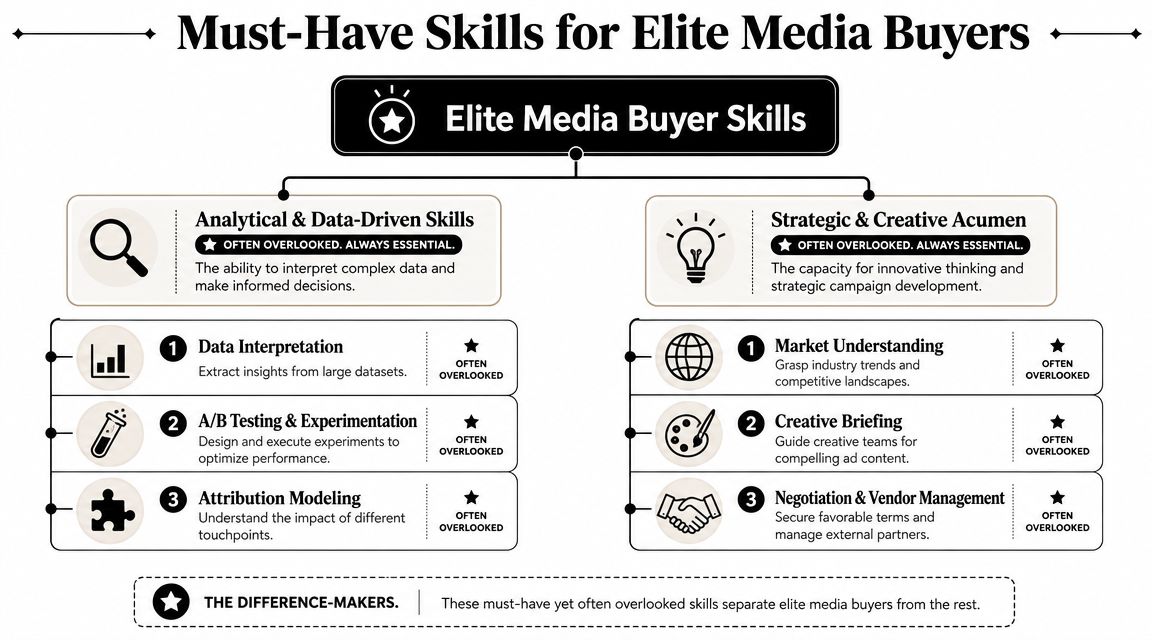
I'd write requirements in two groups so the role filters for thinking, not just platform exposure.
Data interpretation
They can read performance in context, spot the signal, and tell you what action follows.
Testing discipline
They know how to structure experiments, control variables, and avoid calling random motion a win.
Attribution judgment
They understand that reporting has blind spots and can still make sane decisions across touchpoints and conversion paths.
Budget and bid control
They can pace spend, protect efficiency, and adjust bids without turning the account into a bonfire.
Customer and market understanding
They connect media decisions to buyer intent, offer strength, and competitive pressure.
Creative briefing
They can give designers and copywriters direction that improves performance, instead of tossing out useless notes like “make it pop.”
Cross-functional communication
They work well with founders, marketers, creatives, analysts, and sales teams. No drama. No jargon smoke screen.
Commercial judgment
They understand the business behind the dashboard. A cheap lead that never closes is not a win. It is a spreadsheet prank.
CourseCareers makes a smart point in its overview of core junior media buyer skills. Media buying now overlaps heavily with growth thinking and creative strategy. That lines up with real hiring experience. Buyers who treat creative as someone else's problem hit a ceiling fast.
This section of the job description should feel a little demanding. Good. That is the point.
Skip soft filler like “detail-oriented,” “results-driven,” or “passionate about paid media.” Everyone writes that. It filters nobody. Ask for proof of decision-making instead. Ask candidates to describe a test they designed, a performance drop they diagnosed, or a time they pushed back on a bad internal request. Underperformers hate specifics because specifics expose them.
One line I like: “We want a media buyer who can connect audience insight, media decisions, and creative direction into one growth system.”
A strong candidate reads that and thinks, finally. A pretender reads it and starts polishing buzzwords.
You post a vague media buyer role on Monday. By Thursday, your inbox is full of two types of applicants. Juniors who want to “help with growth” but have never touched a budget, and “senior strategists” who talk beautifully and cannot explain a single optimization decision without hiding behind jargon. That is not a sourcing problem. That is a job description problem.
A strong job description does not try to attract everyone. It filters. It pulls in operators who care about outcomes, and it pushes away applicants who only know how to recite platform terms. That is the standard for every level.
A junior role should hire for execution, judgment, and learning speed. Give them real work. Do not hand them company-level growth ownership and then act shocked when tracking breaks and spend drifts.
Sample summary
We're hiring a Junior Media Buyer to support paid acquisition across key digital channels. This person will help build campaigns, check setup accuracy, monitor pacing, pull reports, and turn performance data into useful observations with clear next actions.
Core responsibilities
What to require
As noted earlier, the junior version of this job now includes more measurement and reporting work than many founders expect. Good. You want that expectation on the page. It scares off people who thought this role was just clicking around in Ads Manager.
This is the hire that carries real weight in a growing team. A good mid-level buyer owns channels without needing constant correction. A bad one burns budget, gives you pretty reports, and always has a reason performance slipped.
Sample summary
We need a Media Buyer who can manage paid campaigns across assigned channels, optimize toward business goals, and work with creative and internal stakeholders to improve performance over time. This role owns day-to-day decisions and is expected to explain those decisions in plain English.
Typical scope
| Area | Expectation |
|---|---|
| Channel ownership | Manages one or more paid channels independently |
| Budget control | Adjusts spend based on pacing, efficiency, and business goals |
| Optimization | Runs tests and makes allocation decisions with a clear rationale |
| Communication | Explains results, risks, and next actions without jargon |
| Creative input | Gives useful feedback based on performance patterns, not personal taste |
What to require
If a candidate cannot describe how they handled a budget tradeoff, they are not mid-level. They are still waiting for instructions.
A senior media buyer owns strategy, prioritization, and accountability. They should know how to structure accounts, guide creative direction, make tradeoffs, and coach less experienced buyers. Senior means the team gets clearer because this person joined, not noisier.
Sample summary
We're looking for a Senior Media Buyer to lead multi-channel paid media strategy, improve acquisition efficiency, and work closely with leadership, creative, and production teams. This role owns planning, budget allocation, testing frameworks, reporting standards, and channel-level decision-making.
What changes at this level
Here is the acid test. A senior buyer should be able to walk into a messy account, identify the waste, explain the tradeoffs, and tell you what to stop doing this week. If they only describe what happened last month, they are a historian.
Use a contract role when you need specialized help, temporary coverage, account cleanup, or an outside operator to check whether your current setup is wasting money.
Sample summary
We're hiring a contract Media Buyer for a defined engagement focused on campaign performance, account structure, and short-term optimization priorities. This role will audit current activity, identify waste, recommend improvements, and execute approved changes within a fixed scope.
Use this version when
What to specify
A contract post should read like a statement of work, not a wish list. If ownership is fuzzy, the project sprawls. Then the invoices get very specific.
You post a “senior” media buyer role at a bargain rate. Then the applicants roll in. Plenty of button-pushers. Very little judgment. Then you hire one, hand them budget, and spend the next three months paying tuition through wasted spend. I've seen that movie. It stinks.
Pay for the level of decision-making you need, not the title you want to slap on the listing.
The cleanest benchmark here is directional, not absolute. Earlier salary references in this article already show the role is paid like a specialized performance function, not admin support. The US market follows the same logic. Buyers who can manage budget responsibly, diagnose tracking issues, explain tradeoffs, and improve CAC are priced well above coordinators who just keep campaigns live.
Use these as hiring ranges, not gospel. Geography, channel mix, business model, and bonus structure still matter.
| Seniority Level | Typical Annual Base Salary Range (USD) |
|---|---|
| Junior Media Buyer | $50,000 to $70,000 |
| Mid-Level Media Buyer | $70,000 to $95,000 |
| Senior Media Buyer | $95,000 to $130,000+ |
For contract or freelance buyers, expect a different math problem. Strong specialists often price by monthly retainer or project scope because fixing a broken account is not the same job as maintaining a healthy one. And yes, the person who can walk into chaos, find the leak, and stop the bleeding this week costs more. Good. They should.
Here's the filter I use:
Pay for ownership
If the role owns channel strategy, budget allocation, testing priorities, and performance reporting, price it at mid to senior level.
Pay for complexity
Multi-channel ecommerce, lead gen with offline attribution, and B2B funnels with long sales cycles all justify higher compensation.
Pay for proof
Candidates with real case studies, clear account examples, and strong media buyer client references deserve more than candidates selling confidence and screenshots.
One more rule. Don't try to save money on salary while implicitly expecting senior judgment, analytics fluency, stakeholder management, and creative direction. That's how you hire someone who talks a great game in the interview, then lights your budget on fire with cheerful weekly updates.
If your interview starts with “tell me about yourself,” fine. If it stays there, you're basically running a podcast.
Media buying is practical work. Interview it that way. Ask questions that force candidates to make decisions, explain tradeoffs, and reveal how they think under pressure. That matters even more now that many employers still like degrees while skills-based hiring is gaining ground. WGU's media buyer career guide notes that beginners may break in without a marketing degree if they can demonstrate Google Ads or Meta Ads skill, fluency with GA4 or Looker Studio, and optimization ability.
Use scenario questions. Then shut up and listen.
These questions work because they force candidates to show judgment, not memory.
Don't reject junior candidates just because they don't have a polished pedigree. Some of the best early-career buyers are scrappy, self-taught, and a little obsessed. That's often a feature.
Ask things like:
| Question | What you're listening for |
|---|---|
| Walk me through a campaign or project you optimized | Clear thinking, not fancy language |
| How do you use GA4 or Looker Studio to spot problems? | Comfort with measurement |
| What would you test first on a weak campaign? | Prioritization |
| How do you know whether a result is good enough to scale? | Discipline and caution |
A strong junior candidate may not have years of experience. They should still be able to reason through a problem.
Ask for evidence. Not vibes.
Request a campaign walkthrough, a reporting sample, or a short written explanation of how they'd approach an account problem. If you can, check client references from past media buying work before you make the offer. Candidates who've done the work usually don't panic when you ask for receipts.
Smooth talkers love generic interviews. Real operators usually get better when the questions get specific.
By this point, the obvious truth is staring back at you. Hiring a strong media buyer takes real work.
You need a sharp job description. Then decent sourcing. Then disciplined screening. Then interviews that test thinking, not charisma. Then reference checks. Then onboarding that doesn't throw the new hire into a live account fire on day one. It's a lot. That's why so many companies settle. They get tired before they get selective.
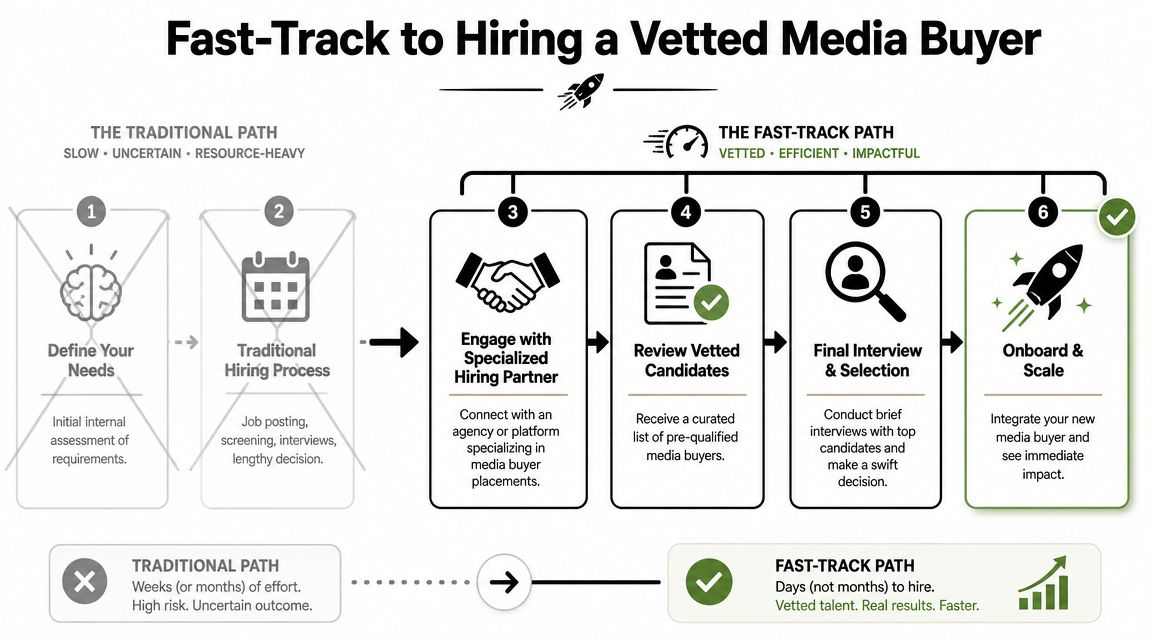
Traditional hiring usually looks like this:
That process can drag. If you want a blunt comparison, review a typical paid media hiring timeline and where delays usually pile up. The longer it stretches, the more likely your team lowers the bar just to get someone in the seat.
A smarter process does fewer things, better:
Define the business problem clearly
Growth, lead quality, account cleanup, creative testing, multi-channel ownership. Pick the primary need.
Screen for judgment early
Ask for examples, tools used, and how they think through tradeoffs.
Use practical evaluation
A short exercise or account walkthrough tells you more than another “culture fit” chat.
Check communication hard
If they can't explain results clearly, they'll create friction with everyone around them.
That's the whole game. Better filtering. Faster decisions. Less résumé theater.
If your team doesn't have the time or patience to build that machine properly, don't fake it. A weak process won't magically produce a strong media buyer. It'll just produce a stronger headache.
If you want to skip the résumé pile and meet pre-vetted media buyers faster, HireMediaBuyers.com is built for exactly that. You can review vetted talent for Meta, Google, LinkedIn, TikTok, and more, without turning your week into a hiring side quest.


