

You've done this dance before.
You open Meta Ads Manager or Google Ads, see a dashboard full of green arrows, healthy-looking CTR, maybe a decent pile of clicks, and for a brief moment you think, “Nice. We're cooking.” Then finance asks the annoying adult question: if performance is so good, why does the bank account look like it got mugged?
That gap is where many organizations lose money.
Most ad dashboards are built to report activity, not business quality. They'll happily tell you that people saw the ad, clicked the ad, maybe even “engaged” with the ad. Very generous of them. What they won't do is stop you from funding traffic that never turns into customers worth having.
I've watched teams obsess over a tiny CPC improvement while the offer was weak, the landing page leaked conversions, and the creative had all the persuasive charm of a parking ticket. If you read ad performance metrics like a platform rep wants you to, you'll stay busy. If you read them like an owner, you'll make better decisions and cut bad spend faster.
The dashboard isn't technically lying. It's just telling a partial truth, which in advertising is often more expensive than a direct lie.
A founder sees high CTR and assumes the campaign is working. An agency points to “strong engagement” and asks for more budget. Meanwhile, sales quality drops, margins get weird, and everyone starts speaking in acronyms so nobody has to admit they don't know what's happening.
That's the trap. Ad performance metrics are often treated like school grades. They're not. They're diagnostic signals.
Platforms reward what they can measure cleanly inside their own walls. Impressions, clicks, reach, video views. Those are easy to display and easy to celebrate. They also happen to be the numbers most likely to flatter a mediocre campaign.
Industry guidance has long centered advertising measurement around foundational KPIs like impressions, clicks, CTR, conversion rate, CPC, and ROAS, with formulas such as CTR = clicks divided by impressions and CPC = total cost divided by clicks, because those are the core mechanics of campaign optimization, not just decorative reporting, as explained in Adverity's overview of performance marketing metrics.
That sounds dry. It matters because it tells you something important: these numbers are tools, not trophies.
Your dashboard shows what happened inside the ad account. Your business needs to know what happened after the click.
When you look at ad performance metrics, stop asking, “Is this number good?” Start asking better questions:
Here's the blunt version. A dashboard can show healthy motion while the business is bleeding internally. That's why experienced operators don't worship single metrics. They use them to locate friction, then they fix the actual cause.
You launch a campaign on Monday. By Wednesday, the agency is celebrating a strong CTR and cheap clicks. By Friday, sales look flat and your inbox is full of excuses.
That happens because click metrics describe movement, not business results. You still need them. You just need to read them like an operator, not like someone admiring a dashboard.
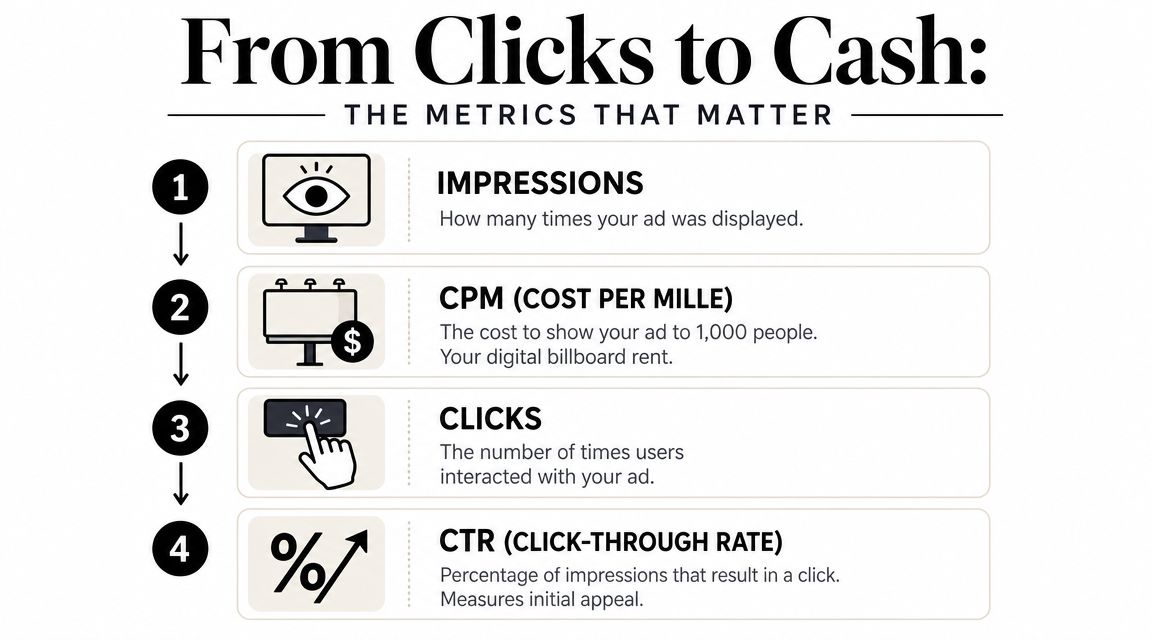
These are the checkpoints between attention and action.
| Metric | What it tells you | Formula or interpretation |
|---|---|---|
| Impressions | How often the ad was shown | Exposure, not intent |
| Clicks | How many people took the first action | Initial response |
| CTR | Whether the ad earns attention | Clicks divided by impressions |
| CPC | What you paid for each visit | Total cost divided by clicks |
| Conversion rate | Whether traffic takes the desired action | Clicks turning into conversions |
| Cost per conversion | What each conversion costs you | Ad spend divided by conversions |
You do not need to memorize jargon here. You need to know which number points to which problem.
Impressions answer one question. Are you getting seen at all? If impressions are weak, you have a delivery problem, a budget problem, or an audience that is too narrow. Do not waste time rewriting headlines before you fix distribution.
Clicks show initial interest. They matter because they prove somebody cared enough to leave the feed. They do not prove buyer intent. Curiosity clicks and buying clicks are not the same thing.
CTR is a creative and audience fit signal. A low CTR usually means the message is missing the mark, the audience is wrong, or the format is fighting the platform. A high CTR can still be a trap if the ad overpromises and the page underdelivers.
CPC tells you the market price of attention. Rising CPC does not automatically mean the campaign is failing. It often means competition increased, your audience is saturated, or the platform is forcing you into pricier inventory. The right response is not always to cut bids. Sometimes you need a stronger hook, a better offer, or a broader audience.
Conversion rate is where traffic either becomes useful or gets exposed as junk. If CTR looks healthy and conversion rate is ugly, stop blaming the media buyer for everything. The landing page, checkout flow, lead form, pricing, or offer usually deserves a hard look.
Cost per conversion is where bad reporting gets dangerous. Plenty of ad managers brag about a cheap lead or purchase event that has no real value to the business. If your "conversion" is a low-intent lead, a freebie seeker, or a spam form fill, low cost per conversion is a vanity stat in a suit.
One metric by itself is how inexperienced teams burn money with confidence.
Use the combinations that point to action:
That last point matters more than people admit. Platforms will happily find you more of whatever you ask for. If you tell them to optimize for cheap leads, they will deliver cheap leads. Then you get to explain to finance why none of them close.
Practical rule: If a media buyer reports CTR without conversion rate and cost per conversion in the same conversation, they are reporting ad engagement, not business performance.
Different goals need different scorecards. Founders get in trouble when they judge every campaign by the same number and call it discipline.
Use a simple standard:
This is also where platform quirks start to matter. Meta can make weak traffic look exciting because the click volume is there. Google can look expensive while producing better intent. TikTok can flood the top of funnel and leave you with a conversion story that falls apart under scrutiny. A competent operator knows the metric definitions. A useful operator knows which ones deserve skepticism on each platform.
If you are hiring someone to run ads, ask one blunt question: "What would make you ignore a high CTR?" If they cannot answer with specifics about conversion quality, landing-page mismatch, and bad optimization events, keep interviewing.
At some point, every ad account faces adulthood.
That's when the conversation moves from “How did the ads perform?” to “Did this spend make financial sense?” Those are not the same question.
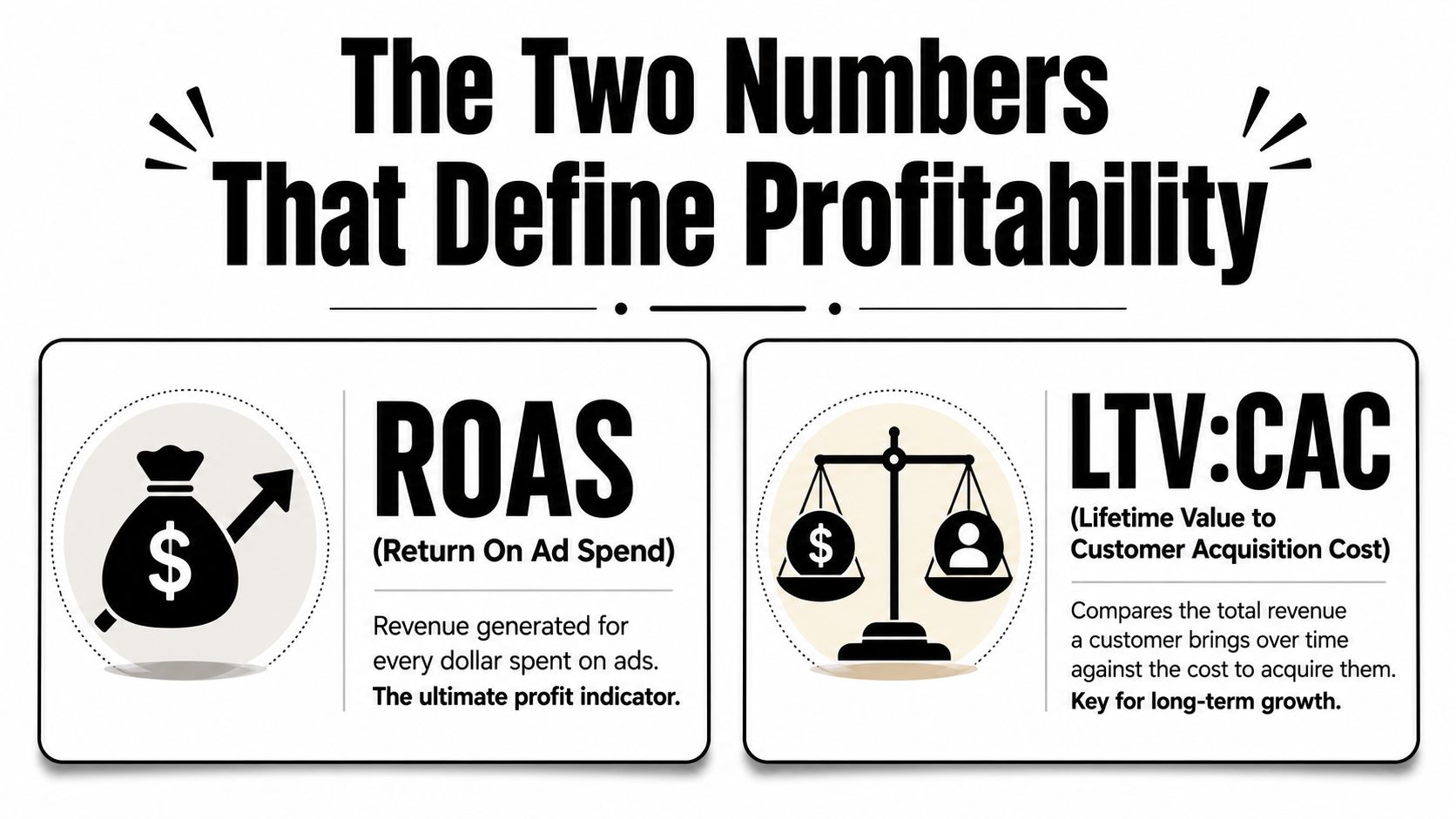
ROAS tells you how much revenue came back relative to ad spend. It's the fastest profitability check available, and yes, it matters. A lot.
But don't get cute with it. ROAS is a snapshot. It tells you what happened in the reported window, not whether you acquired the right customers, protected margin, or built something scalable.
A high CTR can still hide poor landing-page or offer performance, which is why practitioners are advised to separate impressions, clicks, conversion rate, and ROAS instead of treating CTR as success on its own. Connecting ad-platform data to web analytics with UTM parameters helps trace the path from click to conversion and find the drop-off point, as outlined in Improvado's guide to advertising analytics.
I care even more about LTV:CAC, because businesses don't survive on platform screenshots. They survive on customer economics.
If you sell a one-off impulse product, short-window ROAS may tell you most of what you need to know. If you run a subscription business, a repeat-purchase brand, or any model with retention, then your first purchase is only part of the story. A campaign can look mediocre on day one and still be excellent when those customers buy again.
That's why founders get in trouble when they let media buyers optimize only for immediate platform-reported return. You can accidentally kill profitable acquisition because the dashboard didn't show the full customer value yet.
Use this table as your sanity check:
| If this happens | Ask this next |
|---|---|
| ROAS drops | Did traffic quality worsen, or did attribution/reporting shift? |
| CAC rises | Are auction conditions tougher, or did creative burn out? |
| LTV looks weak | Is acquisition attracting the wrong buyer profile? |
| ROAS looks great but growth stalls | Are you overfishing the easiest audience and missing scale? |
The point of ad performance metrics isn't to praise campaigns. It's to decide where money should go next.
If your media buyer can talk fluently about clicks but gets foggy when you ask about customer payback, that's not a media buyer. That's a dashboard tour guide.
Every ad platform grades its own homework.
That's the first thing to remember. The second is that each one has a personality. Ignore that, and you'll misread the numbers.
Google Ads can make smart operators look dumb if they rely on one universal target across every region, device, and auction.
Recent guidance around Google Ads pushes advertisers toward context-aware benchmarking using Auction Insights, Ad Preview and Diagnosis, and competitor-ad transparency, so performance gets interpreted by market conditions, device behavior, and auction pressure instead of some generic “good CPA” fantasy, as explained in this breakdown of Google Ads competitive analysis tools.
That's the right lens. Search performance is heavily shaped by intent and competition. A number that looks bad in one market might be perfectly sensible in another.
The best Google operators don't just ask, “Is CPA acceptable?” They ask, “Acceptable where, on what device, against which competitors?”
Meta will show you reach, clicks, engagement, and enough shiny graphs to keep a growth team occupied all week. Useful, yes. Dangerous, also yes.
Meta is especially good at making broad activity feel like proof of business impact. If you're hiring for this channel, you want someone who understands platform nuance, not just Ads Manager buttons. A strong Meta Ads specialist should be able to explain what the platform is optimizing for, what it tends to over-credit, and how they validate performance outside the native dashboard.
| Good sign | Potential trap |
|---|---|
| Healthy click activity | Clicks from curiosity, not buying intent |
| Broad delivery | Audience too loose to produce quality outcomes |
| Low-cost top-funnel actions | Optimization drifting toward easier but weaker events |
Meta can find cheap events all day if you let it. Cheap isn't the same as valuable.
TikTok is brilliant at generating interest. It can also make attribution feel like séance work if your team gets sloppy.
The platform prioritizes content that feels native, captures attention, and keeps people watching. That's useful for discovery. It also means you need more discipline when interpreting the numbers. Strong view behavior doesn't automatically equal commercial intent.
Founder filter: Ask of every platform, “What does this system naturally want to optimize?” Then check whether that lines up with what your business actually needs.
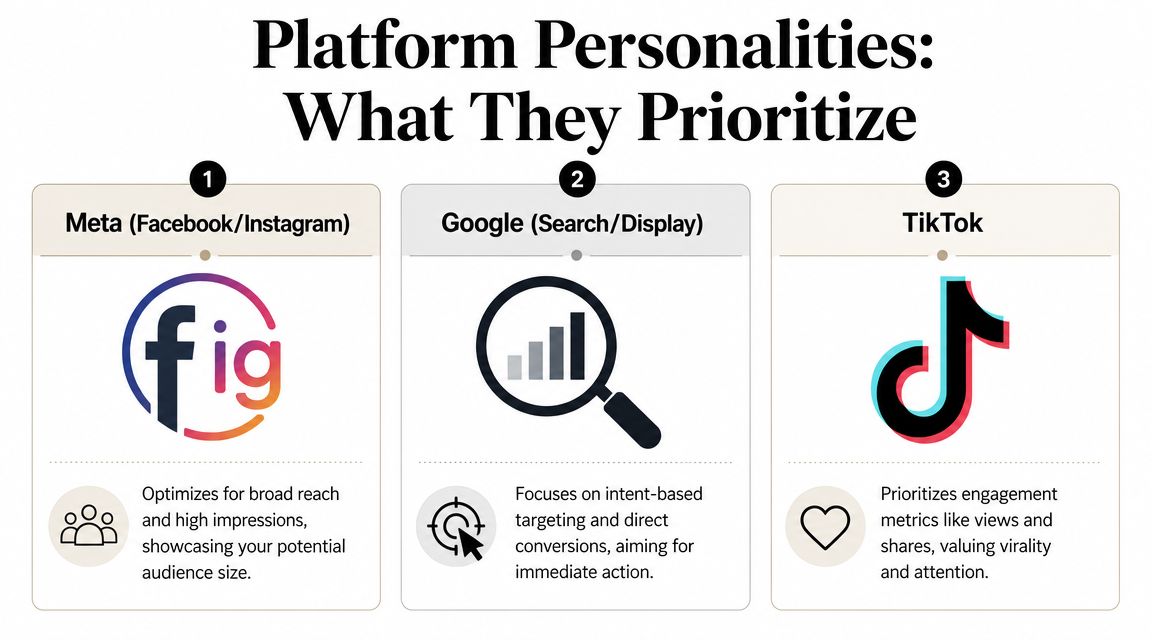
Google leans into intent and auction dynamics. Meta leans into scalable delivery inside its ecosystem. TikTok leans into attention and engagement behavior. None of them are evil. None of them are neutral.
Treat platform reports like witnesses, not judges.
Most ad account “optimization” is theater.
People adjust bids, fiddle with budgets, duplicate ad sets, rename campaigns with increasingly deranged spreadsheet logic, and then act surprised when results barely move. That's because the biggest gains usually don't come from dashboard tinkering. They come from creative, offer, and landing-page fit.

A lot of ad performance content treats CTR, CPC, CPA, and ROAS like universal scorecards. That misses the bigger driver. Recent Meta-focused guidance argues that the creative angle can account for roughly 70% to 80% of performance variation, which is why metric dashboards often miss what's moving outcomes, according to Segwise's analysis of creative testing.
That should change how you manage ads.
If creative angle drives that much variation, then the job isn't “optimize the campaign.” The job is “test better hypotheses.” Different message, different hook, different objection handling, different offer framing. That's where grown-up gains live.
Ask which idea won.
A practical testing stack looks like this:
Testing versions of the same idea is often called experimentation. Swapping a thumbnail or headline can help, but it's not strategic testing if the core angle stayed the same.
The ad account can tell you which ad variant got the click. It cannot tell you whether your value proposition is weak. That's your job.
Creative fatigue doesn't arrive with a dramatic speech. It sneaks in.
One Meta-focused guide notes that a frequency of 1.0 means each person saw the ad once, and that frequency above 5 combined with declining CTR signals severe ad fatigue, a point where teams should refresh creative or broaden targeting. The same guide warns that a CPA increase of 50%+ over three days can indicate a campaign issue that needs immediate investigation, as described in AdStellar's explanation of Meta ad performance monitoring.
That's not a universal law for every account, but it's a very useful operating guardrail.
Founders waste a fortune trying to rescue stale messaging with media math. You can't out-bid a boring ad.
Attribution is where smart teams become hilariously overconfident.
One dashboard says Meta drove the sale. Another says branded search closed it. Analytics says direct traffic deserves the credit. The CRM shrugs. Everyone leaves the meeting with a different truth and the same budget request.
Last-click attribution is popular because it's simple. It's also lazy. It gives all the credit to the final touchpoint, which is a bit like giving the waiter full credit for the restaurant's reputation.
First-click has the opposite problem. It flatters discovery and ignores the work required to convert.
The practical move is not to become a philosopher of attribution. It's to use models as directional tools, then compare them against blended business results. If spend rises across channels and total qualified outcomes don't follow, your attribution setup can't save the story.
For a deeper look at how teams structure this work, attribution modeling approaches are worth understanding before you let any platform claim heroic levels of credit.
A sudden drop in ROAS doesn't always mean the campaign broke. Sometimes attribution lags. Sometimes conversion reporting catches up later. Sometimes normal volatility is just being rude.
Recent material on anomaly detection in ad performance points to methods like z-scores, moving averages, and regression-based expected-value modeling to separate real problems from normal noise or delayed attribution, as outlined in Meegle's overview of anomaly detection in ad performance.
You don't need a PhD to apply the idea.
A disciplined team asks, “Is this a real change or a measurement artifact?” An undisciplined one starts editing campaigns before breakfast.
Attribution isn't about finding perfect truth. It's about reducing self-deception enough to allocate budget intelligently.
It happens fast. You hire a media buyer with a polished résumé, clean reports, and plenty of confidence. Three months later, spend is up, explanations are slippery, and finance still cannot tell whether the ads are producing profitable customers.
That mistake costs more than bad CPMs. It burns time, muddies decision-making, and teaches your team to trust the wrong signals.
The right hire does not start with platform tricks. They start with your business model. They ask about margin, sales cycle, offer limits, lead quality, and what counts as a real conversion after the click. If someone jumps straight to CTR, audience hacks, or bid strategy, keep the interview short.
A strong operator can explain performance in plain English and connect metrics to decisions. They know when a metric is a warning sign, when it is noise, and when it should change budget, creative, or targeting.
Use questions that force them out of dashboard theater:
A capable Facebook Ads specialist should answer those clearly, without hiding behind jargon, acronyms, or screenshots with green arrows.
Here is the short list.
| Red flag | What it usually means |
|---|---|
| They brag about CTR first | They optimize for attention, not profit |
| They cannot explain attribution tradeoffs | They trust platform reporting too much |
| They only talk about one channel | They do not understand how channels affect each other |
| They obsess over tiny account tweaks | They underweight creative, offer, and funnel strategy |
One more red flag. They talk like every business should use the same targets. Good buyers know a lead gen account, an e-commerce brand, and a high-ticket sales process should not be judged by one neat benchmark.
Ask this. “If performance dropped tomorrow, what would you check first, second, and third?”
A serious operator gives you a sequence. They start with tracking integrity, then check funnel breakpoints, creative fatigue, sales quality, and market context. They know the order matters because bad diagnosis creates expensive fixes.
A weak candidate gives you mush. “Test new audiences.” “Try fresh copy.” “Optimize bids.” That is not a diagnosis. That is account busywork.
The best media buyers are not campaign caretakers. They are capital allocators. They know which metrics deserve attention, which ones are vanity furniture, and when a reporting issue is really a business issue wearing a platform costume.
Finding that person can become a job of its own. If you would rather focus on running the business than sitting through résumé theater, HireMediaBuyers.com helps companies find pre-vetted media buyers and paid ads specialists without turning your week into an interview marathon.


