

Your remote media buyer is in another time zone, the ads are live, and the dashboard looks fine until a compliance complaint lands in your inbox at 2:07 a.m. Now you're staring at a server-side event path, a consent banner you half-trusted, and a platform rep asking why data moved through a country your legal team never signed off on. That's not a theoretical privacy issue, it's a marketing uptime problem with a lawyer-shaped aftertaste.
Data privacy regulations stop being a “legal department thing” and become a practical question of who can touch what, when, and from where. If you run paid media, manage an agency, or hire remote buyers across borders, you're already in the blast radius. A lot of teams only discover that when a platform flags suspicious data flow or a customer asks for deletion and the request lands in the wrong Slack channel.
The point of this guide is simple. Know what matters, what's noise, and what will break your campaigns if you ignore it. No legal perfume, no 40-page policy cosplay, just the parts that keep your acquisition machine from face-planting.
The worst versions of this story start the same way. A U.S. brand's Meta campaigns are humming, the remote media buyer in Manila is optimizing creative, and then someone notices that event data is being routed through a server that nobody on the team fully documented. The founder suddenly needs answers, the agency wants a meeting, and the only thing moving faster than the panic is the finger-pointing.
That's the essential lens for data privacy regulations. They're not just about notices and legalese, they're about whether your marketing system can keep operating when someone asks, “Where did this data come from, who touched it, and why is it still here?” A privacy complaint is often the first visible symptom of a much older operational mess.
Practical rule: if your team can't explain the path from ad click to stored customer record, your compliance posture is already softer than it looks.
This is for U.S. marketing leads, agency owners, and the remote buyers they hire. It's also for the ops people who get pulled into fixing things nobody documented because “we'll clean that up later” became a company habit. If your team runs ads across borders, handles CRM syncs, or uses server-side tracking, you need more than a policy page.
The next sections save you from three ugly outcomes. First, treating privacy as a legal afterthought. Second, signing vendor agreements that say nothing useful. Third, discovering too late that your targeting stack, consent stack, and deletion workflow don't agree with each other.
If you want a fast gut check before things go sideways, start with a practical compliance review like this marketing compliance check. It won't replace judgment, but it'll tell you where the rotten floorboards are.
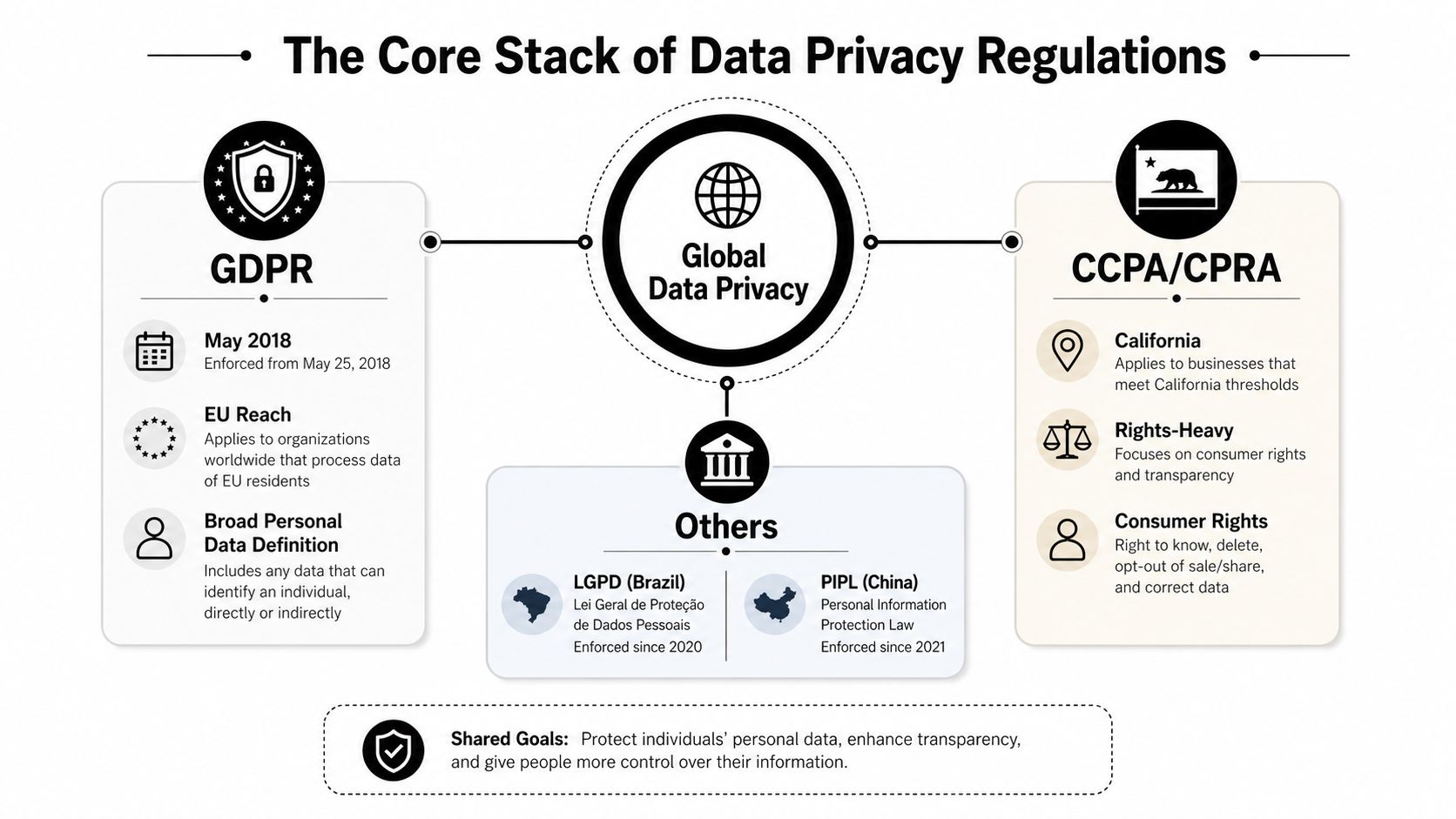
The cleanest way to think about data privacy regulations is as stacked jurisdictions, not a single rulebook. At the top sits the GDPR, which became applicable in May 2018 and is still the global reference point because it gave privacy real teeth, broad rights, and an enforceable framework across the EU. EU law makes that reach explicit, since the GDPR is binding in its entirety and directly applicable in all Member States, alongside the Law Enforcement Directive and the EU institutions' Data Protection Regulation as part of the wider EU privacy framework. See the EU's own text on the GDPR's scope and timing in the official EU regulation text.
The next practical layer for U.S. teams is California. CCPA/CPRA is not a European clone, but it's rights-heavy in the same “don't surprise people with their own data” spirit. For marketers, that means you're dealing with access, deletion, correction, and opt-out expectations that shape how you collect, store, and use audience data.
The U.S. is still a patchwork. There's no comprehensive federal privacy law, so businesses end up navigating state, sector, and local rules that don't line up neatly. The practical result is blunt, if your team handles sensitive data, children's data, biometric data, geolocation data, or health and financial data, you can't use one generic checklist and call it a day. The state map changes often enough that “we're probably fine” is a dangerous internal memo.
Reality check: the strictest rule often wins in practice because it's the only one that won't embarrass you when a request, complaint, or vendor review lands.
Sector laws complicate the picture further. HIPAA matters when health data shows up in your funnels, COPPA matters when kids' data gets involved, and GLBA matters when financial information enters the stack. That's why a marketing team should ask a coverage question first, not a policy question. Which data are you touching, which jurisdictions apply, and which rule is the one likely to bite?
Here's the working mental model. GDPR defines the broad baseline, California adds consumer rights pressure, and the rest of the U.S. patchwork fills in the gaps with state-specific obligations. The strictest applicable rule usually becomes your operational standard, because it's cheaper than building three different privacy stacks and pretending they'll stay in sync.
If you're building a cross-functional strategy for first-party data, the practical version is less glamorous than the keynote version. It's mostly about knowing which data flows are allowed, which ones need consent, and which ones should never have been created in the first place. For a useful planning lens, the same idea applies when you shape your first-party data strategy.
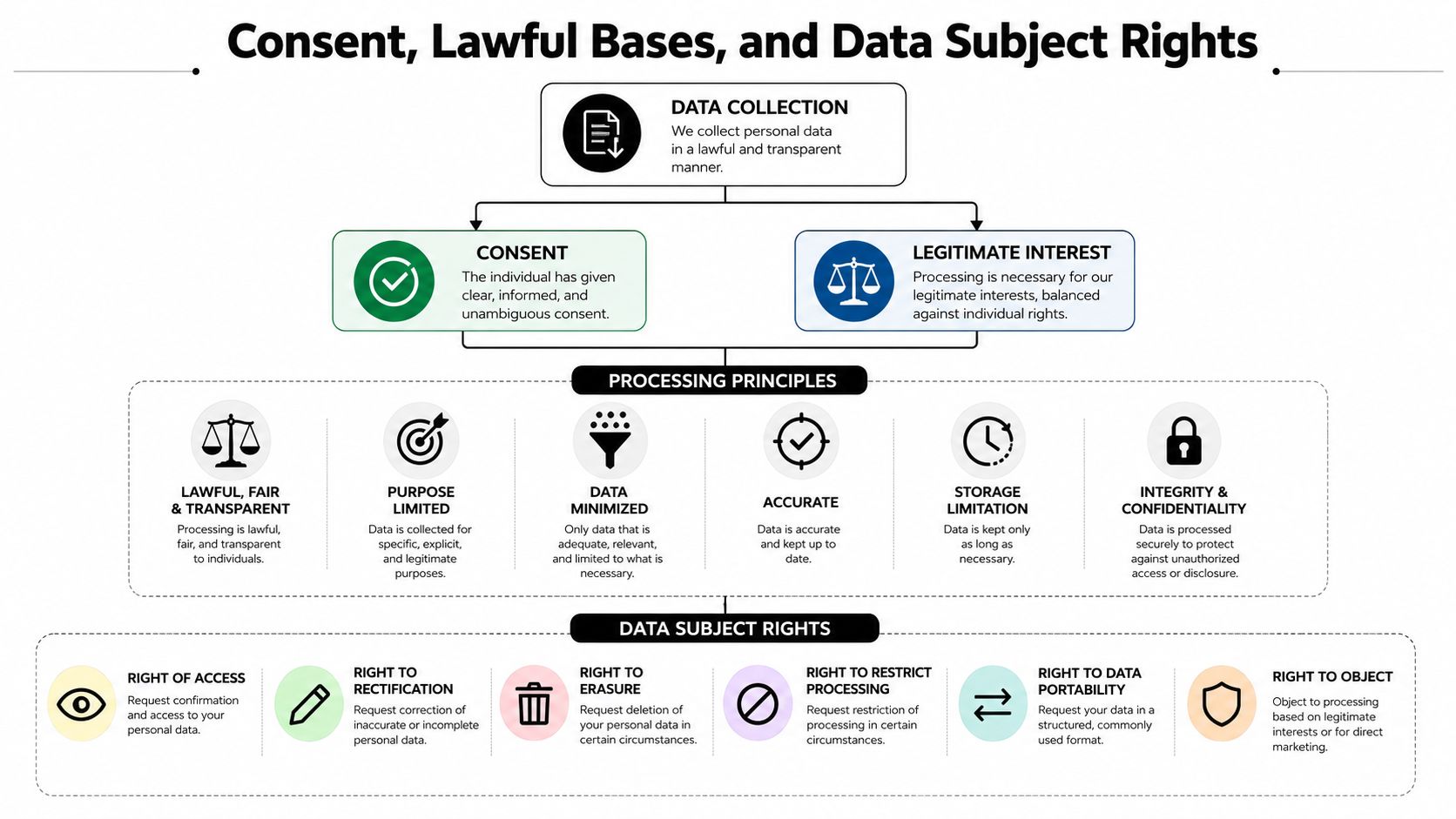
The biggest mistake marketing teams make is treating consent like a banner and lawful basis like paperwork. Under GDPR-style rules, the test is whether your data handling is lawful, fair, transparent, limited to the purpose you stated, accurate, kept only as long as needed, and secured properly. Those are the six Article 5 processing principles, and they are the engine room of the whole system, not decorative legal wallpaper. The World Bank's privacy guide lays them out clearly in its summary of GDPR Article 5.
If your Meta or Google setup is collecting events that aren't necessary for the campaign objective, you're already drifting. If your event taxonomy is a junk drawer, your retention windows are “forever unless someone complains,” or your audience lists came from a mystery spreadsheet, that's not a small issue. It's how a campaign becomes a compliance mess with a pretty dashboard.
Consent management platforms are supposed to keep that mess from happening. In theory, they capture user choices and pass them downstream. In practice, they only work if your tags, server-side events, and vendor stack honor the signal instead of treating it like polite background noise.
IAB Tech Lab's privacy standards are useful because they're built for the plumbing problem, not the slide deck problem. The Global Privacy Protocol is designed to move privacy, consent, and consumer-choice signals across sites, apps, and ad-tech vendors, while the Data Deletion Request Framework standardizes deletion handling and the Accountability Platform adds auditable data structures for verifying whether restriction signals were communicated correctly. That matters because your team doesn't need more philosophy, it needs machine-readable workflows that don't fall apart at handoff. You can see the standards stack on the IAB Tech Lab privacy standards page.
The rights themselves are not abstract, either. Access, deletion, portability, and related requests become real tickets that a customer can pull, and your media buyer or ops lead needs a clean path for routing them. If a request sits for weeks because everyone thought someone else owned it, the problem is no longer privacy policy, it's operational laziness.
Operational truth: if a request lands in legal but the pixels keep firing, your system is lying to itself.
Cross-border transfer rules are where a lot of U.S. teams get blindsided. They assume the issue is where the server sits, but the key question is who processes the data, from where, and under what safeguards. A U.S. server accessed by a contractor in Manila can still create GDPR-style exposure if the processing chain is messy enough.
The basic tools are straightforward, even if the jargon isn't. Standard Contractual Clauses are the old workhorse for data exports that need contractual guardrails. The EU-U.S. Data Privacy Framework is the cleaner path for certain transfers into the U.S. when the parties and certification line up. The UK has its own adequacy flavor, which matters if you're dealing with British data flows or vendors with UK operations.
| Mechanism | Best For | Key Limitation |
|---|---|---|
| Standard Contractual Clauses | Vendors and contractors when no adequacy decision covers the transfer | They still need real operational safeguards, not just a signed PDF |
| EU-U.S. Data Privacy Framework | Certain transfers into certified U.S. organizations | It only helps if the transfer chain actually fits the framework |
| Contractual safeguards | Lower-risk vendor relationships with limited data movement | Contracts can't fix bad internal access or sloppy retention |
If your media buyer is in Manila and your customer data sits in Virginia, the question is not whether the data is “safe” because it's in the U.S. The question is whether your processing, access controls, and vendor terms make the transfer defensible. That's where teams need a transfer map, a vendor list, and a grown-up conversation about whether a contract is enough or whether the relationship itself needs to change.
A transfer impact assessment is usually the right next step when the path is complex or the data is sensitive. If the transfer can't be described cleanly in one page, that's often a sign that the arrangement needs tightening before anyone hits launch. A vendor can be great at performance and still be a terrible choice for regulated data.
Most vendor agreements are full of comforting nonsense. The rep says “we're GDPR compliant,” the contract says “industry standard protections,” and everyone on the marketing side signs because the launch is already late. That's not compliance, that's wishful thinking with e-signatures.
The clauses that matter are the ones that define who can use the data, how far the vendor can subcontract, and what happens when things go wrong. Purpose limitation should be explicit. Sub-processor approval should not be buried in a footnote. Exit and return clauses should tell you exactly what gets deleted, what gets returned, and how fast. A vendor that can't answer those questions clearly is telling you something important.
A lot of teams also miss the fact that contract posture isn't the same thing as operational reality. A SaaS logo on a website doesn't mean the workflow is safe, and a well-worded DPA doesn't mean a remote buyer won't accidentally route data the wrong way. The contract is the floor, not the finish line.
For ad-tech vendors and remote media buyer placements, I'd ask a short, brutal RFP set. Who is the processor, what data do you store, what sub-processors do you use, how do you honor deletion, and what happens when a consent signal changes mid-campaign? If the answers sound rehearsed instead of precise, keep walking.
If you're hiring through a structured process, use the contract the way it's meant to be used, as a control surface. That's the kind of place where social media contracting stops being a paperwork chore and starts acting like a risk filter.
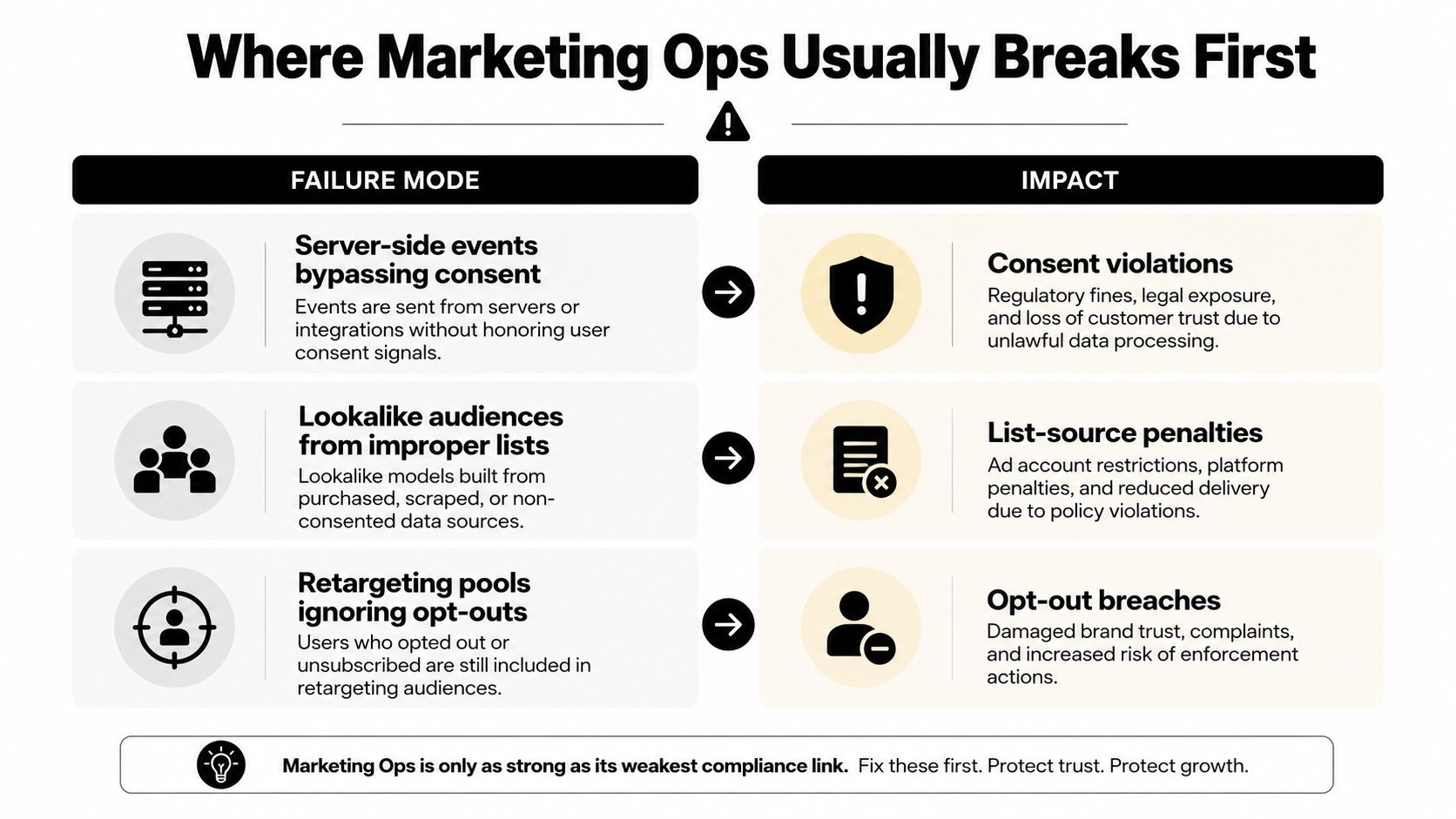
The places where campaigns fall over are almost always the same, and they're almost never the places people brag about in pitch decks. Server-side events bypass consent state, lookalike audiences get built from questionable lists, and retargeting pools keep ignoring opt-outs because nobody wired the signal all the way through. That's the stuff that turns privacy into a paid-media tax.
The risk isn't abstract. By early 2025, more than 140 countries had enacted data protection or privacy laws covering about 6.3 billion people, or 79% of the global population, and cumulative GDPR fines were reported at EUR 4 billion since 2018 and EUR 7.1 billion by January 2026 in the cited source, which shows how aggressively enforcement is maturing. See the privacy statistics summary for those figures in the data privacy statistics report.
Start with consent and event routing. If your pixel, CAPI, or server-side setup can fire before consent is known, you've built a compliance trap and called it sophistication. Then look at audience sourcing, because a list is only as clean as the data that entered it.
Next, check your attribution logic. If your reporting stitches together data the user never agreed to share, the dashboard may look smart while the legal position gets stupid. AI tools add another layer, since a lot of them pull customer data into training flows without anyone on the marketing side understanding what got reused.
The fastest way to reduce risk is usually boring. Clean the pipeline before you write another policy.
The right order is simple. Fix consent state propagation first. Then fix audience source quality. Then fix deletion and opt-out handling. After that, worry about optimization sophistication, because cleverness built on dirty inputs just scales the mess faster.
A sane privacy rollout doesn't start with a 90-page policy doc. It starts with inventory, ownership, and a short list of things that can't stay vague anymore. You can do a lot in 30 days if someone is assigned to each decision.
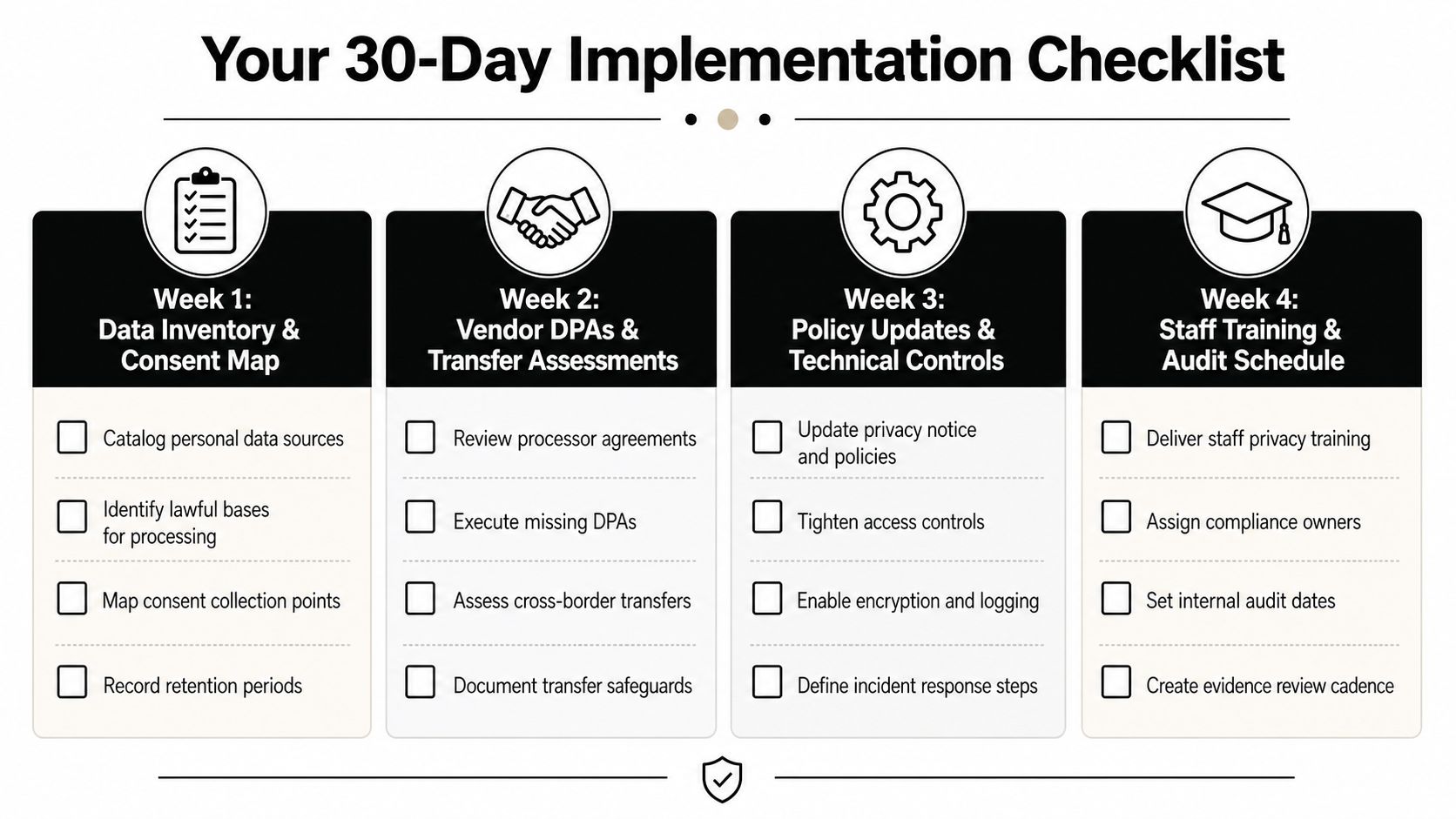
Week 1, Data inventory and consent map. Assign marketing ops to list every source, destination, and tag path that touches personal data. The good-enough test is blunt, can you explain, in one sitting, where data enters, where consent is captured, and where it leaves?
Week 2, Vendor DPAs and transfer assessments. Assign legal or ops to review every processor relationship and every cross-border path. The good-enough test is whether each high-risk vendor has a usable contract, a clear sub-processor view, and a transfer story that doesn't require interpretive dance.
Week 3, Pixel, CMP, and server-side cleanup. Assign the technical owner to fix event firing, consent propagation, and deletion handling. The good-enough test is whether the system behaves the same way in a consented state and a non-consented state, without manual heroics.
Week 4, Training and incident drills. Assign the founder or marketing lead to run a short drill with the buyer, ops, and whoever owns customer requests. The good-enough test is whether the team knows who handles a complaint, who pauses a campaign, and who documents the response.
Here's the simple version of the do's and don'ts.
The point isn't perfection. It's making the system legible enough that a complaint, audit, or deletion request doesn't force everyone into panic mode.
A media buyer is not just a button pusher anymore. In practice, they're a data processor with creative taste, and that means you're hiring someone who can influence both performance and compliance. That's a much bigger job than “Can you run Meta?”
The best interview questions are practical, not theatrical. Ask how they handle consent state in campaign workflows, what they do when a source list looks shaky, and how they document deletion or opt-out handling. Then ask what they'd refuse to do, because a buyer who's never said no is usually the one who creates your next 2 a.m. headache.
Look for maturity in four places. Can they explain tracking without hand-waving, can they work with a processor-style contract, can they respect data boundaries, and can they keep a campaign clean when the stack gets messy? If they sound brilliant on ROAS but vague on data handling, that's not a star, that's a future incident report.
Under GDPR-style privacy regimes, compliance is increasingly an engineering problem, because controllers are expected to implement appropriate technical and organisational measures, including pseudonymisation, and to bake data minimization into the design instead of bolting it on after launch. The UNDP's drafting guidance makes that shift clear in its discussion of technical and organizational measures. That's exactly why the buyer you hire matters so much. They're not just operating ads, they're operating inside your control system.
Onboarding should reflect that reality. Give them a written data map, a defined approval process, and the rule that no new tool gets connected without someone reviewing its data role. That sounds boring because it is boring, and boring is what keeps campaigns alive.
Founder rule: a great buyer can't fix a broken consent state, but a bad buyer will absolutely break a working one.
That's why hiring platforms with vetting, IP ownership, and contract flexibility are useful in this world, not because they're trendy, but because they reduce the amount of guessing you do before someone touches your stack. If you're going to outsource the wheel, at least make sure the person holding it understands the brakes.
If you want help building a remote paid media team without turning compliance into an afterthought, visit HireMediaBuyers.com. They focus on pre-vetted media buyers and paid ads specialists, which matters when your campaigns touch consent, transfers, and vendor risk. It's a cleaner way to hire people who can scale performance without making privacy your midnight hobby.


