

Your ad reports are probably lying to you. Not because the platforms are evil geniuses, although some days that feels plausible. They're lying because each platform grades its own homework, and your customer didn't wake up, see one ad, and instantly buy.
They bounced around. Search, social, email, maybe display, maybe a branded search later when they finally got serious. Then your dashboard gives the trophy to whoever touched the ball last and calls it “insight.”
That's how teams burn budget with confidence.
You know this scene.
Meta says it drove the sale. Google Ads says it closed the sale. Your store platform shows total revenue that doesn't cleanly match either one. Then someone in the meeting says, “So what's working?” and the room goes weirdly quiet.
The ugly answer is that single-channel reporting can't tell you how channels work together. It only tells you what happened inside that channel's tiny little kingdom. That's useful for platform optimization. It's terrible for budget decisions.
Think about a customer who sees a display ad, ignores it, gets your email later, clicks a paid search ad a few days after that, then buys. Which channel did the work?
If you use last-click logic, paid search gets all the credit. Nice. Clean. Completely incomplete.
Kissmetrics gives a simple example that nails the problem: an email might convert at 5%, but jump to 15% when a display ad came first. That's the whole game. Channels often look weak alone and strong in sequence, which is exactly why ad performance metrics without attribution context can send you in the wrong direction. The display ad didn't “fail.” It softened the ground.
Practical rule: If one channel keeps “closing” deals, check which channels keep introducing the buyer before you crown the closer king.
It's who created movement.
That's the element often neglected. Instead of mapping the customer journey, the focus frequently shifts to settling a bar fight between platforms. The point of multi channel attribution isn't to satisfy your reporting OCD. It's to stop cutting the channel that starts demand just because another channel happened to collect the receipt.
Here's my blunt take:
If you've ever paused a top-of-funnel campaign, watched branded search weaken later, and then acted surprised, congratulations. You've already paid tuition.
Multi channel attribution is how you figure out what helped produce a sale when the buyer touched more than one channel on the way in.
That sounds obvious. It isn't how a lot of reporting works.

Last-click reporting hands the goal to the player who tapped it in. Clean stat. Bad explanation.
The run that pulled defenders out of position mattered. The pass into the box mattered. Winning the ball back twenty seconds earlier mattered. If you only credit the final touch, you miss the play that created the chance in the first place.
That is the whole point of multi channel attribution. It tracks contribution across the journey instead of pretending the final click did all the work.
For founders and lean marketing teams, that changes the conversation fast. You stop staring at the checkout receipt and start looking at the chain of events that got someone there. Paid social may start the interest. Search may capture it later. Email may be the nudge that gets the deal over the line. If you only see the last touch, you will keep overpaying the closer and starving the channels that create demand upstream.
Use multi channel attribution as decision support, not as a quest for perfect fairness. You are trying to answer practical questions:
That last point matters more than people admit. Real customer journeys are messy. Someone sees a video on Monday, ignores your brand for a week, clicks a retargeting ad, opens an email, then comes back through branded search. A single-touch report turns that into a fairy tale with one hero. Multi channel attribution gives you a version closer to real life.
It is still not magic.
Attribution is a model, not surveillance footage. You are estimating influence with imperfect tracking, missing data, and platforms that love taking credit for themselves. That is why the useful question is not "which model is true?" The useful question is "what does this model help me do with budget?" If you want the mechanics behind those tradeoffs, read this guide to attribution modeling approaches and how they shift credit.
My advice is simple. Treat multi channel attribution like a map drawn in bad weather. It will not show every pothole, but it will stop you from driving straight into a ditch by cutting the channels that start the journey.
You pull a report after a rough month, and every platform claims it drove the sale. Search wants a raise. Meta wants more budget. Email looks like a hero. They cannot all be right.
That is why attribution models matter. Not because one of them reveals the truth, but because each one tells a different version of the same story. Your job is to compare those versions and decide where to place the next dollar.
Here's the table I wish founders saw before they let a dashboard bully them into bad budget calls.
| Model | How It Works | Best For | Founder's Hot Take |
|---|---|---|---|
| Last-Click | Gives all credit to the final touchpoint | Very short, simple journeys | Fine for platform summaries. Bad for real budget decisions. It rewards whoever shows up at the cash register. |
| First-Click | Gives all credit to the first touch | Awareness analysis | Useful for finding door-openers. Blind to what turns attention into revenue. |
| Linear | Splits credit evenly across touches | Teams graduating from single-touch | A participation trophy model. Not elegant, but a decent step up from last-click. |
| Time-Decay | Gives more credit to touches closer to conversion | Journeys where recency matters | Solid if your funnel intensifies near purchase. It still shortchanges channels that start the relationship. |
| Data-Driven | Uses machine learning on conversion-path data to estimate contribution | Teams with enough volume and cleaner paths | Strong when your inputs are clean and your volume is healthy. A fancy label for noise when they are not. |
If you want the mechanics behind these tradeoffs, read this guide to attribution modeling approaches and how they shift credit.
Last-click is fast food. Cheap, convenient, and terrible as a steady diet. Keep it for quick reporting. Do not hand it the keys to your budget.
First-click answers one sharp question: what starts the journey? That matters if you are trying to protect top-of-funnel spend from getting chopped by bottom-funnel reports.
Linear is boring, and boring is sometimes useful. It helps a team stop worshipping the final click without forcing everyone to trust a black box they do not understand.
Time-decay works when late touches do more of the heavy lifting. That happens in funnels with demos, trials, retargeting, and repeat visits close to purchase. It also has a bad habit of flattering the channels closest to the sale, which is why it should be checked against first-click or linear instead of used alone.
Data-driven attribution sounds smart because it is hard to argue with machine learning in a slide deck. In practice, it is only as good as the path data feeding it.
If your conversion volume is thin, your tracking is patchy, or half your journey lives inside tools that do not talk to each other, data-driven models will not save you. They will just hide the mess behind nicer charts.
Use data-driven attribution when you have enough clean conversion paths to spot patterns with confidence. If you do not, stick with rule-based models and compare them side by side. That comparison is usually more useful than pretending your model is smarter than your setup.
My rule of thumb: weak data plus a sophisticated model still gives you weak decisions.
Start with two views, not one. Pair first-click with time-decay, or linear with last-click. The gap between models is where the insight lives.
If a channel looks weak in last-click but keeps showing up in first-click, it is probably doing discovery work. If retargeting dominates time-decay but barely appears earlier in the path, it is probably harvesting demand more than creating it. That is the kind of difference that changes budgets.
Pick the model your team can explain in plain English. Then use it to make one better decision at a time. Fancy attribution is useless if nobody trusts it enough to change spend.
Attribution is not a report. It's plumbing.
If the pipes are cracked, the dashboard is lipstick on a leaky sink. You can call it advanced analytics if you want. It's still broken.
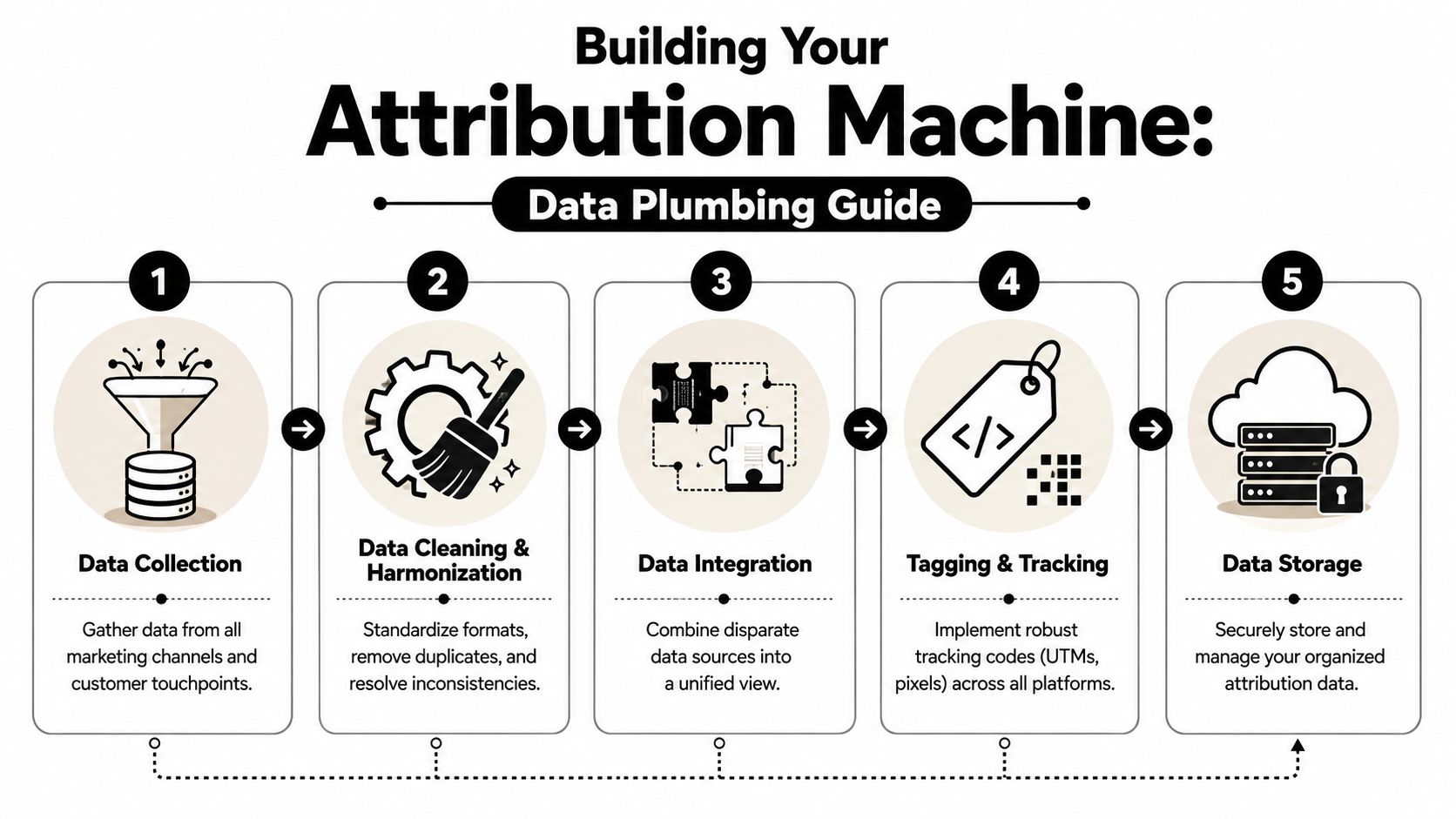
A robust multi channel attribution stack requires pixels, UTMs, site events, and Conversion APIs, then consolidation of ad-platform, CRM, and analytics data into a single warehouse or CDP before you can model anything. MNTN and Twilio are cited together on this point in MNTN's overview of multi-channel attribution setup.
That sounds technical because it is. But the logic is simple. You can't assign credit across a journey when every clue lives in a different tool and none of them agree on names.
Clean UTM discipline
Stop naming campaigns like “spring_test_final_v2_reallyfinal.” UTMs are your labeling system. If they're inconsistent, your reports turn into modern art.
Pixel coverage across key touchpoints
You need event collection where user actions happen. Product views, signups, purchases, lead submits. Basic, but constantly botched.
Conversion API and server-side support
Browser-only tracking misses things. Privacy changes and blockers make that worse. Server-side signals won't solve everything, but they make your data less flimsy.
CRM connection
If you're in B2B, SaaS, or any sales-assisted model, ad clicks alone won't tell you much. You need marketing touches tied to actual pipeline and revenue outcomes.
A single home for the data
Warehouse or CDP. Pick your flavor. The point is one place where ad data, site behavior, and CRM outcomes can be stitched together.
A sane setup usually follows this sequence:
If your attribution “model” lives in a spreadsheet exported from three dashboards and a prayer, it's not a model. It's a hostage situation.
Don't try to become a data engineer overnight. Just know enough to spot nonsense.
Ask these questions:
If the answer is no to any of those, don't waste time debating linear versus time-decay. You're choosing paint colors before the walls exist.
Here's the uncomfortable truth. There is no perfect attribution model.
There are useful models, misleading models, and models that become useful only when compared against each other. That's the game. Not perfection. Contrast.

A lot of teams want attribution to behave like accounting. One clean answer. One number everyone salutes.
Marketing doesn't work like that. Buyer journeys are messy, device behavior is fragmented, privacy restrictions create blind spots, and your CRM probably doesn't line up neatly with your ad platforms. Piwik points out that the value often isn't in finding one “perfect” model, but in comparing the gaps between models, because those deltas reveal which channels single-touch reporting undervalues or overvalues. That argument is laid out well in their piece on conversion attribution model comparison.
That's the useful frame. The gap is the insight.
Run your business through different lenses.
If last-click says branded search is carrying the team, but a broader model shows paid social or display showing up earlier in profitable journeys, don't argue about which report is “right.” Ask what the difference reveals.
Use comparisons like these:
In 2023, Google began sunsetting legacy rule-based models like first-click and linear for new conversion actions, making data-driven attribution the default in GA4 and Google Ads, as covered in Piwik's write-up on GA4 and the shift to data-driven attribution.
That change matters for one reason. Teams can't pretend this is a niche analytics debate anymore. The biggest ad ecosystem on the planet moved toward machine learning-based attribution by default.
Does that mean you should blindly trust it? No.
It means you should understand what lens you're being handed, what it helps with, and where it can still miss.
Use one model to report. Use multiple models to think.
If your data is still messy, start with a rule-based model you can explain in one sentence. Then compare it to GA4's data-driven view. Don't chase a final answer. Look for repeatable differences.
If a channel keeps gaining credit when you move beyond last-click, that's not noise. That's a clue. Follow it before you slash budget and congratulate yourself for being “efficient.”
Attribution usually breaks long before the model does.
It breaks in the plumbing. A paid social campaign gets tagged three different ways. The CRM logs one sale twice. Branded search picks up credit for demand created by email, YouTube, and sales follow-up. Then someone stares at a clean dashboard and makes a dirty budget decision.
That is the minefield. Not theory. Operations.
Dirty inputs
Bad UTMs, duplicate conversions, broken event tracking, mismatched channel names, half-connected CRM data. If the inputs are sloppy, the model just spreads bad credit with more confidence.
Path trivia instead of budget questions
It's easy to get hypnotized by every click, view, and revisit in the path. Stop doing surgery with a butter knife. The question is simpler: which channels create demand, which ones assist, and which ones harvest demand that already exists?
Missing influence you cannot neatly track
Word of mouth, dark social, sales calls, podcast mentions, forwarded emails, offline conversations. These push people toward a purchase all the time. If you only count what leaves a UTM trail, you will overfund the measurable and underfund the effective.
Platform self-reporting
Meta says Meta drove the sale. Google says Google did. Email wants credit too. Of course they do. Each platform grades its own homework. Treat platform attribution as directional, not as your accounting system.
The worst mistake is declaring one report the truth and building budgets around it.
Last-click will flatter closers. Equal-weight models can make weak channels look productive just because they showed up. Data-driven outputs can look smart while sitting on top of broken tracking. None of that is rare. It happens every day.
Use attribution like a flashlight, not a religion.
If your reports disagree, good. That disagreement is the clue. It tells you where to inspect the funnel, the tracking, or the budget assumptions. A paid ads specialist who can clean up tracking and pressure-test attribution is often worth more than another month of debating dashboards internally.
Attribution should reduce bad budget calls. If it mainly creates prettier arguments, your setup is failing.
Audit the inputs first. Before you debate models, fix naming conventions, conversion rules, CRM syncing, and channel mapping.
Then set a review cadence. Monthly is fine for many teams. The point is to catch drift before it gets expensive. Buyer behavior changes. Offers change. Sales cycles change. Tracking breaks subtly.
Keep your standard brutally practical. If the model helps you cut waste, protect assist channels, and explain results in plain English, keep it. If it turns into a philosophy seminar, throw it out and simplify.
There's a point where DIY stops being scrappy and starts being expensive.
If you're juggling Meta, Google Ads, email, CRM data, UTMs, offline sales signals, and GA4 weirdness, you're not “figuring it out.” You're splitting your attention across strategy, tracking, and analysis while the campaigns still need to run.
A good paid media operator doesn't just launch campaigns. They build the measurement layer that keeps you from making dumb budget calls. That includes channel tagging discipline, cleaner conversion tracking, model comparison, and the unglamorous detective work required to explain why reports disagree.
You should probably hire help if any of this sounds familiar:
That's when a paid ads specialist earns their keep.
You don't need a philosopher. You need someone who can walk into the mess, clean the tracking, pressure-test the model, and tell you which channels deserve more budget, less budget, or a harder look.
Trying to patch multi channel attribution together part-time usually ends the same way. Months pass. Confidence rises. Accuracy doesn't.
If you want help finding someone who already knows how to untangle attribution, tracking, and paid media strategy, HireMediaBuyers.com is the fastest place to start. They connect companies with pre-vetted media buyers and paid ads specialists who can build the measurement setup, compare attribution models intelligently, and turn conflicting reports into decisions you can trust.


