


Most advice on audience segmentation is backward. It starts with categories. Age, gender, income, interests. Nice slide. Clean diagram. Zero guarantee that any of it helps you buy better traffic.
That's the problem.
I've watched teams spend weeks building “customer personas,” then dump money into campaigns so broad they might as well target “people with oxygen.” The decks look polished. The media efficiency looks like a kitchen fire. If your segment can't be targeted on a real platform, matched to real data, and judged against real revenue, it's not a segment. It's decoration.
Smart marketers still fall into this trap because segmentation sounds strategic. It feels like progress. But ads don't care how clever your taxonomy is. Meta, Google, TikTok, LinkedIn, and your CRM only care whether you can translate insight into an audience, a message, and a measurable result.
Most audience segmentation content reads like it was written by someone who has never had to explain a blown budget to a founder.
You know the version. “Divide your market into meaningful groups.” Great. Thanks. Super helpful. Meanwhile, the campaign is targeting everyone, the creative is trying to say five things at once, and nobody can explain why click quality is terrible.
Broad targeting isn't advanced just because the algorithm is involved. If you hand platforms vague inputs, you get vague outcomes. That's not machine learning magic. That's lazy media buying with better branding.
This isn't a philosophical debate. Segmentation changes outcomes when you use it. Salesgenie's customer segmentation statistics roundup reports that segmented campaigns can drive 14.31% higher open rates and 101% more clicks than non-segmented campaigns, while personalized emails deliver 6x higher transaction rates.
That's the whole ballgame.
If one audience responds differently from another, but you force them into the same campaign, same offer, and same creative angle, you're choosing worse performance. On purpose. With a spreadsheet open.
Practical rule: If two groups need different hooks, they should not live in the same audience just because that makes reporting easier.
Here's where teams waste money:
Audience segmentation isn't a branding exercise. It's a control system for spend allocation. It tells you who deserves budget, who needs a different message, who should be excluded, and who's too expensive to keep chasing.
That's the standard. Anything softer is just expensive homework.
The classic segmentation types aren't wrong. They're just incomplete. In real paid media, the question isn't “What kind of segment is this?” The question is “Can I target it, can I tailor a message to it, and can I measure whether it outperformed the next option?”
That lens changes everything.
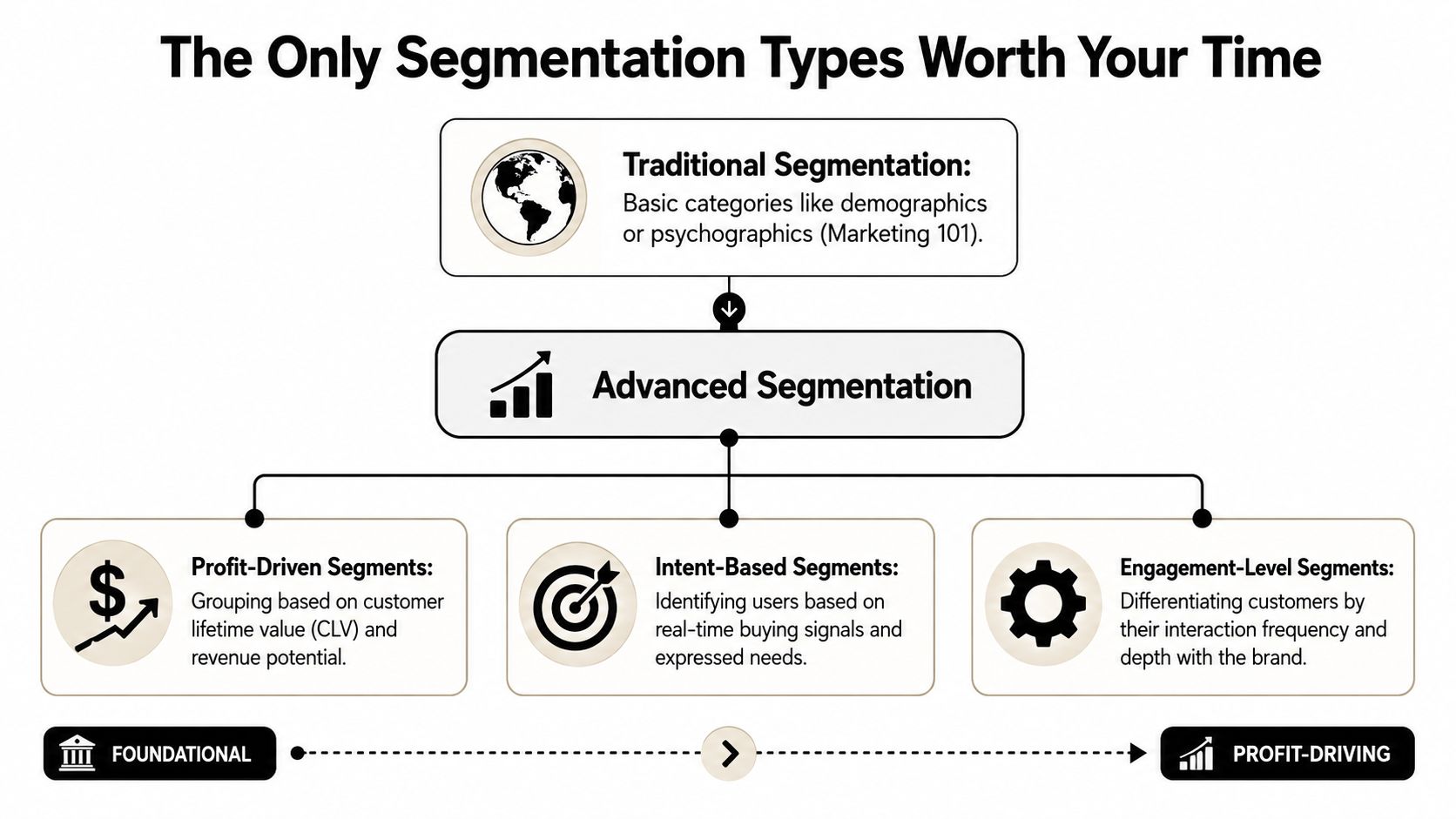
Modern audience segmentation typically organizes data into demographic, behavioral, psychographic, and geographic dimensions, with geographic targeting stretching from broad regional targeting down to zip-code precision, as outlined by GWI's overview of audience segmentation. Useful marketers layer these dimensions instead of worshipping one of them.
That said, not all dimensions pull equal weight in performance marketing.
| Segmentation Type | What It Is | Best For… | Biggest Trap |
|---|---|---|---|
| Behavioral | Actions people already took with your brand or site | Retargeting, upsells, funnel progression, suppression | Teams track too little, then pretend pageviews equal intent |
| Intent | Signals that suggest someone is close to taking action | Search, product-aware campaigns, bottom-funnel messaging | People confuse curiosity with buying readiness |
| Contextual | The environment or moment someone is in | Creative relevance, placements, situational offers | It gets treated like audience truth when it's only a temporary clue |
| Geographic | Where someone is, from region to local area | Local services, distribution limits, regional offers | Teams overread location and underread behavior |
| Demographic | Basic identity traits | Narrowing broad markets, compliance, creative framing | It's blunt, often overused, and rarely enough on its own |
| Psychographic | Attitudes, values, lifestyle clues | Messaging angles, brand voice, offer framing | It sounds smart but gets mushy fast if you can't target it cleanly |
Demographics still matter. Age range, household stage, job seniority, and income proxies can help narrow waste. But demographic targeting is a hatchet, not a scalpel. If that's your whole strategy, you're buying stereotypes.
Psychographics are useful when they shape creative. They tell you why someone buys. Fear, ambition, convenience, status, control. The catch is operational. A psychographic segment sounds brilliant in a workshop, then falls apart when no one can build it cleanly in Meta Ads Manager or Google Ads.
A psychographic segment that can't be translated into creative angles, audience logic, and exclusions is just branding theater.
Behavioral segments are where paid media starts getting serious. Visited pricing page. Started checkout. Bought once. Bought repeatedly. Watched product demo. Downloaded a guide. Opened emails but never purchased. That's the good stuff because actions beat assumptions.
Intent segments come next. Search terms, product comparisons, demo requests, in-market patterns, category-specific browsing. These don't always show up neatly across every platform, but when they do, you're closer to the moment money changes hands.
Then there's contextual segmentation. Underused. Often misunderstood. Device, placement, content environment, local event timing, even the difference between mobile scrollers and desktop researchers. Context isn't identity, but it changes how ads land.
My bias is simple. Build from behavior, sharpen with intent, use demographics and geography as filters, and bring psychographics in through creative. That stack usually makes money. The reverse order usually makes meetings.
Many teams don't have a segmentation problem. They have a data discipline problem.
They keep shopping for audience insight while ignoring the gold sitting in their own systems. Website behavior. CRM stages. Purchase history. Product usage. Email engagement. Support conversations. Sales notes. That's the stuff your competitors can't copy.
The strongest audience segmentation is built from first-party behavioral data combined with other variables, because that creates groups that are more internally consistent and more meaningfully different from each other. Count's explanation of audience segmentation analysis also points out that teams should validate those segments with A/B testing, not just admire them in a dashboard.
That's exactly right.
If someone visited your pricing page twice, opened onboarding emails, and talked to sales, you know more about that person than any rented audience list ever will. You have sequence, depth, and recency. Those three things beat generic third-party labels every day of the week.
Third-party data often enters the room because a team doesn't trust its own tracking. Harsh, but true.
If your CRM is messy, your pixel setup is half-baked, and nobody trusts event quality, buying more data feels like progress. It isn't. It's putting tinted windows on a car with no engine. Before you chase outside enrichment, fix your measurement basics with clean conversion tracking.
Here's the priority order I'd use:
You do not need more dashboards. You need cleaner joins between systems.
Your ad platform should know who bought, who churned, who upgraded, who requested a demo, who never activated, and who shouldn't see another acquisition ad because they already converted. Until those signals feed your audience logic, your segmentation will stay half-blind.
Good segments come from owned signals stitched together well. Everything else is rented confidence.
A segment that can't survive contact with Ads Manager is useless.
Many beautiful strategies falter when teams define “high-value repeat purchasers with premium affinity” and then discover they can't build that audience cleanly across platforms without decent event mapping, naming discipline, and some tolerance for platform nonsense.
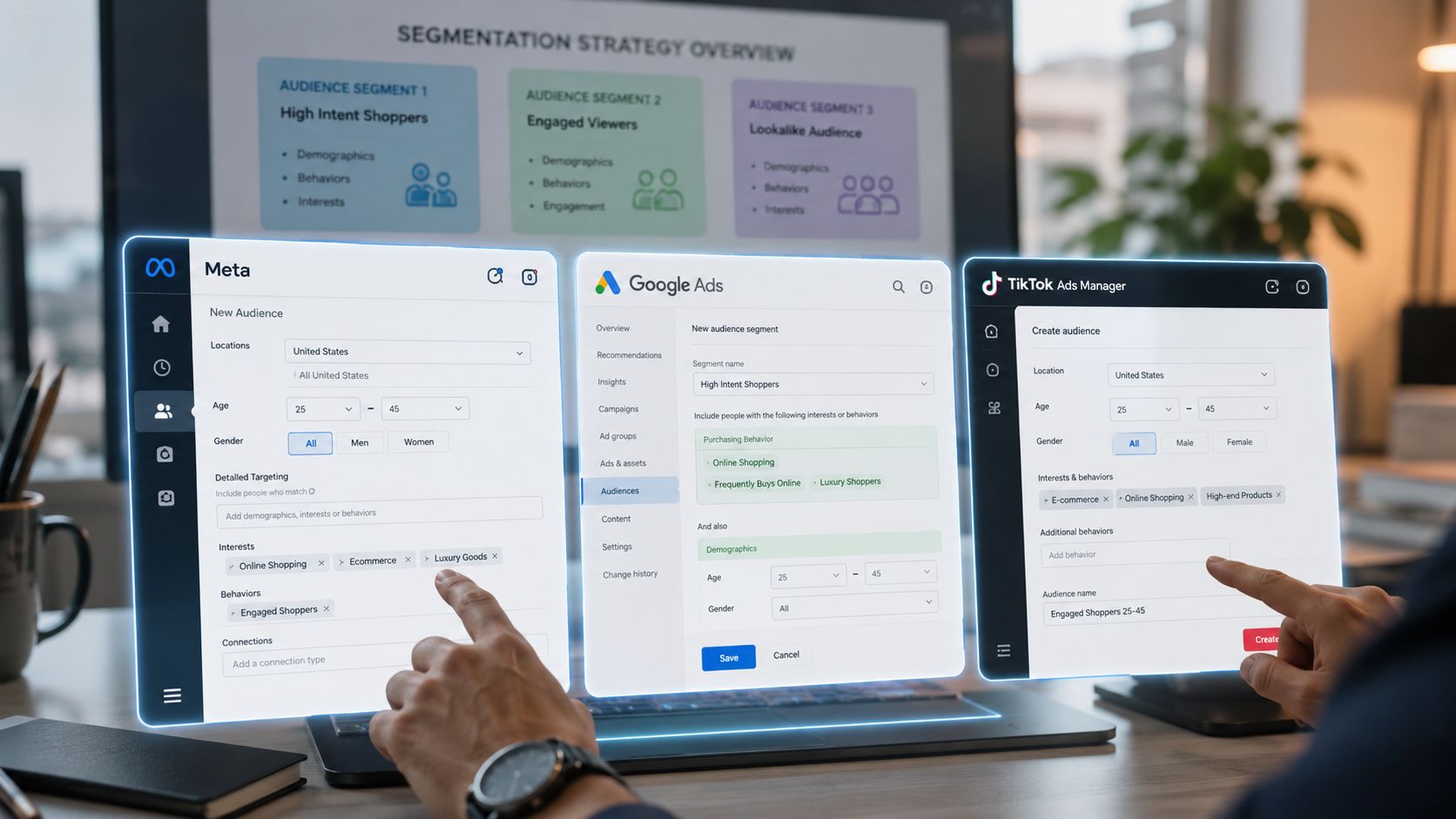
Meta is excellent at turning first-party signals into scalable audiences. Customer lists, site visitors, product viewers, add-to-cart users, recent purchasers, value-based seeds. You can do a lot if your event quality is solid.
The downside is that marketers often let Meta's automation blur segment boundaries. Prospecting starts leaking into retargeting. Warm audiences overlap. Existing customers get hit with acquisition creative because exclusions were an afterthought. Then people act surprised when reporting looks drunk.
Use Meta for behavior-rich audience construction. Just don't trust default setups to protect your budget.
Google's edge is obvious. People tell you what they want. Search campaigns, Customer Match, remarketing lists, and audience layering make Google the home field for bottom-funnel intent.
That strength comes with its own trap. Teams often over-index on keyword intent and ignore stage-of-funnel nuance. Someone searching a category term is not the same as someone comparing your brand to a competitor, and neither is the same as someone who abandoned a quote flow yesterday.
Treat Google like an intent engine, not a monolith. Segment searchers by query class, conversion path behavior, and customer status.
LinkedIn is valuable when firmographics are important. Job title, company, seniority, industry, account list matching. For B2B, that's powerful. For lazy B2B, it's a money shredder because people assume precision equals relevance.
TikTok is different. It rewards creative and engagement pattern recognition more than rigid audience theory. Interest clusters, engagement retargeting, creator adjacency, video viewers. It can work beautifully if you build segments around interaction depth and content response instead of trying to force old-school persona logic onto the platform.
Platform strength should shape your segment design. Don't force a LinkedIn-style segment onto TikTok or a TikTok-style segment onto Google.
When moving from strategy to execution, build a platform map:
And yes, some channels have quirks. If you're testing less conventional paid social audience logic, Reddit ads targeting options are a good reminder that community context can matter as much as identity data.
The operational point is simple. A segment isn't done when the strategy team names it. It's done when it exists inside the platform, maps to creative, has exclusions, and can be judged against spend.
You don't need a grand unified theory of audience segmentation. You need a few plays that match buyer behavior and are easy to deploy without turning your account into spaghetti.
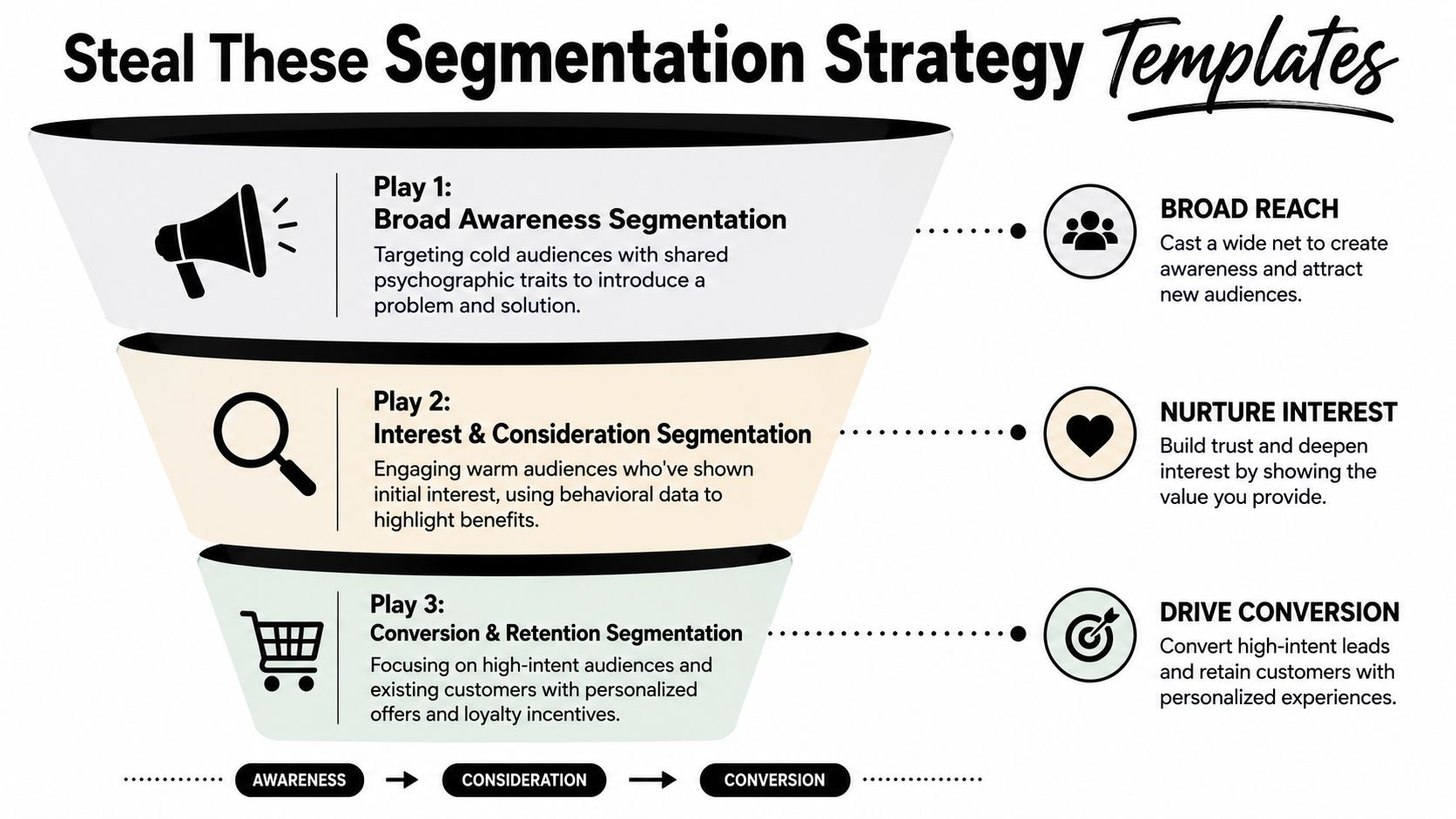
This one is simple because it should be.
Start with cold audiences built from broad category relevance and creative angles tied to the problem or desired outcome. Move to warm audiences based on product viewers, cart visitors, and repeat site engagement. Finish with hot audiences like recent buyers, high-value customers, or people eligible for cross-sell and replenishment messaging.
What usually breaks this model is overlap. Brands forget to suppress buyers from prospecting, or they lump all retargeting users into one pool and serve the same ad to a casual browser and a near-buyer. That's sloppy.
Use different offers and different urgency by rung. The person discovering the product does not need the same message as the person who already put it in the cart.
B2B buyers tell you a lot through content depth.
Segment light engagement users like blog readers and social engagers separately from mid-intent users like webinar registrants, guide downloaders, and repeat site visitors. Keep sales-ready users in their own lane: demo requesters, pricing page visitors, account-list matches, and high-fit leads that already touched sales.
This works because content consumption creates a practical proxy for readiness. Not perfect. Useful.
If your B2B retargeting strategy treats a casual article reader the same way it treats a demo requester, your nurture logic needs adult supervision.
SaaS teams love to segment by signup source. Fine. But in-app behavior usually tells the better story.
Split trial users into groups like activated, partially activated, stalled, and highly engaged but not upgraded. Then pair each with the friction it faces. Activation prompts for stalled users. Workflow education for partially activated users. Upgrade pressure for heavy users who already hit value.
A simple checklist helps:
Templates work because they force operational clarity. You know who belongs where, what they should see, and what they must be excluded from. That alone puts you ahead of most accounts.
Many marketers measure segments the same way toddlers play soccer. Everyone chases the ball.
They watch CTR, CPC, maybe CPA if they're feeling responsible, and call it a day. But audience segmentation should answer a harder question. Did this group produce better business outcomes than the alternative, and did it justify dedicated budget?
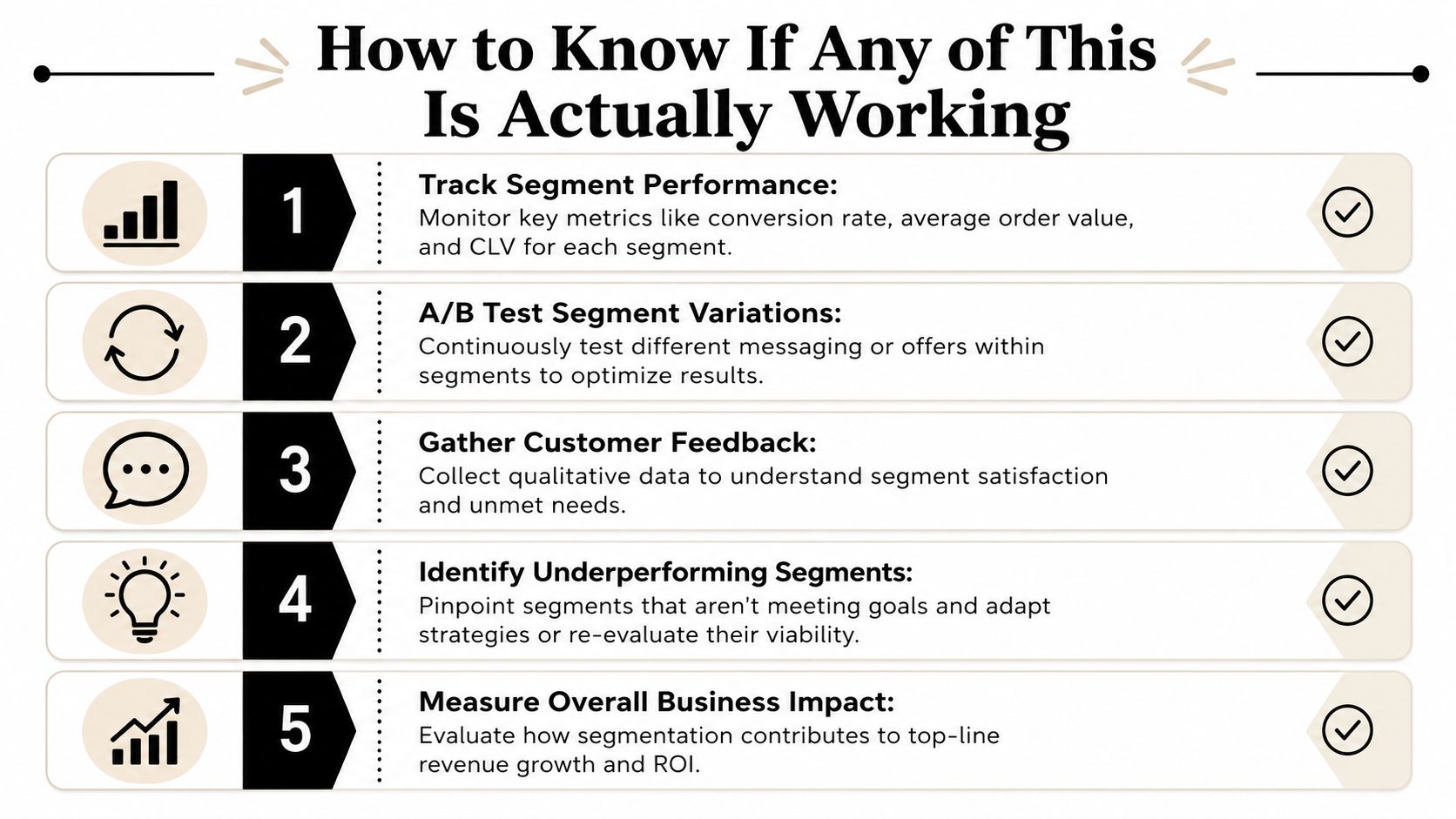
A strong ad can hide a weak segment for a while. Don't let it.
Run tests where the message stays reasonably consistent and the audience changes. Or keep the segment constant and test a distinct offer inside it. Either way, isolate the variable. If your “repeat buyer” segment responds well to bundles and your “first-time browser” segment needs proof and education, that's useful. If two segments perform the same, merge them and simplify your life.
The right KPI depends on the business model, but segment measurement should usually lean toward downstream outcomes, not surface-level engagement.
Look at things like:
Modern segmentation is increasingly algorithmic. Aerospike's discussion of real-time audience segmentation notes that clustering methods such as K-Means can uncover natural groupings in customer data without predefined rules, which is useful for predictive work like lifetime value and churn propensity.
That matters because your best segment may not be the one you named manually. Sometimes the actual split is frequency plus product mix. Or content depth plus time-to-return. Or location plus repeat visit behavior. Clustering can surface those combinations faster than a room full of marketers with sticky notes.
Measurement should do two jobs. Prove which segments deserve budget, and expose which segment logic was wrong in the first place.
If you're not willing to kill segments that underperform, you're not doing audience segmentation. You're collecting pets.
The expensive mistakes aren't subtle. They're repetitive.
Teams over-segment until every audience is too small to matter. They build elegant frameworks nobody can activate. They mix customer stages inside one ad set, then wonder why creative performance looks unstable. Or they create segments that sound analytically impressive but can't be reached cleanly in any channel.
That last one is the killer. Audience Answers' guidance on segmentation makes the standard clear: a useful segment must be distinguishable, sizeable, and locatable through accessible channels. If it isn't, it has no business value.
You can absolutely learn this yourself. You can also cut your own hair with kitchen scissors. Both are technically possible.
But profitable audience segmentation lives at the intersection of tracking, platform mechanics, offer strategy, creative sequencing, exclusion logic, and measurement. That's a job. Not a side quest.
If your campaigns matter, put someone on it who already knows how to build audiences that translate from CRM to platform to reporting. For brands running Meta-heavy acquisition, hiring a real Facebook Ads specialist is often cheaper than another quarter of “we're still testing.”
The point isn't to outsource thinking. It's to stop paying tuition with live ad spend.
If you'd rather skip the trial-and-error phase, HireMediaBuyers.com helps companies find pre-vetted media buyers and paid ads specialists fast. It's a practical option for brands and agencies that need someone who can turn segmentation theory into profitable execution on real ad platforms, without spending months sorting through resumes and hoping for the best.


