


You're probably in one of two camps right now.
Either your ad dashboard says things are “working,” while your sales team, finance sheet, or Shopify orders say otherwise. Or you're trying to hire someone to run paid media, and every candidate claims they “know tracking” because they installed a pixel once in 2022 and watched three YouTube videos.
Neither situation is fun.
Conversion tracking is where easy talk goes to die. It's also the point where good media buyers separate themselves from button-clickers. Anyone can launch campaigns. Plenty of people can make a dashboard look busy. Very few can tell you, cleanly and confidently, what happened after the click, what got counted, what got missed, and why the platforms disagree.
That's the whole game. If you can't measure outcomes with some level of trust, you're not optimizing. You're gambling with better branding.
A founder checks the ad account on Monday morning. Reported conversions look healthy. Cost per lead looks manageable. The agency says the account is improving.
Then payroll hits, sales closes the week, and the cash in the account tells a different story.
Many ad accounts fail first from bad measurement, not bad creative. Bad tracking makes average campaigns look great, good campaigns look weak, and weak operators sound competent. Once that happens, every budget decision rests on fiction.
This problem shows up in boring, expensive ways. A thank-you page loads twice. A form submit event fires when the page loads instead of when the form is submitted. Meta takes credit for a sale. Google takes credit for the same sale. GA4 shows another version again. The team wastes hours debating attribution when the underlying issue is setup quality.
The practical question is simpler. Which spend produced real customers, and can your tracking defend that answer?
Conversion tracking is no longer "install the pixel and move on." It is a workflow across site behavior, platform signals, consent choices, server-side handoffs, CRM status changes, and reporting logic. If your media buyer still explains tracking like it starts and ends with one browser tag, they are behind. If you want a clearer view of how credit gets split across channels, read this guide to multi-channel attribution models and what they actually change.
Practical rule: When reported conversions and revenue drift apart, assume the tracking is wrong first.
That mindset will save you money. It will also save you from hiring the wrong person. Anyone can repeat platform terminology. A competent media buyer can trace an event from click to sale, explain where it breaks, and tell you which numbers deserve trust.
"Mostly accurate" sounds acceptable until you use it to scale spend, kill campaigns, or judge a hire. Then the bill arrives.
A sloppy setup creates four predictable problems:
This is the part too many founders skip. Tracking knowledge is not only a technical skill. It is one of the fastest ways to tell whether a media buyer understands performance or just knows how to spend money inside an ad platform.
If you cannot trust measurement, you are not managing paid media. You are placing bets with nicer charts.
Forget the jargon soup for a minute. A solid conversion tracking setup for web campaigns usually has three separate layers. One identifies where the visitor came from. One records what they did on your site. One sends signals back to the ad platform.
That separation matters. Sprout Social's conversion tracking overview describes a robust stack as a combination of UTM parameters, analytics event definitions, and platform-specific pixels or tags such as Meta Pixel, TikTok Pixel, or LinkedIn Insight Tag.
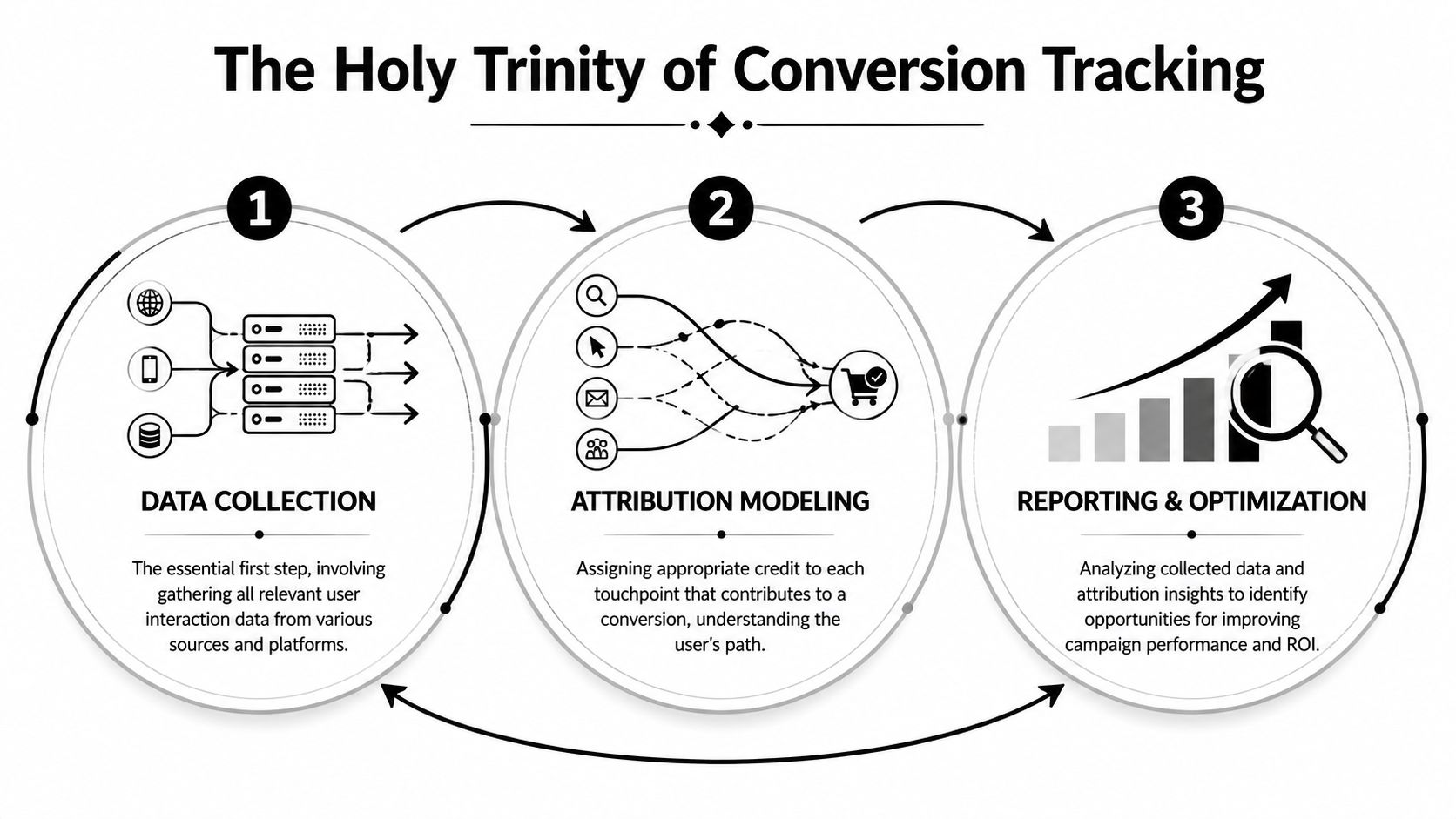
The easiest way to understand this is to treat every conversion like a package delivery.
| Layer | What it does | What goes wrong when it's missing |
|---|---|---|
| UTM parameters | Labels the traffic source, medium, and campaign | You can't reliably tell where the visit came from |
| Analytics events | Defines the on-site action such as lead, signup, or purchase | You collect visits but not meaningful business actions |
| Platform tags or pixels | Sends conversion signals to ad platforms for reporting and optimization | Platforms optimize on partial or missing feedback |
UTMs are the mailing label. They tell your analytics system, “this person came from this campaign on this source.”
Events are the delivery confirmation. They say, “this user completed the action we care about.”
Pixels and tags are the scan sent back to the carrier. They tell Meta, Google, TikTok, or LinkedIn that the ad led to something valuable.
Miss one layer and you get fiction dressed up as reporting.
If someone says, “we've got tracking covered,” they should be able to explain the stack in plain English. Not with buzzwords. With cause and effect.
A useful answer sounds more like this:
That's the baseline. Not advanced. Baseline.
If you want to go deeper on the reporting side, this multi-channel attribution guide is worth reviewing because it helps frame why these layers must work together instead of pretending one dashboard can magically settle every dispute.
A tracking stack is not one tool. It's a chain. Weakest link wins.
Every ad platform wants credit. That's not a scandal. That's the business model.
Google wants to show that Google Ads drove the conversion. Meta wants to show that Meta influenced the conversion. TikTok would also like a trophy, thank you very much. None of these platforms are neutral judges in your attribution drama.
Google's ecosystem is powerful, but people still make a mess of it by treating GA4 imports as the whole answer.
In GA4, the default counting method for new conversions is “Once per event,” and Google recommends that option, as noted in this GA4 conversion tracking breakdown. That tells you something important. Measurement has moved away from old session-based thinking into event-based logic.
Good. That's progress.
But it also means lazy setups break in new and exciting ways. If your event definitions are sloppy, your conversion logic is sloppy. If your team doesn't understand the difference between a user action, a session metric, and a platform conversion, they'll import confusion straight into Google Ads and call it insight.
Meta's native reporting can be directionally useful. It is not your truth machine. Same with TikTok.
The common failure is treating platform dashboards as if they are closed books from a trusted accountant. They're not. They're sales environments with measurement tools inside them.
Here's the practical view I use:
That doesn't mean your external analytics tool is perfect either. It means you need a source outside the platforms to compare claims.
When Google, Meta, and GA4 disagree, that doesn't mean one system is evil. It means your job is to understand what each one is counting and why.
A lot of teams say “GA4 is our source of truth” without thinking. That can work for some businesses. It can also be a terrible choice if your setup misses key platform signals, undercounts across devices, or fails to connect offline outcomes.
The smarter stance is simpler. Pick a primary decision system for business reporting, then make sure your platform-native setups are strong enough to optimize inside each ad channel. Don't ask one tool to do all jobs badly.
That's how grown-up conversion tracking works in 2026. Less blind faith. More explicit tradeoffs.
If your current measurement plan is “the pixel will probably catch it,” you've got a fragile system.
Browser restrictions, privacy controls, consent friction, and cross-device behavior have already made old-school client-side tracking less reliable. This is not a future problem. It's an operating condition.
Recent practitioner guidance argues for moving beyond client-side pixels toward first-party and server-side tracking, because platforms can miss conversions, undercount cross-device behavior, and struggle with attribution when teams rely on GA4 alone. The same guidance recommends using native Google Ads tags plus enhanced conversions rather than depending only on imported GA4 data, according to PPC Mastery's update on Google Ads conversion tracking best practices.
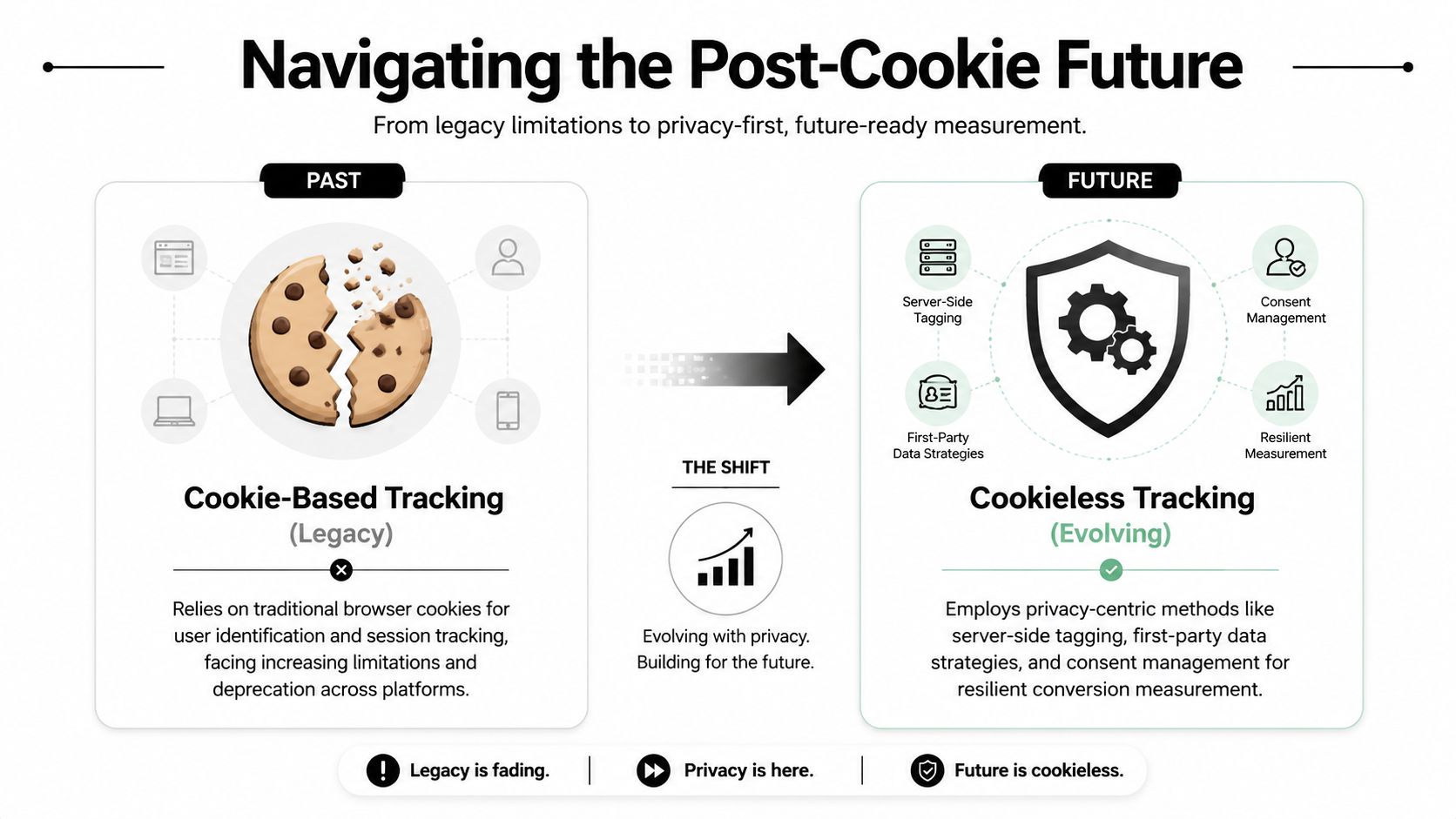
Client-side tracking depends heavily on the browser behaving nicely, the user allowing enough access, scripts loading correctly, and identifiers surviving long enough to connect the click to the action.
That's a lot of hope packed into a tiny snippet.
When that chain breaks, you get familiar symptoms:
You don't need to become an engineer, but you do need a better standard.
A modern approach usually includes:
If attribution is part of your operating headache, this attribution modeling resource helps frame why server-side and first-party strategies matter. They don't “solve attribution” in some magical way. They make your measurement less brittle.
Client-side pixels still matter. They just shouldn't be carrying the whole piano up the stairs by themselves.
The teams that still treat server-side tracking as a fancy extra are usually the same teams wondering why reported performance gets fuzzier every quarter.
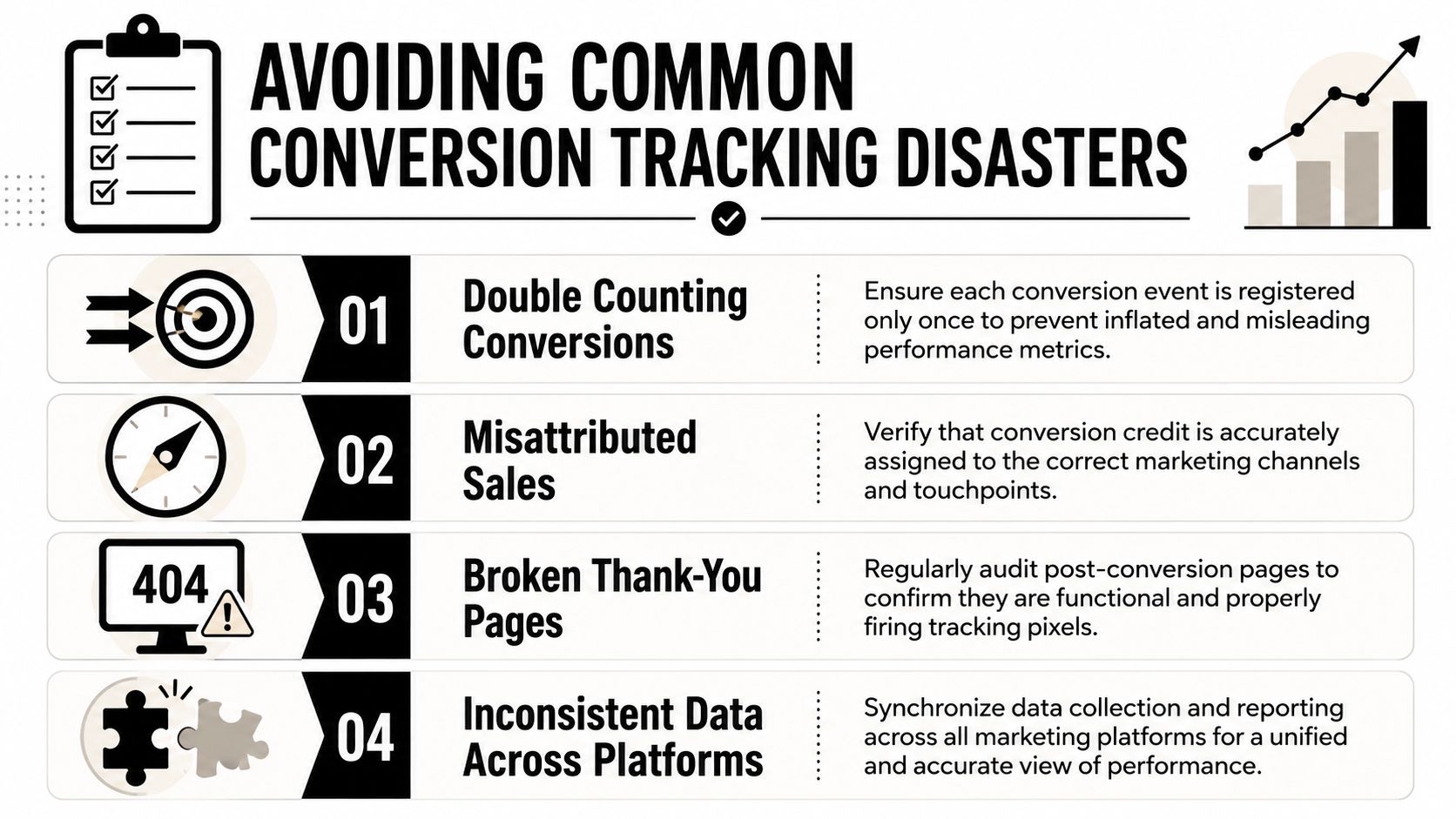
Tracking failures rarely arrive with fireworks. They sneak in, then wreck your reporting for weeks.
One of the nastier parts is that broken conversion tracking can still look believable. The dashboard populates. Events show up. Something appears in the conversion column. Everyone relaxes. Bad idea.
Troubleshooting guidance for complex funnels often points to cross-domain setup, conversion linker configuration, and offline conversion tracking for lead-to-close steps as common places where attribution gets lost or outcomes get miscounted, according to Analytics Mania's Google Ads troubleshooting guide.
| Symptom | Likely cause | Best fix |
|---|---|---|
| Conversion numbers look suspiciously high | Duplicate firing or overlapping event logic | Audit triggers, deduplicate browser and server events, test end to end |
| Platform totals don't match business outcomes | Different attribution rules or bad event mapping | Align event definitions and compare against actual business records |
| Funnel drop-offs make no sense between steps | Cross-domain tracking is broken | Review domain handoff, linker behavior, and event continuity |
| Lead quality looks weak despite low CPL | You're optimizing to cheap form fills, not downstream outcomes | Import offline outcomes and optimize to qualified stages |
When numbers go weird, don't start by changing bids or blaming creative. Run this check first:
Most “performance problems” are measurement problems wearing a fake mustache.
You hire a media buyer, give them budget, and three months later the account looks busy. Clicks are up. Leads are coming in. Nobody can tell you which leads turned into revenue, why Meta shows one story, GA4 shows another, or whether the conversion events are even firing correctly. That hire did not solve your growth problem. They made it harder to see.
That is why tracking knowledge belongs in the interview process, not buried in onboarding. A competent media buyer in 2026 does more than build campaigns. They define the right conversions, pressure test the setup, and explain where the numbers can break. If they cannot do that, you are hiring a dashboard operator.

Skip soft questions. Ask for process, tradeoffs, and failure points.
“How do you decide what should count as a conversion?”
Strong candidates start with revenue, qualified pipeline, or another real business outcome. They work backward from the sales process and define primary and secondary actions on purpose. Weak candidates accept the platform defaults and call every form fill a win.
“What do you do when ad platform numbers and GA4 numbers do not match?”
Strong candidates explain attribution differences, counting methods, identity gaps, and event mapping. They also tell you which system they would use for optimization and which one they would use to sanity check business performance. Weak candidates pick a favorite tool and defend it like a religion.
“How would you track leads that close offline?”
Strong candidates ask about the CRM, sales stages, lead IDs, and how closed revenue gets passed back into ad platforms. Weak candidates stop at the thank-you page and pretend the rest of the funnel is somebody else's problem.
“How would you audit a new account before trusting its conversion data?”
Strong candidates talk through test submissions, tag inspection, event deduplication, consent behavior, and source-to-CRM continuity. Weak candidates say they would look at the dashboard for a few days.
“How do you handle Shopify, external checkouts, booking tools, or multi-domain funnels?”
Strong candidates know where session identity breaks, how referral pollution happens, and how to verify that the conversion still ties back to the original click. Weak candidates assume the platform tag will sort it out.
“What would you set up first in a privacy-restricted environment?”
Strong candidates prioritize first-party data capture, platform-native signals, server-side routing where it makes sense, and clear consent-aware measurement. Weak candidates give you a vague speech about cookies disappearing.
You are listening for precision.
A serious operator can explain tracking in plain English, name the failure points before they happen, and tell you how they would verify the setup before spending money. They know the difference between attribution reporting and optimization inputs. They know ecommerce and lead generation should not share the same conversion logic. They mention QA without being prompted.
You are also listening for ownership. The right person does not say, “tracking is the developer's job.” They treat measurement as part of media buying because bad measurement produces bad bidding, bad reporting, and bad hiring decisions.
Cut candidates who do any of the following:
The best hiring shortcut is simple. Ask them to explain your tracking setup back to you after a short brief. If they cannot turn a messy funnel into a clear measurement plan, they will not fix your account once money is on the line.
If you are defining the role itself, this breakdown of a strong paid ads specialist will help you set the bar properly. Hire for judgment, technical fluency, and the ability to connect ad spend to business outcomes. Anything less is guesswork with a login.
You don't need to become the most technical person in the room.
You do need to stop rewarding vague answers and pretty dashboards.
Conversion tracking is not a side chore for your ops person, your developer, or the intern who “knows GTM.” It sits right under revenue. It tells you whether your paid media is producing real outcomes or just making charts that keep everyone calm enough to miss the problem for another month.
If I were cleaning this up from scratch in 2026, I'd keep the standard brutally simple:
Accurate measurement doesn't make marketing easy. It makes it honest.
That's enough.
Once the data is trustworthy, budgeting gets sharper. Channel decisions get less emotional. Creative testing becomes less chaotic. Hiring gets easier because you know what competence sounds like. And the next time someone says, “performance is strong,” you can ask one follow-up question and know whether they're talking about reality or just reading numbers off a dashboard with great posture.
Your ads do not need more optimism. They need better instrumentation.
If you need someone who can untangle conversion tracking, not just nod at it in a kickoff call, HireMediaBuyers.com helps companies find pre-vetted media buyers and paid ads specialists who understand the messy reality behind paid performance. That means people who can think through attribution, platform setup, measurement reliability, and the difference between reported conversions and real business results.


