


Most Google Ads bidding advice is backwards.
It starts with the dropdown menu. Manual CPC, Maximize Clicks, Target CPA, Target ROAS. Pick your poison, cross your fingers, and hope Google's robot accountant doesn't spend your budget like it found your corporate card under the sofa.
That's nonsense.
Your Google Ads bidding strategy isn't a settings choice. It's a capital allocation decision. Get it right and your budget compounds into leads, sales, and signal. Get it wrong and you end up paying premium CPCs for traffic that behaves like window shoppers at a sample sale.
Google loves to imply automation solves this. Sometimes it does. Sometimes it just automates your mistakes at scale. I've watched accounts get wrecked by “best practices” that looked great in a help doc and awful in a real P&L.
The fix is less glamorous than people want. You need the right goal, the right data volume, the right conversion setup, and the patience to stop fiddling with the machine every afternoon. Toot, toot. That's the whole game.
Choosing a bidding strategy because it sounds advanced is one of the fastest ways to waste a healthy budget.
Bidding decides what auctions you enter, what you pay to win them, and what kind of user Google goes hunting for. If that sounds like a minor settings choice, you have not been burned by Smart Bidding hard enough yet.
Use a simple sequence. KPI first, then ad format, then budget, then bidding strategy.
That order matters because the wrong KPI poisons everything downstream. If your real goal is revenue and you choose a traffic-first strategy to “get things moving,” you are training the account to find cheap clicks, not valuable buyers. Google will happily deliver what you asked for, then leave you to explain the gap in the pipeline.
The useful split is straightforward. Some strategies chase visibility. Some chase traffic. Some chase conversions. Some try to hit an efficiency target like CPA or ROAS. Your job is to match the strategy to the financial outcome the business cares about, not the metric that looks busiest in a weekly report.
Here is the part the glossy guides skip. A bidding strategy is only as good as the signal feeding it.
Google will suggest that certain Smart Bidding strategies can run on surprisingly little data. In practice, low-volume accounts usually turn automated bidding into a guessing machine with a nice interface. If you do not have enough clean conversion volume, choose a strategy that tolerates sparse data instead of pretending the algorithm will figure it out.
This is why conversion architecture matters more than the dropdown. You need a Primary vs. Secondary Conversion Architecture that reflects buying intent. Primary conversions should be the outcomes you are willing to let bidding optimize toward. Secondary conversions should collect signal without steering budget. Mix those up and Google will optimize for the easiest action to generate, not the one that makes you money.
That mistake is common, expensive, and completely avoidable.
Bad inputs produce bad bidding decisions. That includes sloppy tracking, mixed-intent campaigns, tiny budgets, and targets copied from a spreadsheet fantasy.
My rule is simple. If you cannot explain a campaign's bid strategy in one sentence tied to margin, pipeline, or revenue, the strategy is not ready. “The rep recommended it” is not a reason. Neither is “it uses AI.”
Treat bidding like an operating policy for spend. Set it based on the outcome, the data you have, and the conversion actions you trust enough to hand to Google.
Google presents bidding like a menu. It is closer to triage. Pick the wrong option for your data, budget, and sales cycle, and the account starts optimizing for activity instead of outcomes.
A bid strategy is a spending rule. Treat it that way.
Manual CPC still has a place. Use it when conversion volume is thin, tracking is still being cleaned up, or you are testing a narrow slice of traffic where you want hard bid control. It is slow to manage, but slow is better than blind if the account does not have enough trustworthy signal to support automation.
Enhanced CPC is the compromise option for teams that want manual bidding with training wheels. Google gets room to raise or lower bids based on its own confidence. That can work, but it often leaves you with the weaknesses of both systems. Less control than Manual CPC, less clarity than full Smart Bidding.
Maximize Clicks buys visits. That is all. It can make sense for brand new campaigns, awareness pushes, or filling the top of the funnel when you deliberately want cheap traffic and you know how that traffic will be filtered later. If your primary goal is qualified leads or sales, this is usually a detour. Set a max CPC cap or Google will spend into expensive clicks faster than you expect.
Maximize Conversions is usually the cleanest first step into automation. No target to choke delivery. No fake precision. Just use the budget to pursue the conversion actions you marked as Primary. That last sentence matters more than the dropdown. If your Primary conversions are junk, this strategy will scale junk efficiently.
Target CPA sounds disciplined, which is why people adopt it too early. It works after the account has enough stable conversion history and after you know the CPA target is grounded in economics, not wishful thinking. Set the target too low and Google stops entering auctions you probably should have competed in.
Maximize Conversion Value is the better choice for businesses that care about revenue quality, margin tiers, or downstream pipeline value. It only works if the values in the account reflect reality. If every lead is worth the same in Google but wildly different in your CRM, the strategy is optimizing a cartoon version of your business.
Target ROAS is powerful for ecommerce and mature value-based accounts. It is also one of the fastest ways to throttle volume if you copy a return target from a spreadsheet instead of starting from observed performance. Aggressive ROAS targets tell Google to hunt for perfect traffic. Perfect traffic is scarce and expensive.
Target Impression Share is for visibility goals, usually branded search or defensive campaigns where showing up matters more than efficiency. For lead gen or ecommerce, it is often a vanity metric with a professional-looking label. If profit is the KPI, use ad performance metrics tied to revenue and conversion quality, not page position trophies.
| Bidding Strategy | Primary Goal | Best For | When to Avoid |
|---|---|---|---|
| Manual CPC | Control over bids | Small tests, tight control, low-data situations | When you need scale or do not have time to manage bids closely |
| Enhanced CPC | Manual control with some automation | Accounts easing out of manual habits | When you want a clean manual approach or full Smart Bidding |
| Maximize Clicks | Traffic | Awareness, site visits, early traffic generation | When conversions or revenue are the KPI |
| Maximize Conversions | More conversions | Lead gen or sales campaigns with reliable Primary conversion tracking | When tracking is messy or volume is too thin to guide automation well |
| Target CPA | Cost-efficient conversions | Mature lead gen accounts with stable conversion data and realistic CPA targets | When the account lacks conversion history or the target comes from wishful thinking |
| Maximize Conversion Value | More conversion value | Ecommerce or value-based accounts with accurate values | When values are incomplete, flat, or disconnected from actual business value |
| Target ROAS | Efficiency on revenue | Mature ecommerce accounts optimizing for return | When revenue tracking is weak or targets are unrealistic |
| Target Impression Share | Visibility | Branded defense, visibility-focused campaigns | When you care about leads, sales, or profit |
For serious search campaigns, click-based bidding is a temporary tool, not a destination. The end state is usually conversion-based bidding, but only after the account earns it with enough clean data and a sane Primary versus Secondary conversion setup.
Google's official minimums are too forgiving to be useful in practice. If the account is starved for signal, use the strategy that matches that reality instead of pretending the machine will sort it out.
Smart Bidding feels mysterious because Google shows you the controls but not the full engine room. That's annoying, but the core idea is simple.
Google isn't setting one bid for your keyword. It's making a decision for each individual auction based on the signals it sees in that moment.

It is akin to a hyperactive trader who never sleeps and never stops repricing risk. Device, intent, context, conversion history, auction conditions. The system weighs those factors and decides whether this click deserves a stronger bid or a lighter one.
That's why manual bidding often feels like bringing a calculator to a high-frequency trading desk.
A human can set sensible max CPCs. A machine can make auction-time decisions at a level of granularity you cannot match. That's the core appeal of Smart Bidding. Not magic. Speed plus pattern recognition.
This is also why looking at the wrong metrics scrambles your judgment. If you obsess over CPC while ignoring conversion quality, you can talk yourself into “efficient” traffic that never turns into revenue. A better habit is to anchor your decisions to ad performance metrics that actually matter.
I trust Google's machine to process signals better than a person. I do not trust it to care about my business more than I do.
That distinction matters.
If you feed the system clean goals and enough data, it can do great work. If you feed it junk, it will optimize junk with breathtaking confidence. That's the part Google's marketing pages tend to whisper.
Smart Bidding is not a strategist. It's an optimizer. It can only optimize for the game you tell it to play.
So yes, let the robot drive. But only after you've checked whether it has the right map.
Choosing a bid strategy is not a creativity exercise. It is a filtering problem. Start with the business outcome, then check whether the account has enough clean data to support the strategy. If it does not, Google will still spend your money. It just will not spend it intelligently.
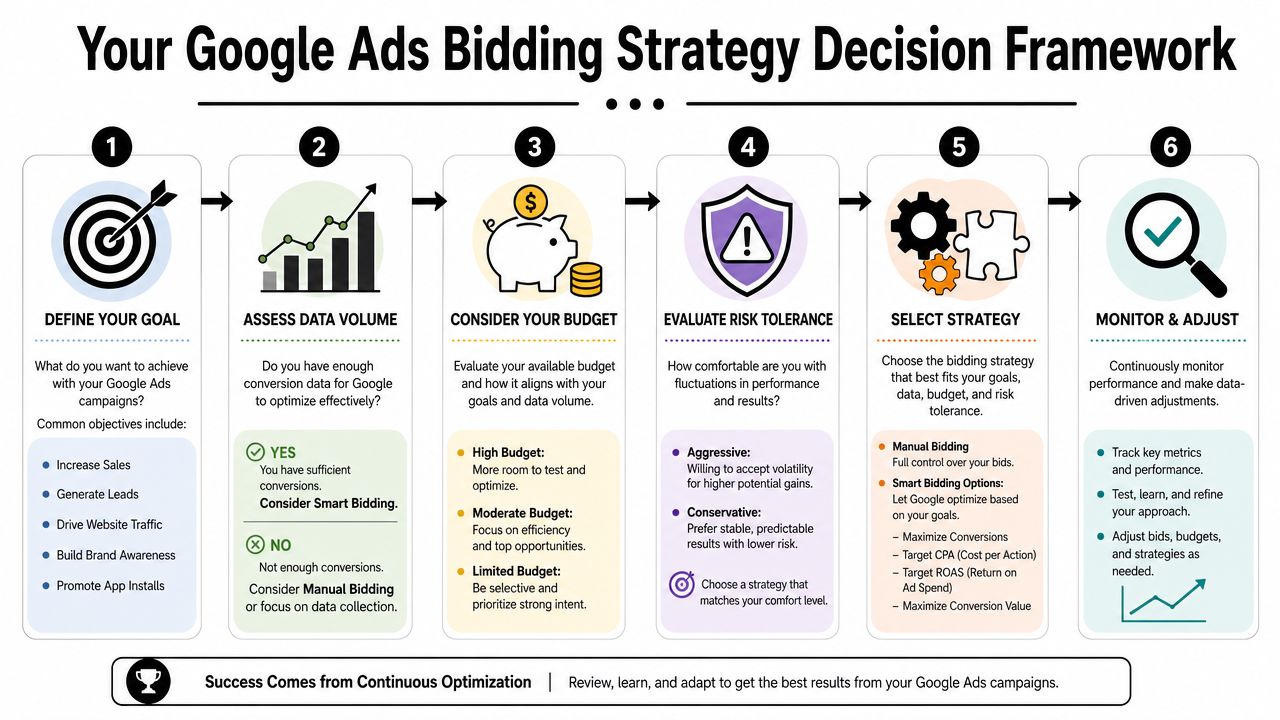
Pick the strategy that matches the outcome you get paid for.
If the goal is visibility, use an impression-based bid strategy.
If the goal is traffic, use a click-based strategy.
If the goal is pipeline, leads, or sales, clicks are a support metric, not the finish line. Use a conversion-based strategy once the account has enough signal and your conversion tracking setup is clean enough to trust.
A lot of accounts fail here because they optimize for what is easy to measure instead of what matters.
Google's official minimums are too forgiving. They describe what can run, not what usually runs well.
Adalysis found that Maximize Conversions tends to beat Manual CPC once an account reaches roughly 30 to 50 conversions per month, while performance is far less reliable below that range in thin-data accounts. That is the line that matters in practice, not the vague promise that automation can figure it out.
The same rule applies before you graduate into tighter target-based bidding. Target CPA and Target ROAS need conversion history with enough volume and consistency to train on. If you force them live too early, you are not being advanced. You are asking a black box to make precise decisions from noisy inputs.
Here is the part many guides skip. Conversion count alone is not enough. You need the right conversion architecture.
If your primary conversion is weak, duplicated, delayed, or padded with low-intent actions, Smart Bidding will optimize for junk with impressive confidence. Keep high-value business outcomes as Primary conversions. Push softer actions, like scroll depth, page views, or low-intent form starts, into Secondary status so they stay visible without steering bids.
Use this operating logic:
Little or no trustworthy conversion data
Use Manual CPC or Maximize Clicks with tight guardrails. Your job is to gather signal, not pretend the machine already has it.
Early conversion volume, but still inconsistent
Use Maximize Conversions once tracking is clean and volume is starting to stack up. This is the bridge strategy for accounts that are finally giving Google something useful to work with.
Steady conversion volume and stable lead quality
Move to Target CPA or Target ROAS only after the account has shown consistent performance for the actual business outcome you care about.
That framework sounds boring. Good. Boring is what keeps spend under control.
Smart Bidding needs room to make decisions. If the budget is so tight that the campaign can barely enter enough auctions, the strategy gets boxed in and performance turns erratic.
Founders usually blame the bidding model. The actual issue is math. A constrained budget plus a conversion goal plus thin data is how you get random-looking results and a lot of false confidence from Google's recommendations tab.
Some businesses can absorb a rough patch while a campaign stabilizes. Others cannot. That should shape your choice.
If a short-term spike in CPA creates cash flow problems, stay conservative longer. If you have margin and patience, automation can earn its keep once the account clears the volume and tracking thresholds above.
Decision shortcut: if your account lacks clean conversion data, enough monthly volume, or a sane budget, Smart Bidding is premature. Fix the inputs first.
Launch is where accounts get wrecked.
The strategy choice matters, but the first two weeks matter more. Founders switch on Smart Bidding, see ugly numbers three days later, then start editing targets, budgets, and conversion settings like they are defusing a bomb. That is how you feed Google a broken training set and then blame the machine.
Google's own Target ROAS documentation is stricter than the way many accounts are run. Start with your current Conv. value / cost. Use that as the initial target. Let the campaign settle for 1 to 2 weeks before you judge it. When you do adjust, keep the change measured instead of swinging the target all over the place.
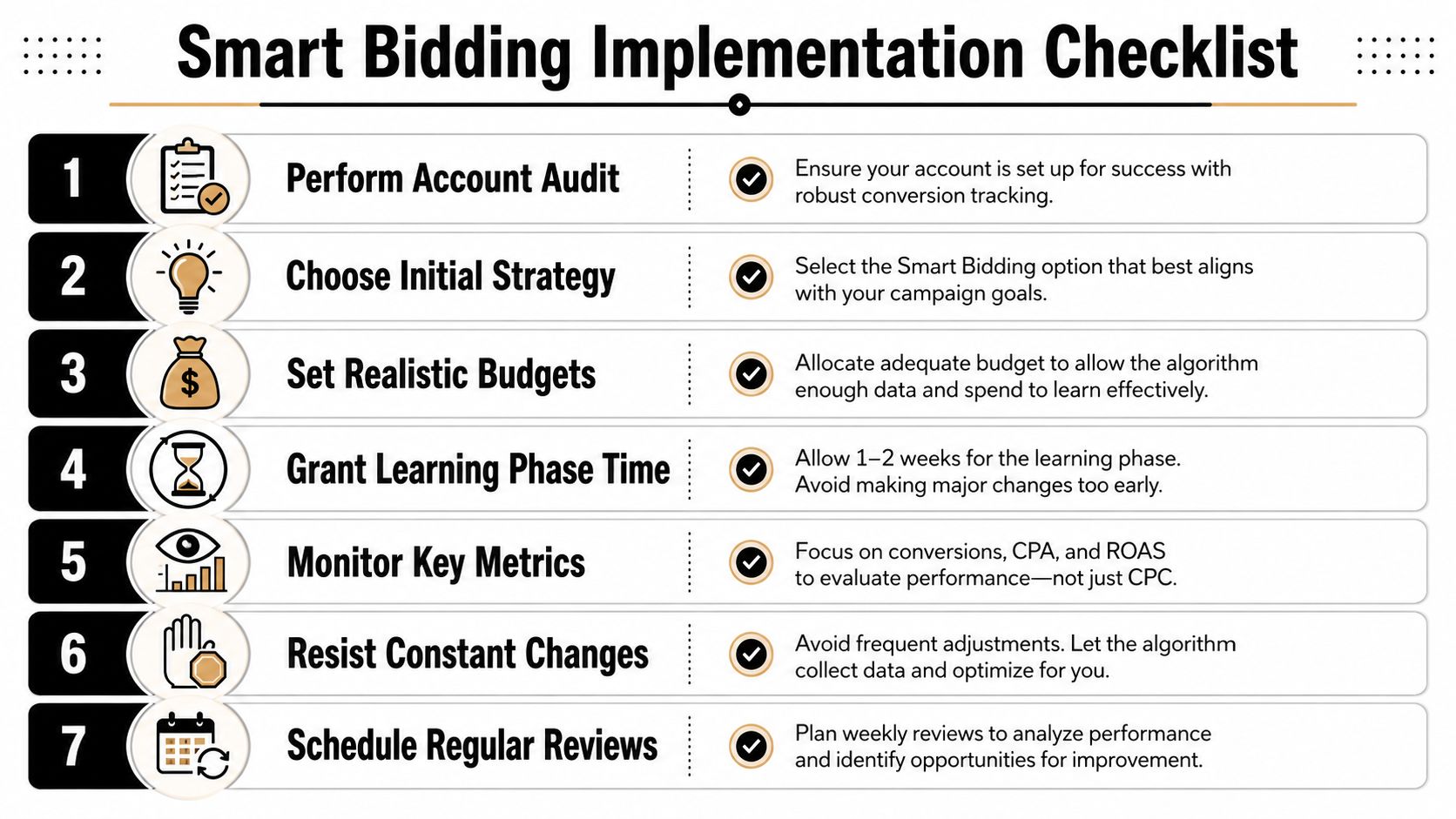
Smart Bidding does not stabilize on your timeline. It stabilizes when the campaign sees enough consistent inputs.
That means one target, one conversion setup, and enough time for the system to react to real auction data. Change the rules midstream and you reset the experiment. Then performance looks random because you made it random.
A lot of bad case studies are just stories about impatience.
Use this before you touch the bid strategy again:
For Target CPA, use your recent cost per conversion as the baseline. Then make small changes. If you want more volume, loosen the target a bit. If you want more efficiency, tighten it a bit. Big jumps are how you create whiplash.
My rule is simple. Do not touch a target because one bad day made you nervous. Touch it because a meaningful chunk of data says the current setting is wrong.
The same applies to budgets, conversion settings, and campaign structure. Smart Bidding can work. It just needs a stable environment and conversion architecture that is built for machine decision-making, not for dashboard vanity.
Manage Smart Bidding like capital allocation. Set the rules carefully, wait long enough to get a signal, then make one controlled change at a time.
If Smart Bidding is failing, the bid strategy is often blamed. Wrong culprit.
The bigger problem is usually conversion architecture. Specifically, whether you told Google to optimize for the actions that matter.
A lot of accounts dump everything into the same conversion bucket. Page views. Form starts. Button clicks. Add to carts. Purchases. Booked demos. Then they turn on Smart Bidding and act shocked when the platform starts chasing the easiest actions instead of the most valuable ones.
That setup poisons the training data.
According to Search Engine Journal's analysis of Smart Bidding failure modes, 90% of Smart Bidding failures stem from a polluted primary pool, where the algorithm trains on low-value micro-conversions instead of true macro goals. Their recommended fix is simple: set only real business outcomes like a completed purchase or booked consultation as Primary, and move lower-value actions like form views into Secondary so the bid strategy ignores them.
You'll usually see one or more of these symptoms:
This is why “more conversions” can be a terrible goal if the conversion definition is lazy.
Clean up the account like an adult:
If your Google Ads bidding strategy is chasing the wrong conversion, the problem isn't the algorithm. The problem is that you trained it to value the wrong thing.
This is the part most “ultimate guides” skip because it's not sexy. But it's usually the difference between stable scale and budget arson.
There's a point where doing this yourself stops being lean and starts being expensive.
Not because you're incapable. Because the account got more complex than a side task deserves.
You should bring in help when:
The strongest case is portfolio bidding. Shifting from campaign-level to portfolio-level strategies can deliver a 3x improvement in lead conversion rates because pooled data gives Google a more stable dataset for auction-time bidding, according to Doctor Ads' portfolio bidding analysis. That kind of setup is powerful, but it's also where an experienced operator usually earns their keep.
It's risk management.
If you're at the point where structure, bidding, budgets, and conversion architecture all interact across campaigns, you don't need another blog post. You need someone who's done this before and can make the judgment calls fast. If that's where you are, it's worth talking to a Google Ads specialist who lives in this stuff.
Because yes, you can keep tinkering.
You can also keep assembling IKEA furniture with a butter knife. Doesn't mean it's the best use of your week.
If you need someone who already knows how to untangle bidding strategy, conversion tracking, and campaign structure without turning your account into a science project, HireMediaBuyers.com is a practical place to start. They help companies hire vetted media buyers and paid ads specialists fast, so you can stop guessing, protect your ad spend, and scale with someone who's been through the black box before.


