

Most brands don't have a short form video ads problem. They have a decision-making problem.
The evidence is staring everyone in the face. In 2026, the global short-form video market is valued at approximately $59.09 billion and is projected to reach $640.9 billion by 2035, at a projected 30.33% CAGR, according to Business Research Insights on the short-form video market. If you're still treating short form as an optional creative experiment, you're not being cautious. You're being late.
I've watched brands burn obscene amounts of money on polished campaigns that looked expensive and sold nothing. Then they post one ugly, phone-shot clip with a sharp hook and suddenly the ad account wakes up. Annoying? Yes. Convenient for your ego? Not even a little. Useful for profit? Absolutely.
Short form video ads work, but only when creative, media buying, and execution live under one brain or under one person who knows what they're doing. That's the primary bottleneck. Not Canva. Not CapCut. Not your budget. The driver.
Your competitors are not winning because they have a better camera, a bigger budget, or some secret Meta setting.
They are winning because they have someone in the driver's seat who knows how to match creative, media buying, and on-camera talent to the feed. That is the gap. And it gets expensive fast.
Brands still waste time arguing over product pages, color palettes, and tiny pricing tests while better operators flood TikTok, Reels, and Shorts with ads people will watch. Attention gets allocated first. Sales follow it.
The short form wave is already here, as noted earlier. Your competitors have accepted that. A lot of brands still have not.
If you're sticking with static images because they feel easier to approve, easier to brief, or easier to produce, you're choosing internal comfort over reach. That trade gets uglier as competition rises.
Practical rule: If your customer spends time on TikTok, Reels, or Shorts, your ad strategy needs to look like content made for those feeds. Feed behavior wins. Banner-ad energy gets skipped.
I see the same failure pattern over and over. A founder hires an editor, gets a few scripts, films a couple of clips, launches them with no real testing plan, then blames the platform when results bounce around. The problem is not "video." The problem is that nobody owns the full system. Creative, audience, offer, media buying, and talent selection are being handled like separate chores instead of one job.
That is why some brands spend less and still beat you.
Static ads can support retargeting, promo pushes, and quick testing. They rarely do the heavy lifting once your category gets crowded.
Short form video gives you more hooks, more angles, and more chances to learn what the market responds to before you burn money scaling the wrong message.
| Format | What usually happens |
|---|---|
| Static images | Fast to launch, fast to fatigue, weak at showing product context |
| Polished brand videos | Nice-looking, often too produced to blend into the feed |
| Native-feeling short form | Strongest chance of earning attention and buying a second view |
The platforms reward behavior, not your production budget. Watch time, hold rate, clicks, comments, and conversions come from creative that feels like it belongs in the feed. Nobody cares that your edit took two weeks if the first second falls flat.
You do not need a studio setup. You need ads that get watched and sold.
A phone-shot clip from the right creator can beat a polished brand video because the audience trusts the delivery more. A sharp media buyer can spot that signal early and shift budget into the right angle before the account bleeds. A founder trying to coordinate three freelancers who barely talk to each other usually gets mediocre creative, muddy reporting, and expensive confusion.
That is the lesson here. Short form video ads are not a tools problem. They are an operator problem.
If you have the right person calling the shots, ugly can print. If you do not, even beautiful creative turns into a tax on your ad account.
The fastest way to waste money on short form video ads is to start filming before you've decided what the ad is supposed to do.
I've done this. It's how you end up with twelve versions of the same vaguely attractive video and no answer to the basic question: what was the job here? Awareness? Clicks? Purchases? Retargeting? You can't optimize fog.
A one-page brief fixes that. Not a corporate monstrosity. One page. Clear enough that a founder, editor, media buyer, and UGC creator all read it and produce the same ad.
Here's the checklist version.
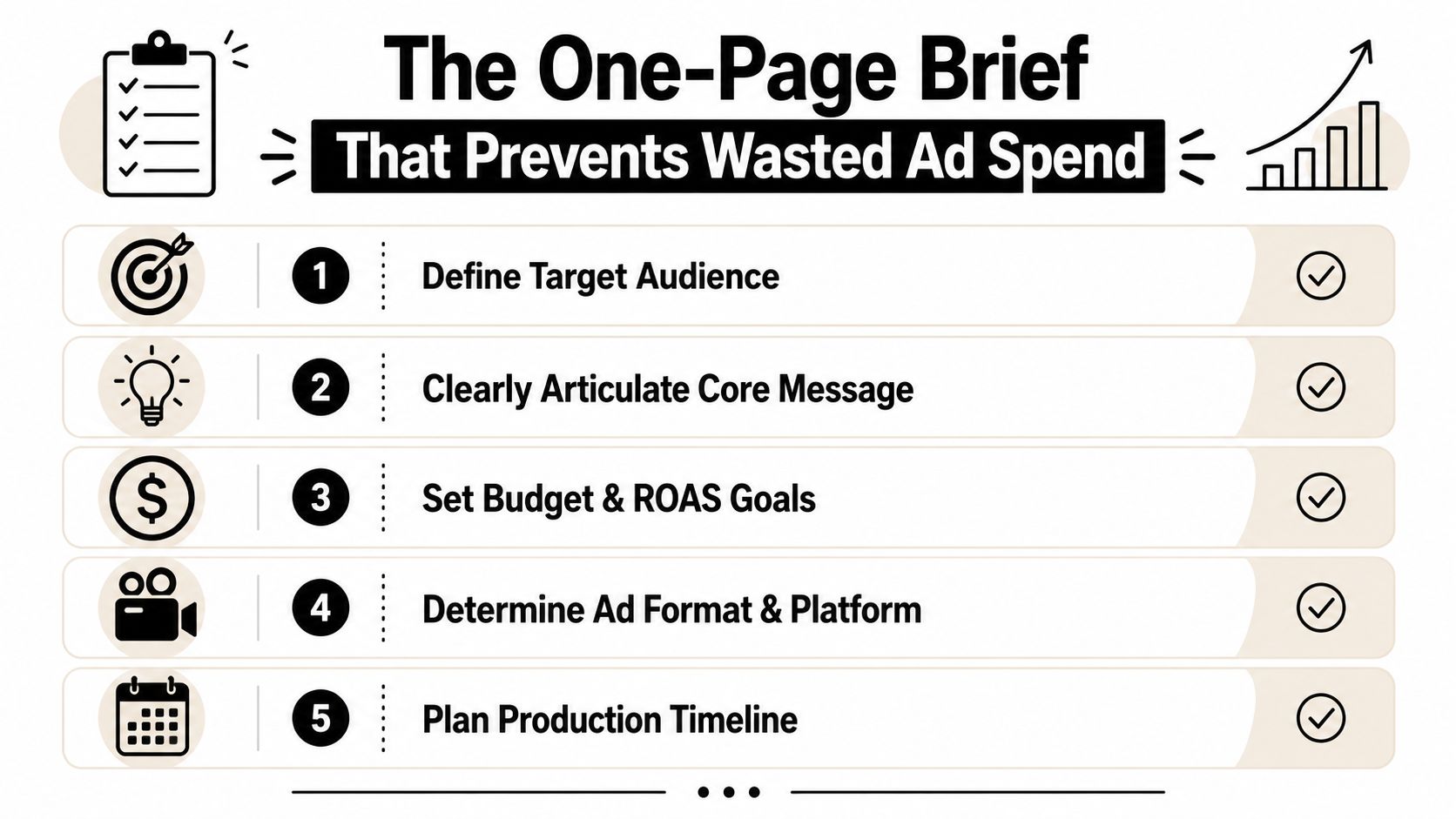
The essential elements are boring until they save you money.
This part matters because the ad itself is short. The strategy can't be muddy. Target Video's short-form ad guide points out the standard approach clearly: define a single objective, identify the target audience, and structure the ad around one core message delivered inside a concise timeframe.
I like this format because it forces honesty:
Who exactly is this for?
If you can't picture the person, the script will sound generic.
What pain or desire are we opening with?
Nobody stops scrolling because your company exists.
What proof or mechanism makes the claim believable?
Demo, before-and-after framing, founder explanation, customer-style narration.
What should the person do next?
Don't ask for three actions. Pick one.
What would make this ad fail?
Too broad, too polished, too many ideas, weak opening, unclear CTA.
A good brief doesn't make the ad pretty. It makes the ad hard to misunderstand.
Here's the difference in practice:
| Brief type | Outcome |
|---|---|
| Committee brief | Safe language, vague audience, crowded messaging |
| Founder brief | Specific problem, sharp promise, obvious next step |
If your team keeps producing "decent" ads that don't move revenue, the brief is probably trying to please everyone. That's how you end up mortgaging your office ping-pong table for content that wins internal applause and external indifference.
The internet has trained people to smell an ad in a split second.
That's why polished creative often underperforms in short form placements. It doesn't matter that the lighting is perfect if the viewer tags it as sponsored fluff before your point lands. On feeds like TikTok and Reels, "high production value" often translates to "skip me."
And yes, that's irritating for anyone who paid for the glossy version.
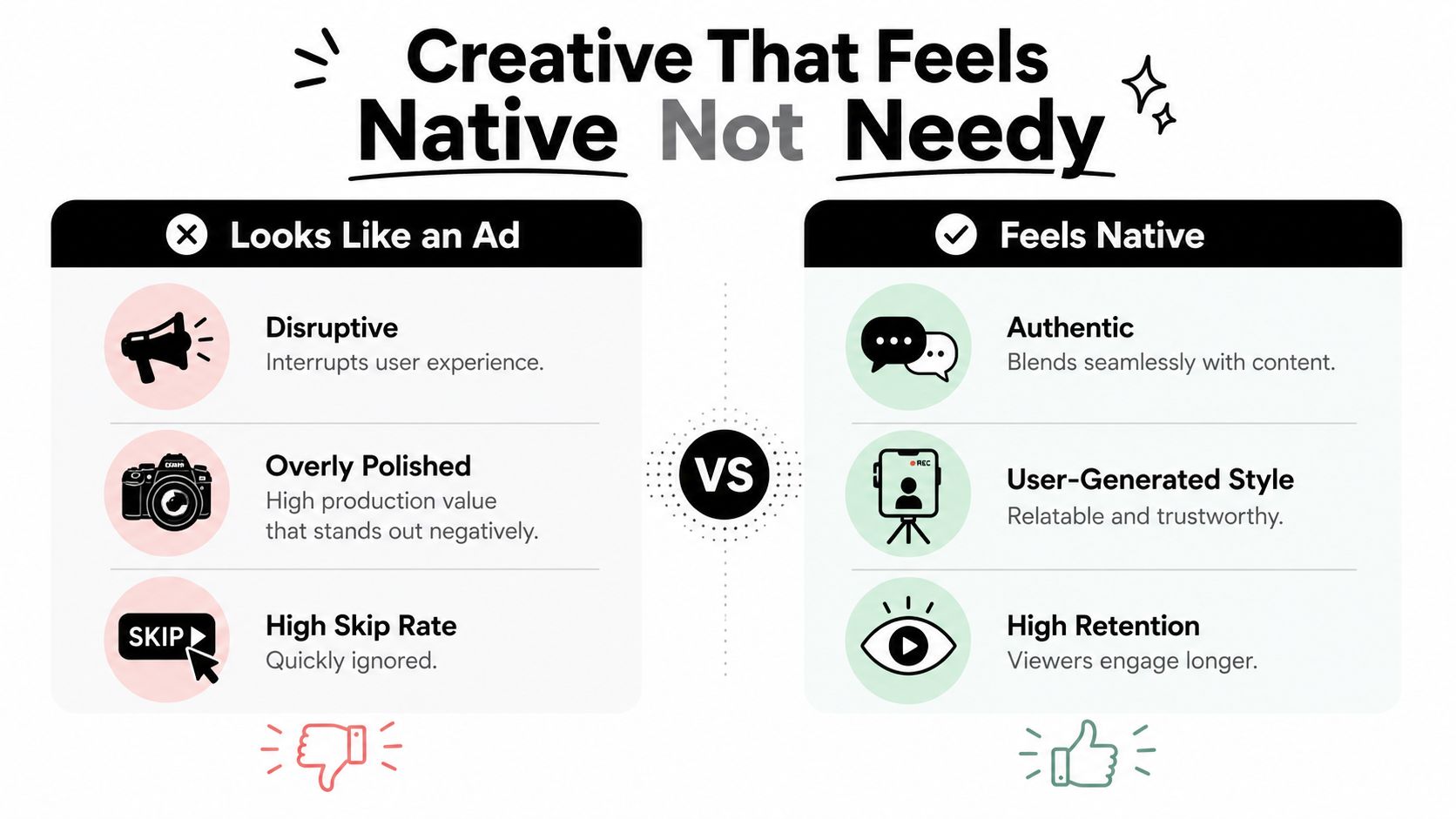
The useful phrase here is native blindness. Your ad should blend into the feed enough that people keep watching long enough to care. Not deceptive. Just culturally fluent.
A big gap in ad strategy is that most advice tells brands to "make it feel organic" but stops short of explaining how to do that at scale without expensive creator partnerships. Basis highlights that exact production scalability problem, especially when 75% of users consume this content on mobile and conventional ads get swiped away fast.
That's the game. You need creative that feels native, but you also need a repeatable way to make a lot of it.
It usually has a few traits in common:
A lot of brands get this backward. They spend on camera gear, then cheap out on scripting. Bad trade.
The hook is not your logo. It is not "Hey guys." It is not a sweeping lifestyle montage.
The first few seconds need to open a loop in the viewer's brain. Problem. Curiosity. Surprise. Demonstration. Contrarian statement. Anything but a slow runway.
Try structures like these:
| Hook style | Example approach |
|---|---|
| Problem agitation | Show the mess, frustration, or wasted time first |
| Direct confession | "I thought this product was overhyped until…" |
| Demo first | Start with the result, then explain it |
| Unboxing reaction | Let the reveal carry the pacing |
| Mistake callout | Speak to a behavior the audience recognizes in themselves |
Your ad should feel like something a user would watch voluntarily, not something they tolerate because the platform inserted it.
User-generated content style isn't magic. It just removes friction.
When the ad feels like a recommendation, a test, a reaction, or a quick explanation, viewers don't put up their guard as quickly. That's why founder-led clips, customer-style demos, selfie explainers, and rough-cut comparisons often outperform polished brand spots.
A few practical production rules I keep coming back to:
Hiring creators can help. It's not the only answer.
Brands with limited budgets can build native-feeling short form video ads by creating a repeatable internal system. One simple script format. One shot list. One editing template. One person owning quality control. Then test multiple hooks across the same core message.
What's a waste of money? Chasing cinematic polish for feed placements where relatability beats glamour. Hope you enjoy paying extra to look more skippable.
Every ad manager claims to make targeting easy. That's adorable.
TikTok, Meta, and YouTube all give you enough knobs and switches to create the illusion of control while helping you spend money in dumb ways. You do not need to master every feature. You need to avoid the obvious traps and make decent decisions fast.
TikTok matters because the scale is ridiculous. TikTok ads reached a reported audience size of 1.1 billion people worldwide as of 2026, according to WiFiTalents' short-form video statistics roundup. You don't get that kind of audience and then treat the platform like a side experiment.
My opinionated take: TikTok punishes stiff creative faster than the others. If your targeting is solid but the ad feels like a brochure, the platform will tell you very quickly.
What I'd do first on TikTok:
Instagram Reels is where I usually lean on existing Meta signal. If you've run Facebook or Instagram campaigns before, Meta often gives you the best starting point because it already knows something about who converts.
That's the advantage. The downside is Meta's tendency to nudge advertisers toward broad everything and then shrug when creative misses. Broad can work. Broad with weak creative is just expensive guessing.
A simple comparison:
| Platform | What I'd trust first | What I'd avoid |
|---|---|---|
| TikTok | Strong hook plus focused audience logic | Overcomplicated targeting stacks |
| Instagram Reels | Existing Meta conversion data | Assuming polished creative will carry |
| YouTube Shorts | Intent-adjacent messaging and clean offers | Treating it exactly like TikTok |
Shorts can work well, but I wouldn't copy-paste your TikTok strategy and call it a day. The creative can still be short form, but the context feels different. Users often tolerate explanation a bit better there, especially when the pitch is cleaner and the value prop is obvious.
If you're a lean team, don't spread yourself thin just because every platform offers inventory. Pick the one where your creative naturally fits, get signal, then expand.
The founders who lose money fastest are usually the ones launching everywhere at once with no real control group. Busy isn't the same as smart.
Most brands say they're testing. What they're doing is changing five things at once and congratulating themselves for being data-driven.
That's not testing. That's chaos with a spreadsheet.
If you're early in short form video ads, keep the framework boring. Boring is good because boring produces answers.
Run one concept at a time and change one variable at a time:
Test the hook first
Keep the same body, same offer, same audience. Swap only the opening.
Then test the message
Once a hook works, keep that opening and change the angle. Convenience versus status. Relief versus savings. Demo versus explanation.
Then test the audience
Only after creative shows signs of life should you start changing who sees it.
Not sexy. Very useful.
If you can't say exactly what changed between Version A and Version B, you won't know why one won.
I like a naming system simple enough that tired humans can follow it. Something like:
Inside each test, keep everything else stable. Same landing page. Same CTA. Same body edit. Otherwise you're measuring soup.
And please make sure your data isn't broken before you start drawing conclusions. If your events are messy, attribution is shaky, or purchases aren't being passed back correctly, you're optimizing on fiction. A clean setup for conversion tracking across ad campaigns saves a lot of fake confidence.
If you only have the bandwidth to test a few things, prioritize in this order:
A common failure pattern is spending too long tweaking minor details on a weak concept. If the hook is dead, no CTA on earth is rescuing it.
Don't panic after a tiny amount of spend. Also don't let losers limp around for days because you're emotionally attached to your favorite script.
You're looking for direction, not perfection. One variable. One takeaway. One next move. That's how a one-person team acts bigger than it is.
Most ad dashboards are cluttered with numbers that feel productive to look at and useless to act on.
Impressions. Reach. View counts. Fine. Nice. Lovely. None of them answer the question your finance brain is asking, which is whether the creative is doing its job and whether the spend is earning the right to continue.
People often overcomplicate things. You don't need a thousand metrics. You need a handful that connect creative to business outcome.
Take a quick look.
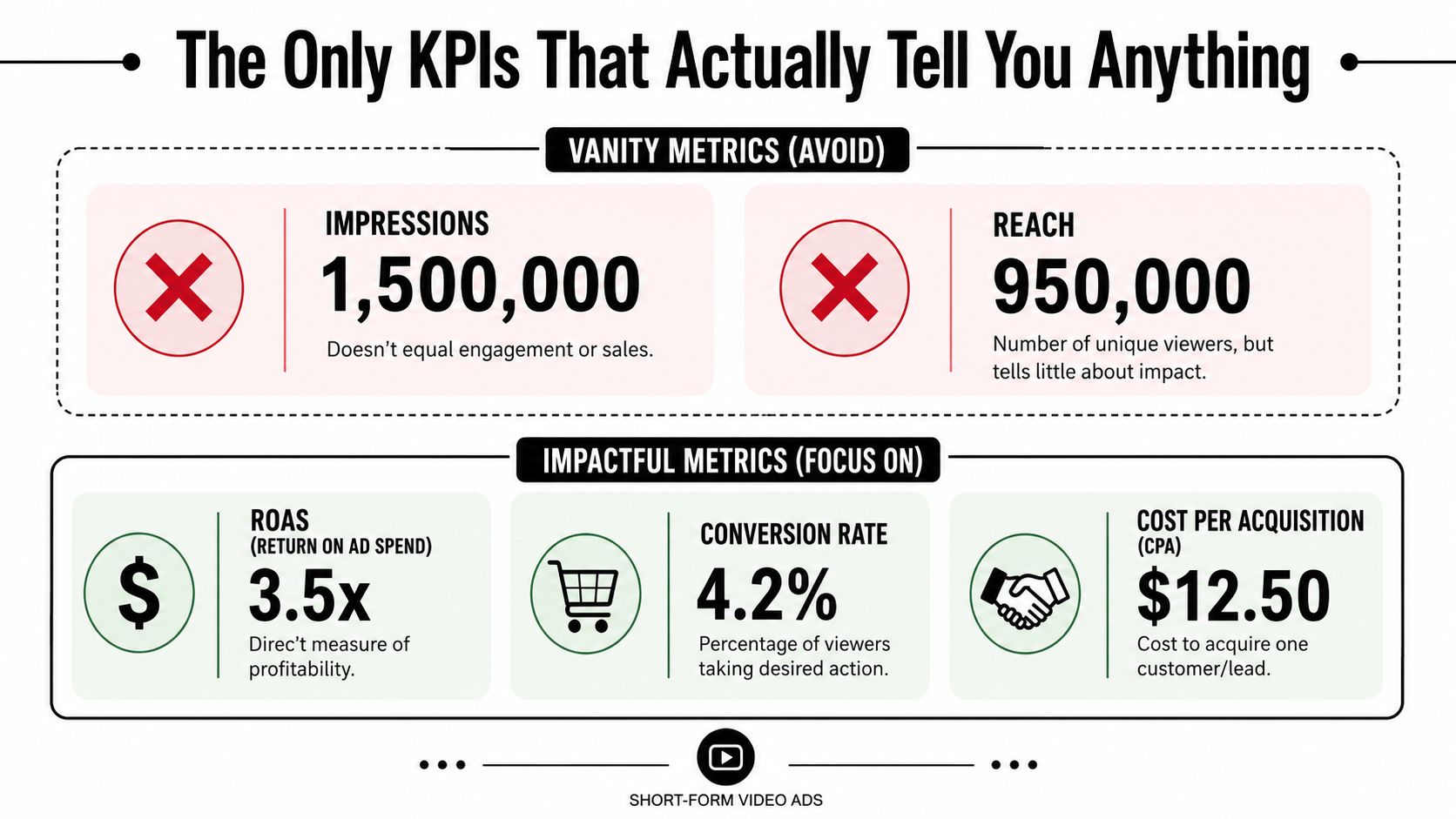
If you're running short form video ads, your first job is to earn a pause. That's why thumbstop rate matters so much. It's the percentage of people who stick around for the first few seconds instead of flicking past immediately.
According to Jetfuel's benchmark guide for short-form video success, a thumbstop rate above 25% on TikTok suggests a scroll-stopping opening, while below 15% means your first second is failing to land. That's a brutally useful benchmark because it tells you whether the creative has a pulse before you start arguing about landing pages.
If your thumbstop rate is weak, don't touch targeting first. Fix the opening.
My short list looks like this:
If you want a cleaner way to think through those numbers, this guide to ad performance metrics that actually matter is a solid reference.
Impressions and reach aren't worthless. They're just not decision-makers.
Use them for context, not comfort. A campaign can rack up visibility and still lose money. That's why I don't let teams celebrate top-line exposure when the front-end hook is weak and the back-end economics are ugly.
Quick gut-check table:
| Metric | Keep or cut |
|---|---|
| Impressions | Keep for context |
| Reach | Keep for context |
| Thumbstop rate | Watch closely |
| CPA | Essential |
| ROAS | Essential |
A pretty report with bad CPA is still a bad report.
When numbers go south, don't thrash around.
Start at the top of the funnel. If thumbstop rate is bad, the opening is bad. If thumbstop rate is decent but conversions are soft, check the message, offer, landing page match, and audience quality. Work top-down, not emotionally.
That habit alone saves more money than most "growth hacks."
Scaling kills more good ad accounts than bad creative does.
A campaign starts printing, and founders do the same four things. Raise budgets too fast, clone winners into five audiences, add placements they do not understand, and call it scale. Then CPA climbs, the team blames the platform, and the winning window closes.
Winning at scale takes control. Not adrenaline.
Use two lanes.
Horizontal scaling expands your surface area. Add fresh creative angles, test adjacent audiences, open up placements that fit the asset, and branch into new platforms only when the operator can manage the extra complexity. This protects you from squeezing one ad to death.
Vertical scaling puts more spend behind combinations that have already earned it. It works, but it breaks faster. Push budgets too hard or too often and performance gets unstable.
A practical view:
| Scaling path | Best use | Main risk |
|---|---|---|
| Horizontal | Extend winners into new segments and fresh creative | Operational complexity |
| Vertical | Increase budget on proven combinations | Performance instability |
Founders want scaling to be a budget problem because budget feels solvable. It usually is not.
The cap is often the person running the machine. Creative, media buying, and talent have to work as one system. If nobody is steering that system with discipline, more spend just exposes the weak spots faster. You do not have a scaling problem. You have a driver problem.
One person can only script, review hooks, brief creators, launch tests, watch pacing, diagnose drops, and preserve learnings for so long before quality slips. That is why brands stall right after they find a winner. The ad was strong enough to get traction. The operator was not strong enough to turn traction into a repeatable process.
If these are showing up, stop pretending this is still founder-efficient:
Here's the screenshot that says the quiet part out loud.
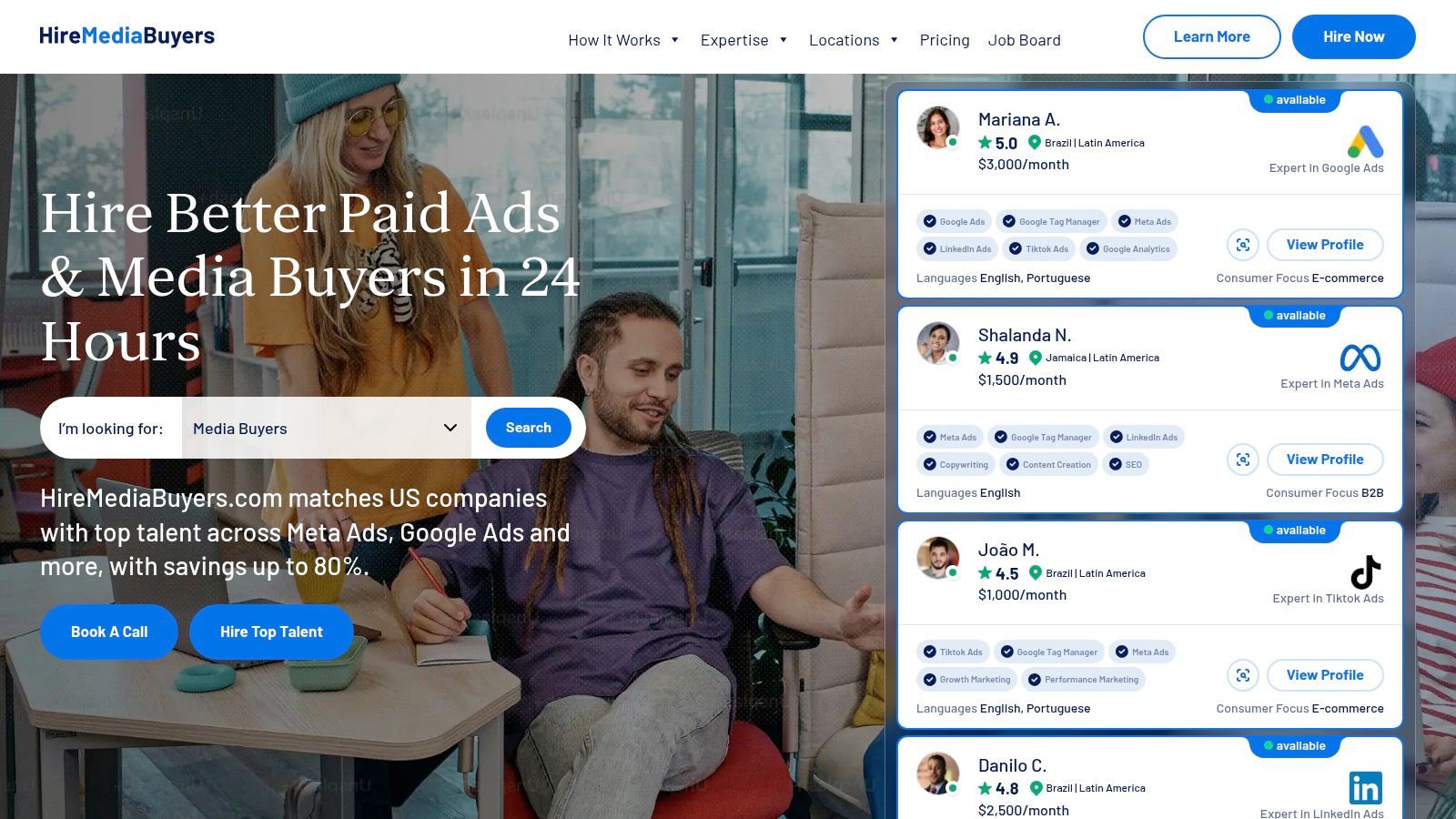
A good media buyer does more than launch campaigns. They connect creator output, hook quality, audience signal, budget pacing, and platform behavior into one operating system. That is the missing piece for a lot of brands with decent assets and inconsistent results.
I have seen this movie too many times. The founder writes copy. A freelancer edits UGC. Someone on the team boosts the post. Nobody owns the system. So tests get sloppy, spend rises before the learning is clean, and the account drifts.
Hire a pro when your ad account starts affecting inventory, cash flow, and weekly decision-making.
You do not need to give up control of the brand. You need one person in charge who knows how to turn creative wins into media buying decisions, and media buying decisions into a better creative pipeline. That is how brands scale without burning cash.
If you're done being the founder, creative director, junior editor, and part-time media buyer all at once, HireMediaBuyers.com is the straightforward next step. They help companies find pre-vetted media buyers and paid ads specialists fast, so you can put an expert in the driver's seat and scale short form video ads without turning your week into one long ad account autopsy.


