

You're probably here because one of three things is happening.
Your ad spend is climbing, your reporting deck looks weirdly cheerful, and revenue isn't keeping up. Or you're hiring for paid acquisition and every resume says the same thing: data-driven, results-oriented, growth mindset, full-funnel, AI-native. Cute. Or you already hired someone, and now you're paying good money for screenshots of CTR trends and explanations that somehow blame “the algorithm” for everything.
I've hired performance marketers who printed money. I've also hired some who could build a gorgeous dashboard while setting cash on fire. The difference isn't charisma. It isn't channel trivia. It's whether they understand that this job is about unit economics, attribution, creative testing, and clear decision-making.
A real Performance Marketing Specialist isn't there to make the graph go up. They're there to make profitable customer acquisition repeatable. If they can't do that, they're not a specialist. They're overhead.
Most job descriptions butcher this role.
They call the person a storyteller, a growth hacker, a digital ninja, or some other phrase cooked up by someone who's never had to explain blown CAC to a board or a founder. A Performance Marketing Specialist is much simpler than that. They're an accountant with the company credit card who happens to buy media.
That sounds harsh. Good. It should.
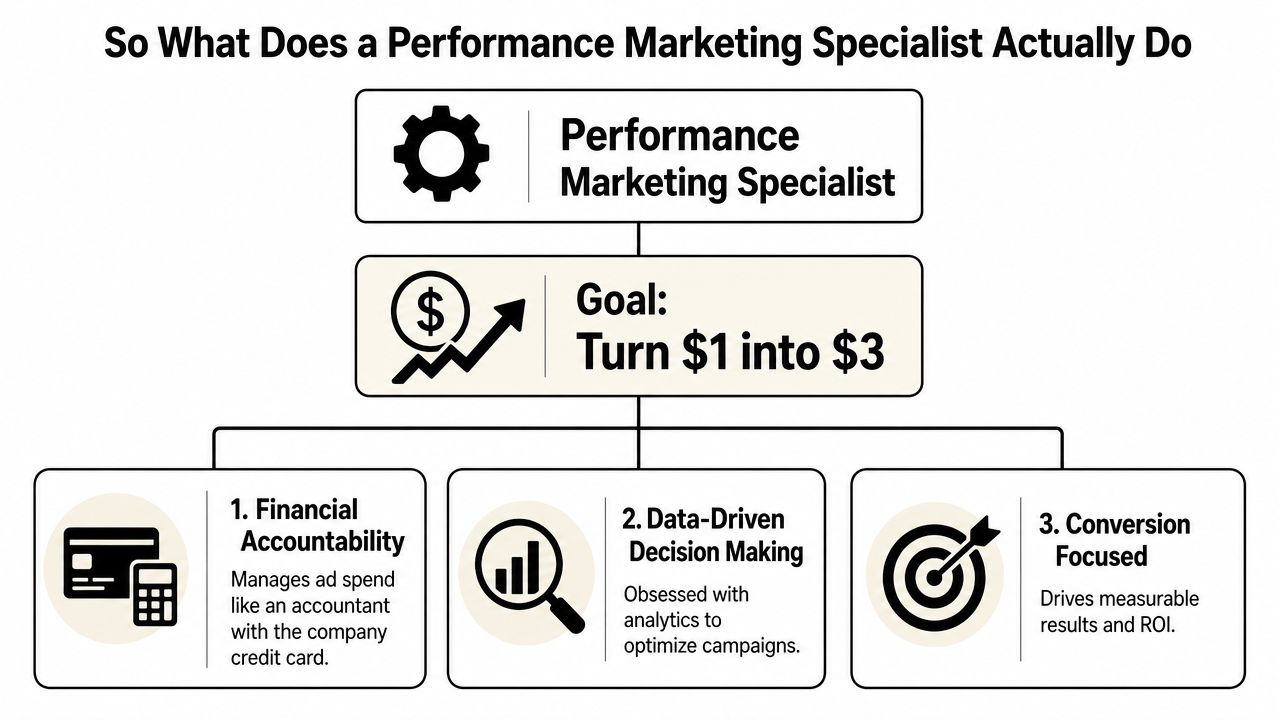
Their job is to turn paid traffic into measurable business outcomes. Not vibes. Not awareness theater. Outcomes.
That means they own pieces of the funnel most generalist marketers only talk about in slide decks:
A generalist marketer can help with messaging, campaign coordination, and content calendars. Useful, sure. But a performance specialist sits closer to finance than brand. They have to connect spend to return, fast, without hiding behind soft language.
Practical rule: If a candidate talks more about reach than revenue, you're interviewing the wrong person.
This isn't some niche specialty anymore. The global workforce for performance marketing professionals is projected to expand by 12% annually through 2030, which is well above the 6% average growth projected for broader marketing roles, according to this performance marketing career forecast. That growth isn't happening because companies suddenly love ad managers. It's happening because businesses want measurable acquisition, tighter accountability, and people who can optimize funnels from acquisition to monetization.
That last part matters.
The specialist you want isn't just launching campaigns. They're verifying impact. They're checking whether the thing worked, why it worked, and whether it will keep working when you scale.
A competent specialist thinks in a chain:
If they skip steps and jump straight to “we got cheap clicks,” run.
Cheap traffic is easy to buy. Profitable customers are hard to buy. That's the whole game.
A resume that lists Google Ads, Meta Ads, GA4, and Excel tells me almost nothing. That's table stakes. Saying you “know” a platform is like saying you can “drive” because you once parked a car.
The right way to assess a Performance Marketing Specialist is to separate what they must know to be employable from what makes them dangerous in a good way.
These are the basics. No applause for having them.
A significant separation arises at this stage.
A serious specialist understands that paid media isn't just button-clicking inside ad platforms. It's a data system with creative inputs and financial consequences.
Consider the difference:
| Capability | Resume version | Useful version |
|---|---|---|
| Attribution | “Familiar with attribution” | Can explain why platform-reported conversions and business outcomes diverge |
| SQL | “Basic SQL” | Can pull and inspect funnel behavior when the dashboard lies |
| GTM | “Worked with GTM” | Can troubleshoot broken events and stop bad data before it poisons decisions |
| Testing | “A/B testing experience” | Has a clear testing framework for creative, offer, audience, and landing page |
Yes, top specialists use automation. They should. Meta Advantage+, Google Smart Bidding, and automated creative tools can help scale execution. But if someone treats automation like magic, they're going to hand your budget to a black box and hope for the best.
Campaigns with structured creative testing can deliver 25 to 60% higher conversion rates and 15 to 30% lower CAC, according to this analysis of performance marketing skills and testing discipline. The reason is simple: precise tracking, segmented creative, and automated bidding work better together than static creative and lazy setup.
That same source also notes that weak technical foundations can push CAC higher after launch. Which tracks with real life. If your events are sloppy and your creative is generic, the machine doesn't save you. The machine amplifies your mistakes.
Automation is a lever, not a strategy. People who confuse those two usually create expensive learning experiences for everyone else.
One more thing. The market is steadily shifting toward specialists who can do more than campaign ops. Some senior roles now expect people to explore, build, and train AI agents to automate repetitive tasks, as shown in this Amazon performance marketing specialist role.
I wouldn't make that mandatory for every hire. I would absolutely treat it as a signal.
Someone who can improve workflows, not just manage ads, will outproduce the person who lives inside dashboards all day and calls it strategy. Toot, toot.
If your specialist leads with impressions, clicks, CTR, or reach, you're being softened up for disappointment.
Those metrics can be diagnostic. They are not the business. I've seen teams celebrate a cheap CPC while leads got worse, conversion quality dropped, and sales started asking who let the junk in. Great work, everyone. The chart is thriving.
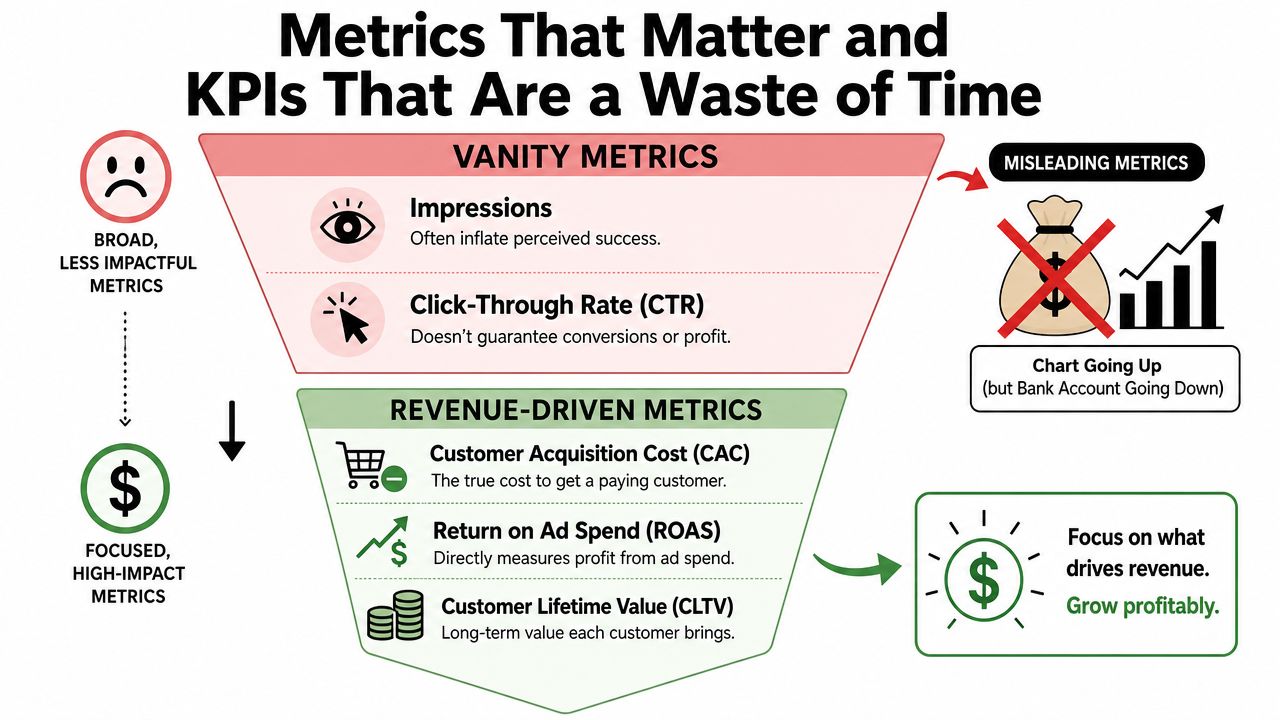
A Performance Marketing Specialist should be judged on the numbers that connect marketing to money.
If they can't discuss these comfortably, they're not ready to manage a meaningful budget.
For a useful framework, this guide to ad performance metrics that actually matter is the kind of thinking I'd want a candidate to reflect. Not parroting definitions. Connecting each metric to a business decision.
A lot of terrible budget decisions come from bad attribution. Last-click reporting is the usual culprit because it's simple, convenient, and wrong often enough to hurt.
Relying on last-click attribution can misallocate 30 to 50% of conversion credit, according to this CXL guide on performance marketing measurement. That tends to overvalue channels like paid social and distort budget shifts. A real specialist uses multi-touch attribution and incrementality thinking to isolate actual impact instead of just accepting whatever the platform claims.
That doesn't mean they need to build a PhD thesis every week. It means they should ask smarter questions:
The fastest way to waste money is to optimize for the metric your platform finds easiest to claim.
Use these carefully. They're supporting actors, not the lead.
| KPI | Useful when | Dangerous when |
|---|---|---|
| Impressions | Checking delivery and reach | Used to prove success |
| CTR | Diagnosing ad-message resonance | Treated like proof of revenue impact |
| CPC | Monitoring traffic costs | Used without conversion quality context |
| Leads | Fine for top-of-funnel management | Counted without qualification or close rate |
A strong specialist can still show these numbers. They just won't hide behind them.
That's the difference.
Most hiring mistakes start before the interview. They start in the job post.
If your description asks for a “rockstar growth marketer” who can own strategy, execution, content, design, CRO, analytics, CRM, lifecycle, and maybe office birthday balloons, you won't attract adults. You'll attract optimists and embellishers.
Keep it blunt. Serious people appreciate clarity.
Include:
Skip the fluff. Add specifics.
If you're hiring for Meta-heavy work, say so. If you need someone who can explain paid media to non-technical stakeholders, say that too. If you want to compare role scope, this page on hiring a Facebook Ads specialist is a useful contrast because channel-specific specialists and broader performance hires are not interchangeable.
Forget “tell me about yourself.” I can get that from LinkedIn and a coffee.
Ask questions that force a thought process.
Your CAC doubled overnight and nothing obvious changed. Walk me through your diagnostic process.
A real pro starts with tracking validation, auction shifts, creative fatigue, audience saturation, landing page issues, and sales quality changes. A fake says, “I'd test new ads.”
Meta shows strong results, but blended revenue doesn't move. What are the possible explanations?
You want someone who talks about attribution distortion, cannibalization, low-quality conversion events, lagging purchase windows, and incrementality.
You have a limited budget. Where do you test first: audience, offer, creative, or landing page? Why?
There isn't one perfect answer. There is such a thing as a shallow one.
Explain your last campaign failure in plain English to a skeptical founder.
This is a big one.
A primary qualification for success is the ability to “explain performance changes and next steps in plain language to clients,” based on this Headlight job listing for a performance marketing analyst. That skill gets ignored constantly, and it shouldn't. A specialist who can't translate data into decisions becomes a reporting bottleneck.
“I was wrong about X, we found Y in the data, and we changed Z.”
That's the sentence structure of a grown-up operator.
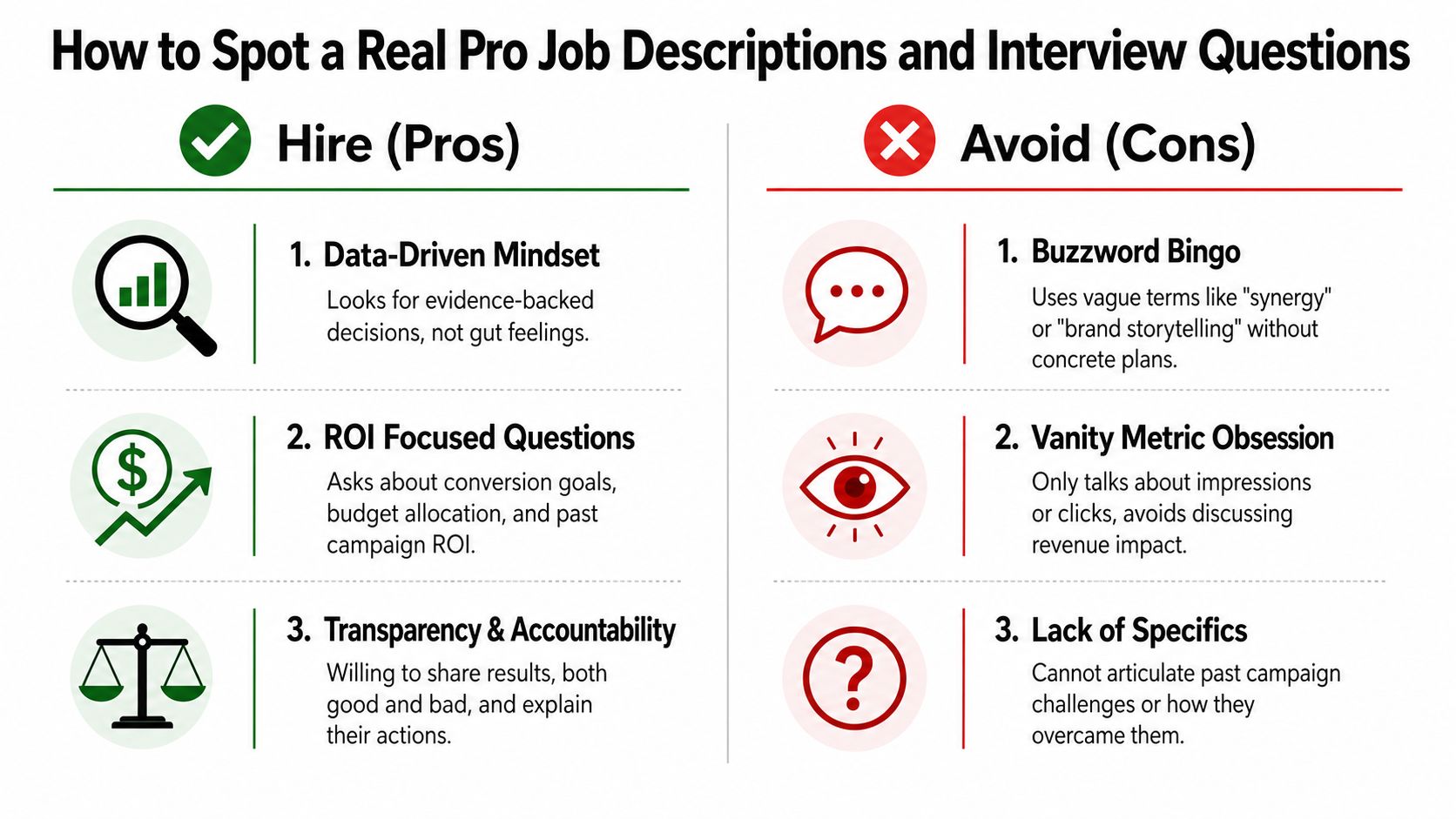
Watch for these green flags:
And the red flags?
Buzzword stacks. Vague wins. No failures. Too much platform worship. Anyone who sounds polished but can't get concrete under pressure usually becomes your most expensive meeting attendee.
There's no universally right hiring model. There is a right model for your current mess.
Some companies need speed. Some need control. Some need strategy. Some just need someone to stop the bleeding before another month of spend disappears into “testing.” The mistake is pretending freelancer, full-time, and agency are basically the same with different invoices. They're not.
Freelancer works when the scope is narrow, the channel mix is simple, and someone internal can manage them. If you think hiring a freelancer means less management, hope you enjoy spending your afternoons chasing updates, untangling access issues, and figuring out what exactly they did last week.
Full-time employee makes sense when paid acquisition is a core growth engine and you need constant iteration, cross-functional coordination, and institutional knowledge. You get more control, more context, and usually better accountability. You also get hiring risk, payroll overhead, and the joy of discovering that a polished interview doesn't guarantee execution.
Agency can be useful when you need a broader bench or fast deployment across multiple channels. It can also become a black box where junior staff touch your account while a senior strategist appears only on kickoff calls and quarterly reviews. If you hire an agency, force transparency early or you'll fund a PowerPoint subscription.
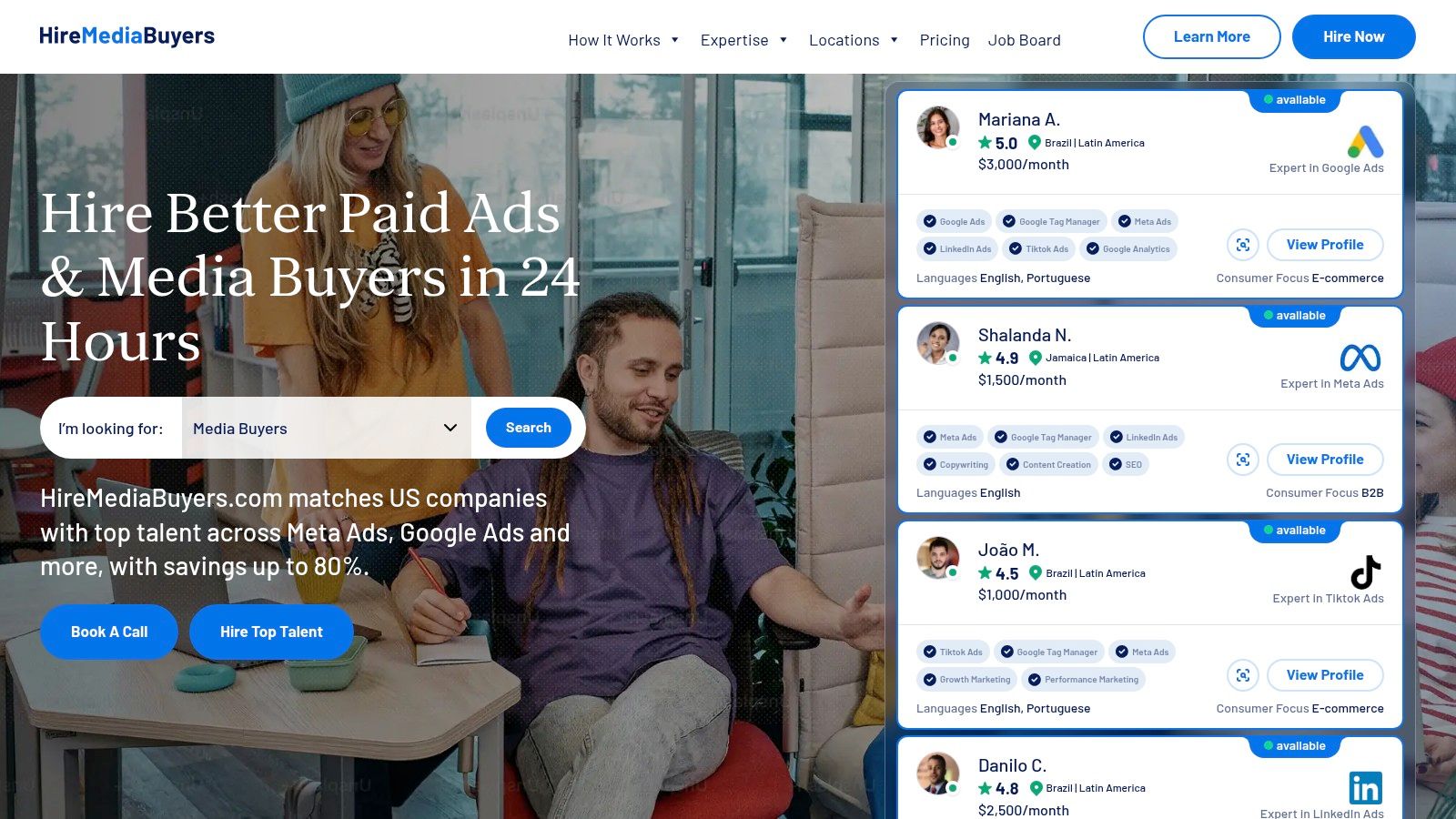
Vetted marketplace sits in the middle. It can be a practical option when you want specialist talent faster than a normal hiring cycle, without handing strategy and visibility to an agency. One example is HireMediaBuyers.com, which connects companies with pre-vetted media buyers and paid ads specialists for remote hiring.
| Factor | Freelancer | Full-Time Employee | Agency | Vetted Marketplace (e.g., HireMediaBuyers) |
|---|---|---|---|---|
| Control | Medium | High | Low to medium | High |
| Speed to start | High | Low | Medium to high | High |
| Internal management required | High | Medium | Low to medium | Medium |
| Channel depth | Varies wildly | Depends on hire | Often broad | Depends on shortlist |
| Knowledge retention | Low | High | Low | Medium to high |
| Transparency | Varies | Usually high | Often mixed | Usually direct with candidate |
| Best fit | Simple scopes | Core growth function | Broader external support | Fast specialist hiring |
Use a freelancer if you already know what needs doing.
Use a full-time hire if paid acquisition is central to company growth and you want ownership inside the business.
Use an agency if you need broader support and have the discipline to manage them tightly.
Use a marketplace if you want direct access to vetted talent without spending forever on sourcing. If speed matters, this breakdown of the typical hiring timeline for paid media talent is worth reviewing because long hiring cycles incur greater costs than many teams acknowledge.
The wrong model creates drag even if the person is talented. That's the annoying part. Sometimes the hire isn't bad. The setup is.
Let's talk about money without pretending salary is the whole bill.
As of July 2026, the average annual salary for a Performance Marketing Specialist in the United States is $61,031, with most falling between $47,500 and $70,000, and top earners reaching $82,500, according to ZipRecruiter salary data for Performance Marketing Specialists.
That's the salary line. It is not the total cost of getting this hire right.
The expensive part of a bad hire usually isn't comp. It's wasted spend, slow learning cycles, muddled reporting, and the months you lose while someone confidently tests the wrong things.
Add in the hidden stuff:
That's why I don't obsess over getting the cheapest person. I obsess over getting someone who can create economic advantage.
There are two ways to overpay.
The first is obvious. You pay top-market compensation for average performance.
The second is sneakier. You hire cheap, get weak execution, and spend months funding “experiments” that never mature into a system.
A better approach is to look for strong operators in remote talent markets where compensation expectations are different but skill level is still high. Done well, that can improve the economics of the role without lowering the quality bar.
The trick is “done well.”
That means proper vetting, communication testing, timezone alignment, and clean employment logistics. If you skip that, you're not cost-saving. You're outsourcing risk to your future self.
Budget for value, not vanity.
If paid media is material to growth, don't hire based on the lowest monthly rate. Hire based on whether the person can protect budget, improve decisions, and communicate clearly enough that you trust them with more responsibility over time.
A mediocre specialist costs less on paper and more in practice. I've run that experiment already so you don't have to.
The first 90 days are not a welcome parade. They're a test.
You're validating whether this person can diagnose reality, make sound decisions, and communicate clearly under imperfect conditions. If they can, great. If they can't, dragging it out won't make them better. It'll just make the eventual cleanup more expensive.
The first month is for orientation and audit, not heroics.
What I want to see:
If they spend this period mostly making cosmetic deck updates, that's not a great sign.
Early on, clarity beats activity. I'd rather see one sharp diagnosis than ten busywork updates.
By now, they should be moving from observation into controlled action.
I expect:
Campaign adjustments with rationale
Budget shifts, creative tests, audience exclusions, landing page recommendations, or bid strategy changes. Each change should tie back to a diagnosed issue.
A reporting rhythm
Not an avalanche of screenshots. A simple explanation of what changed, what they learned, and what comes next.
Cross-functional requests
Good specialists usually need something from design, product, web, or sales. If they ask for nothing, they may not be looking hard enough.
At this point, the hire either starts to look like a keeper or starts sounding rehearsed.
By the end of the quarter, I want:
Don't ignore these because the person seems nice or “still ramping.”
| Red flag | What it usually means |
|---|---|
| Blames the algorithm constantly | Weak diagnosis and low ownership |
| Reports vanity metrics first | Doesn't think in business terms |
| Can't explain strategy simply | Understands tools better than outcomes |
| Changes too much at once | Poor testing discipline |
| Never admits uncertainty | More ego than method |
One more thing. If they can't say what they'd stop doing, they probably don't know what's driving results.
That's a tell.
A strong Performance Marketing Specialist gets sharper over the first 90 days. Their language gets clearer. Their priorities get narrower. Their recommendations get more financially grounded. The weak ones do the opposite. More activity, less clarity, more excuses.
That's your cue.
If you need a Performance Marketing Specialist without spending weeks sorting through buzzword-heavy resumes, HireMediaBuyers.com is one practical route. It helps companies hire pre-vetted media buyers and paid ads specialists, including remote talent in US-friendly time zones, with support around vetting, payroll, and replacements.


