


You're staring at a dashboard that's technically “working” and still feels fake. A few signups. Some polite demo calls. A Slack thread full of optimism. And now someone wants to pour fuel on it, maybe paid acquisition, maybe a media buyer, maybe both, which is exactly how people end up mortgaging their office ping-pong table for a prettier way to learn they never had fit.
The fix isn't more vibes. It's a hard-nosed way to validate product-market fit before you spend like the market already loves you. That means segmenting tightly, testing with real users, reading retention and willingness-to-pay signals, and only then scaling the channel stack. The good news is that fit leaves fingerprints. You just have to stop mistaking applause for proof.
Founders usually spot the problem late. The dashboard looks healthy. Ads are running. Sales keeps calling the leads “promising.” Then usage tells the truth, and the product is basically a one-time tour people never care to repeat.
Validate product-market fit before you hire media buyers or turn on paid spend. If the product does not solve a problem people already feel, you are not scaling demand. You are scaling confusion. The Harvard innovation guidance gets to the point: customers need to recognize they have a problem, be actively seeking a solution, and have a budget to solve it. Miss one of those, and your acquisition budget becomes a bonfire with better reporting.
Fake momentum shows up early. You get signups from curiosity, not intent. You get demo requests from people who like the idea but will not pay. You get a usage spike from one launch email, then a cliff.
Practical rule: if the growth story sounds better than the product story, slow down.
Paying for scale before repeatable value is proven is how teams waste time and money. They start mistaking novelty for demand, then spend weeks arguing over CAC when the core problem is that nobody comes back. PMF validation is the boring guardrail that keeps you from expensive self-deception.
Real fit shows up as repeat behavior, not applause. Users return on their own. They use the core product without being nagged. They describe the same pain in their own words. When you ask what they would miss, they do not shrug.
That is the standard. Validate first, then spend. Otherwise, you are just buying a louder version of uncertainty. Once fit is clear, the next move is to define the segments worth hiring for and scale paid acquisition with a media buyer only after the audience signal is real, starting with disciplined audience segmentation.
If you treat “the market” like one giant blob, you'll get mushy results and mushier opinions. The fastest way to validate product-market fit is to pick a narrow cohort and make a sharp guess about their pain. Not a vague wish. A testable hypothesis.
A second underserved angle is how to validate PMF across segments, not just overall demand, because broad surveys often miss role-based fit signals; focusing on narrow cohorts reveals deeper adoption drivers Singlemind Consulting. That matters because a product can be a disaster for one segment and a quiet obsession for another. If you don't separate them, you'll average your way into nonsense.
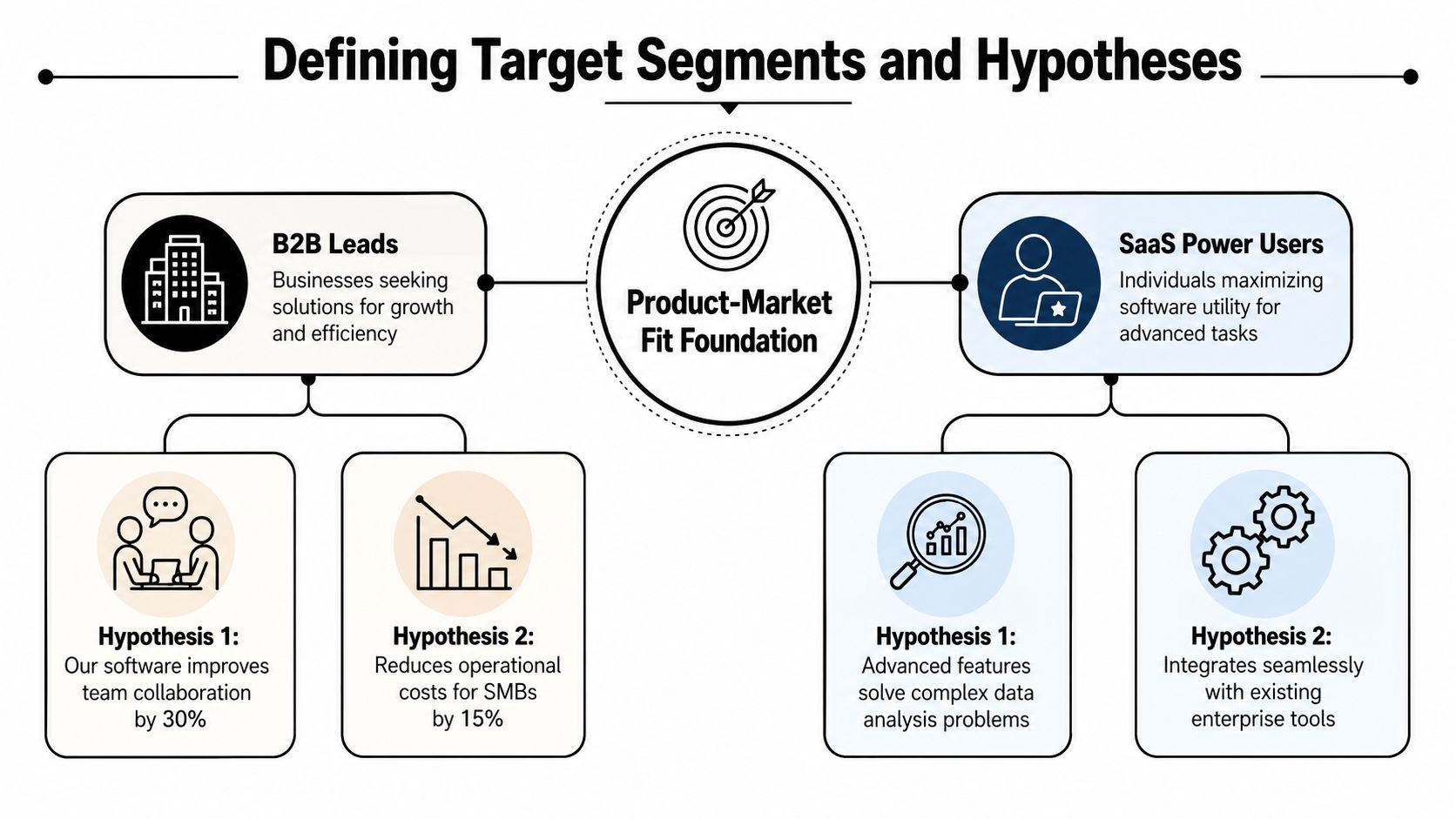
Write down the people who are most likely to care. In B2B, that might be ops leaders, demand gen managers, or founders with a specific bottleneck. In SaaS, it might be power users who hit the ceiling of the current tool and start hacking around it. In DTC, it could be a repeat buyer with a very specific use case.
Then define the job they're trying to get done. What breaks today? What are they using instead? Why now? Those answers turn “interesting product” into a real hypothesis you can test in interviews, landing pages, or a prototype.
A good hypothesis sounds like this, even if you'd never say it in a keynote. “Ops teams in growing SMBs struggle to keep handoffs visible, so they'll adopt a workflow tool that reduces manual follow-up.” Short. Specific. Falsifiable. No poetry, no fluff.
Here's the part people skip because it's annoying. Prioritize only two or three segments. If you chase six, you'll learn almost nothing. Use the segment that has the strongest pain, the clearest buying trigger, and the shortest path to a real test. If you need a cleaner way to map audience splits, the logic behind audience segmentation applies here too, even if you're not ready to scale spend yet.
Pick the smallest segment that can prove or kill the idea fastest.
Document the hypothesis, the trigger, the workaround, and the expected outcome. That's your starting line. Everything else is just theater.
The cleanest validation sequence starts ugly on purpose. Don't build the polished product first. Build the least glamorous version that can still reveal whether the problem is real. If people won't engage with a crude version, they probably won't love the glossy one either.
A practical PMF validation workflow recommends interviewing 20–30 target customers, running prototype tests with 10–15 people, and only moving to beta once you have 50–100 users to observe real behavior Precode. That's not startup cosplay. That's a sane progression from curiosity to evidence.
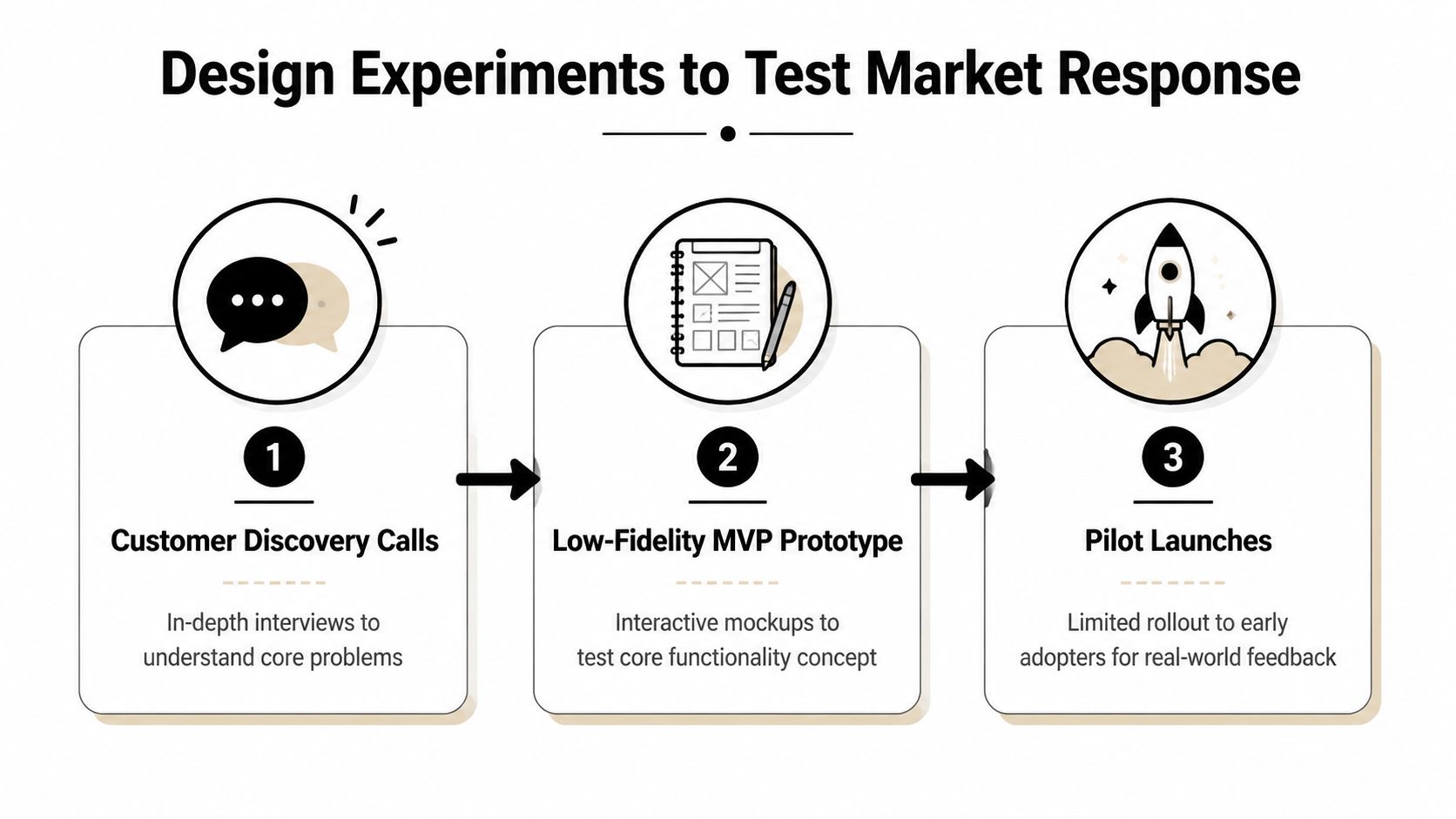
Start with customer discovery calls. You're not pitching. You're hunting for repeated pain. Ask what they do today, what breaks, what they've already tried, and what keeps them awake at night. If three different people describe the same workaround, you've probably found a seam worth testing.
Then build a low-fidelity MVP. A clickable mockup in Figma, a scrappy landing page, a manual concierge workflow, whatever surfaces the core promise without months of engineering. You're looking for friction, confusion, and intent. Not applause. Not compliments. Intent.
Here's the sequence that works.
| Stage | What you're testing | What to look for |
|---|---|---|
| Discovery calls | Problem strength | Repeated pain, repeated language |
| Prototype tests | Usability and clarity | Task friction, drop-off, confusion |
| Pilot launch | Real behavior | Repeat use, reactivation, conversion |
The point isn't to collect opinions forever. It's to move users from “sounds interesting” to “I used this twice” to “I'd be annoyed if it disappeared.” That progression matters because it strips away politeness and exposes demand.
Friends are not a customer segment. Happy users are not a sample. Big-logo accounts are not proof unless they behave like the rest of the market. If you need a structured research loop, interview enough target users to spot repeated patterns, test the rough prototype, then release a small beta and watch what happens when novelty wears off.
Rule of thumb: if your test can't produce a yes, a no, or a clear next step, it's too vague to matter.
You're not trying to build confidence. You're trying to earn it.
Once the experiments run, the numbers stop being decoration and start being the story. The job now is to separate real traction from metrics that just look busy. If your dashboard cannot answer, “Would I scale this?” it is just a very expensive screensaver.
A useful fit check is still the Sean Ellis question. Ask whether users would be “very disappointed” if they could no longer use the product, and base the result on 40–100 survey responses so the signal is not just a couple of loud opinions VivaTech. That benchmark works because it forces people to react to loss, not convenience. Convenience is cheap. Loss is honest.
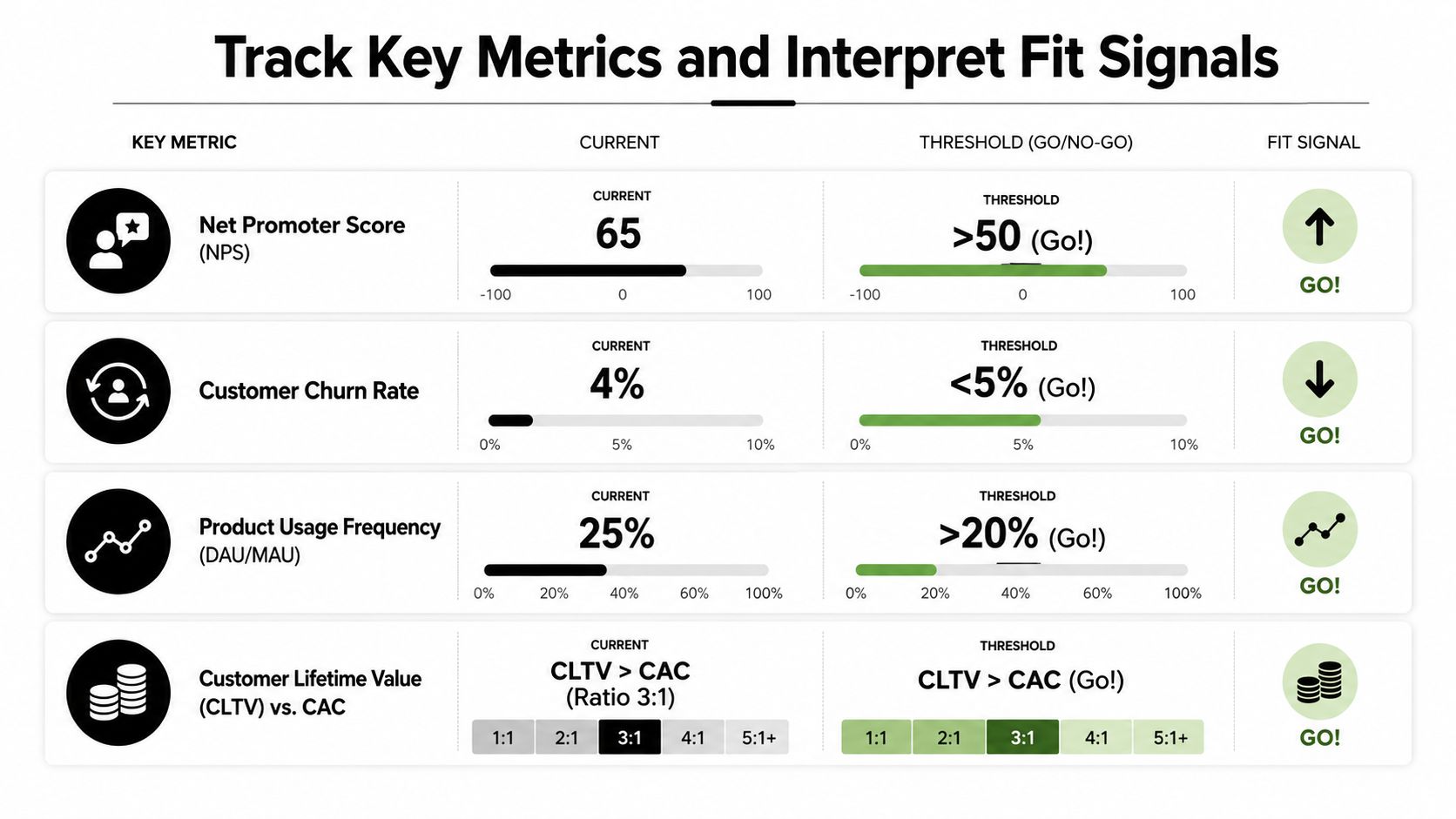
The Sean Ellis question is simple, “How would you feel if you could no longer use this product?” If enough people answer “very disappointed,” you have a strong fit signal. If they say “somewhat disappointed,” that still matters. It usually means the product has interest, but not enough gravity yet to become part of a user's routine.
Retention mechanics give you the harder truth. Analysts and operators at ITONICS point to cohort analysis, retention curves, and median TTV as the cleaner way to see whether users reach value and keep coming back. This is the ultimate test. Signups are noise if activated users do not return on their own.
| Metric | Threshold | Notes |
|---|---|---|
| Sean Ellis “very disappointed” | 40%+ | Strong fit signal when based on enough responses |
| Survey sample size | 40–100 responses | More reliable than anecdotes |
| Retention curves | Consistent repeat use | Look for durable stickiness, not one-off spikes |
| Cohort behavior | Repeat value over time | Early novelty should fade, usefulness should remain |
Big top-of-funnel numbers can still hide weak fit. If users churn quickly, complain about setup, or never touch the core action, the product is leaking value. That is why PMF and scale are different beasts. One tells you the market wants it. The other tells you whether the market wants it enough to stay.
If you are already tracking acquisition, keep that discipline separate and use ad performance metrics to judge paid channels only after the product has earned repeat use. Media buyers care about efficient spend, but you should not hire or scale them until the product can hold attention without constant hand-holding.
The best validation work still starts with real people saying awkward, useful things. Interviews surface the why. Surveys tell you whether the same why shows up again and again. If you lean on only one, you are half blind and weirdly confident, which is a classic founder habit.
Sean Ellis's PMF survey asks, “How would you feel if you could no longer use this product?” and uses 40% or more “very disappointed” responses as a real fit signal. That question works because it forces people to imagine the product disappearing, not just getting a bit less convenient. Convenience is cheap. Absence is revealing.
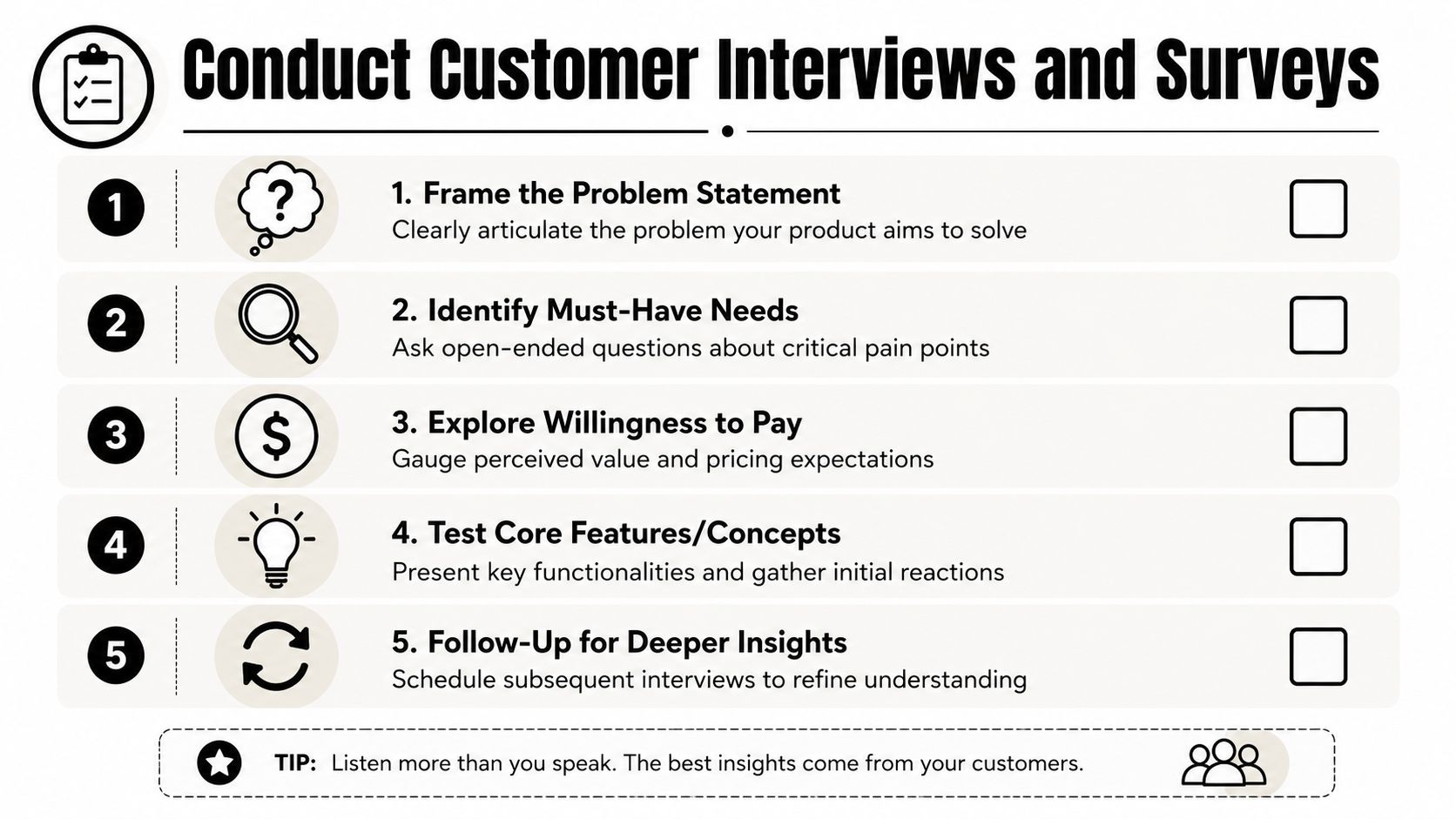
Start with the problem, not the product. Ask what they are trying to fix, what makes it annoying, what happens if they ignore it, and what they have used instead. Do not ask, “Would you use this?” That question is basically an invitation to lie politely.
Then test willingness to pay without turning the interview into a sales call. Ask how they budget for this kind of problem, what a bad workaround costs them, and whether they have already paid for something similar. If someone says they love the idea but will not allocate budget, you learned something useful. It is called a no.
People say “I love it” for all kinds of reasons. They are being nice. They like the demo. They like you. None of that proves fit. What matters is whether the same pain shows up across multiple conversations and whether the product maps cleanly to the workaround they already live with.
Practical rule: if three interviews produce three different problem statements, you do not have a product-market fit problem yet. You have a segmentation problem.
A strong interview does not end with praise. It ends with pattern recognition. Repeated pain. Repeated language. Repeated urgency. That is the raw material for a reliable survey and a sharper go-to-market message. It also gives you the language to brief hires later, especially media buyers. If they know the exact pain and the exact promise that keeps showing up, they can write better creative and waste less spend once fit is proven.
Send the Sean Ellis question to the segment you want, not a random pile of friendly contacts. Add a small set of open-ended questions around the core job, alternatives, and budget. Keep it tight enough that people finish it without rage-quitting.
If the responses cluster around one clear use case, that is a signal. If they scatter across five different use cases, that is a warning. Either way, the survey gives you something better than a founder hunch. It gives you evidence you can defend in front of your team, your board, or your own ego.
Most PMF mistakes are painfully predictable. Founders sample the wrong people, cherry-pick flattering accounts, and call it research. Then the product falls apart the moment it leaves the founder bubble. Shocking, really.
The hard filter is simple. Customers need to know they have a problem, be actively looking for a solution, and have budget to fix it. Miss one of those, and you are fighting uphill with a teaspoon.
The first trap is biased samples. Friends, fans, and big-logo champions are a terrible substitute for a representative cohort. They are often too polite, too invested, or too unusual, and founders still fall for it because optimism is chemically addictive.
The second trap is mistaking enthusiasm for behavior. Someone can adore the product in a call and never use it twice. That is not fit. That is a compliment with a cardigan on.
The third trap is ignoring buying reality. If the customer does not see the problem, is not looking for a fix, or has no budget, the conversation ends there. No amount of positioning magic turns a non-problem into a must-have.
Use real cohorts. Look for repeat use. Track how quickly people hit value. Study the same workaround across multiple conversations. Those are much better signals than a stack of “this is exciting” comments from people who would never survive procurement.
PMF is proven by repeatable behavior, not the loudest voice in the room.
A lot of teams also miss how much segment differences matter. One role may adopt instantly while another stalls at setup. If you do not separate those groups, you will understate the fit or overstate it, and both mistakes get expensive fast. Validate the segment first, then the pattern, then the scale plan.
If you want to sanity-check whether your test design is tied to downstream growth, use incrementality testing for paid acquisition before you start treating early demand like a green light for spend. That keeps you honest when the first paid cohorts arrive and someone starts talking about hiring media buyers before the signal is real.
Once fit shows up, don't go wild. That's how people turn a good signal into a burned wallet. Scale like a grown-up. Tighten the hiring brief, test channels deliberately, and let unit economics tell you what to do next.
If you're planning to hire media buyers or paid ads specialists, brief them against the validated segment, not the generic market. Give them the pain point, the core message, the proof points, and the stage of maturity. A buyer who understands why the segment converts will outwork one who just knows how to launch campaigns.
Your hiring brief should include who the customer is, what job they're hiring the product for, what made them convert, and which objections showed up repeatedly. That turns media buying from guesswork into controlled repetition. It also keeps you from hiring a generalist to solve a problem that's really about message-market alignment.
Use a measured rollout. Start with the channel where your segment already pays attention, then compare the signal across a few controlled tests. If the economics hold, expand. If they wobble, don't pretend more spend will save the day. It won't.
You should be checking whether the cohort that comes in from paid traffic behaves like the users who proved fit. Same activation pattern. Same repeat use. Same willingness to stick. If the paid cohort looks worse, the problem might be the channel, the message, or the handoff, not the product.
For attribution discipline, use incrementality testing so you don't confuse correlation with actual lift. Otherwise, you'll end up congratulating the wrong campaign while the actual drivers sit in the corner, unimpressed.
When the product fits, paid acquisition becomes an amplifier. Before that, it's a smoke machine.
If you want help turning PMF proof into a hiring and acquisition plan that doesn't waste your budget, talk to HireMediaBuyers.com.


