


You know that moment. Monday morning, coffee in hand, dashboard glowing like a slot machine that just hit. Clicks are up. CPA is down. Platform ROAS looks heroic. Your agency deck is practically writing itself.
And yet your stomach says, “Yeah, but would those people have bought anyway?”
That feeling is usually right.
A lot of paid media reporting is just organized credit-grabbing. Platforms are very good at finding conversions. They're even better at claiming them. If you're making budget decisions off attribution alone, you're not measuring causality. You're grading your own homework and acting surprised when you get an A.
I've seen this movie too many times. A brand ramps spend because Meta or Google says performance is “efficient.” Everyone celebrates. Then finance looks at total sales and asks a rude but excellent question: why doesn't business growth match the ad account fairy tale?
That's the crack where incrementality testing becomes necessary.
It answers the only question that matters if you care about real ROI. Did this marketing activity create conversions that would not have happened otherwise? Not “did a customer click.” Not “did a platform touch the journey.” Caused. As in, no campaign, no conversion.
Attribution models are useful for workflow. They're not truth serum. They assign credit to touchpoints. That's different from proving those touchpoints changed the outcome.
If you've ever reviewed a retargeting campaign that looks unbeatable, you know exactly what I mean. Of course it “performs.” It's fishing in a barrel full of people already walking toward checkout. That doesn't make it useless. It does make blind faith expensive.
If you need a refresher on why attribution so often flatters the platform, this breakdown of attribution modeling is worth your time.
Attribution tells a story. Incrementality testing asks whether the story happened because of your ads or in spite of them.
For a long time, incrementality testing sounded like something only giant brands with analysts, consultants, and too many spreadsheets could run. Then Google launched Conversion Lift, which made randomized controlled experiments inside Google Ads much more practical than traditional holdout setups. Google's own explanation also makes a useful distinction: Marketing Mix Modeling gives strategic insight once or twice a year, while incrementality testing is a tactical, short-term tool for operational decisions in live media programs (Google on incrementality testing).
That matters.
It means this isn't just a measurement philosophy for conference panels and LinkedIn philosophers. It's a working method for teams that need to decide whether branded search, YouTube, Meta prospecting, or a promo-heavy campaign is doing anything besides vacuuming up demand that already existed.
A pretty dashboard can still hide waste.
That's why incrementality testing isn't a nice-to-have for “data-mature organizations.” That phrase usually means “we hired three people to explain why nobody can agree on the numbers.” It's a practical discipline for any team that doesn't want to keep paying tuition to attribution vanity metrics.
And yes, that includes smaller teams without a data science department or a sacred internal dashboard named after a Greek god.
Here's the clean definition.
Incrementality testing compares a group that sees your marketing with a group that doesn't, then measures the difference in outcomes to estimate what your campaign caused. That's it. No incense. No black box. No pretending a last-click report discovered physics.
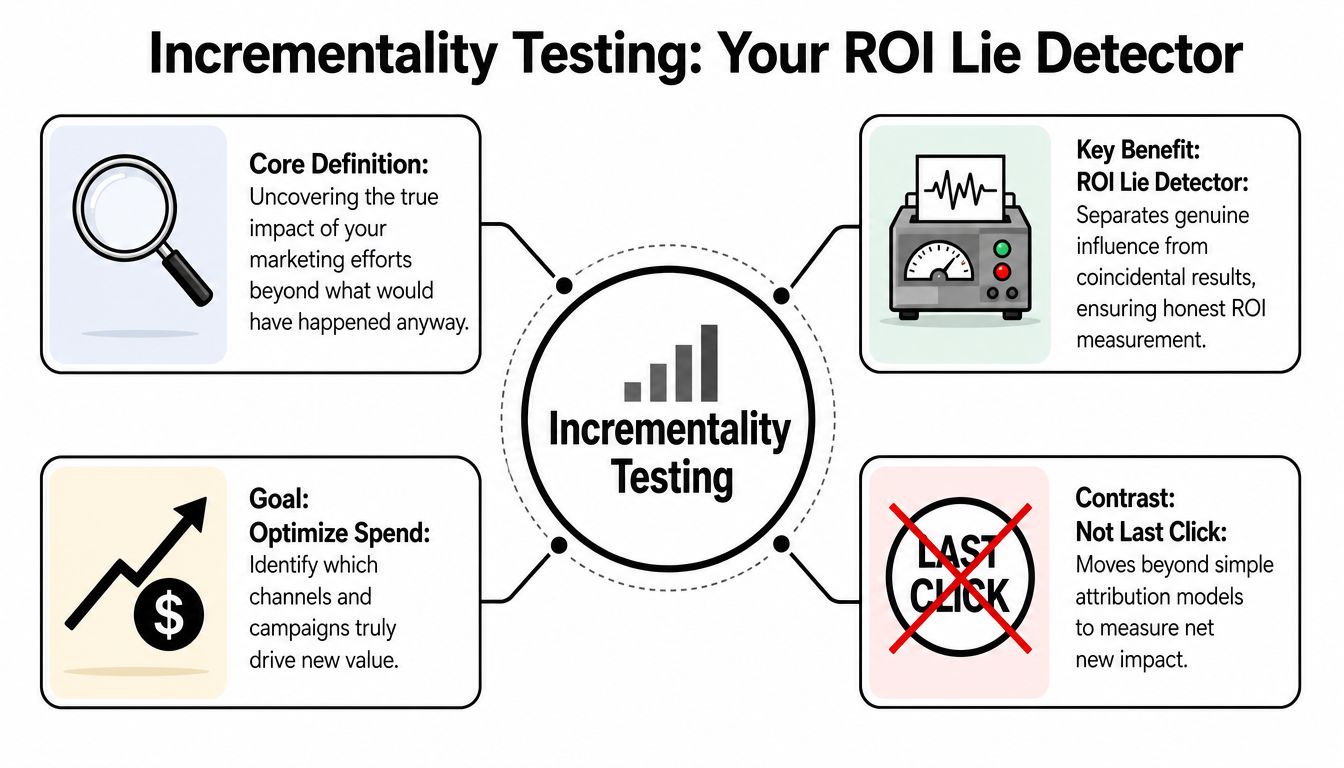
It's like a lie detector for media spend.
Your test group gets exposed to the campaign. Your control group does not. If the test group converts more, that gap is the lift your marketing likely created. If the gap is tiny, zero, or ugly, congratulations, you just learned something useful before setting more cash on fire.
That's why people call it the gold standard. It's built around causal inference, not just credit assignment.
A lot of teams mash three different ideas into one mushy blob:
Those are not interchangeable.
A/B testing is great when you're choosing between two headlines, two landing page layouts, or two offers inside a campaign that's already running. But incrementality testing operates at a different level. It measures the causal lift of the treatment itself, not just which variation wins inside the treatment.
According to Haus on incrementality testing vs A/B testing, incrementality testing requires larger sample sizes and specialized expertise compared to A/B testing because it measures the causal lift of an entire treatment, and one variable must be strictly isolated per test to avoid confounding factors.
Practical rule: If you changed budget, creative, audience, and landing page all at once, you did not run an incrementality test. You created a mystery.
Because attribution is convenient.
It's fast. It's always on. It gives everyone a number to point at in meetings. And if the number looks strong, nobody wants to be the person saying, “Small issue. We might be measuring assisted inevitability.”
Incrementality testing is less flattering and far more useful. It forces you to accept that some channels are brilliant at collecting credit from people who were already going to buy. Toot, toot. Your dashboard hero might be a passenger.
That's why serious operators use incrementality testing when the budget call matters. Not because it's sexy. Because it's the shortest path to finding out which spend is creating net new business.
There isn't one perfect way to run incrementality testing. There's a menu. Some options are practical. Some are overkill. Some sound impressive until your team tries to execute them and half the test gets polluted by overlapping campaigns and an “urgent” promo launch.
Here's the plain-English version.
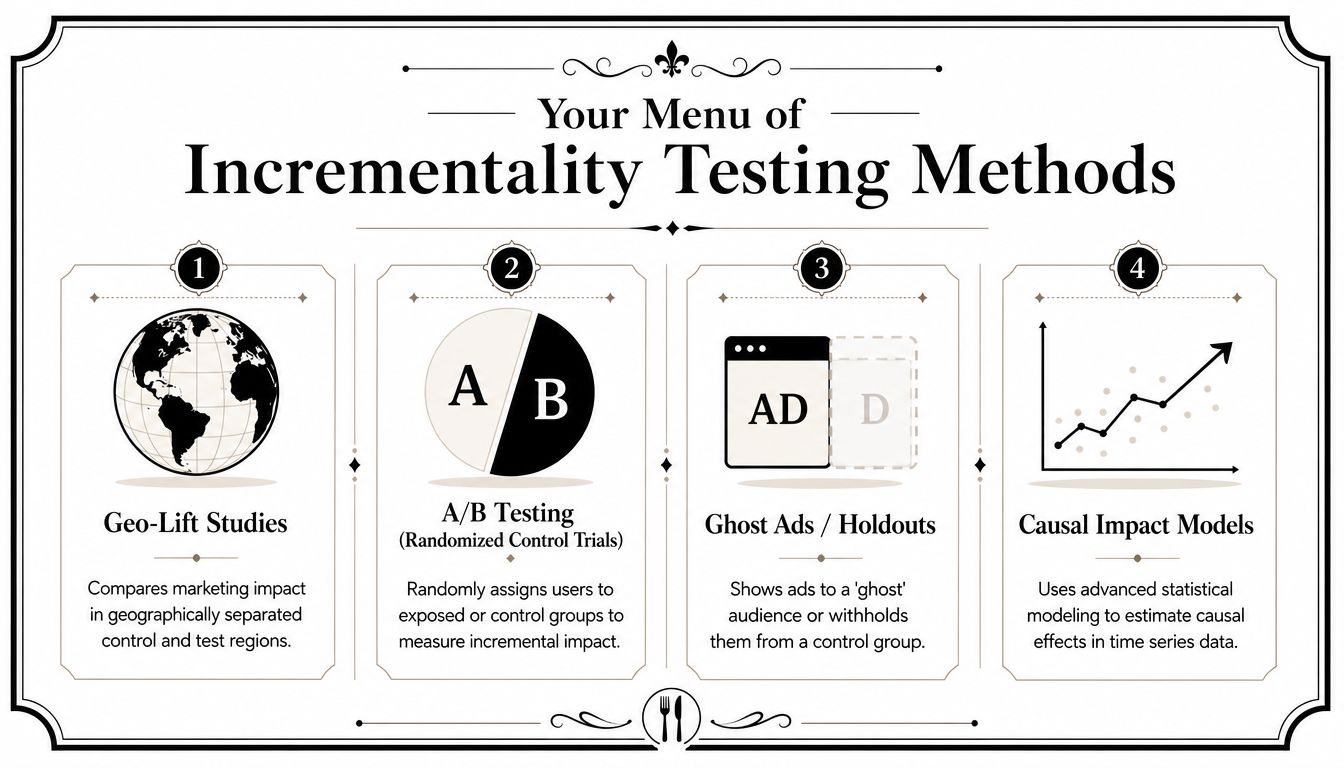
Holdout tests are the workhorse.
You withhold a campaign, channel, or audience segment from a control group and compare outcomes against the exposed group. Clean concept. Often a good starting point for organizations. If you can effectively separate exposure and keep the environment stable enough, this method gives you the clearest answer with the least theater.
Real-world take: this is the burger on the menu. Not glamorous. Usually the right order.
Geo-experiments use location-based splits. One set of markets gets the treatment. Another doesn't. This can work well when user-level randomization is hard, especially for broader channel or budget questions.
The catch is obvious to anyone who's ever marketed across regions. Markets are messy. Promotions differ. Local competition changes. Sales teams do weird things. Your “control” market can stop being a control very quickly if the business doesn't stay disciplined.
Multi-armed bandits get a lot of hype because they dynamically shift traffic toward better-performing options. Useful in optimization contexts. Less useful when your main question is strict causal incrementality.
If your team says “bandit” when what they really need is “clean holdout,” someone's trying to sound clever in a planning meeting.
Uplift modeling and causal impact models can be powerful. They're also not where I'd start if your team still argues over naming conventions in Google Ads.
These methods rely on stronger modeling discipline, cleaner data habits, and more analytical maturity. They can help when direct experimentation is constrained, but they're not a substitute for basic experimental hygiene.
| Method | Best For | Difficulty | Data Needs |
|---|---|---|---|
| Holdout tests | Channel or campaign impact with a clear exposed vs non-exposed split | Moderate | Clean audience separation and reliable conversion tracking |
| Geo-experiments | Regional channel tests when user-level randomization is difficult | Moderate to high | Stable regional data and comparable markets |
| Multi-armed bandits | Allocation among options during live optimization | High | Fast feedback loops and strong platform setup |
| Uplift modeling or causal impact models | Advanced estimation when experimentation is limited | High | Strong historical data and analytical expertise |
For teams without a dedicated data science function, I'd recommend this order:
That sequence saves time and reduces false confidence.
Don't choose a testing method because it sounds advanced. Choose it because it answers a budget question you do have.
Fancy methodology won't rescue a bad question. Start with the business decision, then pick the lightest test design that can answer it.
One more thing. Complexity has a hidden tax. The more moving parts your method involves, the easier it is for your sales promo, creative refresh, or budget reshuffle to contaminate the result. That's why simple often wins in the wild. Not because marketers are lazy. Because businesses are chaotic.
A bad test doesn't just waste money. It creates fake confidence, which is worse. At least wasted spend hurts once. Fake confidence gets invited back into the quarterly planning deck.
Here's the pre-flight checklist.

Pick the primary outcome before launch. Usually that's the conversion event closest to revenue that your team can track cleanly. If your tracking is shaky, fix that first. This guide to conversion tracking covers the basics if your data foundation still has duct tape on it.
Then isolate one variable.
Not one variable “mostly.” One variable, full stop without saying full stop. If you test a new audience while also changing budget and creative, you won't know what caused the difference. You'll just have a pile of movement and a bunch of opinions.
In these situations, marketers get impatient and ruin everything.
A useful benchmark from Amplitude's explanation of incrementality testing is a minimum sample size of 1,000 users per group to confidently detect a 10% lift in conversion rates with statistical power. That means 1,000 in test and 1,000 in control as a starting point for a properly powered read.
If you can't support that scale, don't force a tiny test and pretend the result means something. Shrink the scope, extend the timeline, or choose a more suitable question.
The core calculation is straightforward:
(Treatment Group Results – Control Group Results) / Control Group Results
That formula gives you the percentage lift attributable to the campaign. Not platform-reported fluff. Not vanity engagement. The actual difference above baseline behavior.
Marketers love peeking. Peeking is how weak tests get turned into fake wins.
A test needs enough time to capture normal buying behavior, not just the first burst of response. According to AppsFlyer's guidance on incrementality testing, the duration must be at least one week so the test can capture full customer cycles and avoid being cut short before the data is stable.
If you stop the test because day two “looks good,” you're not measuring incrementality. You're speed-running self-deception.
This isn't glamorous work. It's also the difference between insight and nonsense.
The test ended. The spreadsheet is open. Someone wants a yes or no by noon.
Take a breath.
A result is only useful if you interpret it in context. A positive lift can still be misleading if the test was contaminated. A flat result can be wildly valuable if it tells you a beloved campaign is just collecting credit. And a negative result, while painful, can save you from months of cheerful waste.

Start with the basic question: did the exposed group outperform the control group in a way that makes business sense?
If yes, great. That doesn't automatically mean “scale forever.” It means the campaign likely created incremental value in the conditions you tested. Your next move is usually a follow-up test on a nearby decision, not a victory parade.
If the result is flat, that's not failure. It's evidence. A lot of media teams would save a fortune if they were willing to hear “this channel isn't adding much right now.”
If the result is negative, don't bury it. That's the test doing its job. Better to discover waste in an experiment than in next quarter's P&L.
The ugly stuff usually isn't in the math. It's in the execution.
Triple Whale's incrementality article notes that 82% of misinterpreted incrementality tests stem from uncontrolled external variables, and 67% of marketers run overlapping tests across channels, which leads to a 53% increase in statistical noise that can invalidate lift calculations.
That tracks with reality. Teams say they're testing one thing, then halfway through they launch a discount, refresh creative, boost spend somewhere else, or let another channel overlap the same audience. Then they act shocked when the readout is muddy.
Use this list before you believe any result:
Hard truth: Most “surprising” incrementality results aren't surprising. The setup was sloppy.
Don't treat one test like a sacred tablet.
Treat it like one clean input in an ongoing measurement practice. If the result is strong, validate it in another context. If it's weak, test a narrower audience, different message, or different channel role. If it's messy, don't force a story onto it. Tighten the design and run it again.
The smartest teams don't worship any single outcome. They build a habit of testing, learning, and reallocating spend based on evidence instead of platform charm.
Here's my blunt take. If you're still making serious budget decisions off attribution reports alone, you're gambling in nicer spreadsheets.
The pressure on paid media teams isn't getting lighter. Budgets get scrutinized. Finance wants proof. Leadership wants growth without fairy tales. In that environment, incrementality testing stops being a clever measurement trick and becomes a core operating skill.
You do not need a giant analytics department to start.
You need one testable question. One channel you don't fully trust. One clean control setup. Then you run the experiment and accept the answer, even if it bruises your favorite campaign. Especially then.
Pick one of these:
Run one holdout test this quarter.
Not six tests. Not an “incrementality roadmap workshop.” One real test. Done cleanly. Reviewed objectively. Then use the result to move money, pause waste, or validate a bet.
That's what sharp media buyers do. They don't just launch campaigns. They prove whether the campaigns deserved to exist. That's the difference between someone who can spend budget and someone who can defend it.
And if your agency or in-house team can't do that yet, that gap is the opportunity.
If you need media buyers who can do more than polish attribution decks, HireMediaBuyers.com helps companies find vetted paid ads specialists who understand measurement, testing discipline, and ROI-focused execution. It's a practical way to add operators who can run the campaigns and ask the hard question afterward: did this move the business?


