

You've got the kind of problem that never shows up in a pitch deck. A remote media buyer is crushing your Meta and Google accounts, the numbers look healthy, and everyone's patting themselves on the back. Then the relationship sours, the contractor disappears, and suddenly your best audience segments, testing notes, and creative system are sitting in a competitor's lap like free candy.
That's the ugly truth about intellectual property protection in paid media. The thing you think is “just operations” is often the actual moat. If your advantage lives in account structure, bid logic, creative sequencing, or proprietary audience data, then sloppy hiring is basically volunteering your crown jewels for a midnight handoff.
And yes, this gets worse across borders. A U.S. company hiring in another country isn't just dealing with timezone differences and accent lighting on Zoom. You're dealing with ownership rules, contract enforceability, and exit behavior that can make a brilliant hire either a durable asset or an expensive lesson.
The call started innocently enough. A founder hired a remote media buyer who sounded sharp, moved fast, and knew exactly how to squeeze performance out of a tired ad account. Six months later, the buyer was gone, the competitor's campaigns suddenly looked a lot like the company's old playbook, and the founder was left staring at familiar copy angles, audience logic, and optimization patterns with that special brand of nausea only founders know.
That is what happens when intellectual property protection gets treated like a legal cleanup task instead of a hiring requirement. Once a media buyer has access to your account structure, your creative testing notes, and your internal SOPs, the damage does not need a court battle to become real. It can happen in one afternoon, with a screenshot, a download, or a memory.
Practical rule: if a remote hire can explain your winning strategy better than your in-house team can, assume they can also walk away with it.
It is rarely a movie-villain theft scene. It is usually a spreadsheet, a naming convention, a landing page workflow, or a custom attribution model that never got documented properly.
That matters because the right protection depends on the right classification. Patents, trademarks, copyrights, and trade secrets each cover different slices of your paid media stack, and if you shove everything into one generic NDA, you are mostly buying yourself a false sense of security. WIPO's published IP data shows how hard businesses still compete over formal protection, including millions of patent filings worldwide, which is a reminder that serious companies protect ideas through actual legal channels, not optimism alone (WIPO IP statistics).
The rest of this guide is for founders who want the important parts to work before the drama starts. Not the legal-theater version of protection, the version that helps when a contractor leaves with your playbook.
If you're hiring remote media buyers, your first job is to stop treating every asset like it belongs in the same bucket. It doesn't. A clean intellectual property map is the difference between a clause that protects your business and a clause that just makes everybody feel professional on paper.
Patents protect inventions, not vague “ideas.” In U.S. patent law, utility and plant patents last 20 years, while design patents last 15 years, and protection only exists after application, examination, and fees (University of Wisconsin IP lesson). For media buying, this is usually the wrong bucket unless you've built a novel technical system.
Trademarks protect brand identifiers, like your agency name, your product name, or a distinctive campaign brand. If your paid ads team creates a recurring offer identity or branded content series, the name and logo behavior matter here. WIPO's broader IP framework notes that IP protection is legally recognized through patents, copyright, and trademarks because creators and inventors need a way to earn recognition or financial benefit from what they make (WIPO Facts and Figures 2025).
Copyright covers original expression. In practical terms, that means training decks, written ad copy, landing page text, video scripts, design files, and documentation. Copyright protection generally starts automatically when the work is created, and in Berne Convention countries no registration is required for protection to arise (Copyright Essentials PDF).
Trade secrets are the sneaky one, and usually the most important for paid media teams. Your internal bidding rules, custom attribution logic, lookalike-audience method, internal dashboards, and private optimization playbooks can fit here if you keep them confidential. That means access controls, NDAs, and limiting who can see what. If everyone in Slack can open the “secret sauce” folder, it's not a secret. It's office wallpaper.
Use this checklist on every asset you touch:
The point isn't to over-lawyer everything. It's to stop using the wrong tool on the wrong asset. A contract that says “all IP is owned by us” sounds nice. It also falls apart fast if you never defined what “IP” means in the first place.
Most NDAs fail for the same reason most bad ad accounts fail. They're vague, bloated, and written by someone who thinks volume equals strength. It doesn't. If your contract can't tell a contractor exactly what they can't use, can't share, or can't keep, you've built a paperweight.
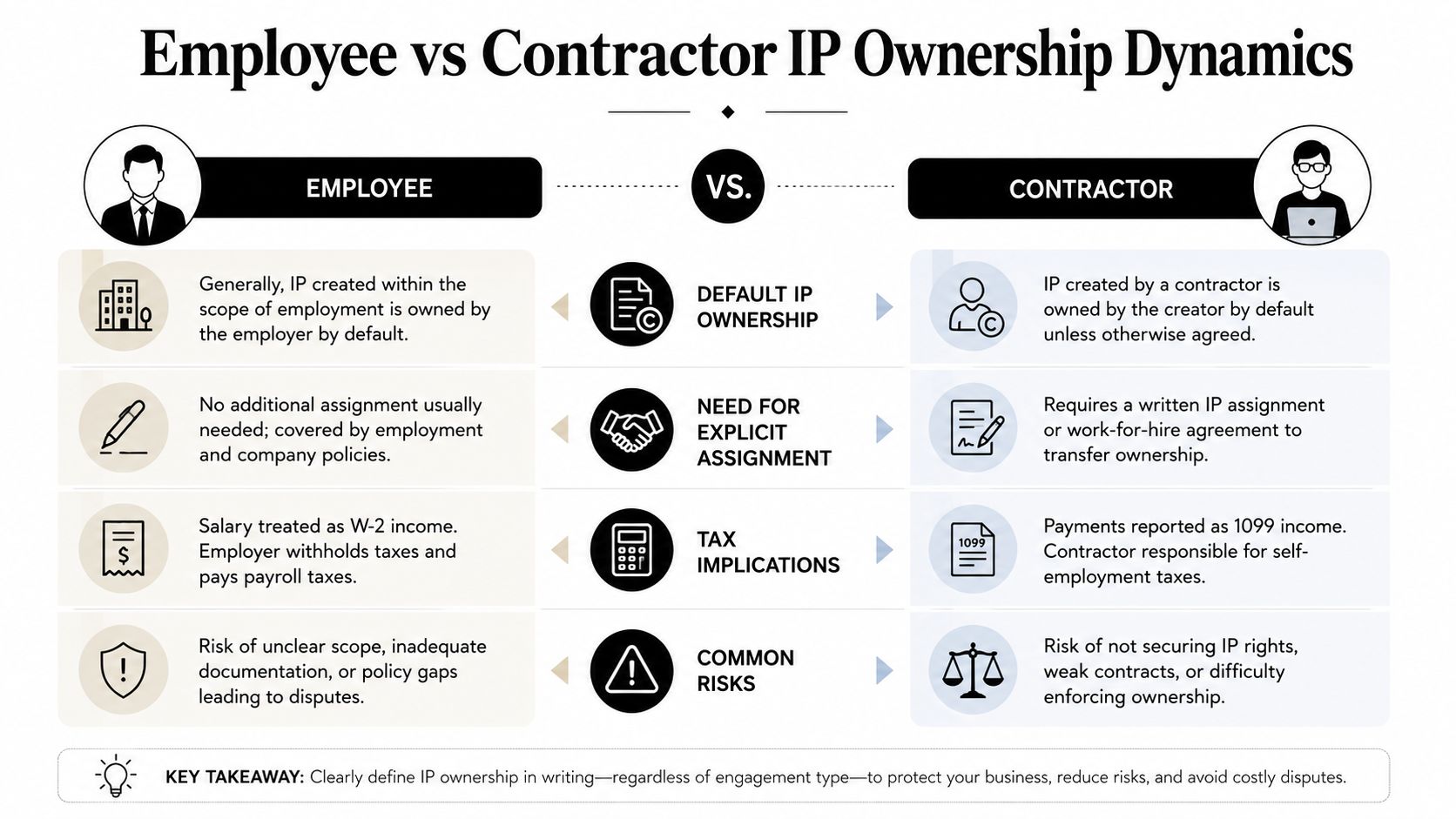
Start with a tight definition of Confidential Information. Don't say “anything we tell you.” That's lazy and easy to fight. Define categories, like account data, media plans, creative briefs, customer lists, test results, internal dashboards, pricing logic, and any non-public process documents.
Then add an IP assignment clause that says every work product created in the engagement belongs to the company on creation or assignment, depending on local law. You want the clause to cover drafts, edits, derivatives, and process documentation, not just the final ad copy that made it into the account.
You also need survival language. Confidentiality shouldn't evaporate when the contractor logs off for the last time. Put plain, durable wording in the agreement that protects obligations after termination. That's the part people skip when they're in a rush, and it's the part that makes the difference when somebody gets a better offer and starts behaving creatively.
Practical rule: if the clause only works while the person is actively on payroll, it's not a protection clause. It's a mood.
People love the phrase work for hire because it sounds clean. In reality, it's only part of the story, and sometimes not even the part you need. For independent contractors, you want a written IP assignment clause in addition to any work-for-hire language, because contractor-created work often doesn't default to the company the way employee-created work can.
A sloppy contractor agreement usually leaves three loopholes:
If you're hiring through a marketplace or vetted recruiting platform, don't just ask whether they “support IP ownership.” Ask to see the actual ownership language, the assignment flow, and the offboarding process. A shiny interface is cute. A contract that survives scrutiny is better.
For a deeper practical look at contractor setup language, use this reference on social media contracting details.
A lot of founders assume a non-compete will save them. Sometimes it won't, and in many remote hiring setups it's not the clause you should obsess over first anyway. If you can't protect the underlying strategy, arguing over who can work where next is just rearranging deck chairs.
Focus first on confidentiality, assignment, and access restrictions. Then tighten post-termination obligations, non-solicitation where lawful, and return-of-materials language. That's the stack that gives you a fighting chance.
The tax savings look great until the ownership question shows up. Then the core issue hits, employee IP and contractor IP sit under different rules, and the gap gets expensive fast for US companies hiring remote media buyers across borders.
In many jurisdictions, work created by employees in the course of employment belongs to the employer by default or by a stronger legal presumption. That is why the employee model usually gives cleaner intellectual property protection, especially when the person is building campaign systems, internal playbooks, or creative assets every week.
Cleaner still does not mean automatic. You still need employment agreements, invention assignment language, confidentiality terms, and disciplined access control. Leave those out, and you are betting that default law will rescue bad paperwork. It will not.
Contractors are where companies get burned. Their work often belongs to the creator unless the contract says otherwise, and if your agreement is vague, the contractor can make a serious ownership claim. That gets especially ugly when the deliverable is not a single ad but a system, a library, or a strategy stack built over months.
The tradeoff is straightforward. Contractors are flexible, often cheaper to onboard, and easier to scale across time zones. Employees usually give you stronger ownership clarity and more operational control. If you are using contractors for media buying, a friendly Slack channel does not replace assignment language.
A company that calls someone a contractor while managing them like an employee creates tax problems and IP problems at the same time. If the relationship is misclassified, the whole legal structure becomes shaky, and the clauses you paid for can start looking like expensive paperweights.
If you are using an offshore hiring process, read the platform's hiring and compliance terms before you assume the workflow has solved the legal side for you. Terms matter more than branding, especially when ad accounts, access rights, and work product all sit in different countries.
WIPO's recent patent activity shows how concentrated filing volume remains in major markets, with China and the United States far ahead of many other jurisdictions, which is a reminder that protection strategy has to match the places where your people and your assets sit (WIPO IP statistics, WIPO World Intellectual Property Indicators). If you hire globally, you are not just hiring talent. You are stepping into different legal systems, and the contract has to hold up in the one that matters.
You hired in Manila, São Paulo, and Cape Town because talent does not care about your headquarters zip code. Good. Now you have to care about what happens if a contractor in another country walks off with your media system.
The biggest mistake founders make is assuming one contract solves everything. It does not. Intellectual property protection is territorial, so enforcement depends on where the work was created, where the person is located, where the company is based, and where the dispute gets heard.
TRIPS changed the rules by forcing a baseline across member countries. The TRIPS Agreement was signed on 15 April 1994 in Marrakesh and entered into force on 1 January 1995 as part of the WTO framework. It became one of the main global legal turning points for IP because it set minimum standards across copyrights, trademarks, geographical indications, industrial designs, patents, integrated-circuit layout designs, and trade secrets, and it applies to all 147 WTO members (TRIPS overview).
That does not mean enforcement is smooth. A country can be bound by the same multilateral framework and still be difficult to deal with when you need quick relief.
| Region | TRIPS Member | US Bilateral Treaty | Enforcement Reliability |
|---|---|---|---|
| United States | Yes | N/A | Strong in domestic courts, but remedies depend on the facts |
| Major EU markets | Yes | Varies | Generally stronger institutional enforcement |
| Latin America | Yes | Varies by country | Mixed, depends on court speed and local practice |
| Southeast Asia | Yes | Varies by country | Uneven, contract drafting matters a lot |
| Sub-Saharan Africa | Yes | Varies by country | Mixed, local execution can be the bottleneck |
This is a judgment call, not a scorecard from heaven. The question is whether your contract gives you an advantage before you ever need a judge. That means clear forum selection, governing law where enforceable, and practical access controls that do not depend on legal miracles.
If your contractor lives abroad, your best protection is usually a boring stack of controls. Limit access to only what they need. Keep sensitive documents segmented. Use centralized storage. Make sure the working files live where you can revoke access instantly.
If you are structuring an offshore hiring process, read the platform's hiring and compliance terms before you assume the workflow has solved the legal side for you, and use offshore hiring considerations as a check on how much control you keep.
The TRIPS dispute history also tells you something useful. Since 1 January 1996, WTO members have filed 45 requests for consultations referring to TRIPS, which shows that IP protection is not some sleepy back-office topic. It is a recurring trade issue that shows up when commercial interests collide (TRIPS overview).
When a remote media buyer copies your audience logic, your campaign structure, or your creative testing framework, the first instinct is usually to send an angry message and start building a case in your head. Do not do that. Move fast, keep records, and stay controlled.
The first move is usually a cease-and-desist letter. Keep it factual. Name the asset, state the ownership basis, identify the unauthorized use, and say exactly what you want stopped or returned. No theatrics, no threats, no email that reads like a personal vendetta.
Then use the platform tools if the copied material is sitting inside an ad account or public channel. Meta, Google, and similar platforms have reporting and takedown paths for certain rights violations, and those are often faster than court if the infringement is obvious. The point is to stop the misuse while the evidence is still fresh and the trail is still easy to follow.
If you hired through a marketplace or staffing workflow, review the platform's own compliance check process before you assume the paperwork already protects you. Too many teams skip that step and find out too late that the platform handled logistics, not ownership.
If a dispute turns into a real claim, the winning file is usually the boring one. Keep original drafts, timestamps, access logs, file history, account permissions, signed agreements, and proof of who created what and when. If you cannot show ownership and sequence, you are asking a judge to sort out gaps that should have been documented from the start.
Keep a clean trail from the first brief to the final deliverable. If it lives only in a DMs thread and two people's memories, it is fragile.
The same discipline matters for cross-border hiring. A contractor in another country can disappear from Slack in minutes, but screenshots and file exports are harder to erase. Build your records as if you will need them in a hearing, because sometimes you will.
Some theft is worth pursuing. Some is not. If the stolen asset is peripheral, or the other side is in a slow forum and unlikely to pay, a lawsuit can burn cash without changing the outcome. That is not a moral failure. It is basic capital allocation.
If the stolen material is part of your core revenue engine and the other side is using it to win accounts, then you need to think about injunctions, damages, and where pressure works. For patent disputes, WIPO Patentscope is a useful place to examine prior rights and filing history before you spend money on an enforcement theory. For broader international trade pressure, WTO members have filed dozens of consultation requests referring to TRIPS issues, which shows that IP disputes keep showing up as commercial fights, not academic debates.
For remote hiring, the hard truth is simple. Your contract matters, but your access controls matter more. If a media buyer never had broad access to begin with, your enforcement position is cleaner, your evidence is easier to defend, and your odds of stopping the damage are better.
Here's the playbook I'd use if I were hiring remote media buyers this quarter.
The blunt version is this. Intellectual property protection only works when legal language, hiring workflow, and access control all point in the same direction. If one of those is sloppy, the others don't get to pretend they're doing cardio.
If you're hiring remote media buyers or paid ads specialists and want the contract, vetting, and ownership pieces handled without guesswork, HireMediaBuyers.com is built for exactly that kind of hiring. It gives U.S. companies a way to hire vetted talent with the IP ownership and compliance guardrails that keep “we trusted them” from becoming your postmortem.


