

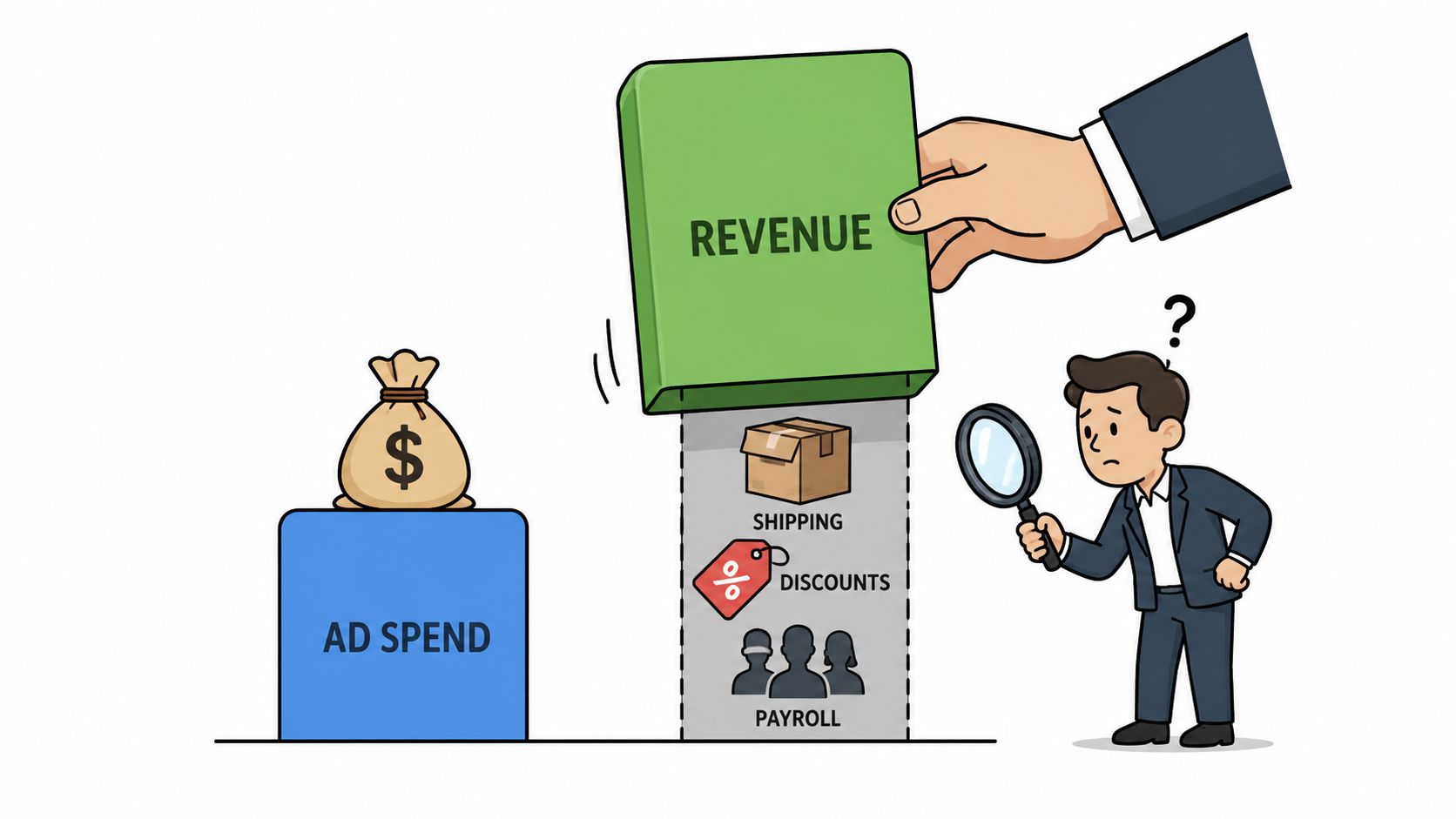
Return on ad spend, or ROAS, is the ratio of revenue generated from ads to the amount spent on those ads. A 4.33:1 revenue-based ROI and a 2.50:1 profit-based ROI can both look “good,” but they are not the same thing, and ROAS measures revenue efficiency, not profit Statista's 2024 benchmark.
That's the bit most advice gets wrong. People talk about ROAS like it's a profit scorecard, then act shocked when a campaign that looked like a genius on paper still burns cash after product costs, fulfillment, payroll, discounts, and overhead take their bite. Been there. Toot, toot.
The classic mistake is simple, and expensive. A founder sees a 5:1 ROAS, buys themselves a little victory lap, and forgets to ask whether the business kept any money after the rest of the machine took its cut.
ROAS is the ratio of revenue generated from ads to ad spend. That means it tells you how much revenue came back for every dollar out the door, which is useful, but only as a revenue-efficiency metric. It is not a profit metric, and it never was Amazon's ROAS guide.
That distinction matters because a campaign can look strong on ROAS while still being margin-negative once you include the actual business costs. Product cost, shipping, payroll, software, discounts, and overhead all show up after the ad platform has already congratulated itself. That's why ROAS without margin is basically a shiny dashboard with a blind spot.
Practical rule: if you're celebrating ROAS before checking contribution margin, you're probably applauding the wrong number.
The healthiest way to think about ROAS is bluntly: it's a traffic quality and bidding signal, not a full business verdict. Use it to see whether one campaign is outperforming another, or whether one creative is pulling more revenue than the rest. Don't use it to decide if the company is healthy enough to keep lighting money on fire.
That's also why people get trapped by “good ROAS” advice. A number that looks fantastic in one business can be mediocre in another, because margins, channel mix, and attribution quality all change the game. If you want to know whether your ads are helping, you need to read ROAS with a cleaner lens than most ad accounts ever get.
The math is refreshingly boring, which is part of the appeal. ROAS = revenue from ads ÷ ad spend. Some teams write it as a multiple, some as a ratio, and some as a percentage.
If you spend $200 and generate $1,000 in revenue, your ROAS is 5:1. If you prefer percentages, that's 500% GrowthLoop's formula guide. Same outcome, different packaging. Fancy labels won't save messy math.
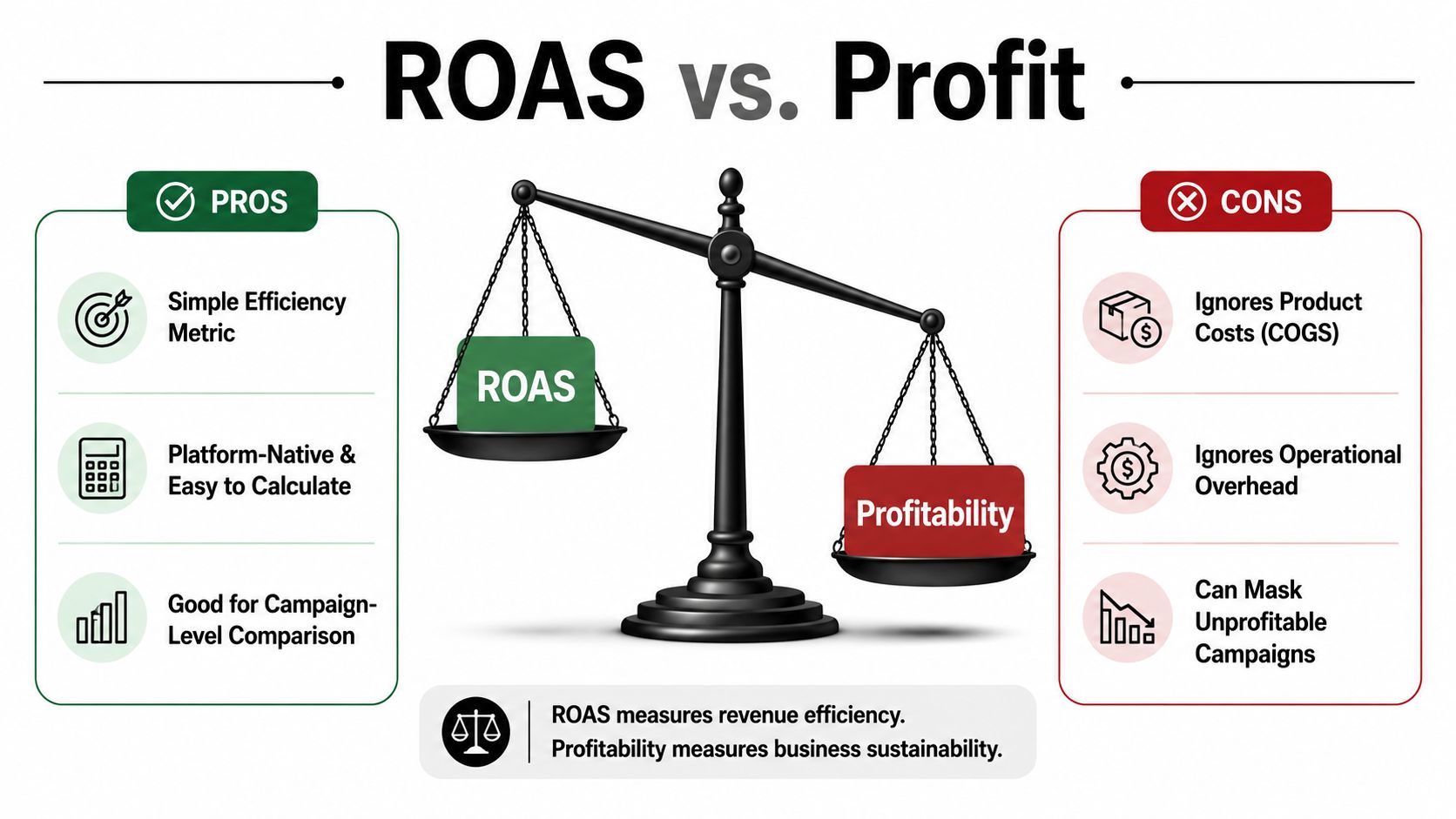
The denominator is where people cheat, usually by accident. Ad spend should include the money paid to ad platforms for impressions and clicks, and it should not include creative production, agency fees, attribution tools, or salaries, because those belong in the broader marketing budget ad spend definition. If you mix those costs into the denominator, you stop measuring ROAS and start inventing your own accounting system.
Use this mental model:
One common mistake is to mix revenue from ads with total business revenue. That inflates the number and makes paid media look more magical than it is. Another mistake is to use gross revenue without understanding whether the attribution window was long enough to capture the actual conversion cycle. The math may be simple, but the inputs can be slippery.
The cleanest habit is to calculate ROAS the same way every time, then compare like with like. If one dashboard uses platform spend and another includes payroll, you're not comparing performance, you're comparing bookkeeping styles.
ROAS is a ratio, which means it is built to compare one number against another. It tells you how much attributed revenue came back for each dollar of ad spend, and that is useful. It still leaves the business question untouched.
The trap is treating that ratio like a profit statement. Revenue can look healthy while contribution margin gets squeezed by product cost, shipping, support, discounts, and overhead. That is why a campaign can make the dashboard look impressive and still be a weak trade for the business. Northwestern Kellogg on ROAS limits
The right way to use ROAS is as a tactical filter. It helps you compare campaigns, trim waste, move budget between ad sets, and decide which creative deserves more spend. It also helps you spot where a channel is producing revenue efficiently but not necessarily profitably.
The useful question isn't “Is ROAS high?” It's “Is this ROAS high enough for this margin structure, this channel, and this business model?”
That question is the one that keeps teams honest. A luxury brand with healthy margins can live with a lower ROAS than a commodity brand with thin margins. A subscription business can also tolerate a different threshold than a one-time purchase model, because future value changes the math. Same ratio, different economics, different answer.
The mistake is using ROAS as if it were the final score. It is not. It is a control metric, not a business verdict. If you want to know whether paid media is worth scaling, you have to ask what contribution margin remains after the ad click turns into a real order, not just attributed revenue.
ROAS belongs at the level where the number can still guide a decision.
For a side-by-side breakdown of the metrics people confuse most often, this guide on ad performance metrics is useful. The point is simple. ROAS helps you allocate spend. Profit helps you stay alive. Use the ratio for media decisions, then sanity-check it against contribution margin before you celebrate.
These metrics get mashed together because they all look like they belong in the same spreadsheet. They don't. Each one answers a different question, and if you use the wrong one, you'll optimize the wrong thing with total confidence, which is the most expensive kind of confidence.
| Metric | What It Measures | Best Used For | Main Blind Spot |
|---|---|---|---|
| ROAS | Revenue generated per dollar of ad spend | Campaign, channel, and creative comparison | Ignores product cost and overhead |
| ROI | Return after broader costs and investment | Business-level profitability decisions | Can be too coarse for ad-by-ad optimization |
| CPA | Cost per acquisition | Bid control and efficiency at the conversion level | Doesn't show revenue quality or margin |
| LTV | Total value a customer may generate over time | Long-term channel strategy and budget planning | Slow to measure and easy to overestimate |
CPA is your daily steering wheel. It tells you what it costs to get a conversion, which matters when a campaign starts drifting and you need to bring it back under control. ROAS sits one layer above that, because it shows whether the revenue tied to your spend looks efficient enough to keep funding.
ROI zooms out further. That is the better lens when you want to know whether the business is keeping enough after all costs are counted. LTV goes wider still, especially if repeat purchases or renewals matter. If you sell subscriptions, replenishment products, or anything with meaningful repeat behavior, LTV can save campaigns that look mediocre on same-day ROAS but are building durable value.
The rule of thumb is brutally practical. Use ROAS for tactical decisions, ROI for business decisions, CPA for efficiency checks, and LTV for long-term strategy. If you keep asking ROAS to explain everything, you are making it do accounting work it was never built for.
That is how dashboards get theatrical. One metric says “great,” another says “awful,” and the answer usually lives in the gap between them. Pick the metric that matches the decision in front of you, not the one that flatters your mood. For a clearer breakdown of ad performance metrics, use the metric that fits the question you are trying to answer.
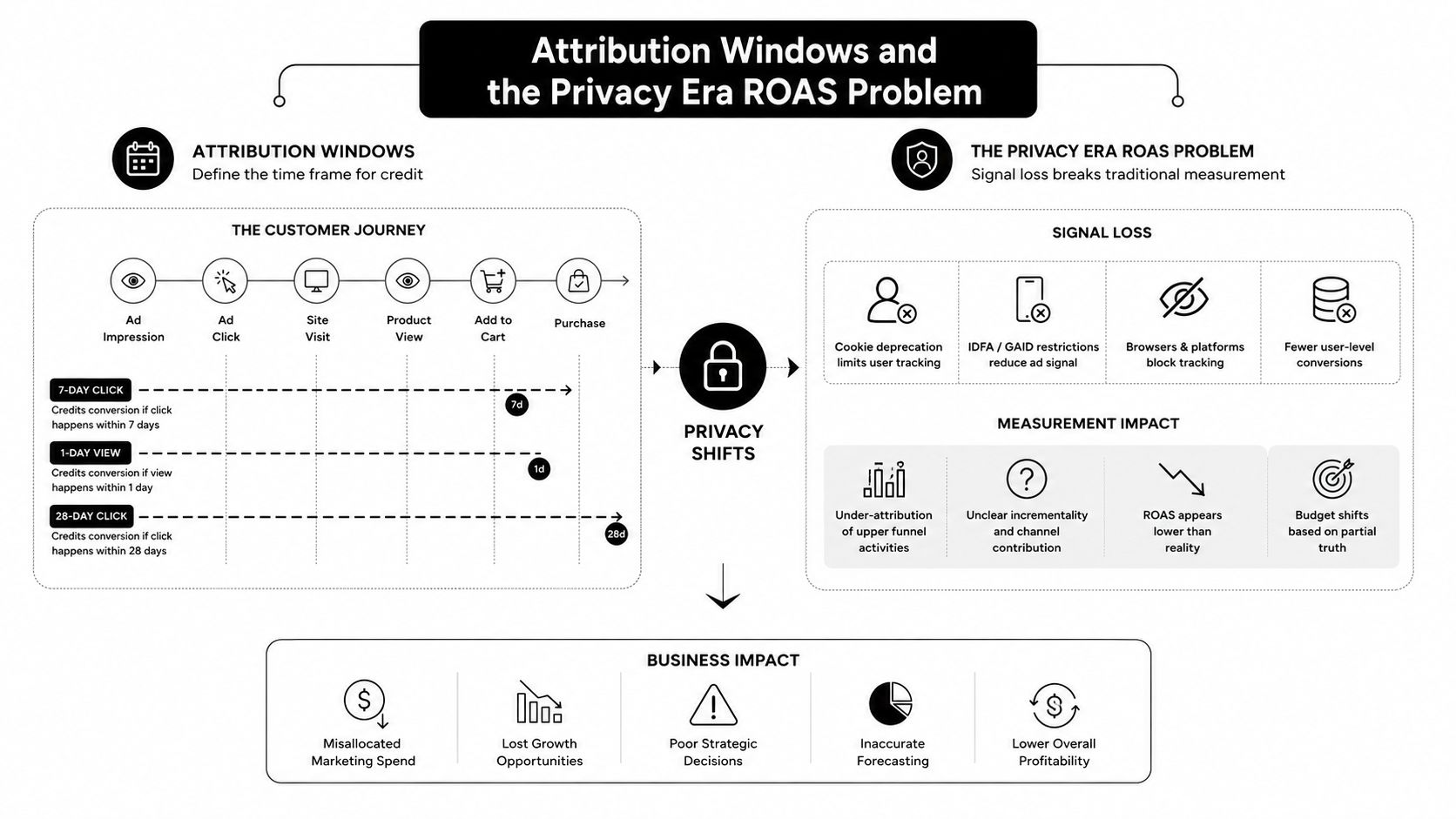
ROAS gets weird the moment attribution gets messy, which is basically the modern internet. A campaign can look brilliant in one dashboard and average in another, not because the ads changed, but because the measurement method did.
Attribution windows matter because the same campaign can look stronger or weaker depending on whether you measure same-day revenue or a longer cohort window. A short window undercounts slower buyers. A longer window can make a campaign look better than the revenue it directly influenced. Neither view is pure truth on its own.
Privacy changes and multi-channel behavior make that worse. Last-click ROAS can heavily favor lower-funnel activity and understate upper-funnel channels, while modeled approaches can redistribute credit in ways that platform dashboards never will. That's why the same channel can show very different values across platform ROAS, GA4, and modeled reporting. It's not magic. It's methodology.
Practical rule: if one dashboard is telling you the truth while the others are all lying, you're probably looking at attribution bias, not business genius.
The best move is to triangulate. Start with platform ROAS, compare it to analytics or modeled reporting, then ask whether the result makes sense against conversion volume, CPA, and downstream revenue quality. If those numbers disagree wildly, don't pick a favorite and call it strategy. Investigate the measurement setup.
For a deeper look at how attribution methods change what you think you know, see attribution modeling. The point isn't to worship a perfect model. It's to stop treating one dashboard number like it came down from the mountain with a stone tablet.
A lot of teams get mugged by their own data. Upper-funnel activity often helps create demand, but last-click reporting hands all the glory to the final click and acts innocent. That's how good spend gets cut and mediocre spend gets rewarded. Annoying? Absolutely. Common? Also yes.
You don't improve ROAS by staring harder at the dashboard. You improve it by changing the inputs that make the number behave. The trick is to do that without gaming the metric on low-incrementality spend, because nobody needs a fancier way to over-credit branded search.
Creative testing comes first. Weak hooks, stale angles, and recycled assets are usually the fastest way to waste budget. If one message keeps winning, mine it harder instead of throwing five more vague variations into the abyss.
Audience segmentation comes next. Separate new demand from existing demand, and stop letting one bucket subsidize the other. If branded traffic and prospecting are blended together, ROAS will happily lie to your face while the business pays for it.
Bid strategy needs a reality check too. Tighten what's clearly inefficient, but don't starve campaigns that create new demand just because they don't look glamorous in last-click reporting. The same goes for landing pages. If the click is good and the page is weak, your ad account is carrying a broken shopping cart uphill.
Don't confuse better reporting with better performance. A prettier number isn't the same thing as more incremental revenue.
A practical 30-day checklist looks like this:
If you want a structured way to pressure-test what's really incremental, this guide helps: incrementality testing. That matters because the goal isn't just higher reported ROAS. The goal is more profit from spend that causes growth. Anything else is just accounting cosplay.
This is also the point where a vetted media buyer can save you from expensive self-education. If your team keeps tweaking campaigns without a measurement plan, you'll keep confusing motion with progress. And your ad account will keep sending you smug little reports while your margin sulks in the corner.
There's a point where “let's try another test” turns into a very expensive hobby. If ROAS has plateaued, attribution is a mess, channel sprawl is growing, and CPA is rising even as spend increases, you're probably beyond the DIY phase.
The first warning sign is stubborn performance. Not bad performance, stubborn performance. You keep changing bids, audiences, and creative, but the account refuses to move. The second warning sign is measurement confusion, where nobody in the room agrees on which ROAS number is real.
That's when outside eyes help. HireMediaBuyers.com connects companies with pre-vetted Media Buyers and Paid Ads Specialists across Meta, Google, LinkedIn, TikTok, Microsoft/Bing, Apple Search, Pinterest, YouTube, and more, with remote hiring and flexible contracts. It's one option when you need someone who can manage budget, attribution, and channel trade-offs without turning the account into a science project.
If those feel uncomfortably familiar, that's your cue. Don't wait until the next budget cycle turns into a postmortem.
If you're tired of ROAS numbers that look prettier than they perform, HireMediaBuyers.com can help you find vetted paid media talent that knows how to read the metric without getting fooled by it. The right operator will separate revenue efficiency from profit, spot attribution noise fast, and keep your budget from wandering off into vanity-metric land.


