


Your phone lights up, your inbox is already a mess, and now there's a fresh note from a client who thinks your team “missed the point.” Lovely. The worst part isn't even the criticism, it's the split second where your brain wants to fire back, over-explain, or pretend the message never arrived. That reflex feels personal, but it's often your nervous system doing what nervous systems do, which is panic first and think later.
The smarter move is to treat negative feedback response like a control problem, not a courtroom drama. Real systems correct drift by detecting the gap, comparing it to a reference point, and pushing the variable back toward normal range, that's the basic logic of negative feedback in control systems and physiology (negative feedback in control systems and homeostasis). In plain English, the goal isn't to adore criticism. It's to separate useful correction from noise before you torch half your afternoon defending a bruise.
The first instinct after a bad review lands is usually some flavor of self-preservation. You want to explain the context, prove the client was difficult, or at least draft a reply that says, “If you'd read the brief…” That urge is human. It's also usually the wrong first move.
Negative feedback doesn't stay in the polite, managerial part of your brain. It can trigger stress, defensiveness, and the kind of emotional spike that makes a small comment feel like a full-scale ambush. Academic work in the brief points to a link between negative emotionality and stronger negative-feedback processing, along with abnormal rostral ACC activation, which suggests the reaction isn't just ego theater, it's partly neurobiology. Harvard Business Review also notes that feedback that feels belittling or humiliating can impair performance instead of improving it (HBR on feedback crossing the line).
That matters because a lot of public advice still treats all criticism as if it were equally constructive. It isn't. Some feedback is data. Some of it is just someone trying to make you feel small, and that's a very different animal.
Practical rule: if the comment attacks competence, character, or status more than behavior, slow down. Useful criticism can sting. Humiliation is just noise with a keyboard.
A peer-reviewed NIH article says negative but informative feedback can help later performance, which is the part people love to skip over when they're busy sulking or swinging a verbal chair (NIH article on informative negative feedback). That's the key distinction. Feedback earns your attention when it contains something you can act on.
The best founders I know don't try to feel great about criticism. They ask one blunt question: Does this tell me something I can change? If yes, it's worth processing. If not, it gets filed under “emotional weather,” and nobody builds a strategy around weather.

The trick is to stop treating every complaint like a verdict. A negative feedback response works best when you first decide whether you're looking at a fixable operational issue, a clumsy delivery, or a straight-up emotional grenade. That first sort saves your sanity and keeps you from spending the afternoon mortgaging your office ping-pong table to win an argument with someone who already made up their mind.
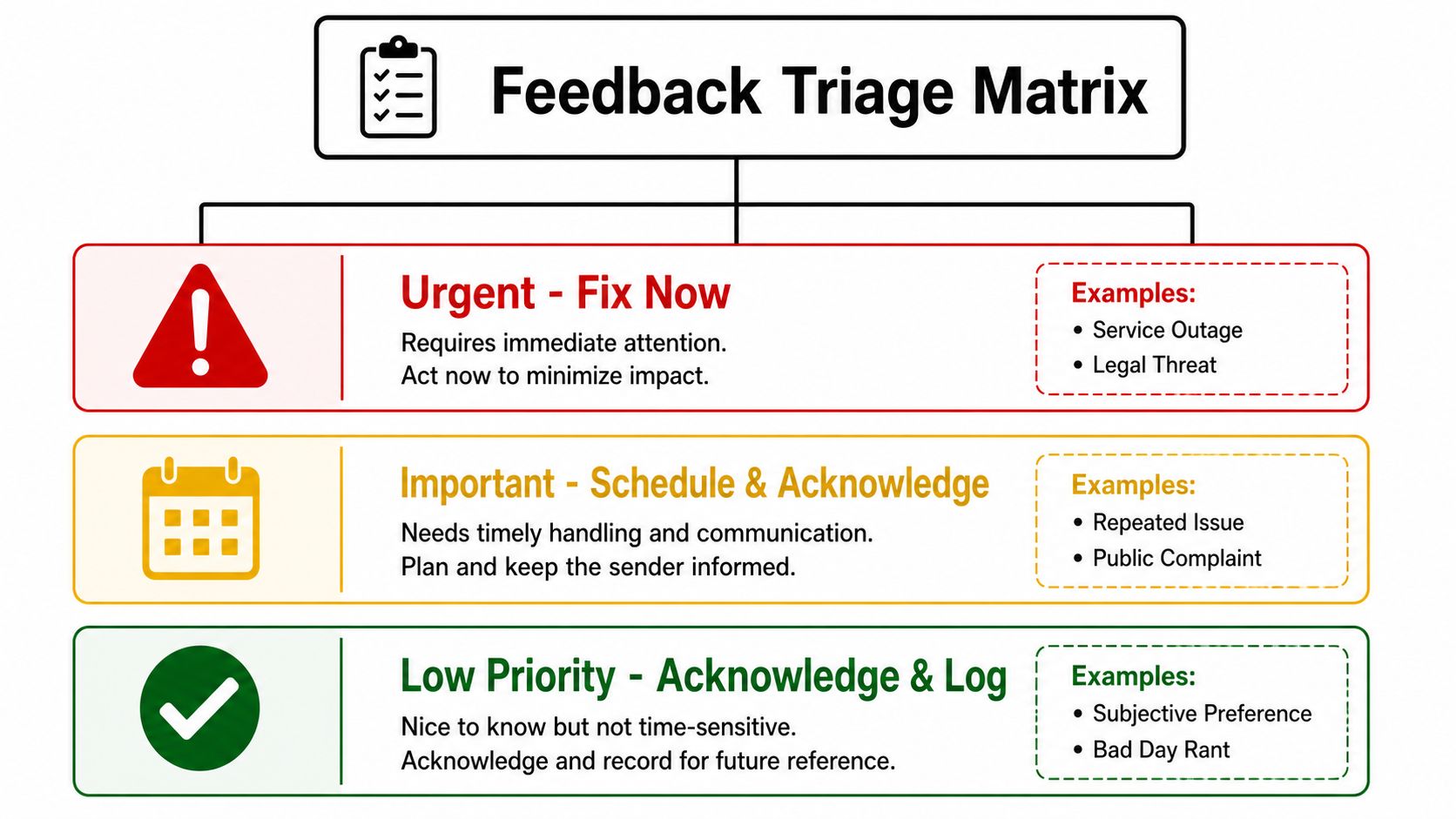
Bad feedback gets dangerous when everyone on the team reacts like every message is a fire. It isn't. Some complaints need immediate escalation. Others need a calm reply and a note in the system. A few deserve exactly the same level of attention you'd give a stranger shouting in the street, which is to say, not much.
The cleanest way to handle criticism is to decide whether it's urgent, important, or low priority. That sounds basic because it is, and basic is underrated when the inbox is on fire. A complaint about a service outage is not the same thing as someone being grumpy about tone. A repeated issue from multiple clients is not the same thing as one person having an off day.
The mechanics of negative feedback loops are simple enough to remember: a sensor detects the change, a control center compares it to a set point, and an effector pushes things back toward normal. That's the point of the loop, counteract the drift, don't amplify it (LibreTexts on homeostasis and control systems/01:_Levels_of_Organization_of_the_Human_Organism/1.03:_Homeostasis_and_Control_Systems)). In agency life, your sensor is the feedback channel, your control center is the human who decides what it means, and your effector is the response.
If you want a triage rule that doesn't require a whiteboard ceremony, use these three questions:
For distributed teams, the difference between local handling and leadership escalation needs to be obvious. A lot of messy back-and-forth disappears when the team has a shared playbook for who owns what, especially in remote environments where silence turns into speculation fast. If your ops setup is scattered, a clear operating rhythm matters even more, and this guide on managing distributed teams is useful for that kind of structure.
Generic replies are where reputations go to die. “We value your feedback” is what brands say when they've run out of actual thoughts. Different channels need different responses because the audience, the tone, and the stakes aren't the same.
For Google, G2, or Trustpilot, the goal is public credibility. The opening should acknowledge the issue without rolling over. Try: “Thanks for flagging this. I'm sorry the experience missed the mark.” That line owns the problem without admitting to facts you haven't verified.
Then give a concrete next step. “We're reviewing what happened internally and want to make this right. If you're open to it, reply directly so we can follow up.” Close with a human invitation, not a scripted apology storm. Public readers want to see that you're steady under pressure, not that you can write the longest regret poem on the internet.
Social callouts are performance art with worse lighting. Don't get dragged into thread theater. Open with: “We've seen this, and we're looking into it now.” That signals awareness without starting a public wrestling match.
Then move the conversation off the feed as fast as you can. “Send us a direct message with your account name so we can investigate.” If the issue is real and visible, post a short public update after you've verified the facts. If it's just outrage confetti, don't feed it.
Client email is where agency teams usually overtalk. Don't. Start with: “Thanks for sending this. You're right to raise it.” Then name the action. “I'm reviewing the issue with the account lead and media buyer today, and I'll come back with options.”
That's the whole game, acknowledge, act, follow up. If the problem is on the agency side, say so plainly. If it's expectation drift, say that too. People relax when they know someone is steering the ship.
In-app feedback is often a quick pulse check, so keep the reply tight. “Thanks, we've logged this and are reviewing it with the product team.” If there's a known workaround, mention it. If not, tell them when to expect another update.
Useful shortcut: public channels need trust management, private channels need problem solving, and in-app feedback needs acknowledgment without clutter. Same issue, different stage.
| Channel | Opening Approach | Response Time Target | Follow-Up Cadence |
|---|---|---|---|
| Public Reviews | Acknowledge the experience, stay composed | Same day when possible | One public reply, one private follow-up if relevant |
| Social Media Callouts | Confirm receipt, avoid argument | As fast as the team can verify facts | Public update only if facts change |
| Direct Client Emails | Ownership plus next step | Within one business day | Internal update, then client follow-up |
| In-App Feedback Widgets | Brief acknowledgment and logging | Promptly after review | One status update if the issue persists |
A junior account manager should not have to play firefighter for every grumpy message. That's how teams burn out and leadership misses the underlying problems. Escalation is for risk, repeat patterns, and situations where one response can't close the loop.
Here's the hard line. If the feedback hints at legal exposure, financial loss, or safety risk, it goes straight up. No waiting around to “see how it develops.” The same goes for high-value clients whose relationship damage would hurt the account materially, or for public complaints that are starting to shape the narrative before anyone has facts.
The internal email should be sharp, not dramatic: “Flagging this for immediate review. The issue involves [risk type], and I need a response path from leadership today.” That's enough. No twelve-paragraph emotional essay about how unfair the universe is.
If the issue is minor, contained, and fixable with a standard apology, let the frontline person handle it. If it's an edge case with no clear pattern, a thoughtful response and a log entry are usually enough. A complaint from someone having a bad day does not automatically become your company's next rebrand project.
One clean way to judge whether leadership needs to step in is to ask whether the complaint could become a repeat issue in the next ten conversations. If yes, escalate. If no, close the loop and move on.
When you do escalate, make the ask specific. “Can you confirm whether we need a leadership call, a legal review, or a client-facing apology today?” That's more useful than a vague “FYI” that drops the problem into someone else's lap like a wet towel.
The worst escalation emails are emotional, vague, and self-protective. The best ones say what happened, who's affected, what risk exists, and what decision is needed. That's it. The rest is just office poetry.
The moment after the first reply is where many teams get lazy. They send the apology, close the tab, and hope the universe handles the rest. It won't. If you want critics to become proof that your team is worth hiring again, follow-up has to be built into the process, not treated like a noble extra.
A good remediation process has checkpoints. A quick check-in after the initial response keeps the issue from drifting into the void. A later update shows the fix wasn't just PR theater. And a final review asks whether the problem stayed gone.
That's where the value compounds. One angry note can become a usable client story if your team tracks the issue, documents the fix, and follows up with evidence that the underlying problem changed. That's also why a structured success story matters, as noted in the case study advantages guide. A clean remediation narrative is often more convincing than a polished pitch deck.
Write down what happened, what was changed, who approved the fix, and whether the same complaint comes back. The point isn't bureaucratic theater. The point is to stop the same mistake from escaping through a different door next month.
A decent follow-up rhythm looks like this:
If that sounds almost boring, good. Boring systems are what keep reputations intact.
A lot of teams get shy. They think showing a fix makes them look weak. Wrong. It makes you look accountable. The best response to criticism is often visible proof that the process got better because someone complained.
A one-star review can become a five-star testimonial if the customer sees real movement, not just a polite message with no follow-through. That only happens when the team owns the repair and documents the result instead of treating the complaint like smoke to be waved away.
If all you track is response time, you're measuring speed, not improvement. Fast replies can still be useless replies. A team can get very good at damage control while learning absolutely nothing, which is a spectacularly expensive hobby.
The metrics worth watching are the ones that tell you whether criticism is being absorbed. Resolution rate tells you how often complaints end in an outcome the customer accepts. Repeat complaint frequency shows whether the same issue keeps returning under different disguises. Sentiment shift score tells you whether the mood changed from the start of the complaint to the close. First response impact tells you whether quick replies correlate with better outcomes.
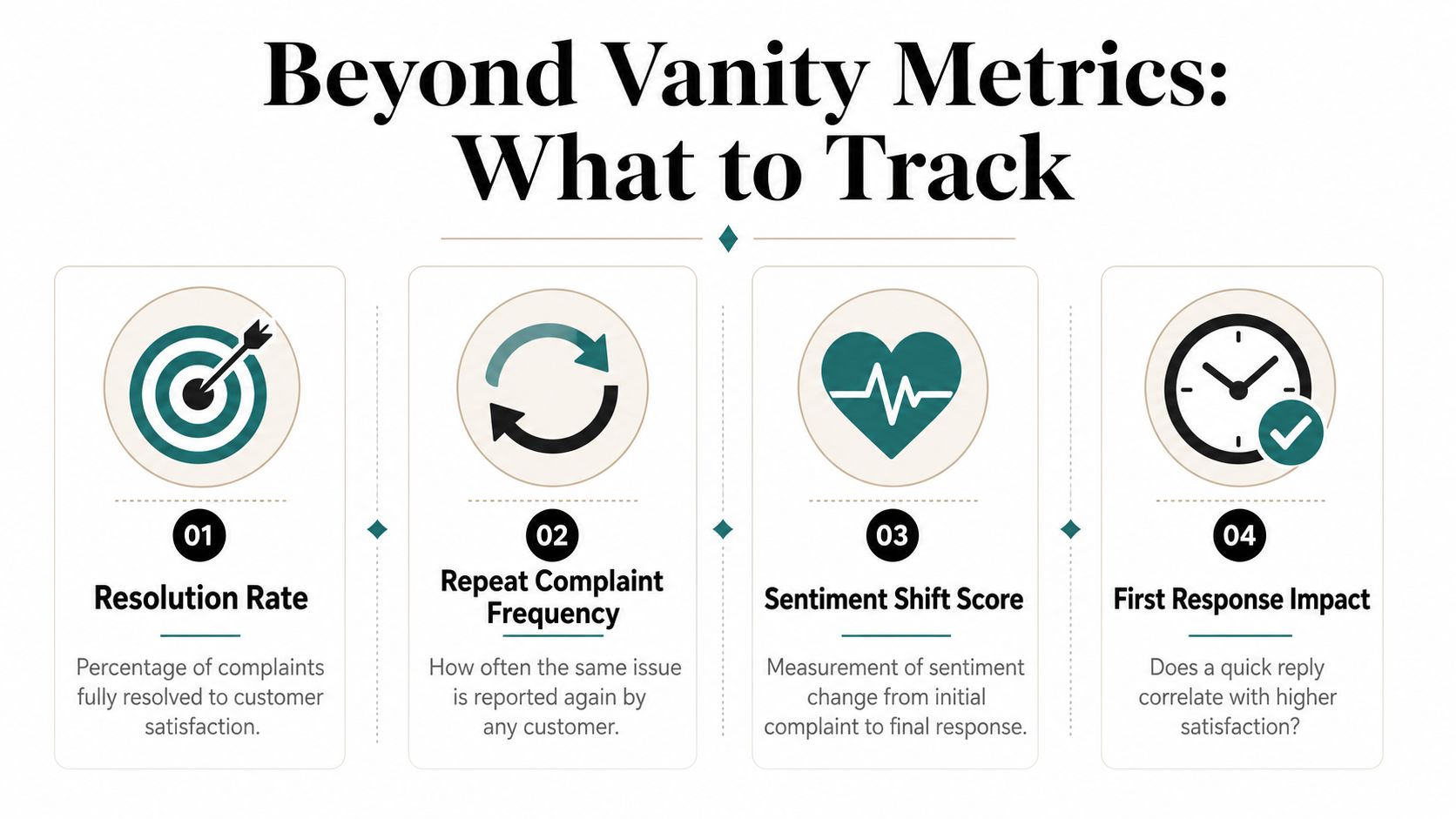
These are the numbers that show whether the system is learning. If the team gets faster but the same issue keeps coming back, you don't have a feedback problem. You have a repair problem wearing a productivity costume.
Keep the dashboard simple. One column for the complaint type, one for the channel, one for the owner, one for the resolution status, and one for recurrence. Add a notes field for what changed and whether the critic came back calmer, angrier, or never again.
That's enough to answer the only questions leadership really cares about. Are we solving the right problems? Are the same mistakes repeating? Are we getting smarter, or just quieter?
For teams that buy media across multiple channels, the same logic applies to reporting discipline. If your performance reporting is sloppy, criticism gets fuzzy fast. The right ad performance metrics make it easier to tell a real signal from a vanity story, and that's exactly what your feedback dashboard should do too.
At the end of each month, ask three questions. What criticism led to a real change? What criticism came back again? What criticism looked loud but turned out to be irrelevant?
If the answers are all vague, the team is probably still treating feedback as a mood instead of a management tool. If the answers are specific, you're getting somewhere. That's the whole point of a solid negative feedback response, fewer surprises, less drama, and a team that can take a punch without losing the plot.
If your team needs better media buying support, HireMediaBuyers.com can help you hire pre-vetted paid media talent without the usual hiring circus. Visit HireMediaBuyers.com to find Media Buyers and Paid Ads Specialists who can handle the pressure, the feedback, and the weird edge cases that show up when campaigns get real.


