

Most advice on managing distributed teams is nonsense.
It says remote work is just normal management with more Zoom calls, a Slack etiquette doc, and maybe a virtual happy hour nobody wanted. That's how you end up with a team that looks busy, sounds aligned, and fails to meet the key numbers.
If you're leading high-stakes roles like media buyers, paid social operators, account strategists, or performance marketers, you can't afford that fantasy. A distributed team isn't an office team without the commute. It's a different operating model. Different failure modes. Different management muscle. Different playbook.
I learned that the expensive way. The soft, feel-good stuff matters, sure. But performance comes from systems. Clear hiring filters. Ruthless onboarding. Communication rules with teeth. Scoreboards people trust. Managers who coach instead of lurking in dashboards like anxious hall monitors.
That's what works. Not vibes. Not surveillance. Not "let's just stay flexible."
Distributed teams do not fail because people are far apart. They fail because leaders keep running office habits in an environment that punishes vagueness.
I made that mistake more than once. I assumed smart people would "stay aligned" if they had enough meetings, enough goodwill, and enough access to me. What I got was slow drift, fuzzy ownership, and expensive confusion. In high-stakes roles like media buying, that cost shows up fast. Missed pacing issues. Late creative swaps. Budget decisions made from half-context. Clients feel the slippage before managers admit it exists.
Remote work strips away the illusion that visibility equals control. Good. That illusion was weak management in nicer clothes.
In an office, managers can get away with reading body language, overhearing updates, and patching gaps on the fly. In a distributed team, that lazy style breaks the moment people work across time zones, accounts, and priorities.
The failure pattern is predictable.
A campaign issue gets mentioned in Slack but never documented. A decision gets made in a meeting, then remembered three different ways. A manager asks for updates by DM because the actual status is buried across chats, docs, and ad accounts. The team stays busy. The work gets worse.
Watch for these signs early:
Rule: If the task, owner, decision, and deadline are not visible without interrupting someone, your team is running on memory instead of management.
This is the part a lot of founders resist. They want distributed teams to feel natural, fluid, and flexible. Fine. Build that after you build structure.
The teams that hold up under pressure use written operating rules. They define where decisions live, how handoffs happen, when escalation is required, and what "done" means for each role. That is how you protect performance when nobody is sitting ten feet away.
If you want a useful model, start with skills-based hiring for remote performance roles. It forces you to define the behaviors and outputs the job needs, which is the same discipline you need to manage the team once they are inside.
Here is the shift that matters:
| Old office habit | Better distributed habit |
|---|---|
| Manage visibility | Manage outcomes |
| Assume alignment | Document alignment |
| Reward responsiveness | Reward ownership |
Writing things down feels slower only to managers who have not paid for rework yet.
A distributed team does not need more check-ins, more tools, or more digital noise. It needs an operating system people can trust under pressure. Without that, distance is not the problem. Leadership is.
Remote teams rarely break because of distance. They break because one weak hire keeps forcing everyone else to compensate.
In paid media, that cost shows up fast. Missed context. Slow decisions. Fuzzy reporting. Budget drift that nobody catches until the client asks the uncomfortable question. In an office, weak operators get exposed by proximity. In a distributed team, they can hide behind calendars, Slack replies, and decent-looking status updates.
That is the hiring trap. Founders hire for confidence, familiarity, and polish, then act surprised when the person cannot make good calls alone.
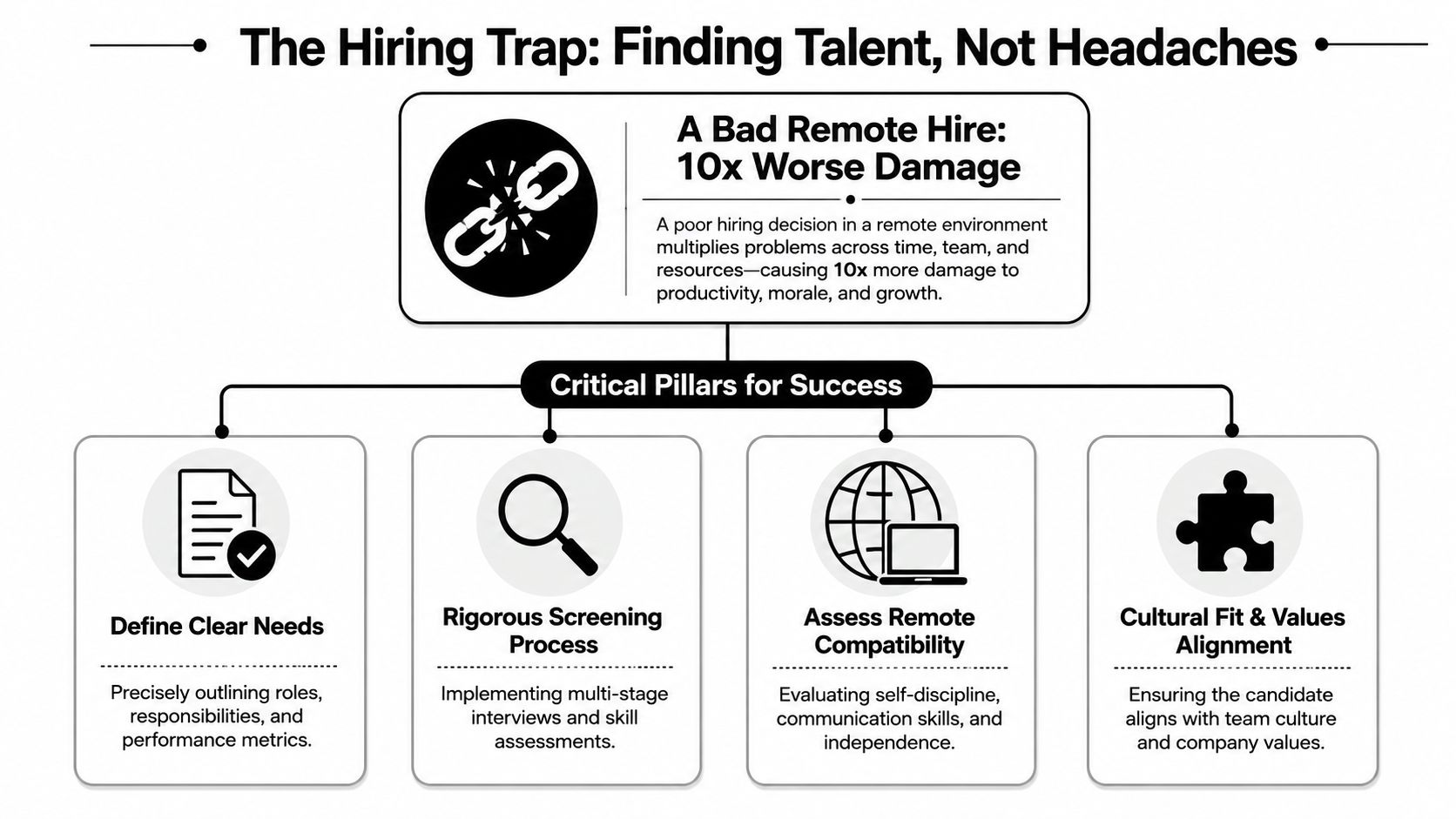
A great remote hire is not the person who interviews best. It is the person who creates clarity without being chased.
A polished candidate can talk in frameworks, repeat platform jargon, and charm everyone on Zoom. Then day one hits, performance dips, and you learn they need constant clarification to do work that should have been routine. That kind of hire creates drag across the whole team, especially in high-stakes roles where speed and judgment matter.
For distributed media buying roles, I look for four things early:
If they cannot do that, the resume does not matter.
Generic interviews produce generic hires.
"Tell me about yourself" tells you nothing. "Are you comfortable working remotely?" is worse. Of course they say yes. The right interview should force the candidate to show how they think when the budget is live, the data is messy, and nobody is around to rescue them.
Ask questions that expose operating habits:
Those answers reveal judgment, not rehearsal. That is what keeps distributed teams stable.
If you want a cleaner process, use a skills-based hiring framework for paid media roles. It forces you to test for output and behavior instead of getting fooled by brand-name resumes and smooth interview energy.
Hire the person you would trust to send the client update, make the account call, and own the result without hiding behind Slack.
I use a simple screen before final interviews because long hiring loops do not fix weak standards.
| Pillar | What you're testing | Red flag |
|---|---|---|
| Role fit | Can they do this exact job? | They speak in generic tactics |
| Writing | Can they explain decisions clearly? | Their answers are bloated or fuzzy |
| Ownership | Do they move work forward alone? | They wait for permission constantly |
| Judgment | Can they make sound calls with imperfect info? | They treat every situation like a checklist |
Fail one of these hard enough and I stop the process.
You are not building a bench of interesting people. You are building a distributed team that can protect budget, client trust, and execution quality without constant supervision. Hire for that standard first, or you will spend the next six months managing around a mistake you should have caught in the interview.
Most remote onboarding is cosmetic.
Laptop shipped. Slack invite sent. Welcome call booked. Maybe a Notion page nobody updates after month one. Then leadership acts surprised when the new hire takes forever to ramp, misses context, and starts operating like a freelancer orbiting the company instead of a real teammate.
That mess is avoidable. Good onboarding in distributed teams is not a vibe. It's a production system.

If your new hire spends their first week asking where things live, you've already burned trust.
They should start with one clean home base that includes account access, success metrics, team norms, reporting examples, escalation paths, and a 30-60-90 day plan. Not ten scattered docs and a cheerful "ask anything."
Their manager should also define what good looks like in plain language. For a media buyer, that might include decision quality, reporting clarity, ownership of experiments, and client communication habits. If expectations stay fuzzy, people don't ramp. They improvise.
A flexible talent model only works if the operating model is clear. That's one reason teams prefer options with cancel-anytime hiring flexibility. But flexibility without structure is just churn with better branding.
Week one is not for dumping information into someone's skull and hoping osmosis does the rest.
Use a rhythm like this:
Each day should end with a short written check-in. What did you learn, what's still unclear, what do you own next? That one ritual surfaces confusion before it hardens into bad habits.
A remote onboarding process should answer one question fast: "How do I succeed here without guessing?"
I don't want new hires "getting comfortable." I want them becoming useful, then reliable, then trusted.
Here's the progression I push:
Give them structure. Heavy context, clear documentation, narrow ownership. Let them make small calls, but review the thinking behind them.
Expand scope. They should start leading parts of workflow, owning updates, and spotting issues before being asked.
Test independence. Can they manage recurring work, communicate tradeoffs, and escalate well without hand-holding?
A simple onboarding table helps:
| Phase | Manager focus | New hire focus |
|---|---|---|
| First 30 days | Teach the system | Learn the rules and rhythm |
| Next 30 days | Expand responsibility | Show judgment in smaller decisions |
| Final 30 days | Reduce support | Operate with visible ownership |
The biggest onboarding mistake isn't moving too slowly. It's pretending autonomy appears automatically. It doesn't. Managers have to install it.
If your communication policy is "just ping me on Slack," you don't have a policy. You have a liability.
Distributed teams frequently bleed performance. Messages scatter across channels. Decisions vanish into threads. Meetings multiply because nobody knows what belongs in chat, what belongs in docs, and what deserves a call. Then deadlines slip and everyone acts confused.
There's a reason structure matters here. Distributed teams are 25% more likely to miss deadlines than teams in the same office, according to Insightful's guide on distributed team management. Not because remote people are lazy. Because informal coordination is gone.
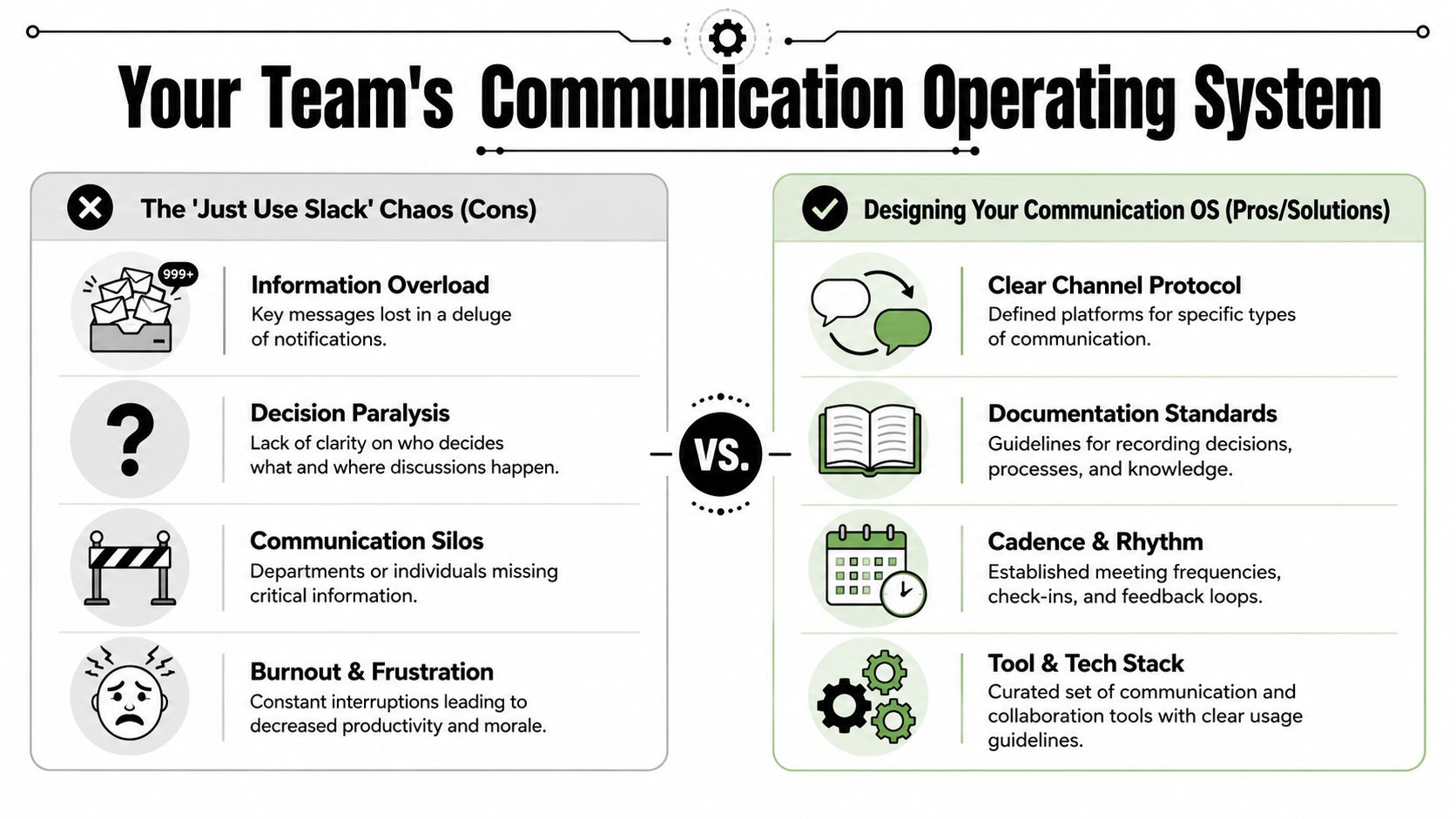
Every team needs a communication map. Not a suggestion. A map.
For a performance marketing team, mine usually looks something like this:
| Tool or format | Use it for | Don't use it for |
|---|---|---|
| Slack | Quick coordination, blockers, urgent clarifications | Strategy debates, final decisions, long updates |
| Notion or Confluence | Process docs, campaign standards, decision records | Fast back-and-forth |
| Asana, ClickUp, or Monday.com | Owners, deadlines, status, handoffs | Brainstorming |
| Loom | Walkthroughs, account reviews, async explanations | Sensitive feedback, conflict resolution |
| Live call | Complex decisions, coaching, repair conversations | Routine status updates |
That's the difference between communication and chatter.
Most managers overuse meetings because live conversation feels efficient. It isn't. It's just immediate.
For managing distributed teams, async should be the default for updates, status, reporting, and routine decisions. Synchronous time should be reserved for moments where speed, nuance, or conflict matter.
Use this rule set:
Slack is a hallway, not a filing cabinet.
Nothing destroys focus faster than fake urgency.
Your team needs explicit expectations for response times by channel. Not "ASAP." Not "when you can." Clear norms. Maybe chat is for same-day coordination, project comments are for structured updates, and documented reviews are handled on a recurring cadence. Pick your rules and stick to them.
This matters even more across time zones. If a U.S. lead, a Latin America buyer, and a South Africa contractor are all working different windows, handoffs need owners, context, and due dates. Otherwise one person's bedtime becomes another person's blocker.
A good handoff includes:
That's your operating system. Without it, your team spends half its energy interpreting silence.
Bad remote managers chase activity because activity is easier to see than value.
They want green dots, timestamps, screen grabs, login records, and little comfort blankets that suggest work is happening. It feels managerial. It's mostly fear with a dashboard.
The stronger approach is simpler. Build a scoreboard everyone understands, then coach against it. According to Gable's guidance on managing a distributed workforce, effective remote performance management works best when teams combine documented goals such as OKRs, structured 1:1s, and clear ownership in project tools. The same guidance warns that productivity can stay high while engagement falls, which is exactly how managers miss the early signs of a future blow-up.
For high-stakes roles, I like three layers.
First, define outcomes. What business result matters? Pipeline quality, cost control, lead quality, revenue efficiency, creative testing throughput. Pick the ones that reflect the role.
Second, define ownership. What does this person fully own versus contribute to? If ownership is vague, accountability gets weird fast.
Third, track health signals. Not creepy surveillance. Signals. Are updates getting thinner? Is decision quality dropping? Is the person avoiding discussion? That stuff matters.
A clean performance system usually includes:
The weekly 1:1 is where the whole system becomes human.
If your 1:1 is just "what did you do this week," congratulations, you've built a slower Slack message. Use that time to talk about decisions, tradeoffs, energy, confidence, and friction.
I like these prompts:
That last question matters. A person can hit targets while slowly checking out. Then one day they resign and everyone says it came out of nowhere. It didn't. You just weren't measuring the right thing.
The point of a scoreboard isn't to control adults. It's to make success obvious and problems discussable.
Remote problems rarely arrive with sirens. They arrive as small weirdness.
A top performer starts giving shorter updates. A buyer who used to challenge assumptions goes quiet in calls. Two teammates in different time zones become "professional" in that chilly way that means somebody's annoyed and nobody wants to say it first. If you're managing distributed teams well, you catch those shifts before they become exits, misses, or client pain.
Not literal ghosting. Functional ghosting.
They reply late. Their updates get thinner. Work still moves, sort of, but the judgment disappears. Managers often respond badly here. They either overreact with suspicion or underreact because they don't want to seem intrusive.
Do this instead:
That keeps the conversation anchored in reality.
This one is seductive because software makes it easy.
The hard part of remote leadership is balancing trust and accountability, especially as monitoring tools become more common. As Scale Army's discussion of distributed team strategy notes, some visibility tools can help coordination, but they can also damage the autonomy strong remote workers need to perform well. That's the tension. Not privacy theater. Performance.
If someone is slipping, don't start with surveillance. Start with clarity.
Ask:
| Problem | Wrong response | Better response |
|---|---|---|
| Missed handoffs | Install more monitoring | Clarify ownership and deadlines |
| Thin updates | Demand constant presence | Set update standards and review cadence |
| Confusing decisions | Track activity harder | Require written rationale for key calls |
For teams building international paid media capacity, especially across regions and time zones, a thoughtful offshore hiring approach for marketing roles only works when managers know how to inspect outcomes without hovering over every move.
This one hides as scheduling friction and then turns personal.
Maybe one teammate keeps waking up to requests they couldn't possibly answer in time. Maybe another feels blocked every morning waiting for approvals from a different region. If you don't redesign the workflow, people start blaming each other for a system problem.
Fix it with handoff discipline and one rule: nobody should need mind reading to continue the work.
Leave written context. Assign the next owner. State the pending decision. If the workflow still depends on live overlap for routine tasks, the process is lazy.
The best distributed teams don't run on constant supervision. They run on context, standards, and trust that has teeth.
That's the whole game. Hire people who can own work without theater. Onboard them like you care whether they succeed. Build a communication operating system instead of a chat addiction. Measure outcomes, not mouse movement. Deal with problems directly before they mutate into politics.
Most managers don't fail at managing distributed teams because remote work is too hard. They fail because they keep using office-era instincts in a system that punishes vagueness.
Lead adults like adults. Give them clarity. Give them scoreboards. Give them room to think. Then hold the line on performance.
That's how distributed teams stop feeling risky and start becoming an advantage.
If you're hiring paid media talent and want a faster, lower-drama path, HireMediaBuyers.com helps U.S. companies find pre-vetted Media Buyers and Paid Ads Specialists for full-time or part-time remote roles. You can browse talent, get a curated shortlist quickly, and build a stronger distributed team without spending your week drowning in resumes and guesswork.


