


You know the feeling. A service looked smart in the sales call, the onboarding deck was polished, and now you're three invoices deep wondering why you signed a contract that feels like a timeshare with Slack access.
I've been burned by this more than once. Agencies that talked a big game. Freelancers who vanished once the first campaigns went live. Software that became shelfware with a login. The common problem wasn't just bad performance. It was being stuck.
That's why I treat Cancel Anytime as a business discipline, not a cute perk. In B2B, especially when you're hiring for high-stakes work like media buying, flexibility isn't soft. It's an advantage. It keeps everyone honest, including you.
The nightmare isn't hiring the wrong partner. That happens. The nightmare is realizing you hired the wrong partner and still owe them months of payments while they slowly explain that bad results are part of a "ramp period."
That's how founders end up paying for underperformance with a smile pasted on. You're not just losing money. You're losing time, momentum, and usually a chunk of confidence in your own judgment.

If you're outsourcing paid acquisition, retaining a creative team, or testing external support, you need an exit route before you need the service itself. That's not cynicism. That's operating like an adult.
A lot of founders learn this after signing annual agreements that looked harmless on page one and feral on page nine. Early termination fees. Notice rules buried in legal mush. Offboarding terms that somehow require more coordination than onboarding did. If you've been shopping among outsourced marketing companies, you've probably seen this movie already.
Practical rule: If a vendor needs to trap you to keep you, they already know performance alone won't do the job.
This isn't just founder grumbling anymore. The policy direction is moving toward lower-friction cancellation. The U.S. Federal Trade Commission announced its final click-to-cancel rule on October 16, 2024, saying sellers must make cancellation as easy as sign-up and that the rule applies to almost all negative option programs in any media. The FTC also said most provisions take effect 180 days after publication in the Federal Register. You can read that directly in the FTC announcement on the final click-to-cancel rule.
Consumer rule? Yes. B2B lesson? Also yes.
Founders should take the hint. The old model was friction on the way out. The better model is simple. If a partner does great work, you stay. If they don't, you leave without a legal hostage situation. That's how healthy business relationships should work.
Let's clear up the biggest misunderstanding first. Cancel Anytime usually means you can stop the next renewal. It usually does not mean you press a button today and get a tidy pro-rated refund by lunch.
Think gym membership, not shirt return. You're ending the ongoing billing relationship, not undoing time you've already paid for.
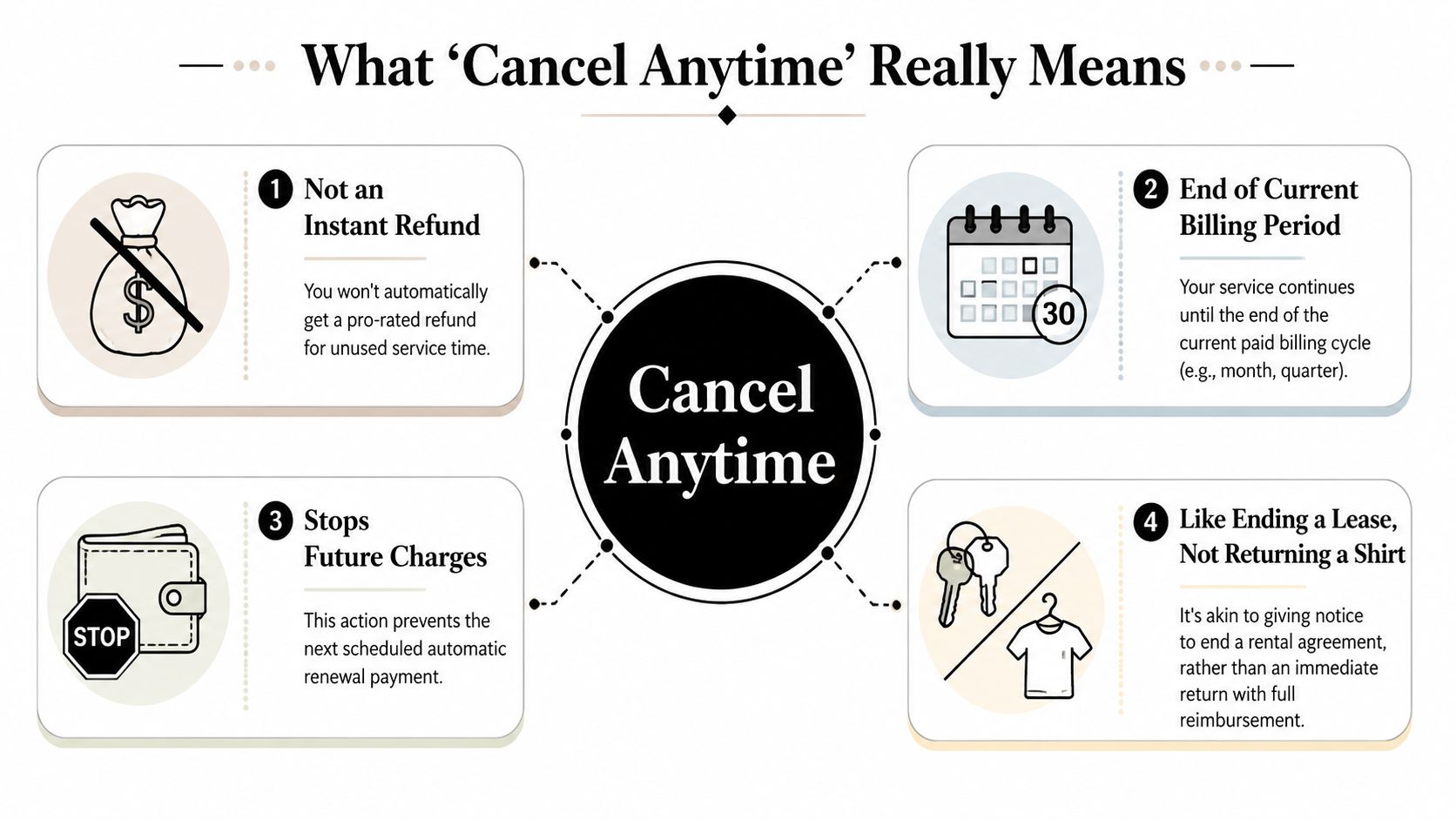
This distinction holds greater significance than commonly recognized.
In many subscription systems, cancellation ends future charges, while access continues until the paid term runs out. IBM's SPSS Statistics Digital offering gives a clean example. When a customer cancels, the system emails the nearest termination date, and for a monthly subscription that date is one month after the purchase date. Their support page is a useful benchmark for how this typically works in practice, and you can see it in IBM's explanation of cancelling its SPSS Statistics Digital offering.
For B2B services, the same logic often applies in human form instead of software form. You cancel the retainer. The work continues until the current paid period ends. Then access, support, or active management stops.
If you're hiring a media buyer on a monthly arrangement, ask three questions before you sign:
When does billing stop
If you cancel today, are you only preventing the next invoice, or are there any extra charges tied to notice?
When does service stop
Do they keep managing campaigns until the current cycle ends, or do they stop touching the account immediately?
What happens to assets
Reports, creative files, campaign notes, dashboards, pixels, ad accounts. If that handoff is fuzzy, your "flexible" contract isn't flexible. It's just lazy.
Cancel Anytime is about preserving control over future commitments. It's not a magic refund button.
I like contracts that say, in effect, "You can leave. You just can't rewrite time." That's fair. You paid for a period, you keep access for that period, and the auto-renewal doesn't keep raiding your budget.
That's the clean version. Anything murkier than that deserves suspicion.
Not all flexible contracts are actually flexible. Some are clean. Some are annoying. Some are a magic trick where your wallet disappears.
The easiest way to judge a Cancel Anytime clause is to stop looking at the headline and read the mechanics. "No long-term contract" sounds nice. It doesn't answer the more important question: what happens if you cancel at exactly the wrong moment?
A lot of users get tripped up by timing. Consumer guidance keeps stressing the difference between no long-term contract and no immediate billing risk, especially when a charge posts right before cancellation. That's the right mental model for business buyers too, and it's laid out well in AARP's discussion of subscription timing and cancellation problems.
| Clause Feature | The Good (Founder-Friendly) | The Bad (Hidden Gotcha) |
|---|---|---|
| Cancellation language | Plain English in the contract | Legal soup that sends you hunting |
| Notice timing | Clear billing cutoff and end date | "Reasonable notice" with no definition |
| Cancellation method | Email or dashboard, documented | Phone call, form request, or account manager maze |
| Fees | No penalty for ending future renewal | Surprise offboarding or termination charges |
| Asset handoff | Account access, files, and notes transferred cleanly | Access gets delayed, restricted, or negotiated |
| Renewal terms | Auto-renewal terms are obvious | Renewal tucked into fine print |
The good version is boring. That's a compliment.
You know where to cancel. You know when charges stop. You know whether service continues through the paid period. You know how accounts and data get handed over. Nobody acts shocked when you exercise the right that was printed in the agreement.
This kind of contract creates better behavior on both sides. The provider knows they must keep earning the business. You know you can hold a quality bar without gearing up for courtroom cosplay.
The bad version doesn't trap you outright. It just makes leaving irritating enough that you procrastinate.
Maybe the clause says "cancel anytime" but requires notice before a billing cutoff that most buyers won't notice. Maybe cancellation must be submitted to a specific contact who conveniently replies after renewal. Maybe the provider says you can leave, but campaign exports, ad history, or creative files are somehow "part of the process" and need extra discussion. That's not flexibility. That's sand in the gears.
The ugly version uses the phrase as bait.
If a contract says Cancel Anytime and then adds penalties, mandatory buyouts, or conditions that make exit more expensive than staying, I wouldn't negotiate. I'd walk. A partner willing to play word games before you've paid them won't become a saint after they have your credit card and account access.
You don't need a law degree to spot a bad deal. You need a decent nose for nonsense and the discipline to slow down when a salesperson wants you to speed up.
When I'm reviewing a service agreement, especially for anything tied to ad spend or revenue, I look for cancellation friction first. Not because I expect failure. Because adults plan for it.
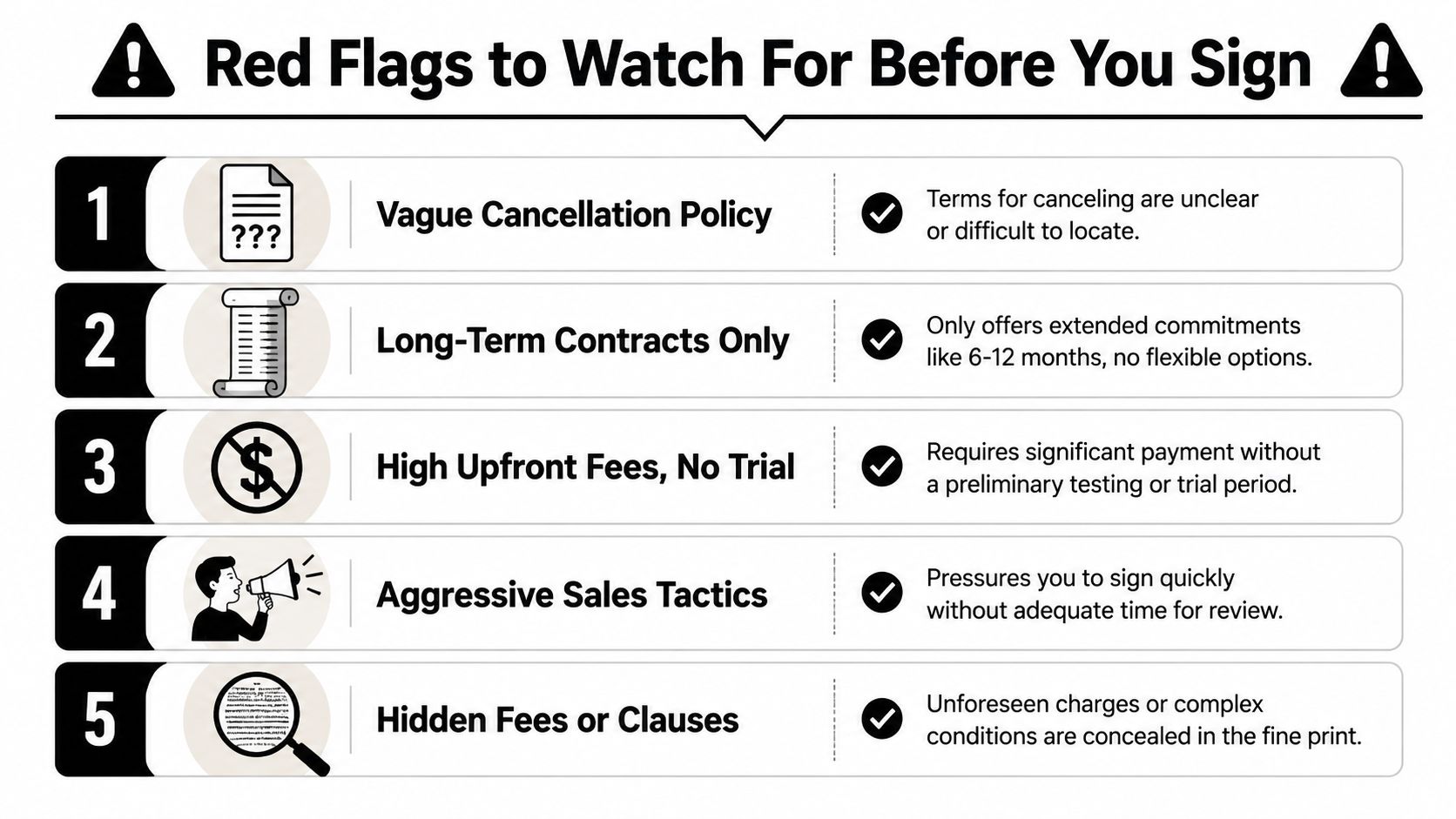
Vague cancellation policy
If the contract says you can cancel but never says how, when, or through whom, assume the process will become interpretive dance when you need it most.
Long commitments as the only option
Sometimes a long term makes sense. But if a provider refuses any flexible path, they're telling you something about where their confidence really lives.
Big upfront payment with no test period
That's a trust fall onto concrete.
Aggressive sales pressure
If they're rushing you to sign, they're trying to keep you from reading.
Hidden fees and tiny-print conditions
If a key commercial term only appears once, buried in a paragraph nobody would naturally find, that's not an accident.
One of the sneakiest gotchas is the billing cutoff. In subscription systems, Cancel Anytime often still comes with a timing rule. Aaptiv states that cancellation must happen at least 48 hours before renewal to avoid the next charge. That small operational detail shows how easy it is to slip into another billing cycle if you wait too long. It's right there in Aaptiv's explanation of its cancel-anytime policy.
For B2B, the equivalent is a notice window buried near the renewal clause.
Use these questions. Steal them shamelessly.
Where exactly do I cancel
Dashboard, email, support ticket, account manager, billing portal. One answer only.
What is the latest moment to avoid the next renewal
If they answer vaguely, that's your answer.
What do I still owe after cancellation
Current period only, or something extra?
Who owns the accounts and data
This matters more than the sales call will admit.
If you want a sanity check before trusting a provider with meaningful spend, reviewing client references and past working relationships is a lot smarter than trusting a polished proposal.
If cancellation requires detective work before you've even signed, leaving later will be worse.
When it's time to leave, don't freelance your own offboarding. Follow a process. Emotions make people sloppy, and sloppy exits create surprise invoices, access fights, and "we never got that request" nonsense.
A clean break is professional, documented, and boring. Boring wins.
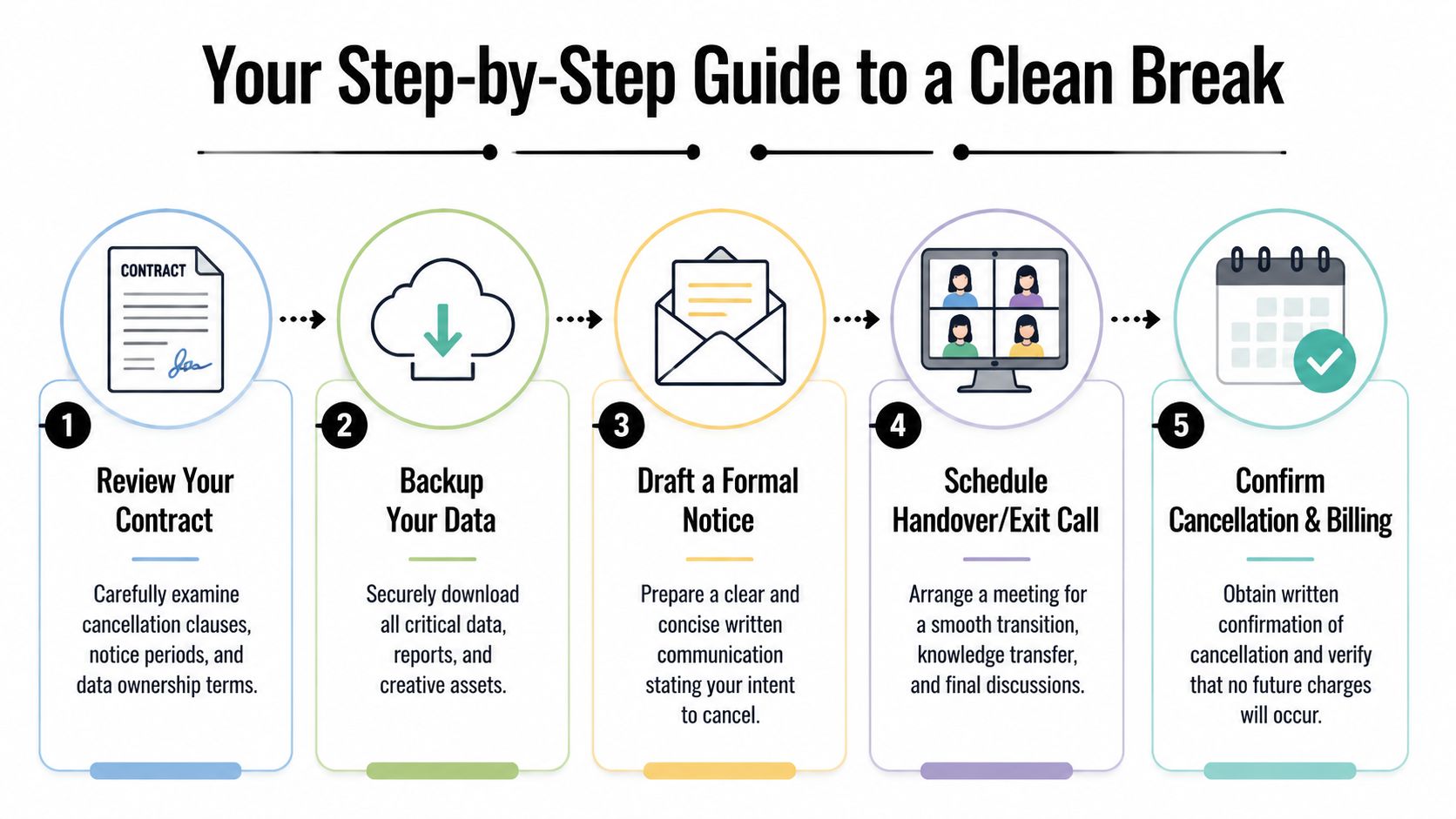
Review the agreement first.
Read the cancellation clause, renewal clause, billing terms, and anything about asset ownership. Don't rely on memory from the sales call. Sales calls have a funny habit of becoming fiction.
Back up what matters.
Download reports, creative files, performance notes, audience lists where appropriate, and access records. If someone gets defensive the moment you ask for exports, that's useful information.
Send cancellation in writing.
Even if they insist on a call, send an email the same day. State the contract name, the accounts involved, the date of notice, and the effective cancellation date you're requesting. Ask them to confirm receipt and final billing.
Cancel on the right platform.
This is a bigger deal than people think. A common failure point is trying to cancel in the wrong place. Support guidance from Angel shows that if a membership was purchased through a third-party platform, the cancellation must be completed there, and the membership isn't fully canceled until that platform's process is done. That's a sharp reminder to check subscription provenance before assuming you're done, and it's explained on Angel's support page about canceling a Guild membership.
Finish with confirmation.
Get the final end date in writing
Not "should be" or "probably." An actual date.
Confirm the final charge
Ask whether one more invoice will post and why.
Request handoff details
Accounts, credentials, files, reporting history, open tasks.
Revoke access after transfer
Once handoff is complete, clean up permissions.
For any service relationship, it's worth checking the provider's terms of service before you start the exit. Not because legal pages are thrilling reading. They are not. Because that's where operating rules usually live.
Clean cancellations are documented cancellations. If it isn't written down, assume you'll need to prove it later.
Cancel Anytime is often treated like a parachute. Useful in emergencies, hopefully never touched.
I think that's too small.
The primary power is what it does before anything goes wrong. It changes the posture of the relationship. A media buyer, agency, recruiter, or software vendor who knows you can leave easily has to keep earning the seat. That's healthy pressure. It produces sharper communication, faster fixes, and a lot less complacency.
Bad contracts protect weak operators. Good contracts reward strong ones.
When a provider can't rely on lock-in, they have to rely on outcomes, responsiveness, trust, and clean execution. That's exactly what you want in high-stakes roles. You don't want someone staying in the seat because procurement forgot a notice date. You want them staying because they're excellent.
For services tied to revenue, growth, or hiring, I prefer flexibility first and loyalty second. Loyalty should be earned monthly. Not extracted upfront like a hostage video.
That doesn't mean every short contract is good. It means every serious buyer should push for terms that preserve the right to walk away without drama. Freedom doesn't weaken the relationship. It filters out the partners who were planning to lean on friction instead of performance.
The best partners aren't scared of Cancel Anytime. They like it. They know good work keeps clients around better than legal handcuffs ever will.
If you need a media buyer but don't want to get welded into a long contract, HireMediaBuyers.com is worth a look. They help companies hire vetted paid ads talent with flexible terms, which is exactly how this should work. Great people stay because they perform, not because your contract forgot how doors work.


