

You're probably here for one of two reasons.
Either you're doing marketing work you shouldn't be doing, which usually means fiddling with ad accounts at 10:30 p.m. instead of fixing product, hiring sales, or talking to customers. Or you already hired help, and now you're paying for slide decks, status calls, and excuses dressed up as strategy.
I've done both. Hired the polished agency. Tried the scrappy freelancer. Built in-house. Rebuilt in-house. Cleaned up after all three. My blunt take is this: most conversations about outsourcing marketing companies are framed the wrong way. It's not agency vs. in-house. That debate is stale.
A central question is who should own strategy, who should execute specialized work, and how you avoid creating a tiny circus of vendors who all claim they're “collaborative” right up until results dip.
That's where most companies get burned. Not because outsourcing is bad, but because they outsource the wrong things, to the wrong model, with the wrong controls.
Are you outsourcing because you need an advantage, or because you're tired and annoyed?
Those are not the same thing. The first leads to growth. The second leads to panic-hiring an agency because someone had a nice website and said “full-funnel” a lot.
This is the sanity check. If you answer yes to several of these, outsourcing probably makes sense. If not, keep the work in-house and stop shopping for magic beans.
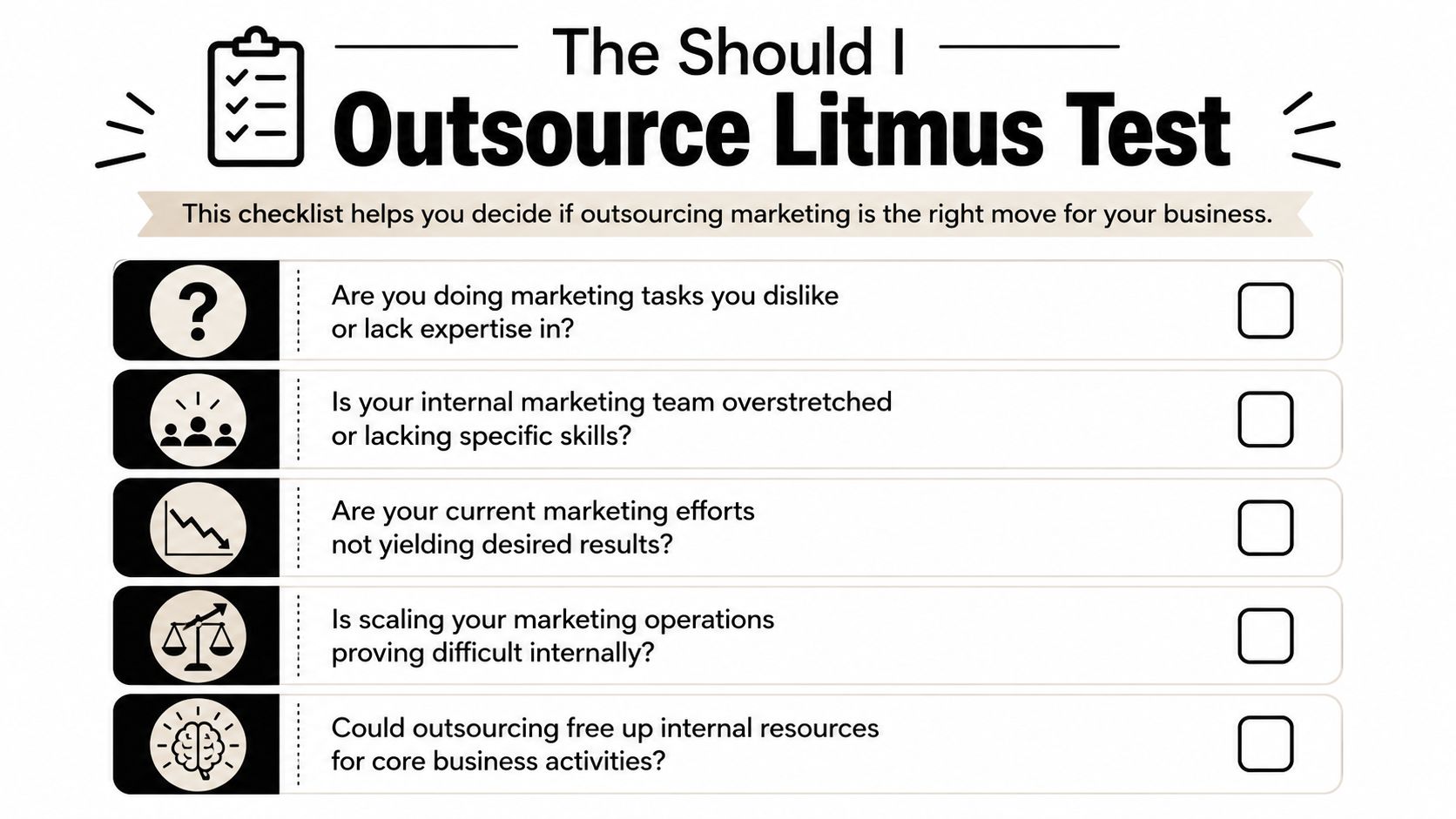
One reason this works is simple. Businesses already outsource work well beyond grunt tasks. Moneypenny reports that companies most often outsource market research and data analysis (45%), content creation (42%), and digital marketing (41%). In specialized sectors, reported outsourcing rates reach 91% in technology and 88% in healthcare in their cited data set, which tells you this is standard operating behavior, not some desperate last resort for disorganized teams (Moneypenny on what marketing businesses outsource).
Outsourcing is a bad move when you're unclear on your offer, your audience, or your economics.
If your positioning is mush, your sales process is messy, and your tracking is held together with duct tape and vibes, adding an external partner won't fix the fundamentals. It just adds another invoice.
Practical rule: Keep strategy, positioning, and final decision-making in-house. Outsource specialized execution that requires speed, repetition, or niche skill.
That's why the old binary framing isn't very useful. If you're stuck choosing between a bloated agency and a full-time hire, read this more useful breakdown of agency vs in-house marketing tradeoffs. Most companies don't need either extreme. They need the right specialist, under the right owner, with the right scorecard.
Here's my line in the sand.
Usually outsourceable
Usually keep in-house
If nobody on your side can say, “This is the target, this is the budget, this is the definition of success,” don't outsource yet. Get your house in order first.
Most bad outsourcing relationships start with a bad brief.
Not a bad partner. Not bad talent. A bad brief.
Companies send over a glorified grocery list. “Need help with Facebook ads.” “Need someone for growth marketing.” “Looking for full-service support.” That's not a brief. That's a cry for help.

A serious operator wants context, constraints, and a definition of winning.
If you're hiring a Meta ads buyer for a DTC brand, don't say, “Manage our account.” Say what you sell, who buys it, what's already been tried, what the customer objections are, what creative exists, what landing pages are in play, and what metrics matter to the business.
The brief should answer these questions:
The best talent is allergic to vague companies.
If you want strong candidates, write a brief that proves you know your own business. That doesn't mean writing a novel. It means being concrete enough that someone good can tell whether they can help.
A decent brief includes:
| Brief element | What to include |
|---|---|
| Business context | What you sell, who you sell to, and where growth is currently stuck |
| Scope | The exact channels or functions this person will own |
| Inputs | Access to data, tools, creatives, landing pages, and internal stakeholders |
| Success criteria | Business outcomes, decision windows, and how performance gets reviewed |
| Non-negotiables | Reporting format, communication cadence, approval process, brand guardrails |
A weak brief creates “yes” people. A strong brief attracts people who ask sharp questions before they touch your budget.
Please stop writing “professional but playful” as if that means anything.
If brand voice matters, include examples. Share top-performing ads, strong emails, landing pages that sound right, and examples of what sounds painfully wrong. Tone gets aligned faster when people can see it.
Do the same with reporting. Show a sample dashboard. List the metrics you want reviewed weekly. Tell them which metrics you consider vanity. If you hate being spammed with impressions and “awareness,” say so upfront.
A proper brief does two jobs at once. It helps the right people opt in, and it helps the wrong people self-select out. That alone will save you weeks of polite disappointment.
Not all outsourcing marketing companies sell the same thing, even when their websites make them sound suspiciously identical.
You've basically got three models. The traditional agency. The freelancer marketplace. The vetted talent platform. Each one can work. Each one can also waste your quarter if you pick it for the wrong reason.
The biggest trap across all three is fragmented accountability. The CMO Survey points to governance and decision-rights confusion as a major blind spot in outsourcing conversations, especially when work is split among agencies, freelancers, and internal teams. That's where programs start wobbling, then gradually fall apart (CMO Survey on outsourcing governance gaps).
Agencies sell convenience. Sometimes they deliver it.
You get a brand, a process, a deck, a meeting cadence, and usually a point of contact who is very polished on Zoom. What you may not get is the senior talent you thought you were buying. Plenty of agency relationships start with the A-team in the pitch and drift toward a rotating cast once the paperwork clears.
Agencies can be useful when you need cross-functional execution and you want outside strategic input. They're less useful when you need one killer paid media operator and don't want to fund layers of account management to get them.
Marketplaces sell optionality. In practice, they sell sorting.
You can find brilliant people there. You can also spend your week reading profiles that all say “data-driven growth hacker” before discovering that nobody can explain how they diagnose a broken funnel.
The upside is flexibility. The downside is you become the recruiter, screener, reference checker, skills assessor, and traffic cop. Hope you enjoy that. It's now your side hustle.
This is the middle path most companies should consider first.
A vetted platform gives you specialist talent without the bloat of a full agency or the chaos of an open marketplace. The model works best when you know the function you need, like a Google Ads buyer, a LinkedIn lead gen specialist, or a lifecycle marketer, and you want someone who can plug into your team without weeks of talent roulette.
One example is HireMediaBuyers.com, which connects companies with pre-vetted paid media specialists across channels. That kind of model is useful when you want direct access to the operator instead of paying for an agency wrapper.
| Criterion | Traditional Agency | Freelancer Marketplace | Vetted Talent Platform |
|---|---|---|---|
| Cost transparency | Often fuzzy once scopes expand | Usually clear at first, less clear when revisions pile up | Typically more predictable |
| Talent quality | Mixed, depends on who actually works the account | Highly variable | More filtered before you meet candidates |
| Speed to hire | Slower, sales process first | Fast to browse, slow to validate | Usually faster to shortlist serious options |
| Strategic alignment | Can be good, but often diluted through account layers | Depends entirely on the individual | Strong if the specialist reports into your internal owner |
| Accountability | Shared across team members, sometimes too shared | Mostly on you to manage | Cleaner when one specialist owns one function |
If three different people touch strategy, execution, and reporting, nobody owns the outcome. They own opinions.
That's why I'm biased toward specialists over agencies for many growth-stage businesses. Not because agencies are useless. Because most companies don't need a mini bureaucracy. They need one or two sharp operators with clear swim lanes and one internal adult in charge.
Resumes are theater.
Case studies are sales collateral. Portfolios are curated. None of that means the person can step into your account, identify what's broken, and fix it without setting money on fire.
You need a vetting process that makes talented people easy to recognize and bluffers easy to reject.

The fastest way to spot weak talent is to ask about decisions, not tasks.
Don't ask, “Have you managed Meta campaigns?” Everyone says yes. Ask what they did when a campaign underperformed, how they diagnosed the issue, what signals they trusted, what they changed first, and why.
Use prompts like these:
Good people answer with tradeoffs. Weak people answer with tactics they memorized from YouTube.
Don't assign free consulting homework disguised as “part of the process.” People hate that, and they should.
Give them a light but realistic scenario. For a DTC media buyer, ask them to review your current account setup and identify the first three things they'd inspect. For a SaaS lead gen specialist, ask how they'd structure a LinkedIn campaign around a specific ICP, sales cycle, and offer.
You're not looking for a finished strategy doc. You're looking for signal.
A strong candidate usually does three things:
That last part matters a lot. Bullish confidence is easy to fake. Good judgment isn't.
Some warning signs are subtle. Others are wearing clown shoes.
Watch for these:
The best marketers don't just know how to push buttons. They know which buttons matter.
If you're checking references, don't ask whether the person was “great to work with.” That question produces useless politeness. Ask if the client would hire them again, what kind of management they needed, and how they handled disagreement. A focused client references checklist helps you get past the ceremonial praise and into the part that matters.
One more thing. If a candidate can't explain your business back to you after a proper interview, don't hire them. Execution without comprehension is just expensive clicking.
The fee is not the cost.
That's the first thing founders learn after their second or third outsourcing mistake. The invoice is just the visible part. The actual cost includes your management time, onboarding drag, revisions, hand-holding, tool overlap, and the opportunity cost of waiting while the wrong partner “finds their footing.”
That's why total cost of ownership matters more than sticker price. MarketVeep's analysis makes the core point well: outsourcing can look cheaper upfront while hidden costs pile up through onboarding, brand misalignment, and duplicated tooling, especially now that AI changes what should be automated versus what still needs human oversight (MarketVeep on total cost of ownership in outsourcing).
A cheap freelancer who needs daily direction can cost more than a more expensive specialist who works independently.
A full-service agency that insists on its own reporting stack, creative process, and project workflow can also create duplicate systems your team has to maintain anyway. Congratulations, you bought complexity.
Here's the short list of hidden costs to interrogate:
My advice is simple. Favor short commitments, clean scopes, and cancellation terms that don't feel like a gym membership from hell.
Push for:
If you're weighing remote global talent, this practical guide to offshore hiring for marketing roles is useful for evaluating cost structure without confusing cheap labor for actual advantage.
The point isn't to pay the least. It's to pay for output without inheriting a management problem.
Even a great hire can flop in a bad setup.
Companies love to obsess over selection and then completely wing the onboarding. Then they act surprised when the new partner misses context, posts off-brand copy, or builds reporting that nobody trusts.
A working partnership starts with shared KPIs and SLAs before launch, then runs on transparent dashboards, regular syncs, and periodic reviews. Datamatics also cites a Marketing Week survey saying nearly 63% of brands outsourced work to an agency or third-party provider in the prior year, which means this isn't edge-case behavior. It's normal. The same guidance flags a common failure point: teams skip documentation for brand voice, reporting standards, and data access, then pay for the confusion later (Datamatics on outsourced marketing workflows and adoption).
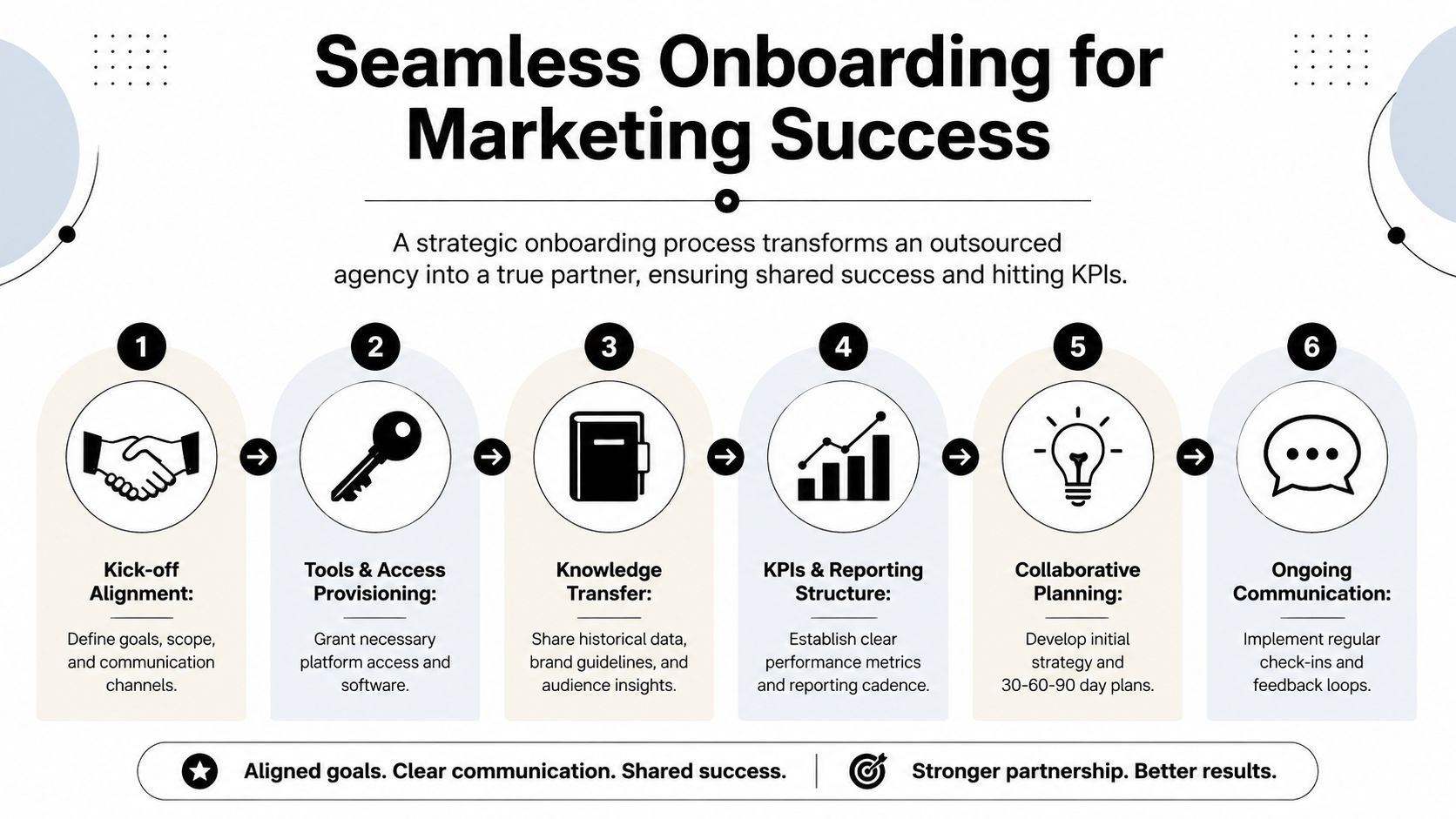
Week one is not for “seeing what happens.” It's for alignment.
Give your partner access to the ad platforms, analytics tools, CRM, brand guidelines, offer docs, customer research, top-performing assets, and historical performance notes. If those documents don't exist, create the lean version now. Sloppy access and missing context are self-inflicted wounds.
During the first few weeks, lock down:
Non-negotiable: If brand voice, reporting standards, and data access aren't documented, you are not ready to outsource that function.
By this point, your partner should be operating with less hand-holding and more initiative.
This phase is about establishing baselines, testing systematically, and building trust through visible decision-making. You want to see whether they can separate noise from signal, explain why they're making changes, and connect their work back to the business goal.
A healthy rhythm looks like this:
| Timeframe | What should happen |
|---|---|
| First 30 days | Access, audit, baseline review, quick wins, dashboard setup |
| Next 30 days | Controlled testing, reporting discipline, sharper hypotheses |
| By day 90 | Clear view of fit, progress, communication quality, and ownership maturity |
Bad fits usually reveal themselves early.
Watch for missed deadlines, vague reporting, defensive reactions to feedback, chronic confusion about priorities, or zero proactive ideas. You're not hiring a pair of hands. You're hiring judgment.
If it's not working, replace cleanly:
That last point matters. If your process is documented, replacing a partner is annoying. If your process lives in Slack threads and someone's memory, replacing them is chaos.
If you're tired of choosing between bloated agencies and random freelancer roulette, take a look at HireMediaBuyers.com. It's a hiring platform for pre-vetted media buyers and paid ads specialists, which is often the cleaner option when you want specialist execution without handing your marketing over to a full agency.


