


Most advice on skills based hiring starts with “remove the degree requirement” and then wanders off for a coffee.
That's not enough.
If your hiring process still begins with resume screening, you're still betting on polished storytelling, familiar logos, and recruiter superstition. You're not measuring who can do the work. You're measuring who knows how to look employed in PDF format. Those are very different skills.
For performance marketing roles, this problem gets ugly fast. Plenty of candidates can say “managed multi-channel paid media strategy.” Fewer can look at a messy account, spot the core issue, and tell you whether the fix is audience structure, creative fatigue, conversion lag, or tracking chaos. One of those people grows revenue. The other writes charming LinkedIn posts.
Skills based hiring is the grown-up answer. Not because it's trendy. Because it's operationally sane.
Resumes are not useless. They're just wildly overpromoted.
A resume can tell you where someone has worked, what they claim to have touched, and whether they know how to arrange bullet points. It cannot reliably tell you whether they can launch a profitable retargeting structure, troubleshoot a broken Meta Ads funnel, or explain why a Google Ads account is leaking budget.
The traditional process goes like this:
That's not a hiring system. That's a casino with nicer fonts.
The core mistake is simple. Many organizations hire on proxies instead of proof. They treat degrees, brand-name employers, and tenure like evidence of capability. Sometimes those proxies correlate with skill. Often they don't. Especially in marketing, where the sharpest operators are frequently self-taught, battle-tested, and allergic to corporate buzzwords.
Resumes reward the people who know how to describe work. Businesses need the people who can actually do it.
If the role requires execution, judge execution.
For a media buyer, that means things like:
A candidate who can do those things is useful. A candidate with a polished resume but no evidence is an expensive guessing game.
That's why skills based hiring keeps gaining ground. It matches how real work happens. Nobody cares whether your media buyer had a pretty resume when CAC spikes on Monday.
Skills based hiring is simple. Hire the chef by tasting the food, not by admiring the diploma.
That's the whole idea.
Instead of using credentials as your main filter, you define the skills the role requires, test for them directly, and score candidates against clear criteria. You stop asking, “Do they look qualified?” and start asking, “Can they do the job?”
This shift has picked up serious momentum. The move away from credentials has been dramatic. The number of roles eliminating degree requirements increased 4x between 2014 and 2023, while some analyses show that removing degree filters can expand the qualified talent pool by nearly 19x, according to Testlify's skills-based hiring statistics roundup.
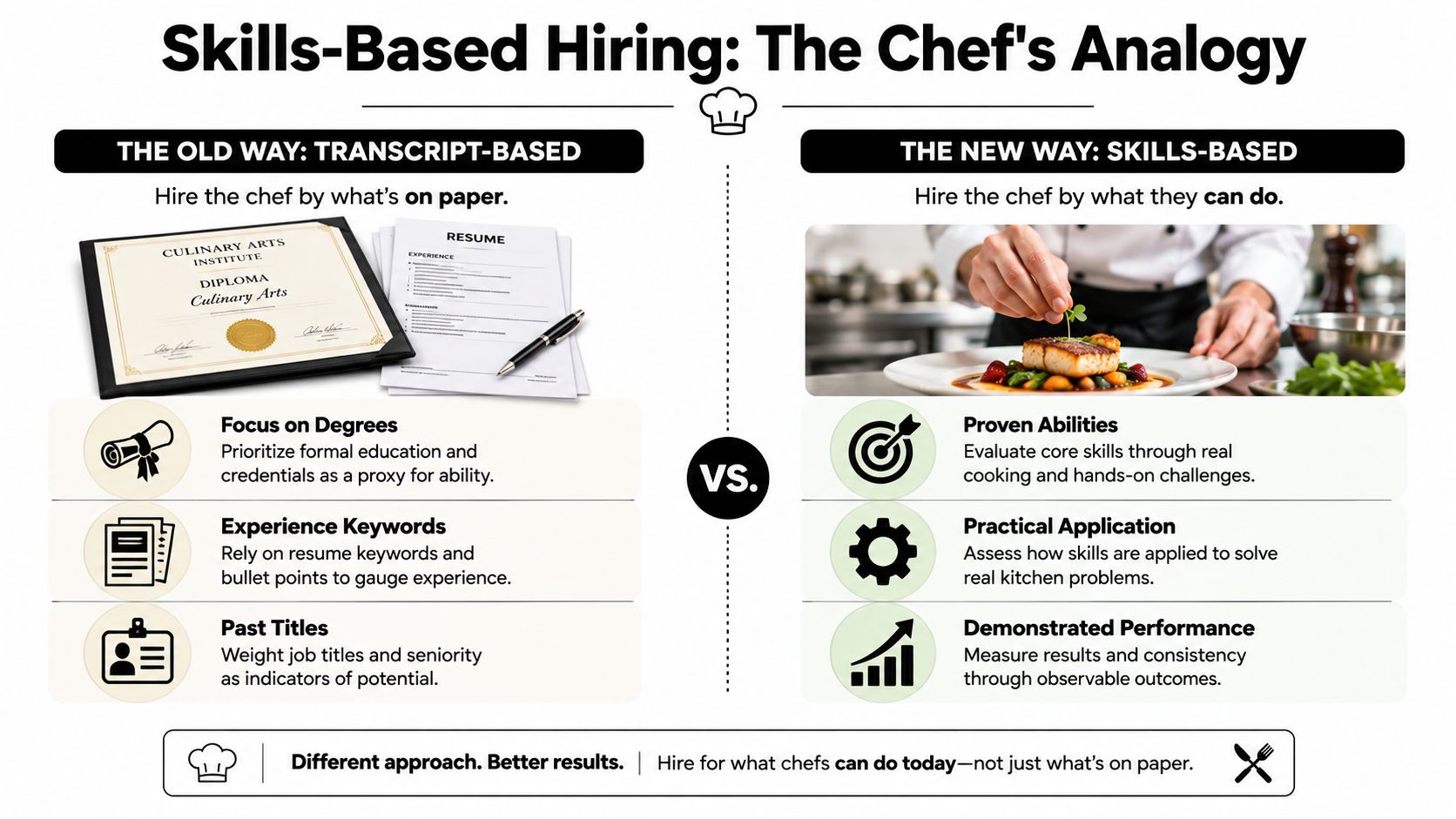
A lot of teams hear “skills based hiring” and think it means deleting the college requirement from the job post. Nice start. Still incomplete.
Here's the cleaner distinction:
| Traditional hiring | Skills based hiring |
|---|---|
| Filters for pedigree | Filters for demonstrated ability |
| Relies on resume claims | Uses work samples, tests, and structured evaluation |
| Rewards familiarity and polish | Rewards performance and judgment |
| Produces inconsistent interviews | Uses repeatable rubrics |
The difference is operational, not philosophical. You're replacing loose signals with direct evidence.
This only works if you stop treating experience as the thing you're buying.
You are not buying “seven years in growth marketing.” You are buying outcomes. Can this person audit an ad account, prioritize fixes, build a testing roadmap, and communicate tradeoffs to a founder who wants miracles by Friday?
That means the hiring team needs to define the role in skill terms, not biography terms.
Practical rule: If a requirement starts with “X years of experience,” ask what specific ability you're actually trying to purchase.
For performance marketing roles, that usually surfaces better hiring criteria fast. “Five years of experience” often collapses into a handful of real capabilities: tracking literacy, budget allocation, experiment design, creative feedback, and revenue judgment.
That's what should be assessed.
Marketing is full of false positives.
Some candidates inherited healthy accounts and now think they're strategy wizards. Others learned inside one platform and fall apart the second attribution gets messy. And some can talk for an hour about “full-funnel omnichannel growth” without saying a single useful thing.
Skills based hiring cuts through that noise. It doesn't care where someone learned. It cares whether they can produce signal under pressure.
That's a much better way to hire adults.
If skills based hiring were just an HR fashion trend, I'd tell you to ignore it and get back to work.
It isn't. It's becoming the default because the old model wastes time, misses talent, and still produces mediocre hires.
According to TestGorilla's 2025 State of Skills-Based Hiring report, 85% of employers say they use skills-based hiring. The same report says 84% are satisfied with hires made using skills tests, compared with 80% satisfaction overall. That gap matters. It tells you this isn't just ideology. Teams are seeing better outcomes when they test for the work itself.
The first win is quality.
When you evaluate real ability, you stop overvaluing fluent interviewers and underestimating quiet operators. That matters a lot in paid media. Some of the best people in performance marketing are not charismatic storytellers. They're pattern recognizers. They notice reporting inconsistencies, weak audience segmentation, and wasteful spend before everyone else does.
Those people often lose in resume-first processes. They win in skill-first ones.
A good example of the kind of role where this matters is a paid ads specialist. The job is not “have relevant background.” The job is make sound decisions with channels, budgets, data, and creative inputs. If you don't test those skills, you're guessing.
The second win is speed.
Not “speed” in the sloppy sense. Speed in the useful sense. You stop burning cycles on endless first-round chats that produce no real evidence. A tight work sample or scenario exercise tells you more than a half hour of chemistry talk and vague campaign war stories.
Here's the blunt version:
The best hiring process gets to disqualifying evidence quickly, without turning the process into an obstacle course.
That's especially important when you're hiring for growth roles and the business is already losing money by not filling the seat.
The third win is access.
When you stop filtering by degrees and prestige markers, you open the door to self-taught buyers, operators from smaller agencies, career-switchers with sharp analytical instincts, and international talent that would never survive your old screening logic. Good. That old logic was lazy.
Teams usually realize they've been excluding exactly the people they claim they want: hungry, capable, adaptable operators.
Toot, toot. We've all seen this firsthand. The best hires often come from the pile your old process never would've touched.
Many organizations botch skills based hiring because they bolt a test onto a bad process and call it innovation.
That's how you end up with random assignments, inconsistent scoring, and hiring managers arguing over “vibes” in a more expensive format. A real system needs structure.
A practical implementation pattern is to move validation earlier in the funnel by using role-relevant assessments such as work samples and scenario simulations, which provide a more direct signal of job performance than resumes, as outlined in Absorb LMS guidance on implementing skills-based hiring.
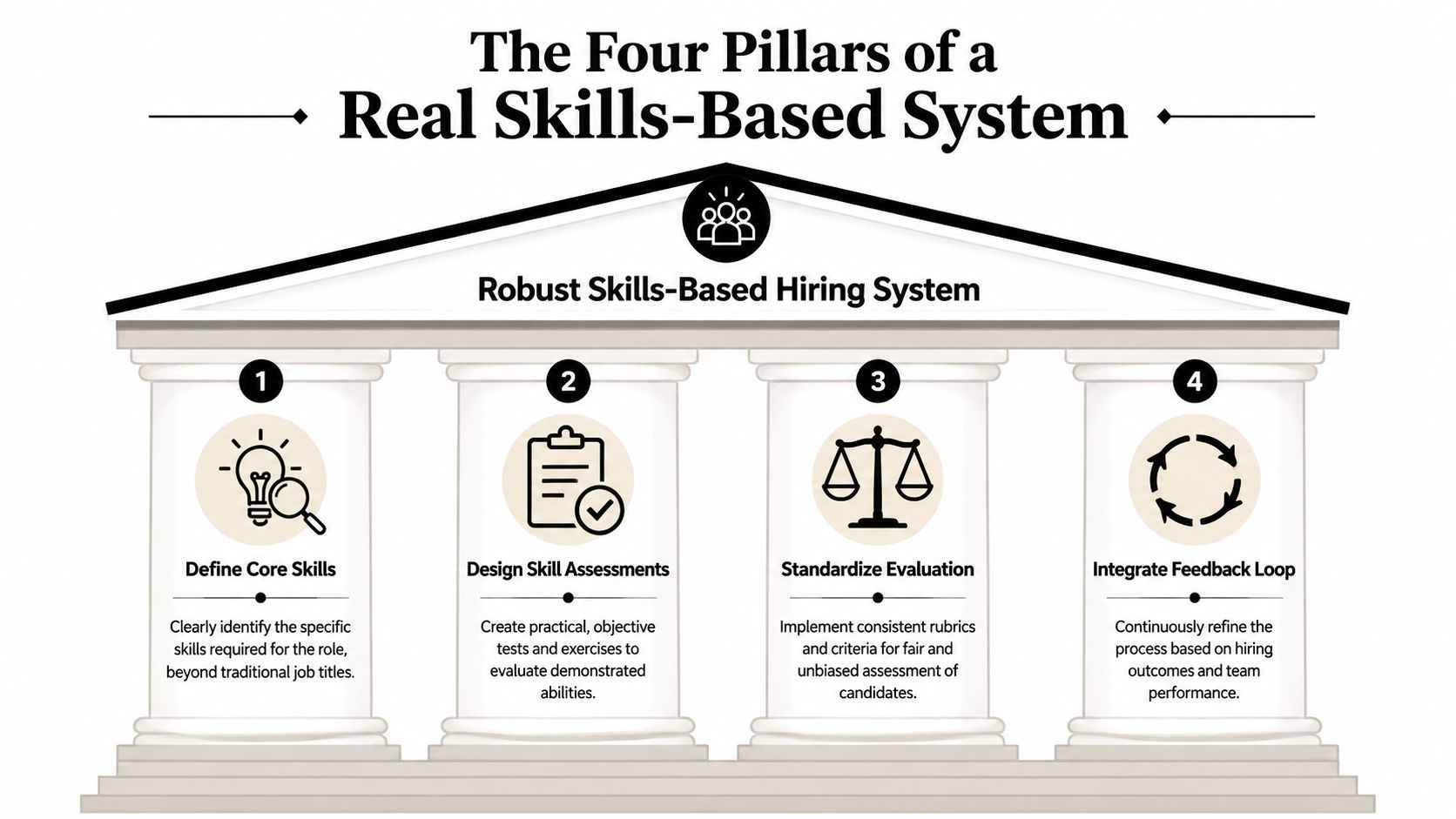
Start by stripping the job down to the minimum viable skill set.
Not twenty-three bullet points. Not a fantasy wishlist stitched together from old job descriptions. You want the handful of abilities that separate success from failure in the role.
For a performance marketing hire, that list might include:
If you can't name the core skills, you are not ready to hire.
Your assessment should feel like a trimmed-down version of the actual work. Not trivia. Not gotcha puzzles. Not unpaid consulting.
For marketing roles, the best assessments usually involve one of these:
| Assessment type | What it reveals |
|---|---|
| Account audit | Diagnostic thinking and prioritization |
| Campaign plan | Strategic judgment and channel fluency |
| Reporting exercise | Analytical clarity and communication |
| Scenario simulation | Decision-making under constraints |
Keep it tight. If the task sprawls, you're testing endurance and free labor tolerance.
A good assessment answers one question. Can this person think and act like someone already doing the job?
Interviews still matter. Just not in the magical, “I have a good feeling about them” way.
The interview should add context to the assessment. Ask why they made certain decisions. Ask what they'd do if constraints changed. Ask how they've handled disagreement, ambiguity, and missing data. You're not hunting for charisma. You're looking for reasoning.
A strong structured interview usually includes:
If you don't track outcomes, this turns into another hiring religion.
Measure the basics that matter in your business. Quality of hire. Retention. Time-to-fill. Interview-to-hire friction. Hiring manager confidence after the first month. Then refine the process like you'd refine a campaign.
That last part is where many organizations quit. Don't.
The process should evolve as your business evolves. New channels, different funnel complexity, bigger budgets, tougher stakeholder environments. Your hiring system should keep up.
Theory is fun for conference panels. Hiring managers need templates.
The cleanest way to make skills based hiring operational is to build a reusable package for each role: a skills-based job description, a short role-relevant task, and a scorecard that forces adults to evaluate the same things.
A technical best practice is to replace credential filters with a shared skills taxonomy. This defines each role's minimum viable skill set and allows for scoring candidates with standardized rubrics tied to observable behaviors, reducing subjectivity, as explained in AIHR's guide to skills-based hiring.
Here's what that looks like in practice for performance marketing.
Bad job post:
Useful role card:
| Category | Example |
|---|---|
| Core outcome | Build and optimize paid acquisition programs profitably |
| Must-have skills | Campaign structure, budget allocation, performance analysis, reporting clarity |
| Nice-to-have skills | Landing page feedback, creative testing workflow, client presentation experience |
| Working context | DTC brand, agency environment, B2B lead gen, or hybrid setup |
| Proof required | Work sample, scenario response, structured interview |
That one change already improves candidate quality because it tells serious people what the job is.
Here's a useful reference point if you're mapping process expectations and internal decision speed. A sloppy timeline kills good candidates faster than a mediocre salary. This hiring timeline guide is the kind of operational lens more teams should apply.
For a media buying role, a good take-home task might be:
What you're looking for is not “the perfect answer.” You're looking for signal:
Once the work sample is in, use a simple rubric.
Hiring rule: If two interviewers can't explain why they scored a candidate differently, your rubric is too vague.
Example scorecard categories:
Technical judgment
Analytical clarity
Communication
Role fit
That's the whole point of templates. They reduce improvisation, and improvisation is where bias sneaks back in wearing a nice blazer.
Hiring a media buyer the old way is miserable.
You post the role, get flooded with resumes, and every third applicant claims they “scaled accounts” or “managed large budgets.” Great. That tells you almost nothing. Plenty of people have had dashboard access. Fewer know what to do when performance goes sideways.
A cleaner approach is to hire the media buyer the same way you'd evaluate a campaign operator. Give them a realistic problem, then watch how they think.

Don't ask for “five years in paid social and search.” Ask for outcomes and decisions.
For example, a real media buyer role might require someone who can:
That role definition tells you what to test.
A solid case prompt might include a short account summary, channel mix, recent performance trend, and business objective. Then ask the candidate to respond to a few practical questions:
That reveals far more than resume bullets ever will.
Some candidates will give you a neat-looking answer. The strong ones will show prioritization, restraint, and an understanding of downstream effects.
Once they submit the exercise, use the interview to pressure-test the logic.
Ask why they chose that budget split. Ask what they'd do if tracking were unreliable. Ask how they'd handle a stakeholder demanding faster scale with weak creative. Good candidates won't pretend every answer is obvious. They'll reason in public.
That's the behavior you want on the job.
The final step is simple. Check whether the story matches the pattern.
You don't need dramatic detective work. You need enough signal to confirm this person has operated in the ways they claim. For that, serious references matter. If you want a model for the type of proof to collect, look at how client references can validate whether someone consistently performs beyond the interview room.
The best part of this approach is that it protects you from both kinds of hiring mistakes. The polished talker gets exposed. The understated operator gets a fair shot.
That's a better market.
Skills based hiring is better. It is not self-executing.
You can still create a biased mess if your assessments are irrelevant, your scorecards are fuzzy, or your team keeps overriding evidence because someone “felt senior.” A broken process with a work sample stapled onto it is still a broken process.
If you want a hiring process that's fair and legally defensible, start with consistency.
Use the same prompt for candidates applying to the same role. Use the same rubric. Train interviewers on what each score means. Keep the work sample tied to actual job requirements. Don't sneak in personality tests disguised as business exercises.
A few practical guardrails help:
A lot of people frame this as a DEI topic first. That's too narrow.
Done right, skills based hiring improves access because it gives nontraditional candidates a legitimate path to compete. But don't get smug. If your task relies on insider knowledge, vague instructions, or arbitrary scoring, you can reproduce bias in a newer, shinier format.
Public-sector adoption makes this point hard to ignore. Lightcast reports that 26 U.S. states and territories have implemented some form of skills-based hiring policy, and Brookings says more than 20 governors have committed to eliminating degree requirements for public-sector jobs, according to Lightcast's review of state-level skills-based hiring adoption. This isn't just a private-sector branding exercise anymore. It's becoming part of how institutions rethink access to work.
The cheerful blog posts usually go quiet here.
A major stumbling block, according to Brookings, is the lack of trustworthy information about qualifications at scale. Employers need efficient ways to cull large applicant pools and platforms that can manage this data, as noted in Brookings' analysis of what it takes to operationalize skills-based hiring.
That means you need systems, not heroics.
| Problem | Practical fix |
|---|---|
| Too many applicants | Add an early role-relevant screen |
| Inconsistent scoring | Use standardized rubrics |
| Hiring manager drift | Calibrate with sample responses |
| Tool sprawl | Centralize prompts, scores, and notes |
If you're hiring at any real volume, platform support matters. Shared records, consistent evaluations, and cleaner workflows are what keep the process from collapsing under its own sincerity.
Build it properly, and skills based hiring becomes a durable operating advantage. Wing it, and you've just invented a more complicated way to be subjective.
If you're tired of resume roulette and want a faster path to proven paid media talent, HireMediaBuyers.com is worth a look. It helps companies find pre-vetted media buyers and paid ads specialists without dragging your team through endless screening, messy interviews, and guesswork disguised as judgment.


