

You've got a campaign showing a beautiful ROAS number, your platform dashboard is glowing, and everyone in the meeting wants to scale. Then finance asks the annoying question: “How much of that revenue would've happened anyway?”
That question separates direct response advertising from expensive theater. A click, lead, or purchase matters only when you can connect it to a commercial outcome and determine whether your campaign created demand or claimed credit for demand already in motion.
I've seen enough ad spend disappear behind polished creative, inflated attribution windows, and dashboards nobody can explain. The fix isn't another hack. It's a measurement discipline that makes the offer, audience, creative, landing page, and data loop answer to revenue.
Most advice labeled “direct response” is recycled brand advertising with a button attached. It tells you to make the ad memorable, use attractive visuals, and add a strong call to action. Fine. But if nobody can say which action the campaign is designed to generate, who should take it, and how the business will verify the result, you're not running direct response. You're buying hope with a media budget.
Direct response advertising exists to trigger an immediate, trackable action. That action might be an order, inquiry, booked call, lead-form submission, or store visit. The defining feature is not the channel. Direct response can use email, search, social, television, or direct mail. The defining feature is the response and the feedback loop around it, as described in this academic definition of direct response marketing.
A brand campaign can ask whether people remember you. A direct response campaign asks whether the right person acted, what that action cost, and whether the resulting revenue justified the spend. That distinction changes everything, from copy and landing-page structure to reporting and budget allocation.
Operator rule: Every impression should have a job, and every job should connect to a measurable business outcome.
A direct response campaign is a controlled commercial system. You define the revenue objective, build tracking through the funnel, assign responsibility to the relevant creative and audience signals, then use the results to decide what earns another impression.
That's why digital media buying requires more than platform familiarity. A buyer who can launch campaigns but can't explain the relationship between offer economics, conversion rate, customer value, and incremental lift is an ad trafficker, not a performance operator.
Direct mail remains a useful historical benchmark because it makes the response visible. The U.S. Direct Marketing Association reported average response rates of 4.9% for prospect lists and 9% for house lists, compared with 2.9% and 5.1% in 2017, showing a meaningful year-over-year lift for 2018, as reported in this direct mail response-rate benchmark. The lesson isn't that every business should mail postcards. It's that accountable media has always been built around observable action.
If the campaign objective is “get attention,” you're measuring brand. If the objective is “generate qualified pipeline at an acceptable acquisition cost,” you're measuring direct response. Don't blur those jobs and then act surprised when the numbers become useless.
Brand and direct response aren't enemies. They're different tools with different clocks.
Brand advertising changes memory, preference, and perception over a longer horizon. Direct response compresses the path between attention and action. One asks, “Do buyers remember us?” The other asks, “Did a qualified buyer do something valuable?”
The mistake is forcing both campaigns into one scoreboard. Brand creative often needs room to build meaning. Direct response creative needs to make the next step obvious. If you judge a brand campaign only by immediate purchases, you may kill useful demand creation. If you judge direct response by reach and vague engagement, you'll keep funding ads that look busy but don't pay the bills.
| Dimension | Brand Advertising | Direct Response Advertising |
|---|---|---|
| Primary question | Do people remember and prefer us? | Did the right person act? |
| Creative job | Shape perception and mental availability | Make the offer and next step clear |
| Typical horizon | Longer-term | Immediate or near-term |
| Core measurement | Recall, consideration, share of voice, revenue lift | CPA, conversion volume, ROAS, qualified action |
| Landing destination | Often flexible | Closely matched to the ad promise |
| Optimization rhythm | Periodic and strategic | Frequent and test-driven |
| Budget logic | Build future demand | Capture or create measurable demand now |
Direct response is not automatically better. It's less forgiving. The campaign has to survive contact with economics, tracking, fulfillment, and customer quality.
A useful media plan funds both, but it keeps their budgets and KPIs separate. Brand activity can create the familiarity that makes later conversion easier. Direct response can harvest existing demand and reveal which promises, audiences, and objections deserve more investment.
For the reporting layer, use a deliberate measurement framework rather than whichever metric the platform displays most prominently. This guide to ad performance metrics is a useful starting point, but the recommendation is simple: define the primary business outcome before launch.
The expensive mistake is not choosing brand or direct response. It's asking one campaign to do both jobs and then blaming the channel when neither works.
Brand creative earns its keep by changing what buyers think. Direct response creative earns its keep by changing what buyers do. Keep those standards distinct, and your budget decisions get much less emotional.
A direct response campaign can fail in five different places. The ad may be excellent while the offer is weak. The landing page may convert well while the audience is too small or too cold. Tracking may look clean while the campaign is taking credit for existing demand.
The machine only works when all five mechanics pull together.
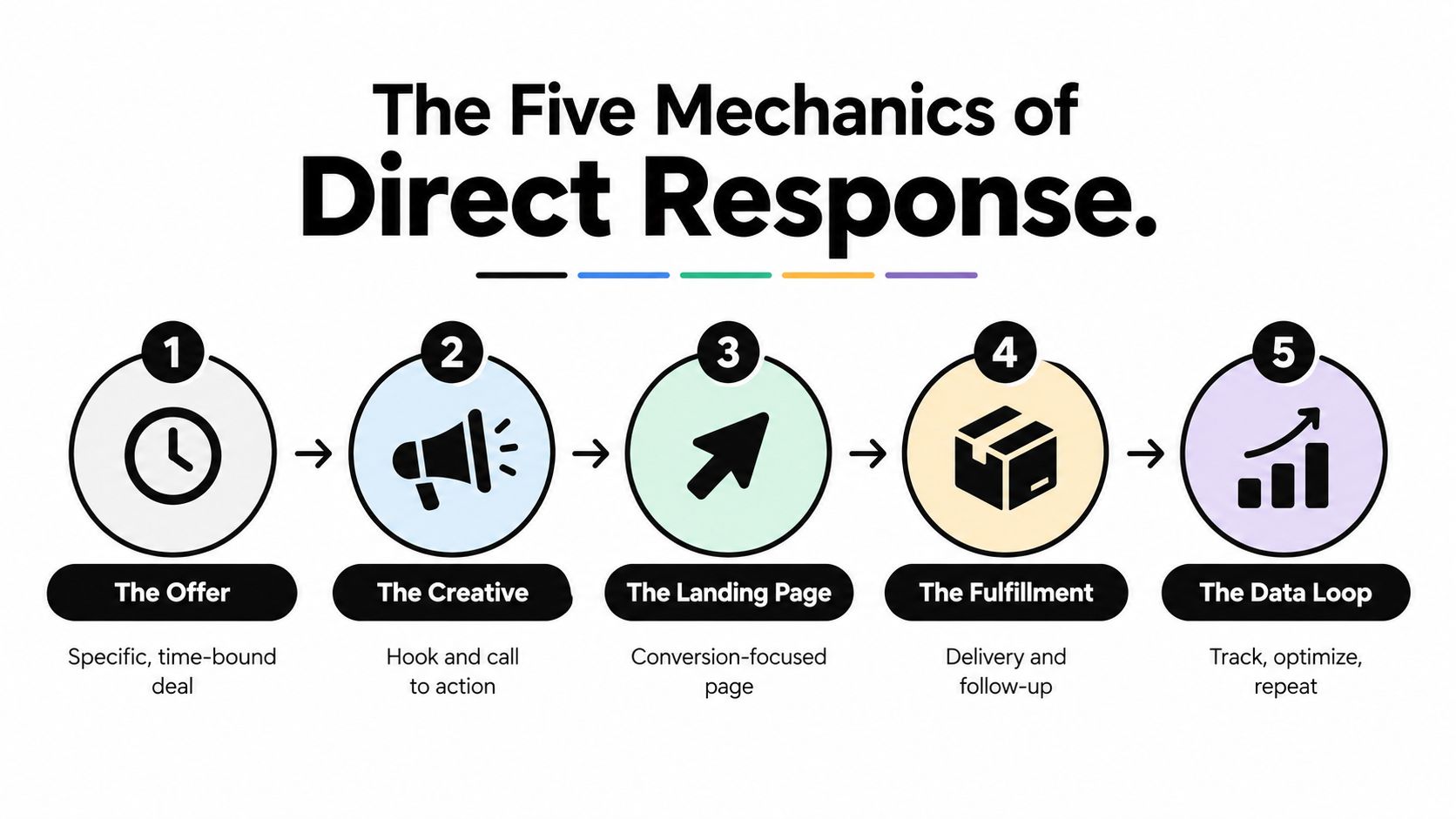
The offer gives people a reason to act now. It isn't limited to a discount. It can be a useful package, a consultation, a trial, a guarantee, or a clear answer to an urgent problem.
Work backward from allowable acquisition cost. If the economics only work when every buyer purchases immediately and never needs support, the offer is not ready for scale. Put the value, conditions, and next step where the prospect can understand them without decoding clever copy.
Audience selection determines whether your creative gets a fair test. Use first-party customer data, intent signals, and meaningful segmentation instead of building an elaborate targeting maze because the platform gives you too many dropdowns.
A house-file customer and an unqualified prospect shouldn't receive the same promise or face the same CPA target. Strong audience segmentation helps you separate those realities before the reporting turns into soup.
The first moments have to establish relevance. Show the problem, introduce the tension, and make the next action unmistakable. Founder-led video, product demonstrations, testimonials, comparison angles, and objection-handling can all work, but only when they serve one clear promise.
Don't produce variants just to fill a content calendar. Produce variants that test a different hook, objection, offer, proof point, or audience belief.
The landing page should feel like the natural continuation of the ad. If the ad promises a specific solution and the click lands on a generic homepage, you've created a trust tax.
Keep the primary action visible, remove unnecessary escape routes, and answer the questions that block conversion. For a complex B2B offer, that may mean proof, process, qualification, and follow-up expectations. For ecommerce, it may mean product clarity, reviews, shipping information, and a credible reason to buy now.
Tracking isn't a launch-day checkbox. It's the mechanism that tells you what to keep, cut, and investigate. Connect the ad platform to analytics, CRM outcomes, revenue, refunds, and customer quality wherever possible.
Then test with discipline. Change one meaningful variable at a time when the sample allows it, document the hypothesis, and decide in advance what result would justify more spend. Skip one of these mechanics and you're buying traffic, not buying response.
Channel selection should follow buyer intent, creative fit, sales process, and measurement quality. Vendor decks make every platform sound like a growth engine. Your bank account has a less diplomatic opinion.
Meta works well when the offer can interrupt a user's attention and the creative does the targeting work. Broad targeting paired with creator-style UGC often gives the system more useful signals than over-segmented ad sets built around assumptions.
For ecommerce, Advantage+ Shopping campaigns can handle much of the delivery work, but they don't rescue weak economics or repetitive creative. Give Meta multiple angles, not endless cosmetic edits. Test the problem, promise, proof, product demonstration, and objection.
Verdict: Meta earns budget when the product is visually explainable, the offer is competitive, and you can maintain a credible creative pipeline. Cut it loose when the account depends on narrow audience tricks, stale assets, or platform-reported revenue you can't validate.
Google captures intent, so separate high-intent Search from brand demand and broader automated inventory. Keep branded search reporting distinct. Otherwise, you may congratulate the campaign for converting people who were already looking for you.
Performance Max can expand reach across Google inventory, but treat it as a system that needs clean conversion signals, sensible exclusions, and business-level validation. Don't pin RSA assets because a blog told you to. Pin only when testing shows the constraint improves the outcome you care about.
Verdict: Google earns budget when demand exists and your conversion tracking reflects qualified business value. Reduce spend when broad automation generates cheap actions that sales or fulfillment teams reject.
TikTok is a creative testing engine disguised as a media platform. The algorithm can find pockets of response, but it can't manufacture a credible hook from a bland script and a product shot.
Build around native-feeling demonstrations, founder explanations, creator reactions, and sharp problem statements. Ship a steady stream of different hooks, then judge them on attention quality and downstream action, not views alone. Budget for production. Saving on creative while funding media is how brands end up mortgaging the office ping-pong table.
Verdict: TikTok earns budget when the product benefits from demonstration, identity, entertainment, or discovery. Cut it when the team refuses to refresh creative or when cheap engagement never becomes qualified demand.
LinkedIn can work for high-value B2B, but it rarely deserves a default direct response budget for low-value offers. The sales process matters more than the ad format. Lead forms paired with fast SDR follow-up can outperform a beautiful campaign that leaves submissions waiting in a CRM queue.
Use firmographic qualification, a specific business problem, and a handoff process sales can execute. Don't celebrate lead volume if the pipeline team calls those leads unqualified.
Verdict: LinkedIn earns budget when a qualified opportunity supports the acquisition economics and the SDR process responds promptly. Cut it when you're buying expensive form fills without a clear path to revenue.
| Channel | Best Use Case | Winning Creative Format | Typical CPA | Strongest KPI | Verdict |
|---|---|---|---|---|---|
| Meta | Ecommerce and interruptive discovery | UGC, demonstrations, founder-led video | Set from unit economics | Incremental purchases and contribution margin | Scale with creative discipline |
| Existing high-intent demand | Search ads and proof-led landing pages | Set by query and customer value | Qualified conversion and blended efficiency | Prioritize when intent is real | |
| TikTok | Discovery and visual product education | Native creator video and fast hooks | Set after quality validation | Qualified action after the click | Test aggressively, refresh constantly |
| High-value B2B pipeline | Lead forms and business-specific creative | Set by opportunity economics | Qualified pipeline and revenue | Use selectively, not automatically |
The best channel is the one you can measure and operate consistently. Not the one with the most enthusiastic sales representative.
A direct response campaign becomes easier to understand when you watch the decisions, not the victory lap.
A DTC skincare brand had monthly revenue at $40K and wanted a path to $300K. The team replaced polished hero videos with founder-recorded talking-head ads shot on an iPhone. They also stopped sending traffic to the homepage and built a 12-page advertorial landing page that handled the customer's problem, product logic, proof, and objections in sequence.
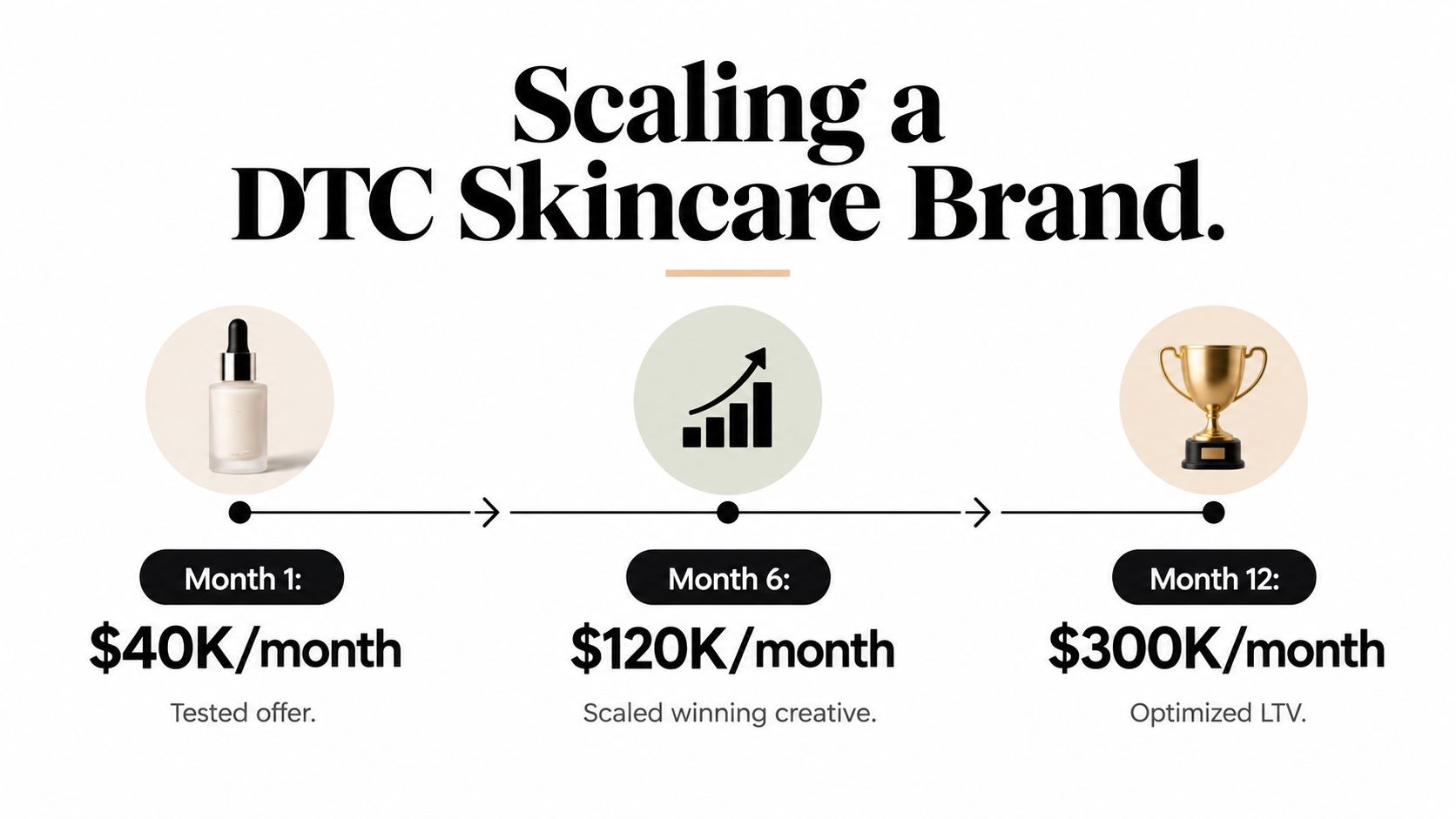
The useful lesson isn't “use an iPhone.” It's that the creative and landing page shared one believable story. Founder credibility did the attention work, while the advertorial gave skeptical buyers enough context to continue.
A B2B SaaS company took a different route. It paired LinkedIn lead-form ads with a 48-hour SDR speed-to-lead rule and an automated Calendly handoff. The ad created the opportunity, but the follow-up process determined whether that opportunity became a booked conversation.
That's where many campaigns die. The media buyer optimizes the form, the sales team receives a notification, and the prospect hears nothing useful. Direct response doesn't end at the conversion event.
The handoff is part of the ad. If the business can't fulfill the promise quickly, the campaign is not finished.
Then there was the supplements brand that burned $90K behind one conversion-optimized creative. The ad produced impressive ROAS in its first week, then collapsed when the learning phase ended and audience overlap saturated.
The warning signs were obvious in hindsight: no creative refresh pipeline, no holdout test, and no second product line to absorb learning decay. The team had found a winner, then confused a temporary signal with a durable acquisition system.
Copy the first two campaigns' operating logic. Avoid the third campaign's superstition. A winner is not a strategy until you can refresh it, validate its incrementality, and extend its economics beyond one audience pocket.
Last-click ROAS is one of the most dangerous numbers in a media buyer's dashboard because it looks precise while answering a narrow question. In online advertising, last-touch attribution gives conversion credit to the last publisher that showed an ad, even when several channels influenced the same person, as explained in this research on online advertising attribution.
That doesn't make last click useless. It makes it incomplete.
Platform reporting can overstate causal performance through view-through windows, overlapping exposures, and optimization toward people who were already likely to convert. Don't repeat a fixed inflation percentage unless your own tests support it. Privacy changes have also reduced attribution visibility, so advanced teams increasingly combine first-party data, modeling, and incrementality testing rather than trusting platform-reported ROAS alone, as discussed in this privacy-first measurement guidance.
Use a dashboard that forces the campaign to face commercial reality:
The technical reason matters. Uplift modeling estimates the incremental impact by comparing treated and control behavior, separating true campaign lift from baseline demand and channel interaction effects, as outlined in this research on uplift modeling and direct marketing attribution.
Before trusting any attribution number, ask:
Viewability also belongs in the conversation. Ads that remain visible longer and receive more attention have a stronger relationship with online conversions, and adding viewability information can improve conversion-credit allocation, according to this industry summary of viewability and conversion research.
Your dashboard doesn't need more decoration. It needs more ways to prove that spend caused something valuable.
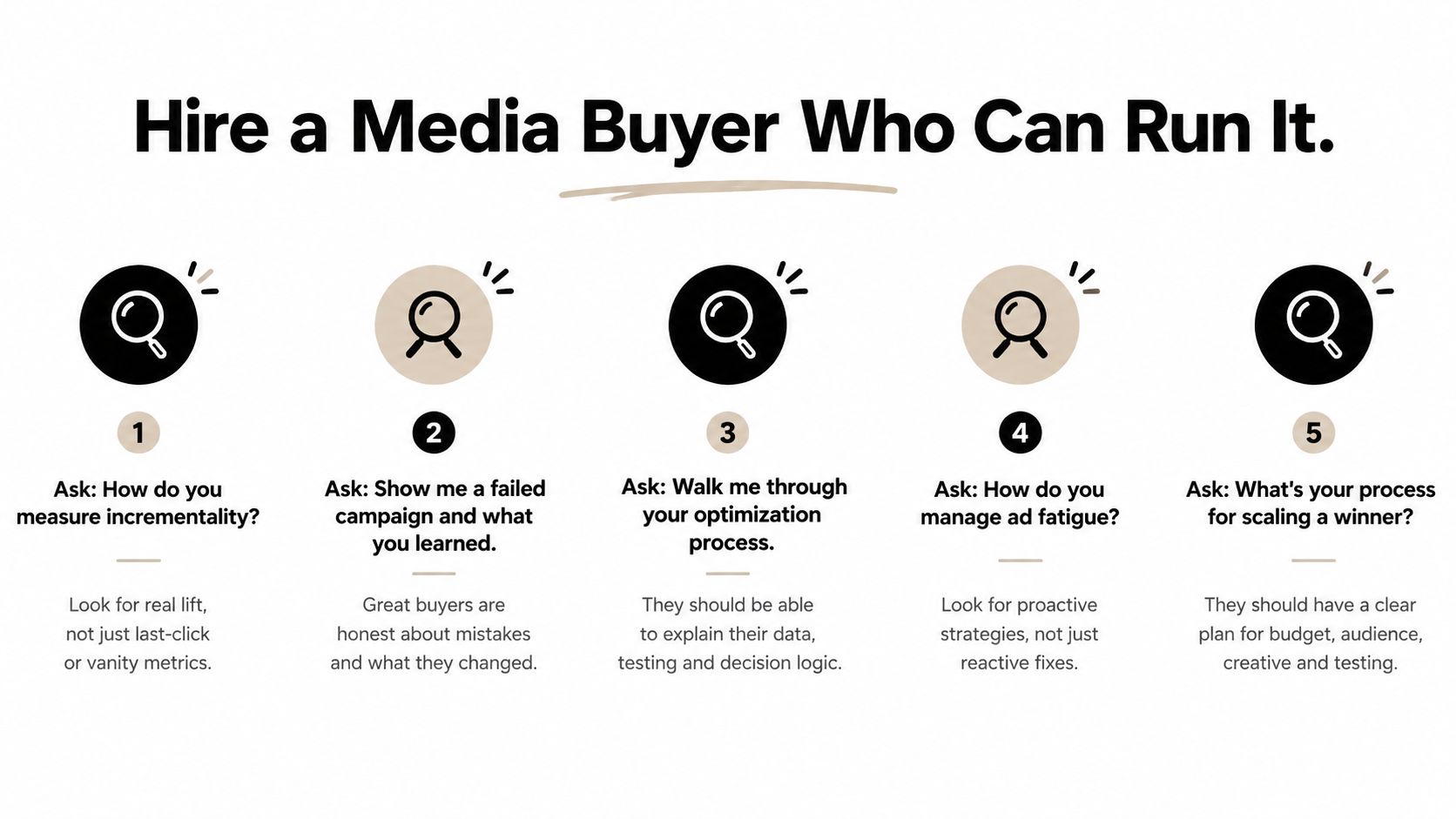
A competent direct response operator can discuss creative, offer economics, tracking, sales quality, and incrementality in one conversation. A glorified ad trafficker talks about campaign setup and sends screenshots.
Screen for thinking, not platform badges. Ask these questions:
An in-house hire makes sense when paid acquisition is a core growth function and the company can provide enough volume, creative support, analytics access, and management attention. An agency fits when you need a broader team, channel expertise, or a structured external operating system. A fractional specialist works when the account needs senior judgment but not a full-time department.
Don't hire around a rough spend threshold alone. Hire around operational complexity and the cost of being wrong. A business spending modestly with weak tracking may need measurement architecture before more media. A larger account with strong systems may need creative strategy, testing capacity, and channel management.
Red flags are easier to spot than people admit:
Verify past results by speaking with references, asking what changed after the buyer left, and requesting a walkthrough of the decision process rather than just the outcome. Platforms such as HireMediaBuyers.com connect companies with media buyers and paid ads specialists across channels, with screening and hiring options for remote roles, but you should still test the candidate's judgment yourself.
Here's the rule I'd put above every media plan:
If a tactic, creative, channel, or metric doesn't move a number tied to revenue or qualified action, it doesn't ship.
That doesn't make direct response anti-brand. Brand can create future demand, improve trust, and make later conversion easier. But brand instincts become expensive when they sneak into a performance campaign disguised as strategy: glossy creative without a clear offer, broad reach without a commercial hypothesis, and attribution nobody can challenge.
Good direct response advertising is creative enough to earn attention and disciplined enough to prove its value. It respects the customer, the sales team, the finance department, and the uncomfortable possibility that the winning platform report is wrong.
Ship the test. Read the number. Cut what doesn't work. Scale what does. Never let a pretty dashboard cover an empty pipeline.
If you need a media buyer who can connect creative, channel execution, attribution, and revenue discipline, visit HireMediaBuyers.com to find vetted paid ads specialists for full-time, part-time, or remote support. Bring them your actual funnel and your uncomfortable numbers, then hire the person who can explain what happened and what they'll test next.


