


You've probably done this already.
You opened Meta Ads, tossed in a budget, picked an audience that sounded plausible, hit publish, and watched the dashboard light up like a slot machine. Reach. Clicks. Maybe even a few add-to-carts. Then you checked revenue and got the emotional equivalent of stepping on a Lego.
That's digital media buying for most companies. Not because the platforms are broken. Because buying ads isn't a “press button, receive growth” machine. It's a discipline. A messy one. Part math, part psychology, part operational paranoia.
I learned this the expensive way. Plenty of founders do. You think you're buying traffic. What you're buying is a chain of decisions: channel choice, audience quality, bid strategy, creative fit, landing page alignment, tracking accuracy, pacing control, and the judgment to know when to kill something before it eats your wallet.
The good news is that digital media buying does work.
The bad news is that it only works consistently when someone competent is running it.
A founder I know once told me, “Our ads are performing great.” Revenue said otherwise.
What he meant was the dashboard looked busy. The campaign had impressions, the CPM looked tolerable, and people were clicking. The business still wasn't getting enough qualified leads, and the sales team was blaming “lead quality,” which is usually corporate code for “marketing is lighting money on fire with extra steps.”
That's the first correction worth making. Digital media buying is not posting ads on the internet. It's the deliberate act of paying for distribution in a way that puts the right message in front of the right people, at the right time, without paying for junk attention you can't monetize.
Boosting a post is hope.
Letting platform defaults choose everything is hope.
Running the same creative for too long because “it used to work” is hope with a nice shirt on.
Real digital media buying is more like inventory management for attention. You're allocating budget into channels, audiences, and placements with the expectation that some will perform, some won't, and your job is to know the difference quickly. If you don't, the platforms will happily spend your money anyway. They're not your CFO.
Practical rule: If your plan is “let's run some ads and see,” you don't have a plan. You have a casino habit with cleaner branding.
Many businesses consider whether to manage ads in-house or entrust them to an outside partner. That matters, but it's secondary to the core issue: who has the judgment to run spend responsibly? If you're weighing those models, this breakdown of agency versus in-house media buying is a useful gut check.
The platform matters. The offer matters. The landing page matters. But the operator matters more than people want to admit.
Why? Because media buying is full of trade-offs. Broader audience or tighter intent. More scale or more control. Aggressive bids or cleaner efficiency. Fast learning or clean attribution. The person making those calls can make an average ad account profitable or turn a promising one into a money shredder.
When companies say they need digital media buying, they usually need one of three things:
Those are different jobs. Different channels do them differently. Different buyers handle them differently too.
That's why “we need ads” is too vague to be useful. You need a buyer who knows what kind of demand you're trying to create, capture, or recover, and who won't confuse dashboard activity with business progress.
The digital ad world is a giant, noisy kingdom full of weird little countries. Each one has its own customs, costs, quirks, and scams. Walk into the wrong one dressed for the wrong occasion and you'll waste money fast.
That's why channel selection isn't a checklist exercise. It's a strategy call.
By 2025, global social ad spend was projected to surpass $276.72 billion, and the typical social user was projected to visit 6.84 platforms per month, which is a big reason modern media buying has become a cross-platform allocation problem instead of a one-channel decision (Sprinklr social media marketing statistics).
A quick map helps.
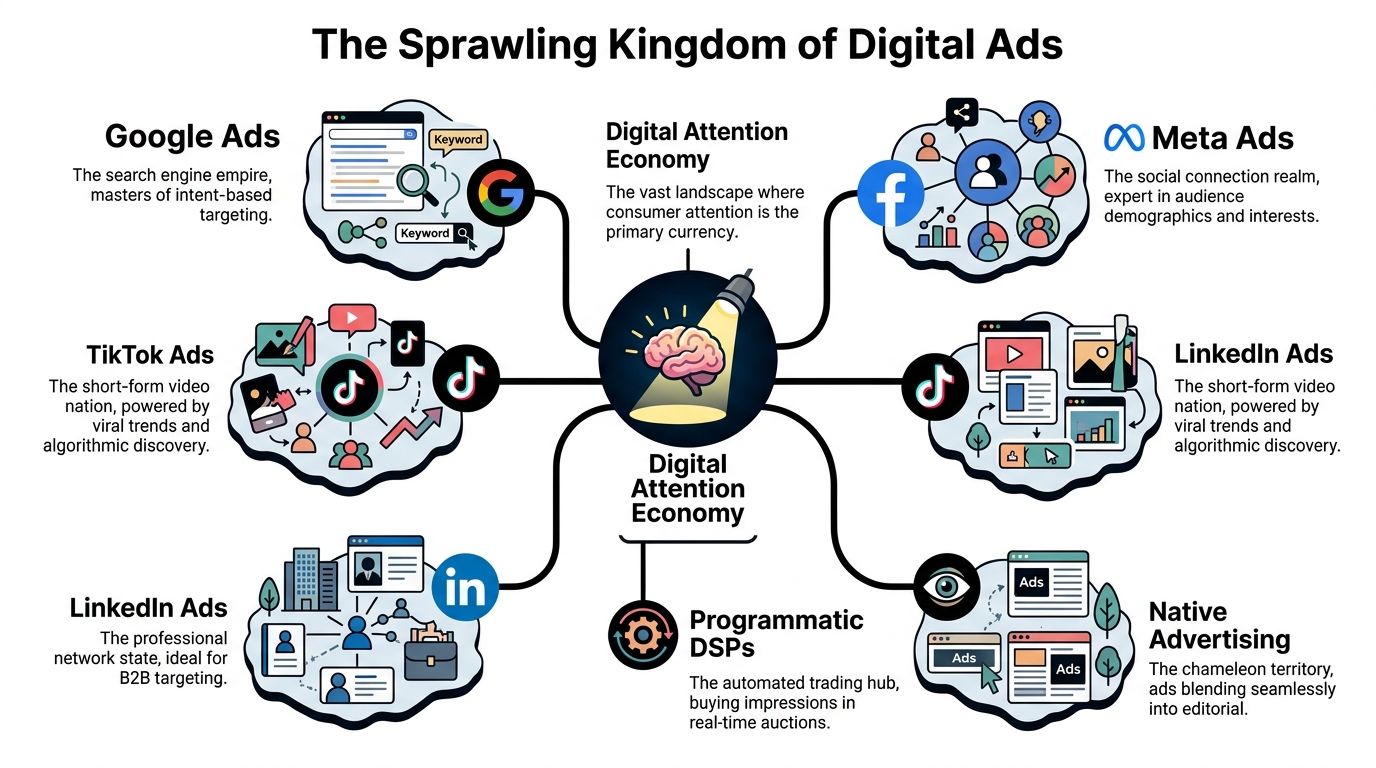
Google Search is where people raise their hand and say, “I need a thing.” That's intent. Beautiful, expensive, high-pressure intent.
If you sell something people already know they want, Google is often where you start. Not because it's glamorous, but because it catches demand that already exists. The downside is obvious. Everyone else wants that same traffic.
Meta is where people aren't shopping in the traditional sense, but they can still be persuaded. You can target interests, behaviors, lookalikes, and retargeting pools. It's good for products people can understand quickly and offers that create instant curiosity.
It's also where lazy advertisers get fooled. Meta can make bad campaigns look healthy for a while because the interface is excellent at making motion feel like progress.
TikTok isn't a polished showroom. It's a street market where attention changes direction every few seconds.
If your creative feels native, your offer is sharp, and your team can make things that don't look like ads pretending to be content pretending to be ads, TikTok can work. If your brand talks like a committee, don't bother. The algorithm may be clever, but it can't save stiff creative.
LinkedIn is not where you go for cheap attention. It's where you go when audience precision matters more than volume, especially in B2B.
Job titles, company attributes, and professional context make it useful. The catch is that weak positioning gets punished fast. If your message sounds like every other “deliver scalable transformation” ad, you're paying premium prices to be ignored by people in blazers.
For sharper targeting strategy across channels, audience planning matters more than typically understood. This guide on audience segmentation for paid media is worth a read before you touch budget.
Programmatic buying covers a huge pile of inventory across websites, apps, streaming environments, and exchanges. It can give you reach, flexibility, and access that the big self-serve platforms don't.
It can also become a very efficient method for buying low-quality impressions if nobody competent is watching it.
A simple founder-friendly way to think about this space:
The mistake is trying to find the “best” platform. There isn't one. There's only the platform that matches your customer, your offer, your creative style, and your stage of growth.
Buying ads happens in a few different ways. It's common to nod politely when terms like direct buy, RTB, and PMP come up, then hope nobody asks a follow-up. Fair enough. Adtech has a talent for turning simple transactions into alphabet soup.
Here's the plain-English version.
It's comparable to buying a car.
A direct buy is like buying from a specific dealer. You know what lot you're walking onto, who you're dealing with, and what inventory you're getting. In media terms, that usually means negotiating directly with a publisher, platform rep, or media owner for placement.
This makes sense when placement context matters a lot, when you want guaranteed inventory, or when you're buying premium environments where uncertainty is the enemy.
The trade-off is that direct deals can be slower, less flexible, and often more expensive.
Real-time bidding, or RTB, is the ad market equivalent of an auction where a ridiculous number of micro-transactions happen constantly. An impression becomes available, buyers bid, and the winner gets the slot.
This is what a lot of programmatic buying runs on. It's scalable and dynamic. It also demands actual oversight, because “automated” doesn't mean “safe” or “smart.” It just means the machine can lose money faster if your setup is sloppy.
A private marketplace, or PMP, sits between direct and open auction. It's a pre-arranged deal with select access. Think private sale, not public brawl.
You still use programmatic pipes, but the inventory is more controlled. That can mean better placement quality and better transparency, though usually not bargain-bin pricing.
| Method | Best For | Cost | Transparency | Analogy |
|---|---|---|---|---|
| Direct | Premium placements, guaranteed environments, specific publishers | Often higher | Usually stronger | Buying from a dealer |
| RTB | Scale, broad reach, flexible optimization | Can vary widely | Often mixed | Buying at an open auction |
| PMP | Curated inventory with programmatic execution | Usually mid to high | Better than open auction | Buying through a private sale |
The method isn't the strategy. It's the transaction layer. Plenty of teams confuse the plumbing with the plan.
If you're hiring someone to manage digital media buying, ask these questions instead of pretending to understand every acronym on the call:
The method you choose should fit the campaign. A high-intent search campaign doesn't need the same buying structure as a brand-awareness push across streaming inventory. If your buyer treats every channel like the same machine with different logos, that's your cue to clutch your wallet.
Most companies ask the wrong budget question.
They ask, “How much should we spend?”
That sounds sensible. It isn't. The better question is, “What can we afford to pay to acquire a customer, and how much are we willing to spend to learn?” Those are different numbers, and if you mash them together, you get terrible decisions wearing spreadsheet makeup.
A media budget should be built around unit economics, not vibes and not some neat little “let's spend this percentage of revenue” rule. Revenue percentages are tidy for board decks and almost useless for execution.
You need a testing budget. That's the money you expect to spend while learning what audiences, creatives, offers, and channels deserve more capital. Then you need a scaling budget, which only becomes available when the economics hold up.
That sounds obvious. It apparently isn't, judging by how many teams dump meaningful spend into unproven campaigns and act shocked when the results look like a raccoon organized the account.
Platforms love the easy button. “Maximize conversions.” “Advantage+.” “Smart bidding.” Very convenient. Also a wonderful way to hand over too much control too early.
The issue isn't that automation is always bad. It's that defaults tend to hide the mechanics you should be managing on purpose. As noted in AI Digital's media planning and buying guidance, strong buyers manage bid strategy, audience layers, and frequency caps as separate technical controls, then use real-time optimization on things like win rates and clearing prices to shift budget toward better-performing line items.
You don't need to worship acronyms. You need to understand the levers.
And then there's frequency. Ignore it and you can end up paying to annoy the same people over and over. That's not media buying. That's digital nagging.
My bias: Start with more control than the platforms recommend. You can always loosen the reins later. It's harder to recover after the machine has spent freely on bad assumptions.
When I'm looking at a new account, I want four things pinned down before budget gets serious:
That last one matters. Too many teams scale because a campaign had a good afternoon. Congratulations. So did a roulette table.
Ad dashboards are full of decorative nonsense.
Impressions. Clicks. CTR. CPC. Video views. Engagement rates. Helpful in context, sure. But many teams stare at these numbers like archaeologists studying sacred text, then forget to ask the only question that matters: did this spend create profitable business outcomes?
That's where digital media buying usually goes sideways. Not in launch. In interpretation.
A visual makes the split obvious.
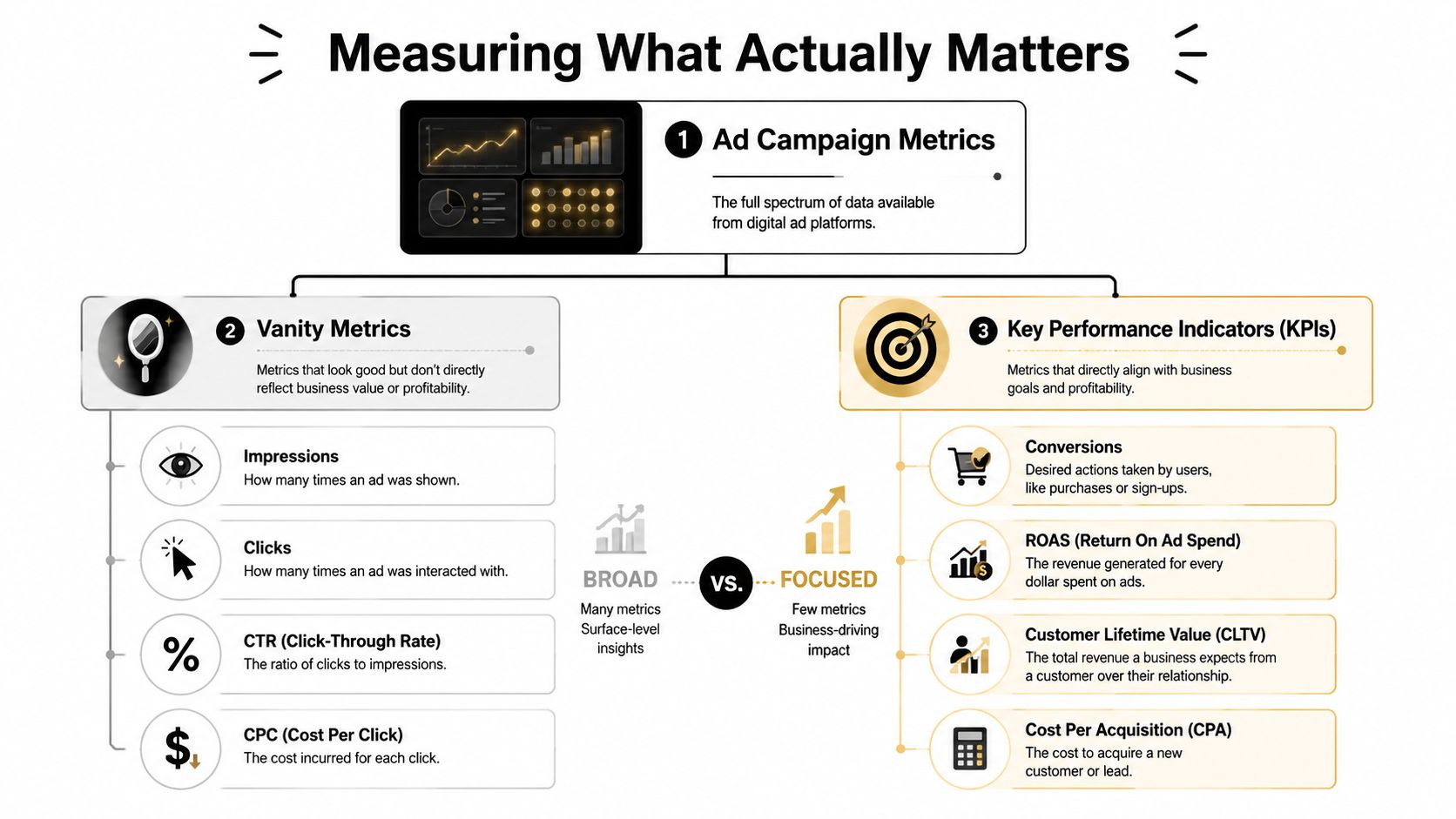
Vanity metrics aren't useless. They're just easy to overvalue.
A high CTR can mean your ad is compelling. It can also mean your ad is bait-y and your landing page is doing all the disappointing. A low CPC can look efficient while attracting the exact wrong people. Impressions tell you your ad existed. That's about it.
If you're running a business, the shortlist is tighter:
Those are the numbers that belong near your bank account and your operating model.
A lot of smart people waste a lot of time trying to build perfect attribution. It's noble. It's also a great way to lose the plot.
Users see an ad on one platform, search later, click an email, come back direct, then convert after talking to sales. Meanwhile every platform would love to take a victory lap and claim credit. Ad platforms are like children around a broken vase. Everyone has a story.
This is why I prefer a grown-up approach. Use attribution as directional evidence, not divine truth. Look at platform data, site analytics, CRM outcomes, sales feedback, and blended business results together. Then make decisions.
If your team needs a better framework for this, this primer on attribution modeling in paid media is a solid place to start.
If the platform says performance is amazing and your finance team says margin is getting punched in the throat, believe finance first.
Instead of asking “What happened in the dashboard?”, ask:
That's the difference between reporting and management.
A weak buyer reports metrics. A strong buyer interprets them, admits uncertainty, and changes the plan accordingly.
Sooner or later, every account has a bad day.
Tracking breaks. Spend runs too hot. Ads deliver to the wrong geography. Frequency goes feral. A sale launches and suddenly your data looks like it was assembled by a sleep-deprived intern with oven mitts on.
This is normal. The difference between an amateur and a pro is response time.
As noted in Keends' media buying process guide, pacing and first-48-hour QA are operationally critical because buyers need to verify delivery, audience alignment, and spend behavior early enough to catch tracking failures, overspend, or under-delivery before the data gets distorted.
Symptom: Conversions disappear, duplicate, or make no sense.
Diagnosis: Broken pixels, bad event mapping, site changes, checkout issues, or a tagging setup that was “handled” by three different people and documented by none of them.
Treatment:
Symptom: Campaigns burn budget too quickly or barely deliver at all.
Diagnosis: Bid strategy mismatch, audience too narrow, constraints too tight, or platform automation deciding today is the day to get adventurous with your money.
Treatment:
Symptom: CPA rises, engagement drops, comments get snarky, and performance decays even though “nothing changed.”
Something changed. The audience got tired.
Treatment:
You can't optimize your way out of creative fatigue forever. At some point, the ad is just tired and needs to be replaced.
Symptom: Plenty of activity, lousy downstream quality.
Diagnosis: Weak placements, low-quality inventory, accidental broadening, fraud issues, or bots pretending to be users with suspicious enthusiasm.
Treatment:
The first couple of days after launch tell you a lot. Not everything, but enough to catch the ugly stuff while it's still manageable. Ignore that window and you're basically letting the campaign write its own incident report.
The biggest lie in paid media is that one person can do all of it well, all the time, at scale.
Can one person launch campaigns? Sure. Can one person own strategy, write copy, brief creatives, build audiences, manage bids, fix tracking, interpret attribution, communicate to stakeholders, and make sober budget calls under pressure? Sometimes. Usually for about five minutes before something slips.
Good digital media buying is a team sport, even when the “team” is lean.
Here's what that team looks like.
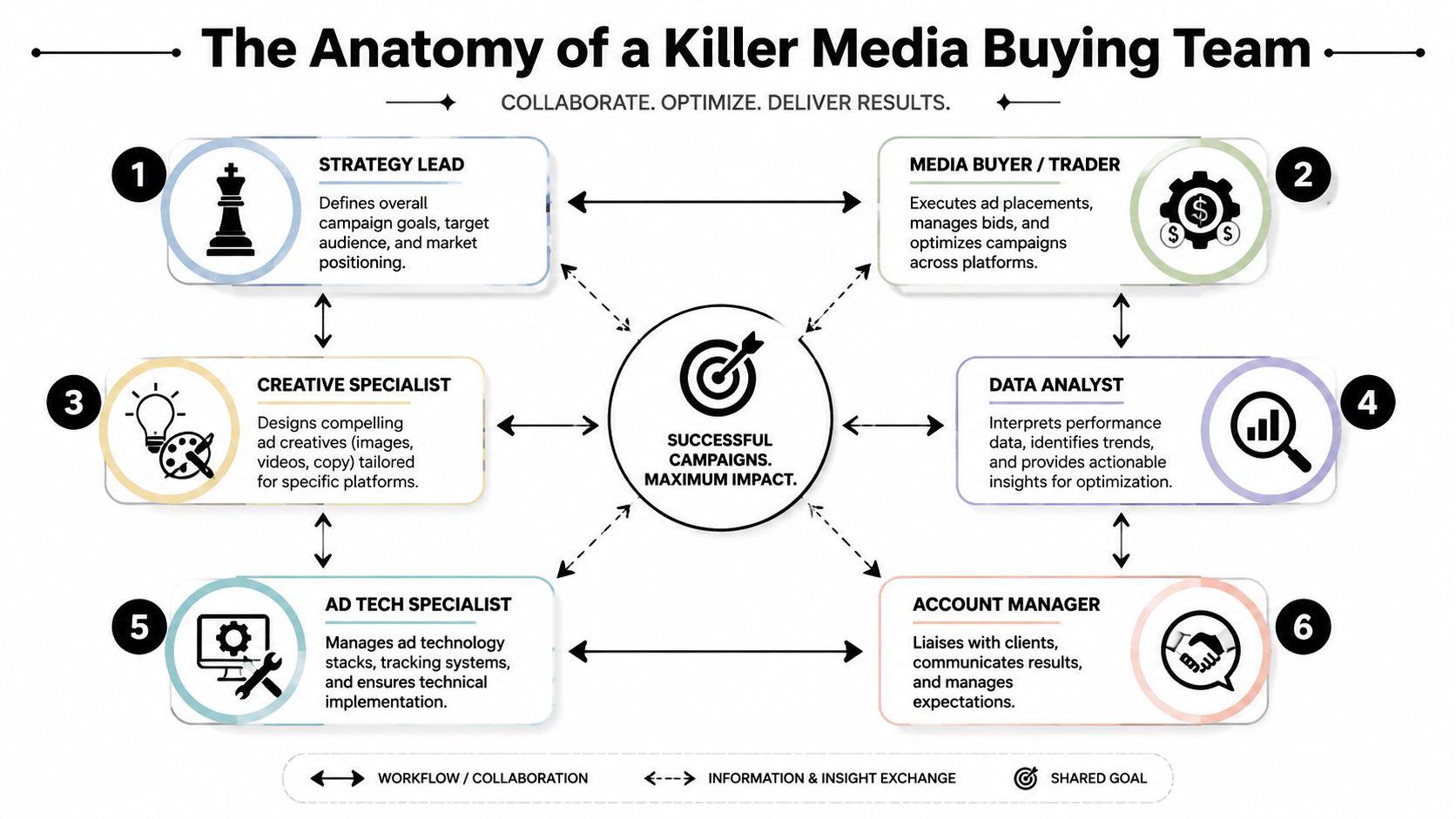
This person decides where the business should play, what success looks like, and what trade-offs are acceptable. They understand the offer, the sales cycle, the margin structure, and the customer journey.
Without this role, teams optimize for whatever the dashboard serves up. That's how companies end up celebrating lower CPCs while revenue slips away unseen.
The media buyer or trader lives inside the platforms. They build campaigns, manage bids, monitor delivery, adjust audiences, control frequency, and kill losers before they become budget sinkholes.
This role is technical, yes. But the best buyers also have taste. They can spot bad structure, weak logic, and suspiciously “good” results that don't line up with business reality.
A buyer sees campaign performance. An analyst connects it to the business.
They look across channels, compare platform claims with actual outcomes, and identify patterns the account team might miss. If nobody owns this perspective, attribution theater takes over and every channel starts filing self-congratulatory reports.
The highest-functioning teams usually also rely on these roles:
Strong teams don't just know how to launch campaigns. They know how to disagree well, test fast, and tell uncomfortable truths before the budget gets hurt.
When hiring, people obsess over platform badges and channel familiarity. Fine. Useful. Not enough.
The traits I trust more are these:
That last one is rarer than it should be.
The platforms are tools. The operator is the edge. Give a mediocre buyer elite software and you'll still get expensive confusion. Give a sharp buyer a decent toolkit and you'll usually get progress.
Once you accept that digital media buying is a talent problem, the next headache arrives right on schedule: how do you get the talent?
You've got three classic options, and none is painless.
An in-house hire gives you focus, proximity, and accountability. They learn your business thoroughly. They can work closely with product, creative, and sales.
The downside is obvious if you've hired for paid media before. Vetting is hard. Plenty of candidates know platform language well enough to sound competent for half an interview. Then you put them in a live account and discover they've been driving with the parking brake on for years.
In-house also creates single-point-of-failure risk. One person leaves, and suddenly nobody knows why the retargeting exclusions are held together with duct tape and superstition.
Agencies can bring breadth, process, and specialized exposure. Sometimes that's exactly what you need.
Sometimes you get the pitch team in the sales call and the B-team in the account.
That doesn't mean agencies are bad. It means agency fit is highly variable. You need to know who will touch the account, how often they'll review it, what they control, and whether they think reporting is the same thing as strategy.
A good freelancer can be excellent. Lean, sharp, and practical.
A bad one can disappear mid-campaign, break your tracking, and leave behind a naming convention that looks like a cat walked across the keyboard.
Freelancers make sense when the scope is clear and you know how to evaluate the work. If you don't know how to evaluate the work, you're outsourcing blind.
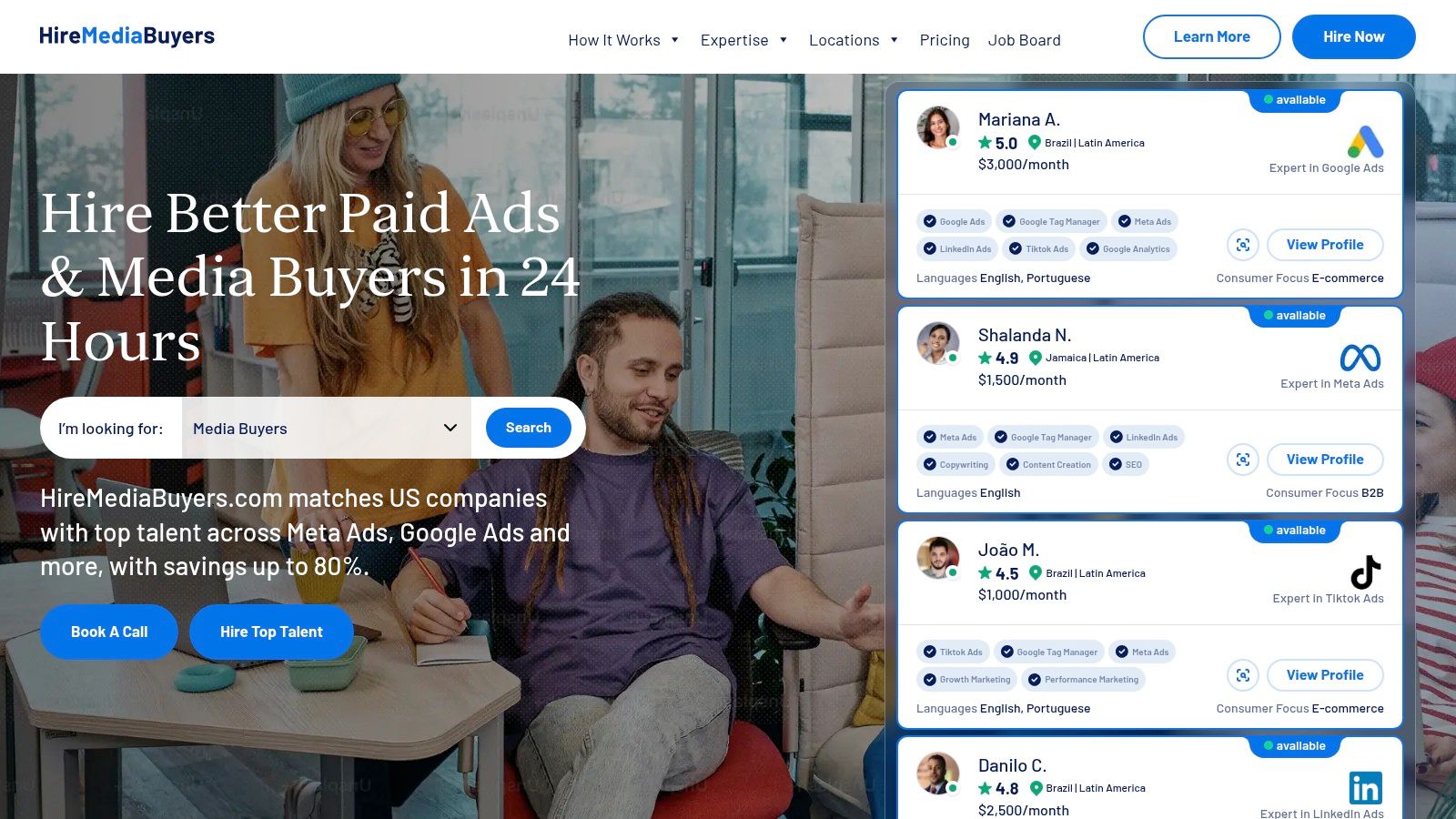
This is why vetted talent marketplaces have become appealing. They sit between full recruitment and pure agency outsourcing. You still need to interview properly, but the pool is narrower and the screening burden is lighter.
One example is HireMediaBuyers.com, a hiring marketplace focused on pre-vetted media buyers and paid ads specialists for channels like Meta, Google, LinkedIn, TikTok, YouTube, and others, with options for part-time and full-time remote hires.
A look at that model helps make the trade-off concrete.
If paid media is core to growth and you need day-to-day ownership, get dedicated talent. Don't treat your acquisition engine like a side quest.
If your needs are broad and strategic, a strong agency can work. If your needs are execution-heavy and constant, a dedicated buyer or lean team usually makes more sense. If you need flexibility and speed but don't want to spend weeks sorting through polished resumes and vague case studies, a vetted marketplace is often the most practical option.
The mistake is hiring for platform familiarity alone.
Hire for judgment. Hire for clarity. Hire for the kind of person who notices when the numbers smell funny and doesn't need a committee meeting to fix it.
Because that's what digital media buying really is. Not button-clicking. Not dashboard worship. Not creative guessing games. It's disciplined money management in a chaotic environment.
And if you get the people part right, the channels get a lot easier.
If you need a faster way to put real paid media talent in the seat, HireMediaBuyers.com helps companies hire pre-vetted media buyers and paid ads specialists without dragging the process into a month-long resume scavenger hunt.


