

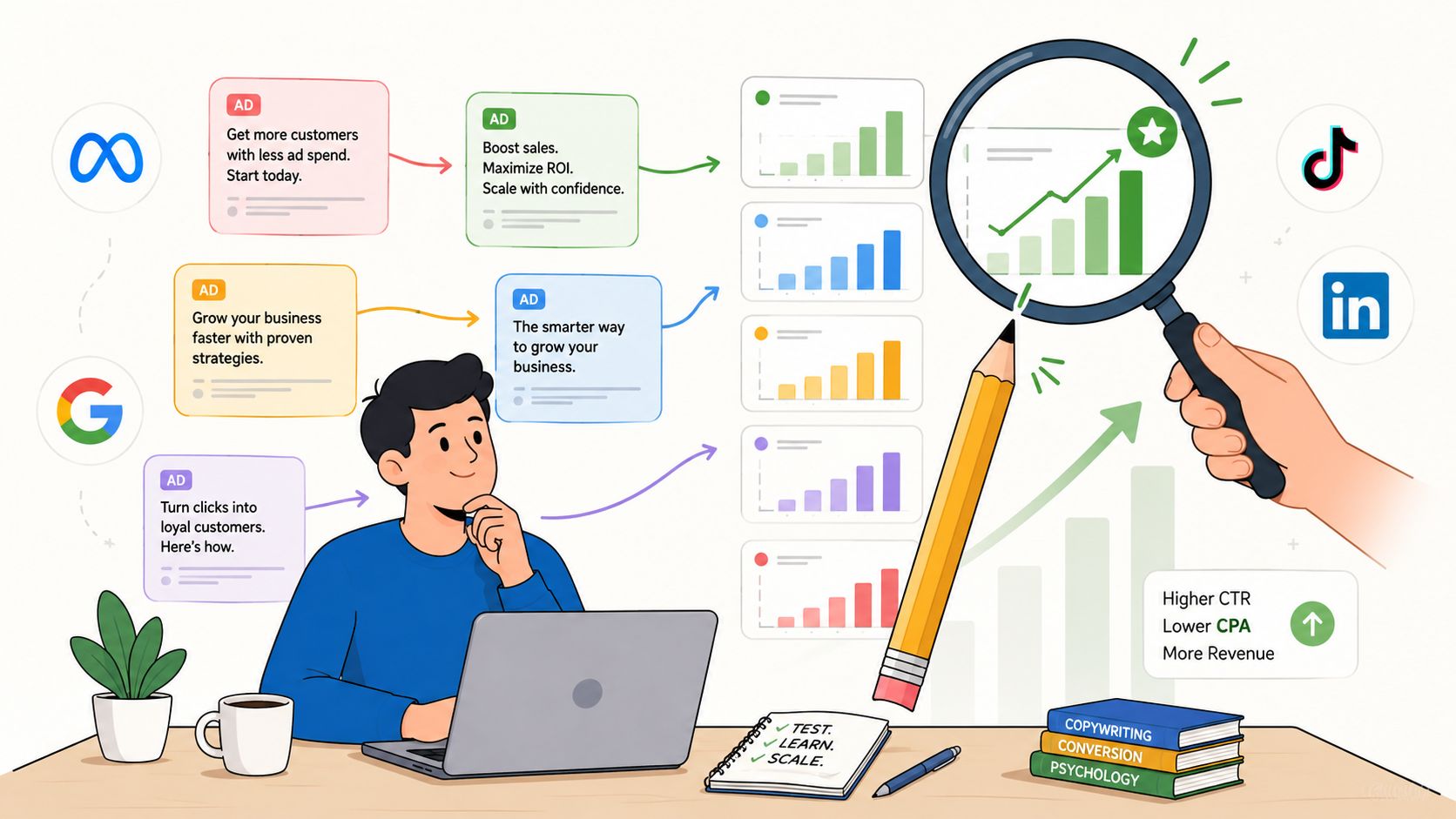
“Write like a human” is some of the most expensive advice in advertising. Clever adjectives don't rescue a weak offer, emoji stacks don't fix intent mismatch, and a headline that makes your Slack channel cheer can still produce terrible revenue. I've burned enough budget on polished nonsense to know the difference.
Ad copy optimization is a measurement discipline first and a writing craft second. The job isn't to produce lines that sound persuasive. The job is to create hypotheses, expose them to comparable traffic, and rank the variants against the KPI that matters. Sometimes that means CTR. Often it means qualified conversions, pipeline, or profit.
The history backs up the mindset. Systematic copy testing became formalized through Claude Hopkins' 1923 book Scientific Advertising, while earlier controlled-experiment methods are traced to an 1835 double-blind trial in Nuremberg. Direct-mail and coupon tests carried that discipline into practical advertising, replacing assumption with response data. The history of copy testing is useful because it makes one point clear: optimization didn't begin with dashboards. It began when advertisers stopped trusting instinct alone.
Most ad copy advice treats writing as the main event. Add urgency. Use emotional language. Keep the headline short. Sound human. Sprinkle in social proof. None of that is useless, but it's dangerously incomplete.
A campaign doesn't pay you for adjectives. It pays you when the right person takes a valuable action at an acceptable cost. A beautiful headline that attracts curious clicks can make performance worse if those visitors never qualify, book, buy, or become profitable customers.
Mistake one, optimizing CTR when conversions are the constraint. CTR can diagnose message resonance before the click, but it can't tell you whether the message attracts buyers or bored browsers. Independent A/B benchmark data reports an average lift of 8.4% among winning experiments and an average result of -7.4% among losing tests, while also warning that CTR shouldn't stand alone. Pair it with conversion and incrementality data.
Mistake two, treating copy as a launch asset. Teams write five ads, pick the one that feels strongest, and move on. That's not optimization. That's creative gambling with a nicer project-management board.
Mistake three, copying competitors. Your competitor's headline sits inside a different offer, brand, landing page, sales process, and funnel math. Borrowing their wording without understanding those conditions is like copying someone's medical prescription because you like their shoes.
Operating rule: Copy is a hypothesis generator. Its only job is to produce measurable signal against a business goal.
The market has moved from manual coupon trials to high-frequency digital experimentation across headlines, descriptions, calls to action, CTR, CPA, conversion rate, and ROAS. Yet platform guidance can still mislead. A study of more than 1 million Google Ads found ads labeled “average” for Ad Strength outperformed ads rated “good” or “excellent” on key performance metrics, a useful warning that platform scores aren't the same thing as business outcomes. The analysis of more than 1 million Google Ads deserves a place in every media buyer's training folder.
The disciplines that matter are straightforward, even if execution isn't: hypothesis design, statistical testing, channel-specific constraints, and KPI alignment. Skip any one of them and you're decorating the dashboard, not improving the account.
“Make it punchier” isn't a hypothesis. It's a mood expressed in project-management software.
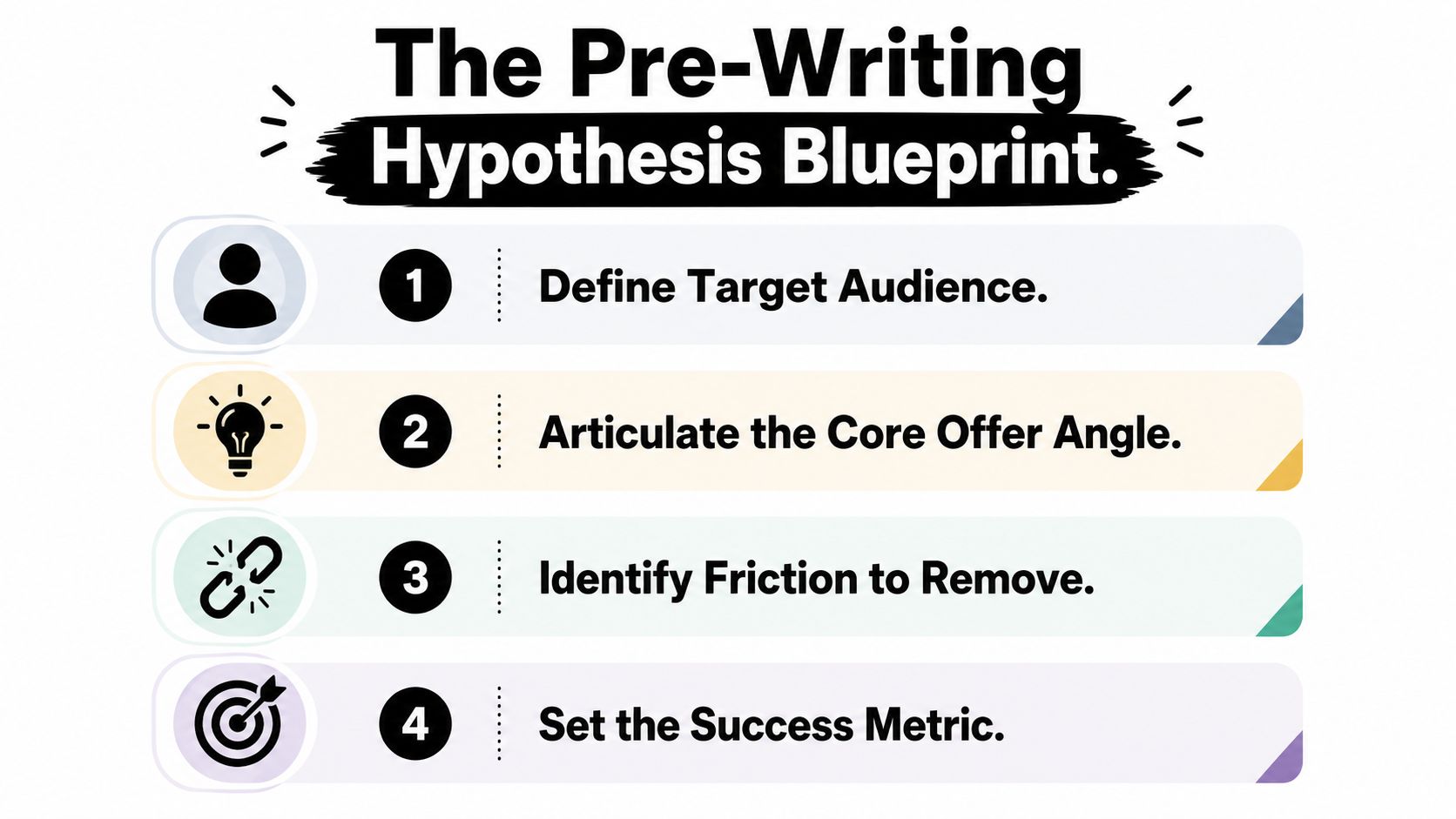
Before drafting copy, write a claim that identifies who should respond, what they'll respond to, which friction the message removes, and how success will be judged. A usable structure looks like this:
For [audience], [offer angle] will remove [specific friction] and improve [defined KPI].
That forces useful specificity. “A stronger value proposition will improve performance” tells nobody what to write or measure. “Operations leaders comparing workflow tools may respond better to implementation-risk language than feature language, measured by qualified demo conversion” gives the buyer, angle, obstacle, and outcome a job.
Copy doesn't exist in a blank document. Google's responsive search ads allow up to 15 headlines and 4 descriptions, with headline fields capped at 30 characters, description fields at 90 characters, and path fields at 15 characters. Google also says double-width languages such as Korean, Japanese, and Chinese count each character as two. Google's responsive search ad specifications make the practical lesson unavoidable: the winning line may be the one that fits cleanly.
Google assembles responsive search ads from multiple assets. At campaign level, advertisers can associate up to 3 headline assets and 2 description assets, and the system can display up to three headlines and two descriptions. Google's asset combination guidance supports a modular approach. Write complementary angles, not one heroic paragraph that tries to handle awareness, proof, objections, and CTA in one breath.
Use pinning with restraint. Pin a critical message when the test requires controlled positioning, but don't pin everything and then complain that the platform can't learn combinations.
Pull phrases from sales-call notes, support tickets, review threads, lost-deal reasons, and customer interviews. Look for the words buyers use when they describe the problem, the risk, and the desired result. “Easy setup” is brand language. “We can't afford another six-week implementation” is usable evidence.
Then complete a one-page worksheet:
Don't open the ad editor until those fields have an answer. It's cheaper to spend ten minutes sharpening a hypothesis than to spend a month optimizing a sentence nobody needed.
A/B testing is simple to describe and easy to corrupt. Put variant A against variant B, split delivery fairly, and measure the outcome. The trouble starts when teams change the audience, offer, landing page, budget, and headline simultaneously, then call the result a copy win.
A rigorous PPC workflow isolates one meaningful variable, forces even delivery, and waits for enough evidence. Common guidance recommends running a test for at least one full week, using a 90% to 95% confidence threshold, and aiming for around 100 conversions per variant to reduce false winners and weekday or weekend bias. PPC testing guidance on runtime and confidence also suggests treating a relative lift of 10% or more as a practical scaling threshold. Smaller movements may be real, but they're easier to lose to audience drift and traffic-quality changes.
A test with 200 clicks sounds active. It may still be useless. If the baseline conversion rate is 1.5%, 200 clicks produce roughly three conversions before you even compare variants. That's not enough evidence to crown a winner, especially when one additional conversion can swing the apparent result.
Sample-size planning should account for the baseline conversion rate, minimum detectable effect, desired power, and significance threshold. If your team can't state those assumptions before launch, it isn't testing. It's peeking at a coin toss and writing a case study.
A/B testing works best when the question is narrow. Test a pain-point angle against an outcome angle, or a low-friction CTA against a commitment-heavy CTA. Multivariate testing earns its complexity only when you have enough volume to evaluate combinations and a reason to study interaction effects. Otherwise, it creates a soup of headline, description, and audience interactions that nobody can interpret.
Stop at a predefined sample size or runtime. Don't end the test because one variant looks exciting on Tuesday morning. Keep overlapping audiences from contaminating delivery, document meaningful changes, and refresh the creative when fatigue changes the traffic context.
| Baseline CVR | Sample Size per Variant | Approx. Runtime at 500 Daily Clicks | Decision Rule |
|---|---|---|---|
| Low | Planned before launch | Depends on required conversions | Scale only with sufficient confidence and meaningful lift |
| Medium | Planned before launch | Depends on required conversions | Declare a winner only when the KPI and confidence threshold agree |
| High | Planned before launch | Depends on required conversions | Treat small differences cautiously and validate downstream quality |
The table deliberately avoids fake precision. Runtime depends on conversion volume, traffic allocation, audience overlap, and the effect you're trying to detect. Anyone promising a universal sample size is selling certainty they don't own.
Classify outcomes cleanly:
The right output isn't “B won.” It's “This audience responded better to this promise under these conditions.” That sentence is reusable. A screenshot of a green arrow isn't.
Copy doesn't transfer between platforms like a file attachment. A line that stops a Meta scroll can look unserious on LinkedIn. A precise Google headline can die on TikTok because it explains before it earns attention.
The shared rule is message-to-context fit. The platform-specific execution is different.
| Element | Meta | TikTok | ||
|---|---|---|---|---|
| Primary job | Stop the scroll | Match query intent | Earn continued viewing | Establish professional credibility |
| Hook placement | Early in primary text or creative | Early in headline structure | Immediately in the opening beat | Early, with a credible business tension |
| Tone | Native and audience-aware | Clear and query-relevant | Conversational, creator-like | Direct, informed, commercially credible |
| Emoji policy | Use sparingly, especially in B2B prospecting | Usually unnecessary | Use only when native to the creator voice | Keep restrained |
| CTA phrasing | Match awareness and commitment level | State the next action clearly | Make the next step feel natural | Reduce perceived professional risk |
| Main ranking signal | Scroll-stop and engagement quality | Relevance and response | Completion behavior | Relevance and credibility |
Meta rewards the first moment of attention, but B2B advertisers often overdo the performance. “Stop wasting money today 🚀🔥” may attract eyes while telling serious buyers nothing.
Do: Lead with a recognizable problem, a surprising observation, or customer language.
Don't: Stack emojis around a generic promise and call it personality.
A prospecting line should make the audience feel identified, not shouted at. Retargeting can carry more proof and specificity because the viewer already has context.
Google search copy has less room for theater and more demand for relevance. Google text ads use 3 headlines capped at 30 characters each and 2 descriptions capped at 90 characters each. Google's text ad format turns editing into arithmetic.
Do: Match the searcher's intent and give each asset a distinct role.
Don't: Lead with a sales offer when the query signals research. Someone comparing approaches needs clarity before a hard CTA.
TikTok-native copy earns attention through a human opening, not a corporate introduction. Use a first line that sounds like something a person would say, then let the demonstration or story carry the argument.
Do: Test several hooks against the same underlying concept.
Don't: Paste a polished LinkedIn paragraph over a vertical video and blame the audience.
LinkedIn buyers want relevance without the costume of internet virality. Lead with a business problem, a sharp point of view, or a credible operational consequence.
Do: Make the reader's role and stakes obvious.
Don't: Import TikTok slang, exaggerated urgency, or a founder monologue that never reaches the buyer's problem.
A winning Meta line often fails on LinkedIn because Meta can reward immediate emotional interruption, while LinkedIn requires professional context. The reverse happens too. A careful LinkedIn statement may be accurate and credible but far too slow to win a mobile scroll.
Generic copy tests fail because the variants differ cosmetically, not strategically. “The best solution for growing teams” and “A smarter platform for modern operations” are the same idea wearing different hats.
Start with raw customer language. Search interviews, call recordings, review threads, support tickets, and sales objections. Then map each phrase to intent: top-of-funnel curiosity, mid-funnel comparison, or bottom-funnel decision. The same buyer may need different language at each stage.
This work also belongs beside a disciplined audience segmentation process, because intent isn't evenly distributed across a campaign. A broad audience and a high-intent searcher shouldn't receive the same promise just because both fit the CRM label.
Generic to customer language
The second line sounds like a buyer because it reflects a belief and a frustration. If it came from an actual customer, preserve the wording and test it against a brand-written alternative.
Feature-led to outcome-led
The feature explains the mechanism. The outcome names the daily pain.
Vague CTA to risk-reversing CTA
The revised CTA tells the reader what happens next and lowers the fear of committing to a sales conversation.
Message-to-intent matching is the lever most formula lists miss. A product-led CTA may suit a ready buyer, while a demo CTA can feel premature for someone still defining the problem. Stronger copy isn't universally more persuasive. It's more specific to the audience's current belief state and the surrounding platform context.
CTR is a useful instrument. It's a terrible steering wheel.
A sensible KPI stack starts with the funnel stage. Awareness campaigns may watch qualified attention and engagement quality. Consideration campaigns should examine meaningful visits and conversion behavior. Acquisition campaigns need qualified conversion cost, sales acceptance, pipeline, and revenue. The exact hierarchy depends on the business, but the principle doesn't change: the primary KPI must sit close enough to the business outcome to prevent attractive nonsense.
Use ad performance metrics to create a shared vocabulary, then connect platform data to first-party records. A cheap lead that sales rejects is not efficient acquisition. It's a cheap way to create administrative work.
The weekly review should answer a short set of questions:
Monthly reporting should add incrementality. Platform-attributed conversion windows can help with optimization, but they don't prove that every reported conversion was caused by the ad. First-party CRM data adds a necessary downstream view. Geo holdouts and brand-lift studies can help when the business needs evidence beyond click-based attribution.
Assisted conversions deserve caution. They can reveal that an ad participated in a journey, but they shouldn't receive inflated credit just because the user encountered it somewhere along the way. Attribution is a decision tool, not a moral reward system for every touchpoint.
Pause a copy test when tracking breaks, the offer changes, delivery becomes uneven, or sales quality collapses. Kill a variant when it improves a proxy while harming the business KPI. Keep a learning note for both outcomes. Losing tests are not wasted if they remove a bad assumption from the next round.
A resume tells you what someone claims. A copy audit shows you how they think.
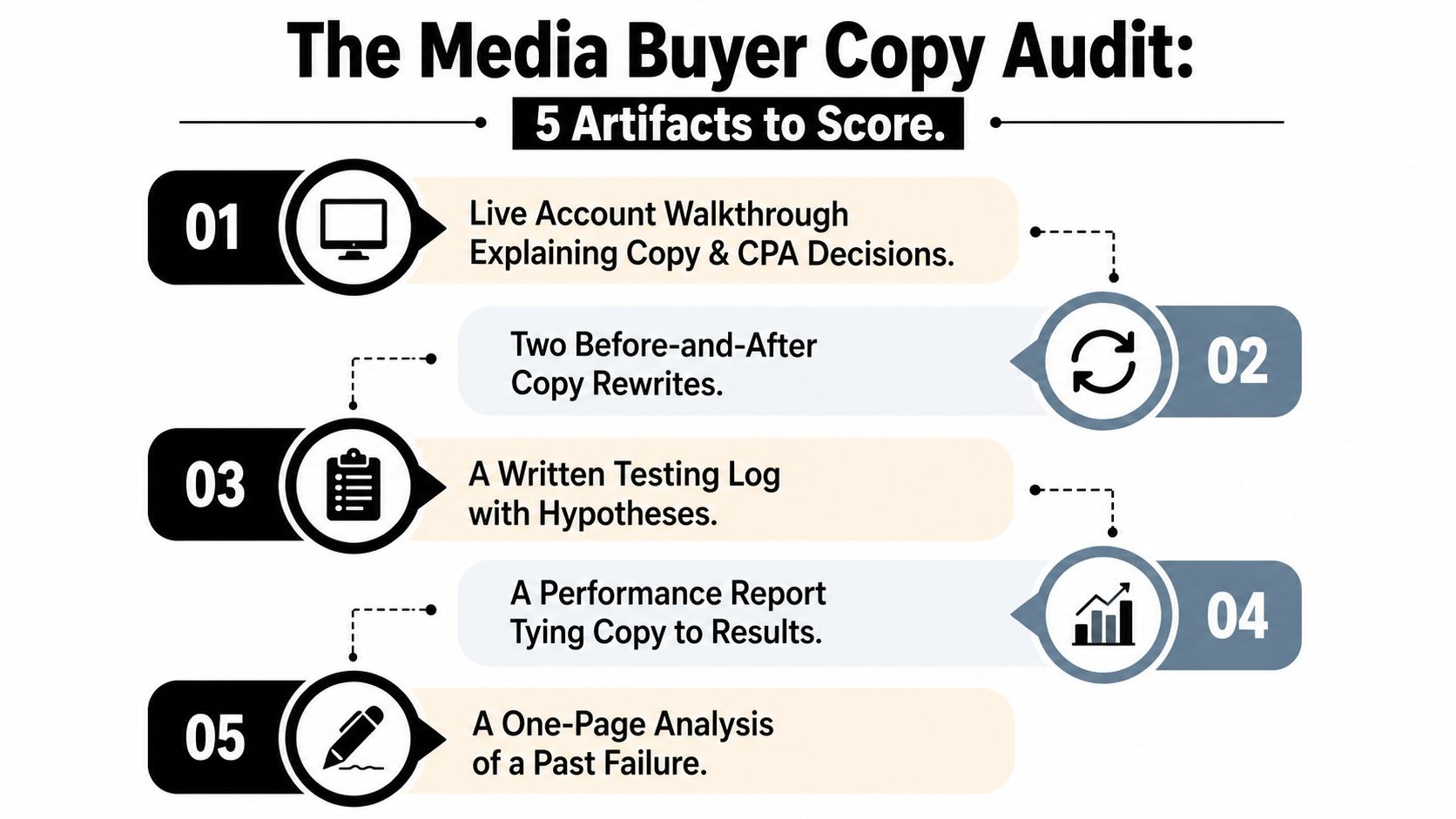
Ask candidates for five artifacts, then score the reasoning rather than the polish. A media buyer who can't explain why a line changed, what metric moved, and how the test was controlled is not an optimizer. They're a person with access to an ad account and a fondness for adjectives.
Live account walkthrough: The candidate should explain which copy decisions affected CPA, conversion quality, or another declared KPI. Screenshots aren't enough. Ask what changed, what stayed constant, and what evidence supported the decision.
Two before-and-after rewrites: Require each rewrite to connect to a specific audience, intent, and observed result. If there's no measurable outcome, the candidate should say so instead of inventing a win.
Documented A/B test: Look for the hypothesis, sample size, confidence interval, primary metric, stopping rule, and interpretation. “Variant B had better ROAS” is not a test log. It's a green arrow wearing a tie.
Channel fluency: Test RSA pinning logic, TikTok-native hooks, Meta prospecting language, and LinkedIn lead-form copy. The candidate should know why the same sentence needs different treatment across channels.
Organized swipe file: A useful swipe file is sorted by angle, funnel stage, audience, and outcome. A graveyard of screenshots proves only that someone knows how to save images.
Hiring rule: If a candidate can't defend a copy choice with evidence, don't hand them a larger budget to find the evidence later.
Use a simple scorecard with five categories, each rated from weak to strong: hypothesis quality, test discipline, KPI judgment, channel adaptation, and learning documentation. Ask for references that can validate the work, and use a structured client reference check rather than accepting polished testimonials at face value.
Red flags should end the conversation quickly: vague “we increased ROAS” claims, no mention of holdout tests, copy swapped every week without learning notes, or refusal to share appropriate account access. You're not hiring someone to produce more variants. You're hiring someone to discover which message earns profitable action, then prove it.
HireMediaBuyers.com offers US companies access to pre-vetted media buyers and paid ads specialists, with options for remote full-time or part-time hiring and support across major advertising platforms. If your account needs disciplined copy testing rather than another round of guesswork, visit HireMediaBuyers.com to review the available hiring options and connect the role to the skills your funnel requires.


