

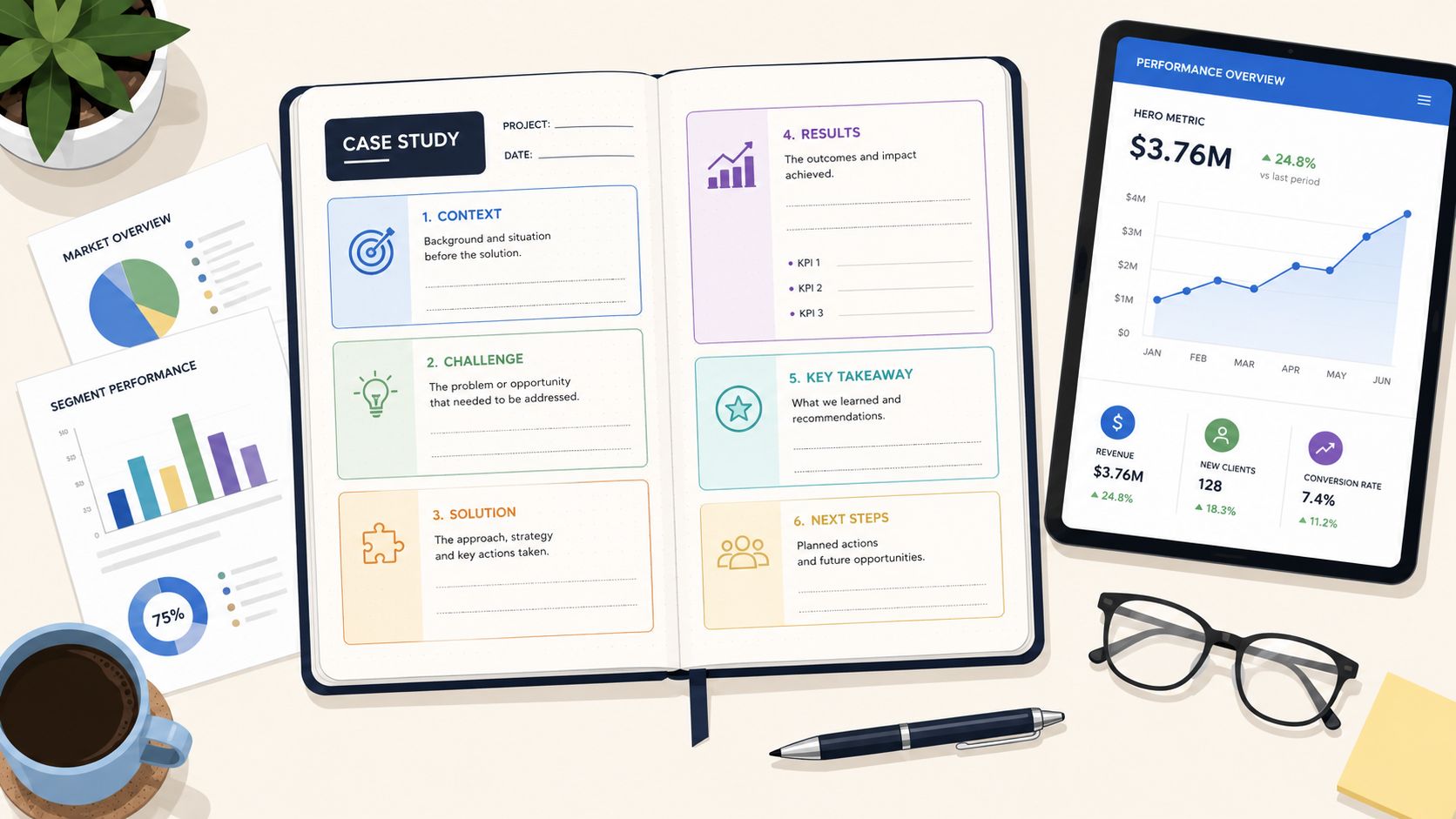
Most marketing teams start with the wrong advice: lead with the story. That sounds sensible until a buyer opens the page between a pricing tab and a procurement spreadsheet. They don't need a sweeping narrative about your brand. They need to know whether you've solved a problem shaped like theirs, how you solved it, and whether the result can survive a skeptical question from finance.
That makes the right case study format for marketing less like a testimonial and more like a compact buying argument. The math comes first, the buyer's psychology comes second, and the story earns its place by explaining the connection between the two. Here's the scaffold that keeps the proof visible instead of burying it beneath twelve paragraphs of agency self-congratulation.
The most popular case study template is half-right. Challenge, solution, results is a useful skeleton, but plenty of teams decorate that skeleton with a client logo, a vague compliment, and a service list. Then they wonder why the sales team never sends it.
A case study isn't a victory lap. It's a decision aid. A buyer should be able to scan the opening and answer three questions:
The format became a core B2B marketing asset because buyers rank it among the most influential content types during purchase evaluation. One industry summary reports that 73% of B2B buyers find case studies the most influential content type, while 66% of B2B marketers place case studies among their top three lead-generation formats (case study statistics and adoption data). That influence disappears when the document reads like a brochure.
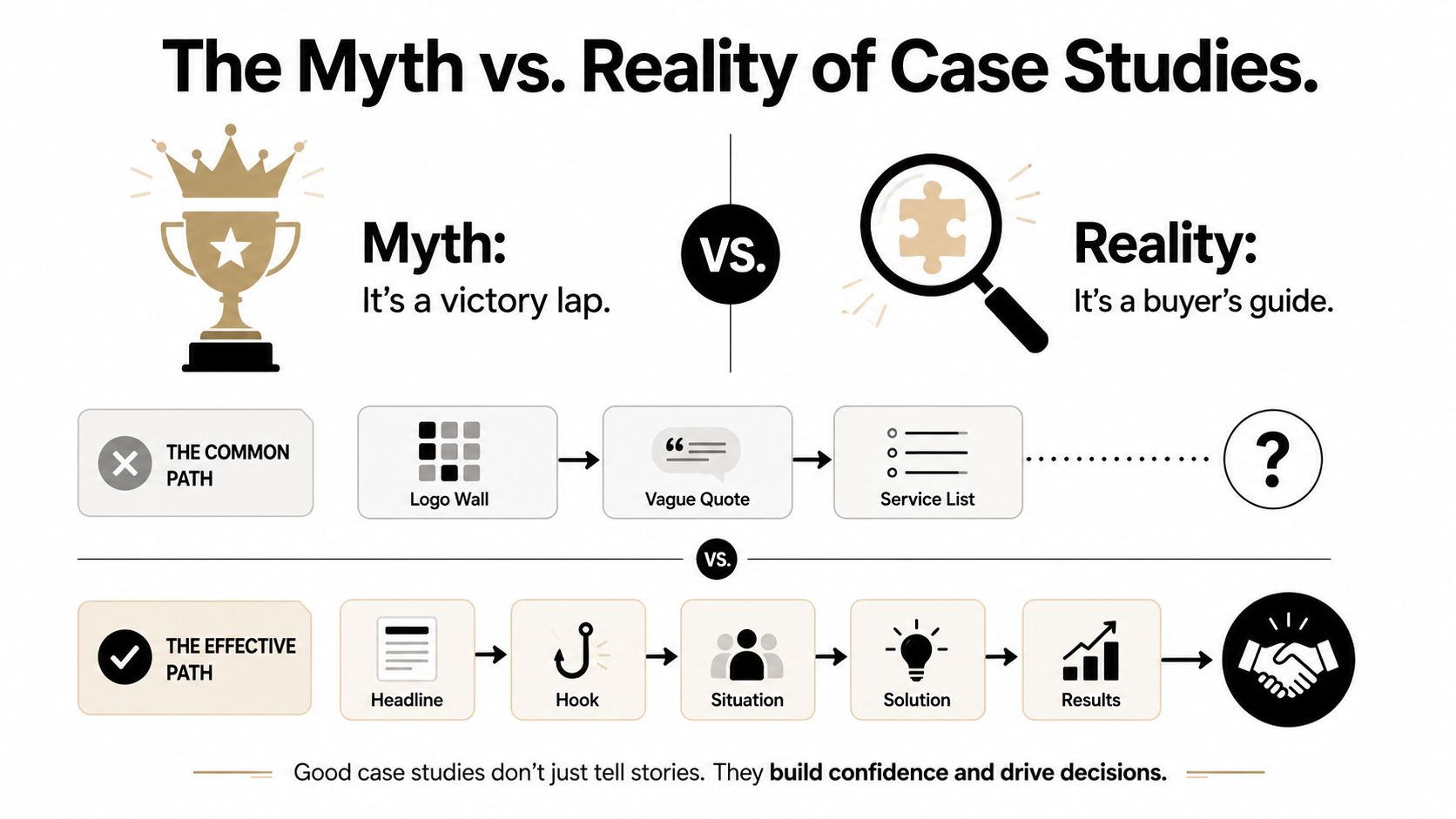
Missing baseline numbers make every outcome slippery. “Lead quality improved” means nothing without the starting condition, the measurement method, and the period being compared. Unsupported ROI claims create the same problem. They ask the reader to trust the vendor's arithmetic instead of inspecting it.
No named decision-maker removes the human who can explain why the purchase happened. A customer quote from “the team” feels manufactured because, frankly, it usually has been polished into harmless mush.
No tie-back to the buyer's pain turns relevance into guesswork. The client may be impressive, but if the reader can't recognize the constraint, buying process, or operational trade-off, the story stays someone else's story.
Practical rule: If a buyer can't identify the problem, the proof, and the next step in a quick scan, you've built a brand trophy, not a sales asset.
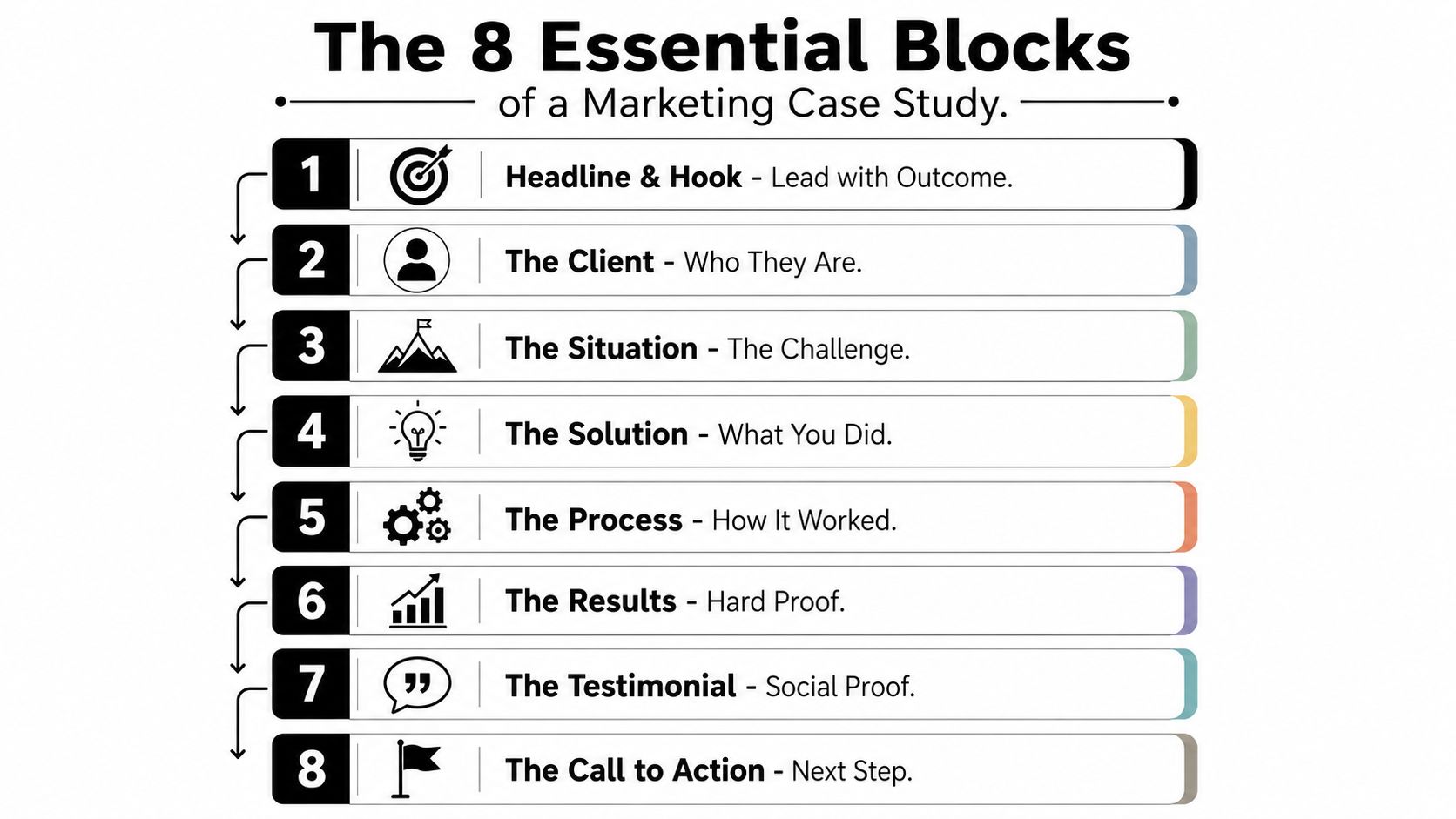
The stronger version uses eight blocks: headline and hook, client background, situation, solution, process, results, testimonial, and takeaway with a call to action. You can see why this format earns a place in a broader case study strategy. It compresses the buying decision without pretending implementation was effortless.
Every block has one job. If it performs that job, the reader keeps moving. If it exists to make the vendor feel important, cut it.
Lead with the outcome, not the client name. “How Northstar Software Cut Acquisition Costs Through Content-Led ABM” gives the reader a reason to continue. “Northstar Software Customer Story” gives them a filing label.
Put the strongest verified metric near the top, then add a short synopsis. Practitioner guidance commonly places case studies around 500 to 1,500 words, with a concise snapshot and the results section carrying the most weight (Adobe's marketing case study guidance). Don't spend the first screen introducing your agency.
Keep this tight. Identify the industry, business context, relevant scale qualitatively, and the constraint that made the engagement necessary. The reader isn't collecting trivia about the customer. They're pattern-matching.
Turn ambition into a testable target. “Grow demand” is a wish. “Improve qualified pipeline while controlling acquisition cost” gives the reader a measurement frame. Name the KPI, its definition, and the timeframe used.
Show the before-state with enough detail to create tension. What wasn't working? What had the client already tried? What made the existing approach expensive, slow, or unreliable?
Explain the chosen strategy and the judgment behind it. Buyers want to know which alternatives you rejected and why. Then make the work concrete with the timeline, team roles, campaign structure, tools, approvals, and operational friction.
Lead with one hero metric, then support it with the other confirmed outcomes. Use a chart for a comparison, a timeline for a sequence, or a simple table for before-and-after values. Text and PDF remain widely used formats, with 74% reporting text or HTML case studies and 73% reporting text or PDF case studies in benchmark data (MarketingProfs case study format trends). Scannable proof still wins.
A quote should add interpretation, not repeat the chart. The customer can explain the decision, the surprise, or the internal consequence. Vague praise usually signals that the first six blocks aren't concrete enough.
End with a takeaway the reader can apply, then give them a specific next action. A case study structure guide also recommends a headline, synopsis, bullet summary, measurable facts, customer quote, detailed narrative, recap, and CTA (structured case study format guidance). Skip the padded conclusion. Tell the buyer what to do next.
For paid acquisition teams, the proof should connect to metrics that matter, not vanity numbers. A useful ad performance metrics reference can help you choose language that a media buyer, growth lead, and CFO will interpret the same way.
Don't write the long version by default. Pick the format based on where the buyer will encounter it and how much context they need.
A long-form case study belongs on a dedicated page or in a detailed PDF. It gives enterprise buyers enough room to inspect the situation, decisions, process, and evidence. A practitioner source places the common overall range at 500 to 1,500 words, while also advising that the results section take the bulk of the piece (WordStream's case study writing guidance).
A one-pager is the sales weapon. Put the hero metric, a short problem statement, the approach, a customer quote, and the CTA on one side. It works in follow-up emails, proposal responses, and trade show handouts because the reader can grasp the argument without opening a small novel.
Video works when a named customer can explain the decision in their own voice. Keep the edit focused, show the before-state, demonstrate the intervention, and put the result on screen. A face doesn't replace proof, but it can make the proof feel less manufactured on a landing page or social feed.
| Format | Ideal Length | Best Funnel Stage | Primary Use Case | Production Cost |
|---|---|---|---|---|
| Long-form | 500 to 1,500 words | Mid-funnel evaluation | Website page, sales follow-up, enterprise review | Higher |
| One-pager | Single side | Late-stage decision | Leave-behind, RFP response, proposal attachment | Lower |
| Video | Short focused cut | Top or mid-funnel attention | Landing page, social, sales deck | Higher |
Use one underlying evidence set across all three. Don't make the content team rediscover the same baseline, metric definition, and quote every time someone asks for a PDF. The long-form page carries the reasoning, the one-pager carries the proof, and the video carries the human explanation.
The interview is where most case studies become polite wallpaper. Marketers ask, “How was your experience?” The client says, “Great,” and everyone goes home with nothing usable.
Run the conversation in sequence. Start with the before-state, move into the buying decision, then cover implementation, results, and the personal takeaway. The client reference process matters here because permission, verification, and context aren't administrative details. They're the credibility layer.
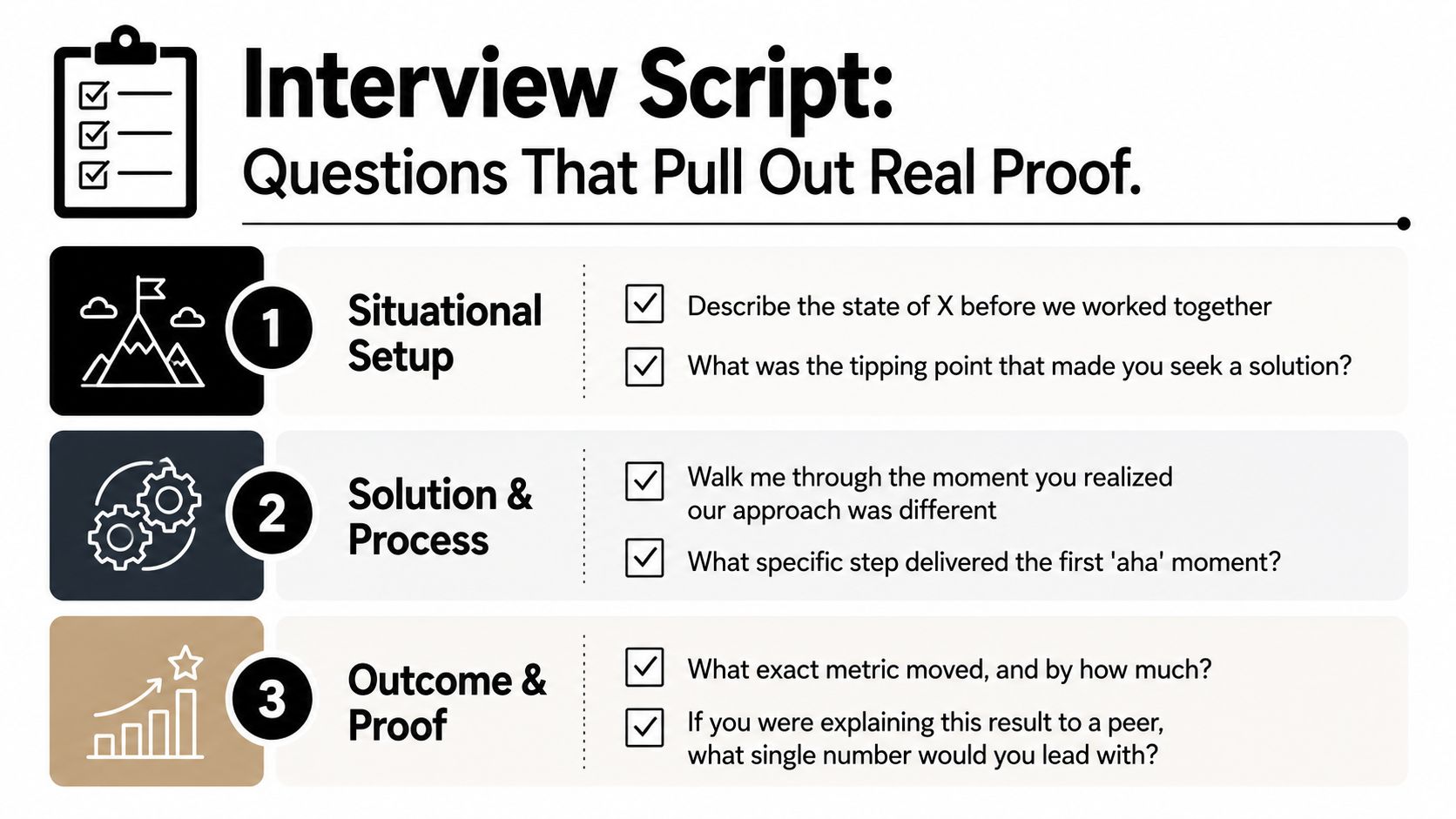
Ask questions that force a specific moment:
Don't accept a sweeping opinion when a concrete scene is available. “The process was frustrating” becomes useful only after the client explains what happened, who felt the impact, and what the old process prevented them from doing.
Move from context into judgment:
These questions reveal the buying criteria your next prospect is already using. They also prevent the case study from pretending that the vendor arrived, pressed a button, and delivered sunshine.
Ask for the outcome in language that can be checked:
Use three follow-ups whenever the answer goes soft: “Can you be more specific?” “What surprised you?” “What would you tell a peer in the same spot?” They sound simple because they are. Simple questions often beat elaborate interview theater.
Close by asking for permission to use the company name, logo, quote, metrics, screenshots, and recording. Confirm who verifies the numbers and who gives final approval. Guidance on case study creation warns against anecdotal success stories, unsupported ROI claims, and unexplained calculations (case study template and verification guidance). Don't mortgage your credibility for a prettier quote.
A case study buried in a resources folder is a case study that never met a buyer. Distribution isn't the victory lap after writing. It's part of the production brief.
Start with sales enablement. Put the one-pager in the rep's attachment folder, pin the link in the relevant Slack channel, and create versions for the objections your team hears most often. Then reuse the same evidence on owned channels and in targeted promotion.
| Day | Channel | Asset | Owner | Success Metric |
|---|---|---|---|---|
| Monday | Sales enablement | One-pager and objection-specific versions | Sales and marketing | Sales usage and relevant follow-ups |
| Tuesday | Website | Long-form case study page | Content and web | Qualified page visits and CTA engagement |
| Wednesday | LinkedIn and email | Carousel, headline proof point, nurture snippet | Social and lifecycle | Target-account engagement and replies |
| Thursday | Video channels | Short customer-led cut for YouTube Shorts and Reels | Creative | Relevant viewers and assisted conversations |
| Friday | Paid and earned | LinkedIn sponsored post, publication pitch, client co-post | Demand generation and partnerships | Qualified responses and pipeline influence |
The point isn't to spray the asset everywhere and celebrate impressions. Track whether the case study helps a real conversation happen. A sales rep should be able to match a prospect's objection to a specific piece of evidence without rummaging through a content library built like a junk drawer.
Distribution rule: Optimize for qualified conversations, not raw reach. A smaller audience with the right problem beats a larger audience collecting screenshots.
Add the case study to proposal templates, demo decks, and nurture sequences where the buyer needs reassurance. Ask the featured client to share the page from their own LinkedIn account if approval allows it. Earned distribution carries more context than another post from the vendor account, and it costs less than mortgaging your office ping-pong table to a media budget.
Consider a representative B2B scenario. A mid-market SaaS company used a content-led ABM campaign and cut customer acquisition cost by 38% in one quarter. That result is the anchor, not an invitation to invent the rest of the story.
The raw interview notes might look like this:
“We had strong content, but sales said the leads weren't close enough to the accounts they wanted. We were spending across broad audiences. The team wanted a more focused program, but they worried that narrowing the audience would reduce volume.”
Useful material sits inside the mess. Strip “strong,” “focused,” and “close enough” unless the client defines them. Keep the tension: broad targeting created a mismatch, sales wanted account relevance, and the team feared a narrower approach.
Headline and hook: “How a Mid-Market SaaS Team Cut Customer Acquisition Cost by 38% in One Quarter With Content-Led ABM.”
Client background: A SaaS company selling to business accounts, with a demand program that needed closer alignment with sales priorities.
Situation: Broad audience activity produced attention, but the sales team wanted stronger account relevance.
Goals: Improve acquisition efficiency and connect content engagement to priority accounts.
Solution: Build an account-focused campaign around content, with audience selection and messaging tied to the buying context.
Process: Document the campaign decisions, creative workflow, reporting method, and the roles involved. Show the work instead of waving at it.
Results: Put the 38% CAC reduction in one quarter at the top, then add only other verified outcomes. Don't decorate the page with invented reach, conversion, or pipeline figures.
Quote and takeaway: Sharpen the client's raw answer into a permitted, accurate statement about the shift from broad activity toward account relevance. Get approval before publication, then end with a CTA for readers facing a similar acquisition problem.
The one-pager keeps the same facts but removes the extended process narrative. It uses the hero metric, a concise situation, a short solution paragraph, the approved quote, and a next step. The rep can attach it to a follow-up email, place it in a demo deck, and reference it during a sales call without asking the buyer to excavate the point.
That is what “done” looks like. One verified source conversation becomes a page, a handout, a social proof asset, and a sales response. The content team does the work once, then gives every channel a job.
Build the page in this order: goal, proof, CTA. The story supports those three decisions. It doesn't get to boss them around.
Use long-form for depth, a one-pager for forwarding, and video when the customer's presence adds trust. Distribute the finished asset through the website, sales enablement, email nurture, and social proof channels.
Two skip-traps ruin otherwise solid work. Don't bury the headline metric below the fold, and don't skip the timestamp that tells readers when the result was measured. Before legal review, check the headline hook, quantified outcome, named client, pull quote, source of every metric, and next action. If any item is missing, the draft isn't ready.
HireMediaBuyers.com helps US companies find pre-vetted Media Buyers and Paid Ads Specialists for platforms including Meta Ads, Google Ads, LinkedIn, TikTok, Microsoft/Bing, Apple Search, Pinterest, and YouTube. Visit HireMediaBuyers.com to find flexible paid media talent that can help turn campaign performance into the verified proof your next marketing case study needs.


