


Most advice about cost per acquisition is too neat to be useful.
It treats CPA like a clean little dashboard metric. Spend this, get that, divide by conversions, done. Meanwhile your ad account says things are fine, your finance team looks annoyed, and cash disappears like it joined a wellness retreat.
I've made that mistake. Plenty of founders and marketing leads have. You celebrate a “good” CPA, then discover you bought cheap conversions, expensive operations, and a very unfun surprise in the P&L.
That's why the only version of cost per acquisition worth caring about is the one that survives contact with reality.
The most popular CPA advice has one fatal flaw. It assumes the number in your ad platform is the number that matters.
It usually isn't.
Google Ads, Meta, LinkedIn, and friends are very happy to show you a tidy cost per conversion. That number can be useful for campaign tuning. It is not a full business truth. If your dashboard says your CPA looks healthy but your margins look like roadkill, you're not crazy. You're just looking at an incomplete number.
A platform-level CPA usually counts media spend against a defined conversion. Fine. Helpful, even. But businesses don't run on ad spend alone.
You still paid for creative work, landing page updates, analytics tools, reporting time, freelance help, internal salaries, and the endless parade of software subscriptions that seemed “cheap” one by one. Funny how “just another tool” becomes a payroll line item with better branding.
A cheap-looking CPA can still be an expensive way to lose money.
That's the trap. Teams optimize the visible number because it's easy to measure. Then they wonder why “efficient” campaigns don't create profit.
CPA also changes wildly by business model, channel, and how aggressively you define an acquisition. A newsletter signup, a booked demo, and a first purchase are not interchangeable. Yet people compare them like they're all the same species.
Here's the practical rule I wish more teams followed:
If your CPA report makes everyone feel smart while the bank account says otherwise, the report is lying by omission. Not maliciously. Just efficiently.
Let's clean up the biggest source of confusion first.
Cost per acquisition and customer acquisition cost are related, but they are not twins. They're barely cousins with matching jackets.
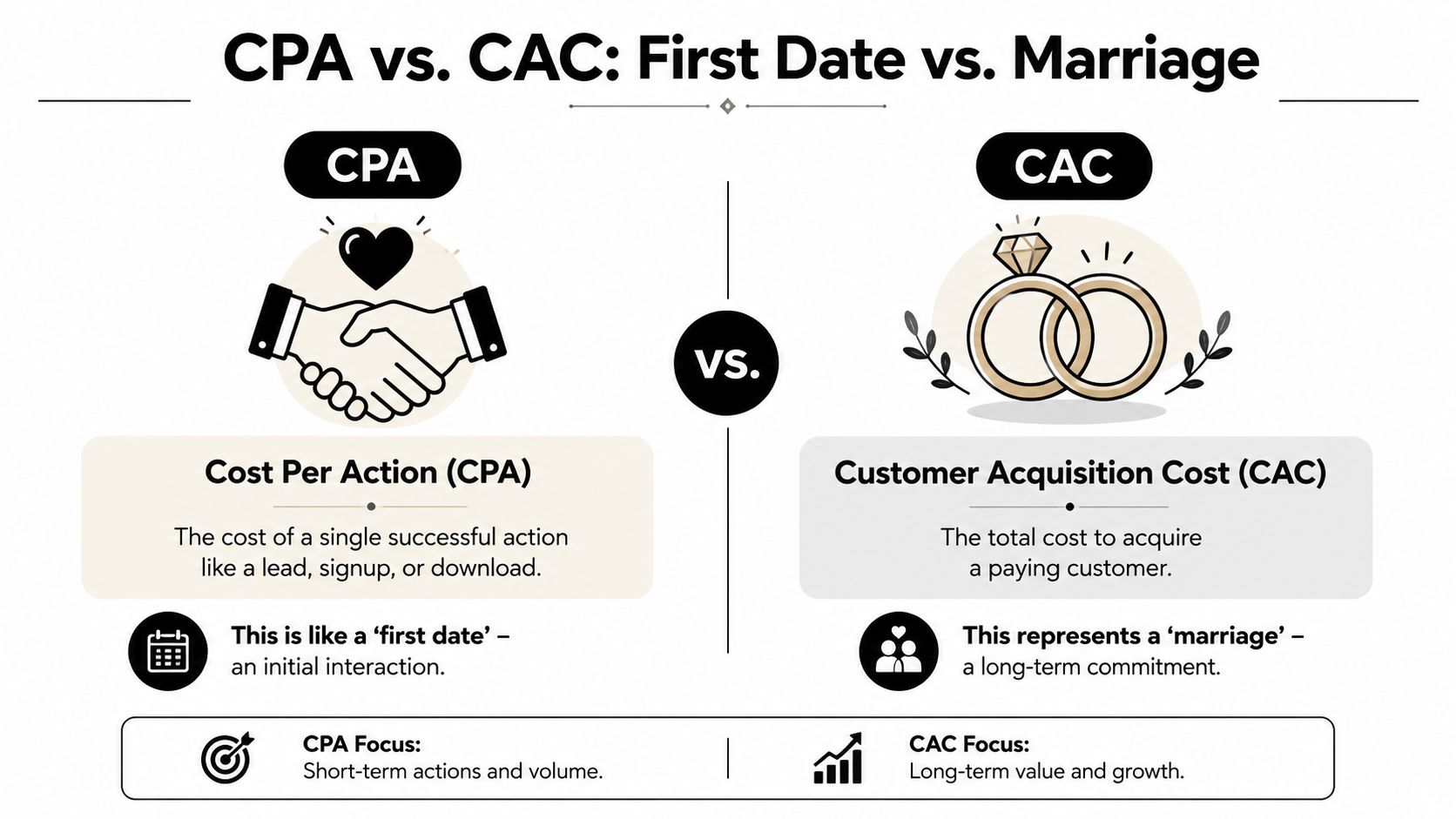
CPA measures the cost of a specific conversion. That conversion might be a purchase, a lead, a signup, or some other action tied to a campaign.
Think of it as the first date. You got attention, got agreement, got movement. Great. Something happened. A media buyer lives in this number because it helps answer tactical questions fast. Which campaign is efficient? Which audience is wasting money? Which creative deserves another week?
CAC is broader. It includes all sales and marketing costs needed to acquire a new paying customer.
That's the marriage. Not the flirty dinner. The whole commitment. Salaries, sales support, tools, overhead, media, and the operational mess required to turn attention into revenue.
A useful benchmark from Vena Solutions on average CAC by industry puts the average CAC across major industries at $606. The same source notes that B2B SaaS often lands between $400 and $900 in fully loaded CAC. That's why tactical CPA optimization matters so much. If your total acquisition cost is already heavy, sloppy paid media makes a hard business even harder.
Here's the clean version:
| Metric | What it measures | Who should care most | What it's good for |
|---|---|---|---|
| CPA | Cost for a specific conversion | Media buyers, growth marketers | Campaign optimization |
| CAC | Total cost to acquire a paying customer | Founders, finance, marketing leadership | Business viability |
Use CPA to steer the car. Use CAC to decide whether the trip was worth taking.
Practical rule: If your team argues about CPA without agreeing on what counts as an acquisition, you don't have a metric. You have a group project.
That's why experienced operators ask two questions immediately. What exactly did we buy? And did it become revenue?
People love asking, “What's a good CPA?”
Usually they want a magic number. Sorry. That number doesn't exist.
A good CPA depends on what you sell, how you sell it, what your margins look like, and what kind of customer comes out the other side. Anyone handing you one universal benchmark is either lazy or trying to close you on a template.
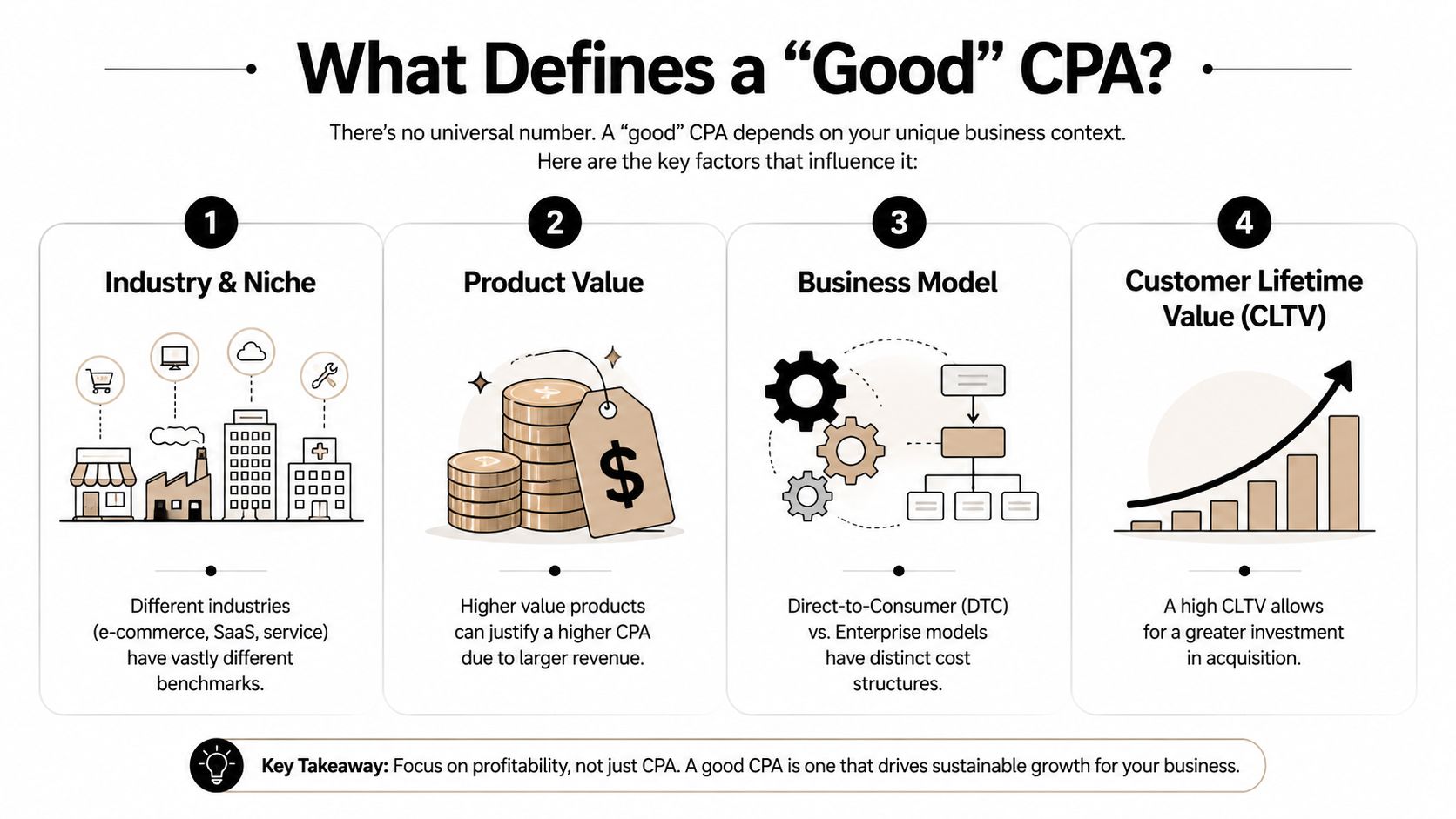
According to Attainment Lab's CPA benchmarks, ecommerce and DTC median CPA sits between $26 and $50, with Apparel & Accessories at a $31 baseline. That can be perfectly fine if the economics work.
SaaS is a different animal. The same source says SMB SaaS acquisition can range from $200 to $800, while enterprise-level SaaS can climb to $50,000 per customer. That's a 60x difference. Which is why average CPA talk gets dumb fast.
If you sell a tee shirt, paying enterprise-software economics would be absurd. If you sell enterprise software, chasing a DTC CPA benchmark is how you starve a real pipeline because some spreadsheet demanded “efficiency.”
Use benchmarks for sanity checks, not identity formation.
A rough comparison helps:
There's another benchmark worth knowing. Triple Whale's overview of what a good CPA looks like notes that PPC search averages $59.18 across industries, while display averages $60.76, and that DTC median CPA often falls between $26 and $50. Useful context. Not a commandment.
Ask this instead: What CPA can this offer support without turning growth into a hobby?
If your DTC brand pays more to acquire a customer than the purchase is worth, you're not scaling. You're funding a very expensive charity.
If your SaaS product has strong retention and account expansion, a higher CPA may still be completely rational. The ad account doesn't know that. Your operator brain should.
Good CPA is never about the lowest number. It's about the lowest number that still buys the right customer.
That's the difference between optimization and self-sabotage.
Here's the dirty part. Organizations often don't calculate true CPA. They calculate ad-platform CPA, then act shocked when profitability doesn't show up.
Your accountant isn't shocked. Your accountant has seen the invoices.
The clean little formula breaks the moment you include the actual operating costs behind acquisition.
Creative production costs money. So do agency fees. So do salaries, software, reporting tools, design support, and the time your team spends rebuilding landing pages because the first version converted like a wet sponge.
Amplitude's CPA guide makes the problem explicit. Non-ad spend such as salaries and software is often excluded, which leads to a 30–50% underestimation of actual acquisition cost. That same source notes that AI-driven bidding can shift CPA by 20–40% month-to-month, and 68% of agencies lack standardized benchmarks for those environments.
That's not a rounding error. That's a business model getting flattered by incomplete math.
Platforms now automate more of the bidding logic, which means your CPA can move even when you didn't make an obvious manual change.
That doesn't mean automation is bad. It means blind trust is lazy.
If your Meta or Google campaigns suddenly “improve,” ask what changed:
Attribution matters. Not in a fancy-deck way. In a “stop kidding yourself” way. If you need to tighten how you judge channel contribution, study attribution modeling for paid media before you give credit to every platform that touched the customer on its way to converting.
Use two layers:
Platform CPA
True CPA
CFO test: If you removed ad spend tomorrow, which acquisition-related costs would still hit your books? Many of those belong in true CPA.
If that makes your CPA look uglier, good. Ugly and honest beats pretty and useless every time.
No magic button exists. Anyone selling one probably has a webinar funnel and a suspicious amount of confidence.
Lowering cost per acquisition comes from pulling the right levers in the right order. Not from random A/B tests run by someone who calls every idea a “growth experiment.”
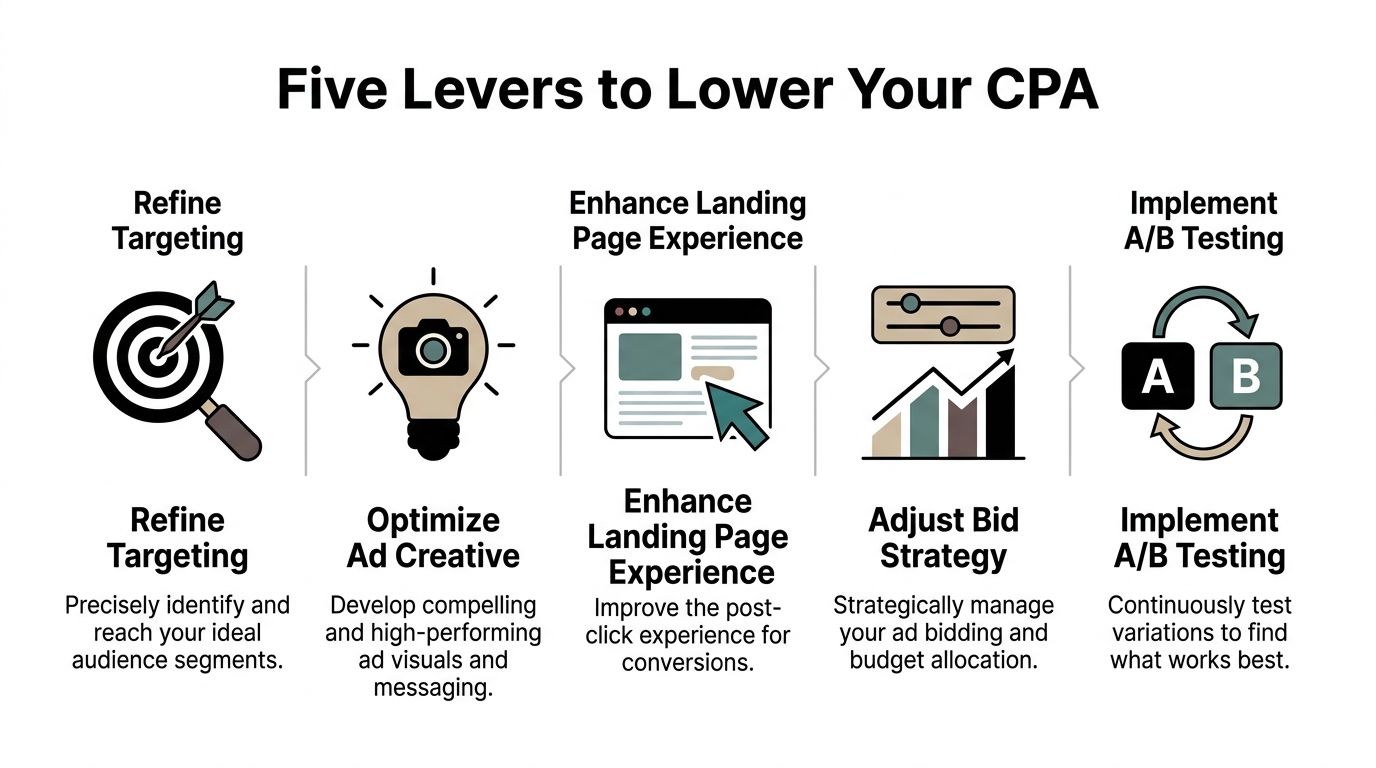
Most bloated CPAs come from one of five places. Sometimes two. Sometimes all five if the account has been “managed” by committee.
Bad creative gets expensive fast. If the hook is weak, the offer is vague, or the ad looks like it was approved by six polite coworkers, CPA climbs.
Use sharper angles. Show the product. Name the pain. Cut the branding fluff. On Meta and TikTok especially, “clever” loses to clear more often than people want to admit.
Broad targeting can work. Broad targeting with weak messaging usually just buys window shoppers.
Segment by intent, awareness, or use case. Don't dump every buyer type into one campaign and call the blended CPA “efficient.” That's how weak segments hide behind stronger ones.
Your ad doesn't convert. Your page does.
Audit the path after the click. Message match, page speed, form friction, trust signals, mobile layout, CTA clarity. If the landing page forces people to think too hard, you're paying for confusion. Teams that want cleaner measurement should also tighten conversion tracking across the funnel, because bad tracking makes good decisions weirdly difficult.
Not everything is creative. Some of it is mechanics.
Here's a blunt breakdown:
| Lever | What to check first | Common mistake |
|---|---|---|
| Creative | Hook, proof, clarity | Making prettier ads instead of clearer ones |
| Targeting | Audience intent and exclusions | Going broad before message fit exists |
| Landing page | Relevance and friction | Sending all traffic to the homepage |
| Bidding | Optimization event | Chasing cheap conversions, not useful ones |
| Offer | Value and urgency | Tweaking ads while the offer stays weak |
Most CPA problems aren't solved by spending more time in Ads Manager. They're solved by getting the message, audience, and offer to agree with each other.
That's what good media buyers do. They don't just buy traffic. They diagnose the whole path.
Low CPA makes weak operators feel smart.
I've seen founders celebrate a cheaper acquisition number while cash leaked out of the business. The ads looked efficient. The customers were terrible. They churned fast, bought once, opened support tickets like it was a hobby, and never generated enough margin to cover what it took to get them.
That is the trap. CPA is only useful if it leads to profit.
The ratio that matters is LTV to CAC. As noted earlier, CDP's guide says healthy businesses usually need an LTV:CAC ratio of at least 3:1. If you spend $1 to acquire a customer, you want at least $3 back over that customer's lifetime. Anything weaker starts to squeeze your margin, your cash flow, and your room for error.
A low CPA can still wreck you if it buys the wrong kind of customer. You can hit your acquisition target and still lose money because those customers refund, churn, never upgrade, or need so much hand-holding that your team becomes part of the acquisition cost.
And yes, that last part counts.
If your media buyer brings in “cheap” customers that force sales to chase junk leads, support to clean up confusion, and ops to patch bad-fit accounts, your true CPA was never cheap in the first place. It was underreported.
This gets uglier in expensive categories. Earlier benchmark data from the same CDP guide shows that customer acquisition in sectors like financial services and real estate can get pricey fast. In those markets, a small drop in customer quality can erase your profit before you notice it.
That's why smart operators don't stare at CPA in isolation. They watch ad performance metrics tied to retention, revenue, and payback and ask a harder question: did this campaign produce customers worth keeping?
That is where expert media buying separates itself from button-clicking.
A real media buyer does not chase the cheapest conversion event and call it a day. They look at lead quality, downstream conversion, contribution margin, and the ugly hidden costs everyone loves to ignore. Salaries. Creative production. Landing page tools. Reporting software. Agency fees. The hours burned by your team fixing what bad traffic broke.
Cheap acquisition is a scam if the customer never becomes profitable.
The goal is not a lower CPA on a screenshot. The goal is a true CPA that leaves enough gross profit to run the company, pay the team, and buy your next customer without praying over a spreadsheet.
At a certain point, managing cost per acquisition stops being a side task and becomes a specialty.
It has to. The job now spans creative judgment, bidding systems, attribution mess, tracking accuracy, funnel economics, and enough spreadsheet sanity to keep everyone honest. Hope you enjoy spending your afternoons fact-checking ad reports and untangling platform credit. Because that's now your full-time job.
Genesys Growth's CAC benchmarks report that customer acquisition costs have surged by 60% over the past five years. The same source says sales-led enterprise CAC has climbed to $11,400, creating a 16x difference from self-serve models.
That gap matters. It means acquisition strategy isn't one game anymore. It's several games with different rules, different economics, and different failure modes.
A decent coordinator can launch campaigns. A strong in-house marketer can keep the machine moving. But true CPA management requires someone who can see around corners.
You want the person who notices that the “improved” CPA came from weaker lead quality. The one who questions attribution before celebrating. The one who knows whether the problem is the bid strategy, the landing page, the creative angle, or the offer itself.
That's not busywork. That's a money skill.
And hiring that person the old-fashioned way is its own little circus. Resume inflation. Channel-specific bluffing. Interviews full of platform jargon and suspicious certainty. Toot, toot.
The better move is simpler. Use HireMediaBuyers.com to find pre-vetted media buyers and paid ads specialists who already know how to manage real acquisition economics, not just dashboard cosmetics.
If your cost per acquisition looks good but profit still feels elusive, bring in someone who knows the difference between platform metrics and business reality. HireMediaBuyers.com helps companies hire pre-vetted media buyers and paid ads specialists quickly, so you can stop guessing, clean up true CPA, and scale with fewer expensive surprises.


