

The most popular advice on diversity in advertising is also the laziest. Make a statement. Add a few more faces to the casting deck. Ask legal to bless the copy. Ship it.
That's not a strategy. That's corporate cosplay.
I've watched brands spend more time polishing diversity language than fixing the actual machinery that produces bland, forgettable ads. Then they act shocked when the campaign lands with a thud. The problem usually isn't that the brand “cares too little.” It's that the people writing the brief, approving the concept, and buying the media all come from the same narrow lane. You can't market to a broad world with a cramped point of view.
And yes, this has everything to do with performance. Not just brand reputation. Not just HR optics. Performance.
The industry loves a pledge because a pledge is cheap. No hiring overhaul. No uncomfortable review of who holds power. No need to admit the same five people keep approving the same safe, generic work.
Meanwhile, the numbers tell a less flattering story. Ethnic diversity among marketers in the advertising industry declined from 32.3% in 2022 to 30.8% in 2023, after rising from 27.6% in 2019, according to the ANA diversity report. That's not momentum. That's backsliding with a polished LinkedIn post on top.
A lot of brands treated 2020 like a copywriting exercise. Publish values. Update the careers page. Book one panel discussion. Then go right back to building campaigns with the same leadership mix, the same agency roster, and the same approval bottlenecks.
That's why the work still feels so familiar. Different headline. Same worldview.
If your diversity effort lives in a PDF and not in your hiring decisions, it isn't an effort. It's décor.
Practical rule: If the people controlling budget, targeting, and creative approval all think alike, your ads will too.
The operational failure is usually boring. Which is why it gets ignored.
I've seen this movie for a decade. The brand says it wants authenticity. Then it hands the account to a team with no lived familiarity with the audience it wants to reach. Hope you enjoy revision rounds, panic edits, and a lot of “something feels off” feedback.
That “something” has a cause. It's not mysterious. You built a monoculture and expected multicultural output.
Some executives only perk up when the conversation moves from values to margin. Fine. Let's talk in the language they already understand.
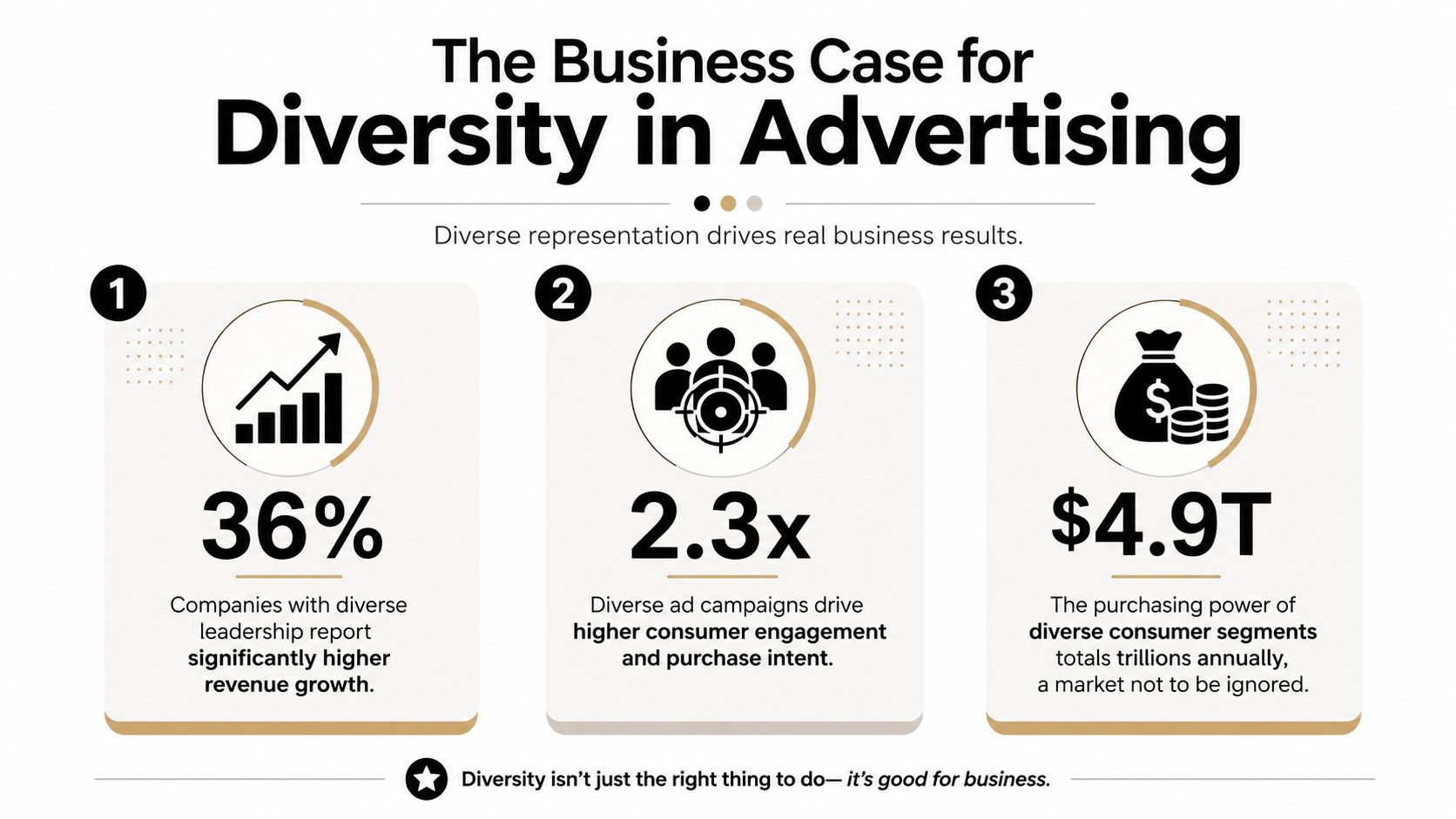
Consumer behavior data shows that 75% of global consumers say a brand's diversity and inclusion reputation influences purchase decisions, and brands with high DEI scores in their advertising achieve 19% higher sales growth, as summarized by WordStream's roundup of diversity marketing data. If you still treat diversity in advertising like a nice-to-have, you're arguing with the buyer, not me.
The “go woke, go broke” line has always been marketing small talk for people who don't test enough creative. Buyers don't sit around rewarding brands for being narrow. They reward brands that make them feel seen, respected, and understood.
And no, this isn't just about the exact group shown in the ad. Inclusive advertising often improves response beyond the audience directly represented. Better creative tends to feel more human, less canned, and more relevant. Funny how that works.
Here's the blunt version:
| Bad assumption | What actually happens |
|---|---|
| Diversity is a brand team issue | It changes how people perceive and buy |
| Inclusive ads only matter to niche audiences | Broader audiences respond to stronger, more resonant storytelling |
| Safe creative protects revenue | Safe creative often produces forgettable campaigns |
I find it particularly frustrating that companies will obsess over bid strategies, landing page spacing, and whether a thumbnail should be blue or green, then treat audience representation like a soft, fuzzy issue for another department.
That's backwards.
A campaign can be technically clean and still culturally clumsy. It can have solid tracking, decent hooks, and competent editing, yet fail because the message doesn't ring true. When that happens, teams usually blame fatigue, CPMs, the economy, or “creative wearout.” Sometimes that's correct. Sometimes the ad just doesn't connect.
Brands don't lose revenue because audiences demand too much inclusion. They lose revenue because the work feels generic, forced, or blind to real people.
Ask yourself three questions before launch:
If the answers make you squirm, good. Better to squirm in pre-production than in the comments section.
Most tone-deaf ads don't come from bad intentions. They come from lazy pattern recognition. Someone grabs the usual stock references, builds the “modern diverse group” scene, and assumes the job is done.
Audiences are not that gullible. Across 17 markets, 44% of global consumers feel they are not fully represented by the people they see in advertisements, according to YouGov's research on representation in ads. That gap exists because brands keep confusing visible variety with meaningful representation.
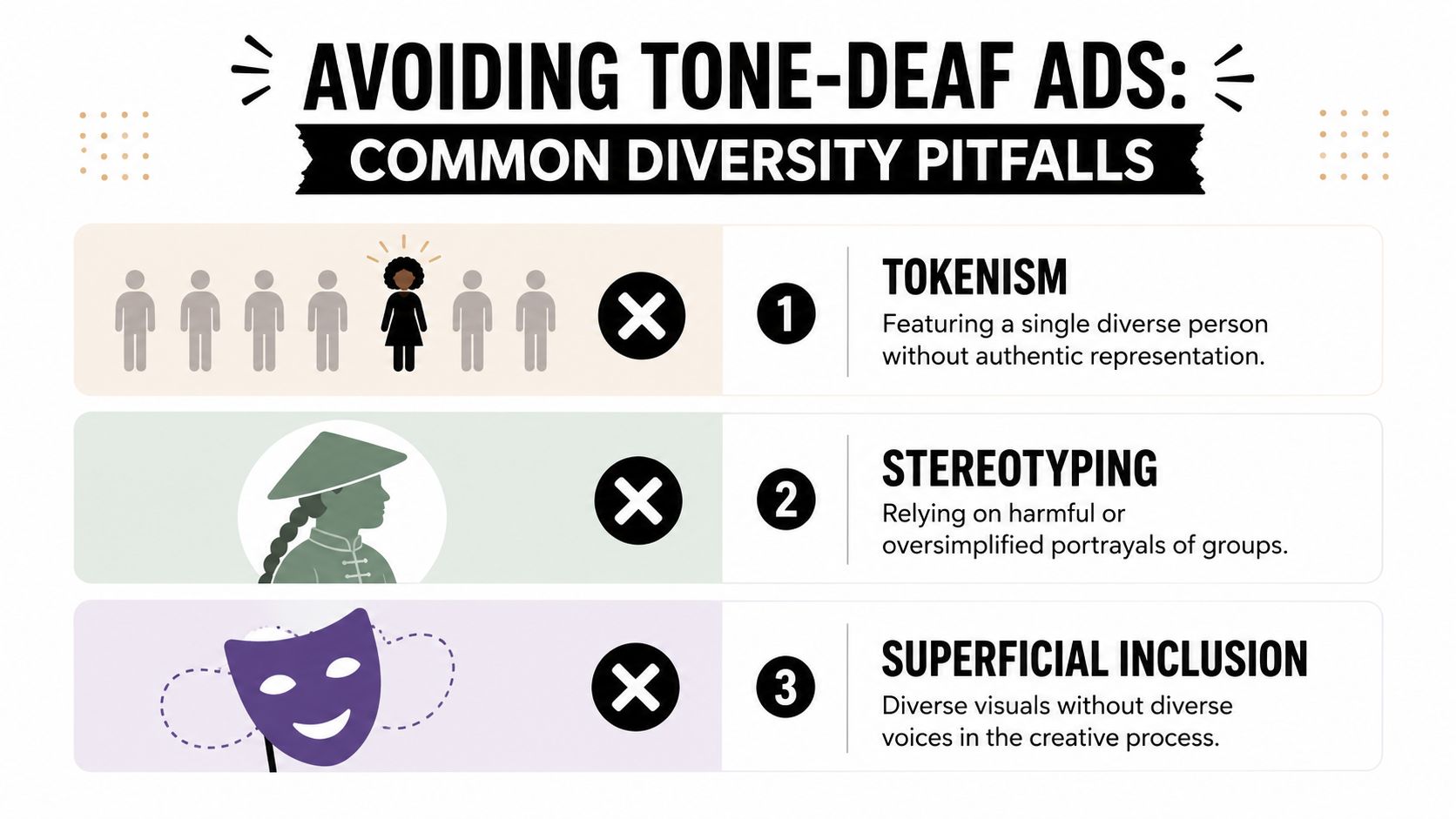
You know the shot. One Black guy, one Asian woman, one older person, one tattooed millennial, all laughing at salad in an aggressively sunlit office.
Nobody talks like that. Nobody sits like that. Nobody believes that scene was assembled by accident.
Tokenism fails because it treats people as visual proof points instead of characters with context. The audience can feel the checklist humming behind the camera.
This one is more dangerous because it often slips past internal review. The creative looks polished. The casting looks “varied.” But each person still gets shoved into a tiny, familiar role.
A few classics that should've died years ago:
Brands also oversimplify people into one trait at a time. Race here. Age there. Gender somewhere else. Real people don't come in neat little silos.
If your brief treats identity like a dropdown menu, the final ad will feel like software, not storytelling.
Campaigns then start sounding weirdly sanitized. They include difference, but flatten it. They show categories, not people. The result is work that may pass internal compliance and still fail the sniff test with everyone else.
The fix isn't to make every ad a sociology lecture. Please don't do that. The fix is to build characters and situations that feel lived in, not assembled by committee.
Here's the part most brands avoid because it requires actual change. You do not get better diversity in advertising by briefing the same type of team more sternly.
You get it by changing who's in the room before the brief is written.
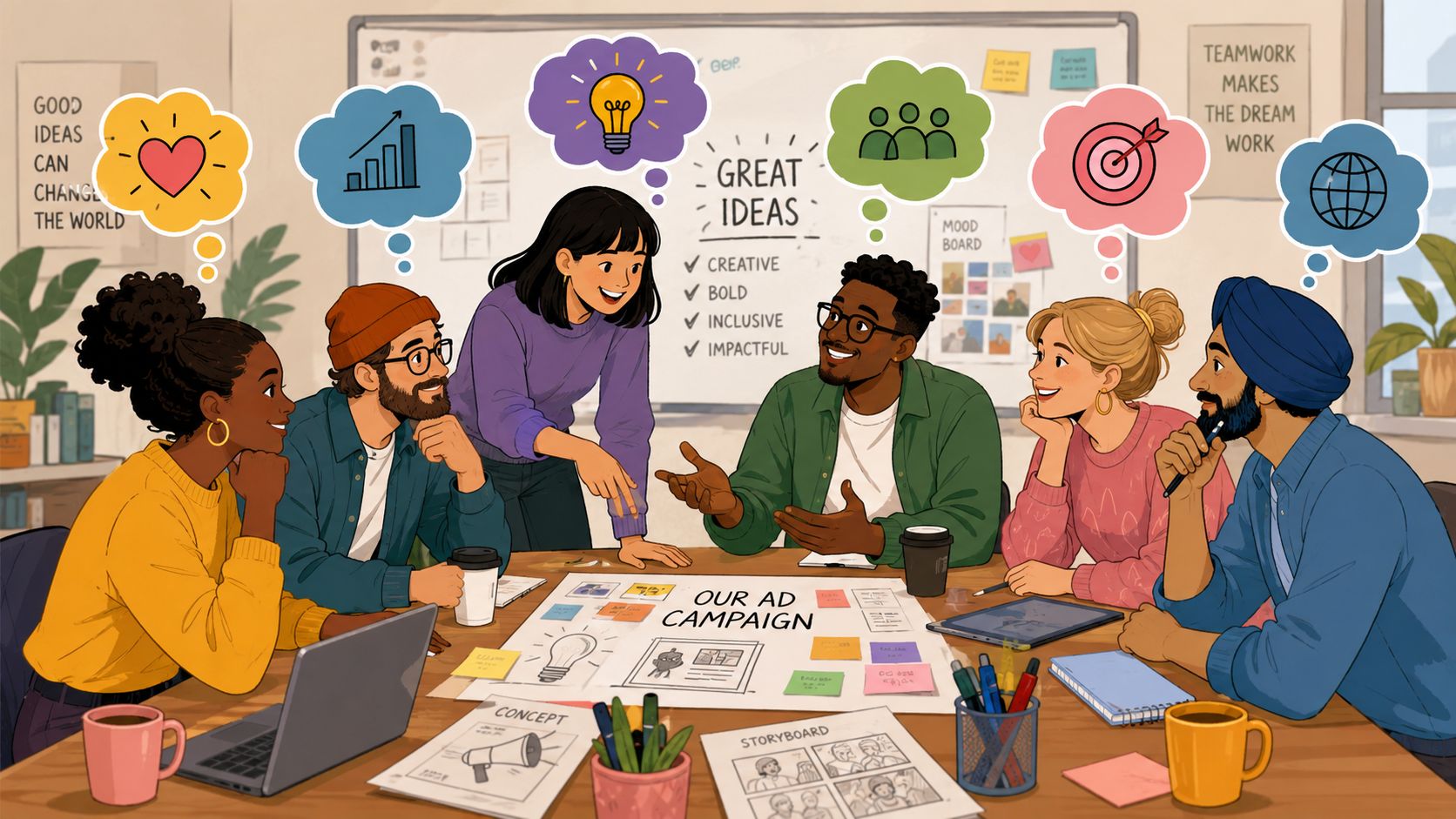
People love to talk about diverse casting and creative directors. Fine. But media buyers influence whether a campaign resonates too. They decide audience segmentation, creative rotation, platform fit, testing structure, creator mix, and how feedback gets interpreted.
That requires judgment, not just dashboard literacy.
A media buyer with strong cultural nuance will catch problems earlier. They'll flag when a message lands differently on TikTok than on Meta. They'll know when a “universal” angle is coded for one audience. They'll recognize when a comment thread is giving you useful market feedback instead of random noise.
That's why I'm biased toward skills-based hiring for marketing roles. Resumes don't tell you who can handle nuance under pressure. Real assessment does.
A lot of hiring managers still act like cultural understanding is nice if you can get it, but optional if the spreadsheet skills are strong. That's how brands end up with technically competent campaigns that feel off by a few degrees.
A few degrees is enough to tank performance.
Consider the practical difference between these two setups:
| Team setup | Likely result |
|---|---|
| Homogeneous team with broad assumptions | Safer briefs, flatter targeting, obvious creative |
| Mixed team with market-specific perspective | Sharper hooks, better audience mapping, fewer unforced errors |
And no, this doesn't mean every account needs a giant global bench. It means the people making decisions should reflect the markets they're trying to reach, or at minimum bring firsthand familiarity with them.
Here's a common agency pattern.
Maybe. Or maybe nobody on the execution side had the context to make the work feel specific.
Hire for perspective before you ask for authenticity. Otherwise you're asking a narrow team to fake wide understanding.
That's the operational heart of the issue. Diversity pledges don't fail because the sentiment is wrong. They fail because nobody changed the hiring inputs behind the campaigns.
Once the right people are involved, the creative process gets simpler. Not easy. Simpler. Fewer fake debates. Fewer symbolic gestures. Better instincts.
And the core principle is straightforward. Inclusive advertising casting that positions underrepresented groups as central characters in non-identity-focused brand narratives drives measurable ROI and supports both short-term sales lift and long-term brand equity growth, according to Kantar's analysis of inclusive casting and brand growth.
Teams often start too late. They try to “add diversity” after the concept is already baked. At that point, you're decorating, not designing.
Do this instead:
If your creative team needs help producing ads that feel native to modern feeds instead of staged conference-room fiction, study examples of UGC-style ads that actually look and sound natural.
A diverse background cast does almost nothing if the story still centers the same default protagonist every time.
Use a quick gut-check:
If underrepresented people appear only as atmosphere, you haven't built inclusive creative. You've built a wallpapered version of the same old ad.
Brands often overcorrect. They hear “inclusive” and assume the ad must revolve around identity itself. It doesn't.
A better route is often more ordinary. Let the underrepresented character be the lead in a story about convenience, confidence, price, speed, comfort, family chaos, bad timing, ambition, or vanity. In other words, the stuff ads have always been about.
The best inclusive ads don't stop the story to announce how inclusive they are. They just let more people be central to the story.
Before approval, ask:
| Review question | Why it matters |
|---|---|
| Would this still make sense if we swapped the cast? | Exposes whether identity is being used lazily |
| Does any character feel symbolic instead of real? | Flags tokenism early |
| Is the cultural signal earned or borrowed? | Helps prevent aesthetic tourism |
| Who on the team is qualified to challenge this? | Stops groupthink from sailing through |
If nobody in the room can push back credibly, pause the launch. That delay will cost less than a campaign cleanup.
Many teams still review diversity in advertising by squinting at a mood board and saying, “Feels better.” That's not measurement. That's vibes with a budget.
You need a scorecard.
Researchers have outlined three validated technical metrics for automated image analysis in advertising: the frequency count of specific gender and race appearances, the occurrence rate of cross-sex interaction contexts, and the percentage of smiling faces categorized by demographic group, as described in the advertising image analysis framework published on arXiv. That's useful because it gives teams something more concrete than opinion.
You don't need to become a computer vision lab overnight. You do need a consistent review method.
Use those three ideas in a practical way:
That's how you move the conversation from “I think we did okay” to “Here's what changed across the last three launches.”
Don't isolate representation review from media results. Compare your creative audit against conversion rate, hold rate, click-through quality, and blended acquisition efficiency. If your team already tracks core ad performance metrics across platforms, layer representation analysis into the same reporting rhythm.
You're not trying to create one magical diversity score. You're trying to build accountability. Different assets, different audiences, different outcomes.
That matters because the industry still lacks strong public data on exactly how inclusive creative performs on each platform and for each intersectional audience. Until that improves, smart teams build their own evidence base and stop guessing.
This is the part people skip because it looks less glamorous than a brand manifesto. Too bad. The boring operating changes are what fix the work.
Print this. Drop it into Asana. Tape it to the espresso machine if you have to.
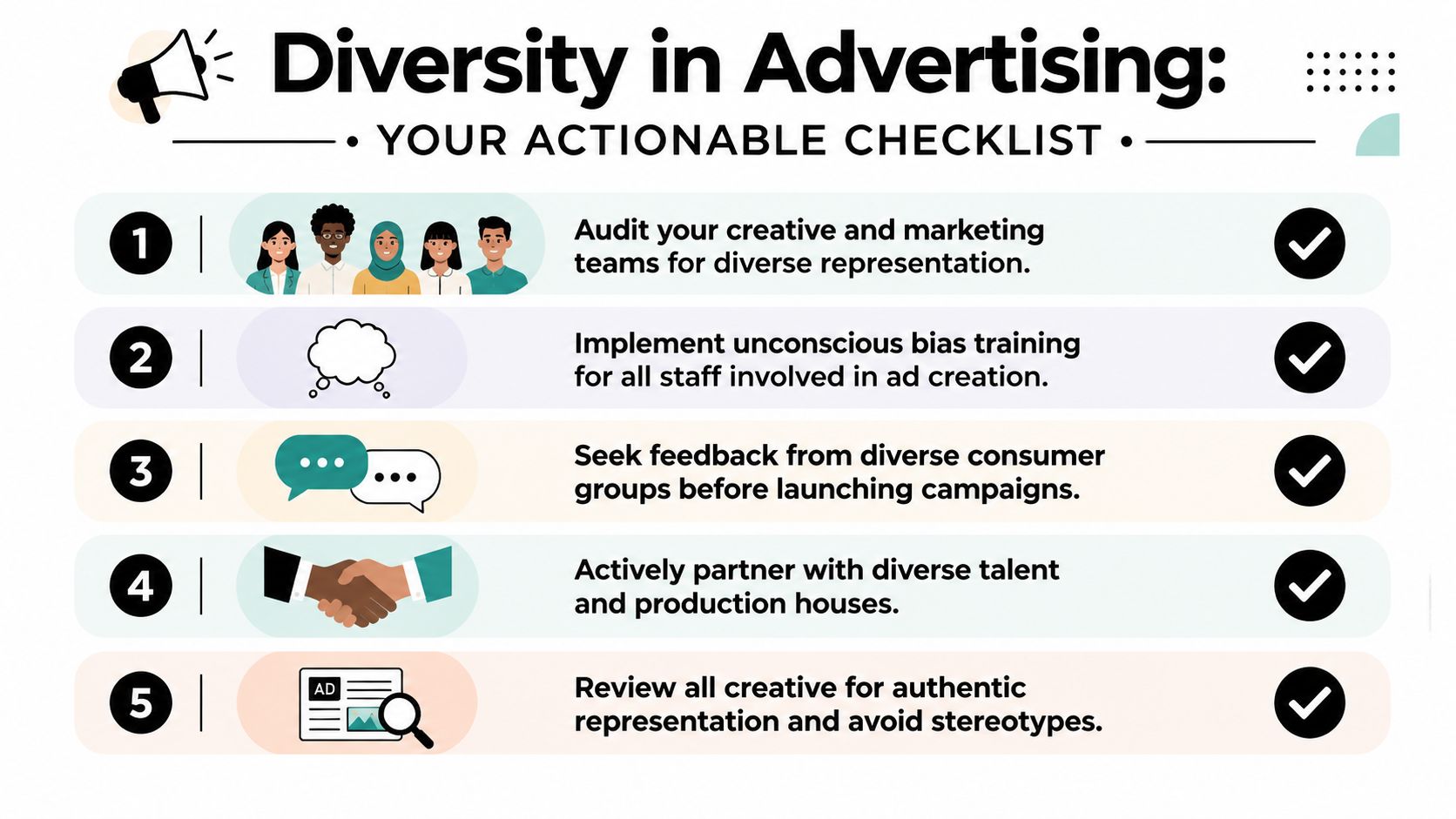
A final one, as it often becomes the downfall of many diversity efforts.
| Leadership move | What it signals |
|---|---|
| Tying goals to hiring and approvals | This is operational |
| Leaving it in brand guidelines only | This is theater |
You do not need another internal slogan. You need better people in the room, better briefs on the table, and better accountability after launch.
Toot, toot.
If you need people who can execute this stuff, not just talk about it in a kickoff meeting, HireMediaBuyers.com is worth a look. They help US brands and agencies find pre-vetted media buyers and paid ads specialists fast, including talent with platform expertise across Meta, Google, TikTok, LinkedIn, YouTube, and more. If your campaigns need sharper execution, stronger cultural nuance, and less time wasted on resume roulette, that's a smarter move than writing another diversity pledge nobody will operationalize.


