


Another List of Virtual "Games"? Hear Me Out.
If I see one more listicle suggest virtual happy hour or Two Truths and a Lie, I might mortgage my office ping-pong table, if I still had one. Yes, those activities have a place. The best ice breakers are typically around 15 minutes and simple in format, which is exactly why they work as a warm-up and not as a real development system, according to Vibe's guidance on team-building games. However, it is common for teams to stop there. That's the problem.
For media buying teams, most games for virtual teams are just calendar confetti. People laugh, someone's dog appears on camera, everybody leaves, and nobody gets better at budget calls, creative judgment, or platform strategy. Cute. Useless.
I prefer games that pull double duty. They should sharpen judgment, reveal weak spots, and make people better at the work they get paid to do. Randomized controlled trials have already shown that team video gaming improved productivity in newly formed virtual teams, with a statistically significant posttest lift in the treatment group, and that's from NIH-published research on virtual team gaming. So no, this isn't fluff. It works when you stop treating it like fluff.
These aren't party tricks. They're high-velocity training simulations disguised as fun. We're talking about exercises that make remote media buyers think faster, argue better, and spot bad assumptions before those assumptions eat your budget. Let's get into the list.
Skip the awkward Zoom small talk and run trivia that respects your team's intelligence. Give your buyers a week-long bracket with questions pulled from real work. Platform updates, creative diagnostics, metric definitions, account structure scenarios. Meta one day, Google the next, then LinkedIn and TikTok.
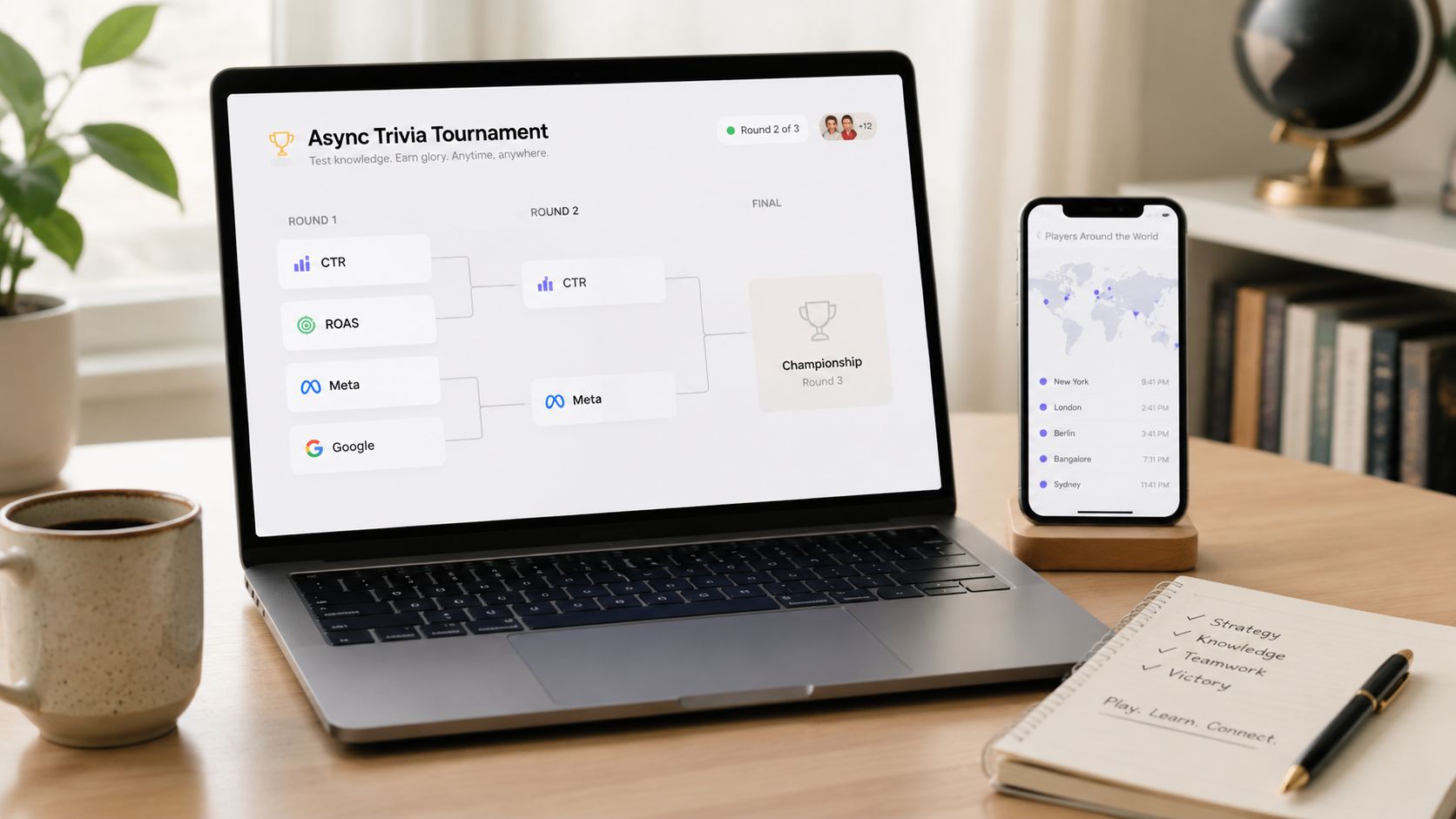
The async format matters. People in different time zones can answer inside a 24-hour window instead of pretending they're thrilled to be on yet another live call. If you're already building a remote culture around virtual employee engagement activities for distributed teams, this is one of the few formats that won't punish people for having actual client work.
Don't hand out a digital gold star and call it motivation. Tie the win to something useful:
A good agency version uses weekly platform-update rounds so buyers stay sharp without pretending they'll read every release note. A strong in-house version uses trivia during onboarding to expose whether a new hire understands paid fundamentals or just talks a good game on Zoom.
Practical rule: Mix obvious questions with a few nasty ones. If everyone aces it, you taught nothing. If everyone bombs, you built a punishment ritual.
This one is part poker, part postmortem, part group therapy for people who've been burned by "surely this creative will work." Pull three campaigns. One strong, one average, one ugly. Anonymize them, show the team the assets and setup, then have everyone place a prediction on which one will outperform.

You don't need chips. You need opinions, a scoreboard, and a facilitator who won't let the loudest person dominate. If your team already tracks ad performance metrics that actually shape decisions, this game turns those metrics into judgment practice instead of dashboard wallpaper.
The reveal isn't the point. The argument before the reveal is the point.
A SaaS team can use competitor teardowns to train buyers on messaging and positioning. A DTC team can use old account winners and losers to spread institutional knowledge that usually stays trapped inside one senior buyer's head. You'll quickly find out who notices landing page friction, who overweights flashy creative, and who understands offer-market fit.
Try these rules:
Some buyers are great analysts after results show up. Far fewer are good forecasters before the results arrive. This game separates the two fast.
Most scavenger hunts are unserious. Find something blue. Grab your coffee mug. Show us your weird desk plant. Fine for morale, useless for a media buying team.
Do the grown-up version instead. Hide clues inside real dashboards, campaign docs, naming conventions, and reporting tabs. Each clue should answer a real business question, not a kindergarten riddle. Find the top audience segment from last quarter. Identify which campaign change came right before performance dropped. Trace the source of the weird conversion spike nobody explained.
This is one of the best games for virtual teams because it teaches people where information lives. New hires stop asking where everything is. Senior people stop hoarding map-in-their-head knowledge. Everybody gets faster.
A good clue path has momentum. The first answer should be easy enough to get people moving. The middle clues should force deeper digging. The final clue should reveal something worth discussing in the next strategy meeting.
Use it in real scenarios like these:
Test the clue flow yourself first. Nothing kills this format faster than sending people to a metric that doesn't exist or a dashboard tab no one has permission to open. That kind of mistake doesn't build trust. It builds mutiny.
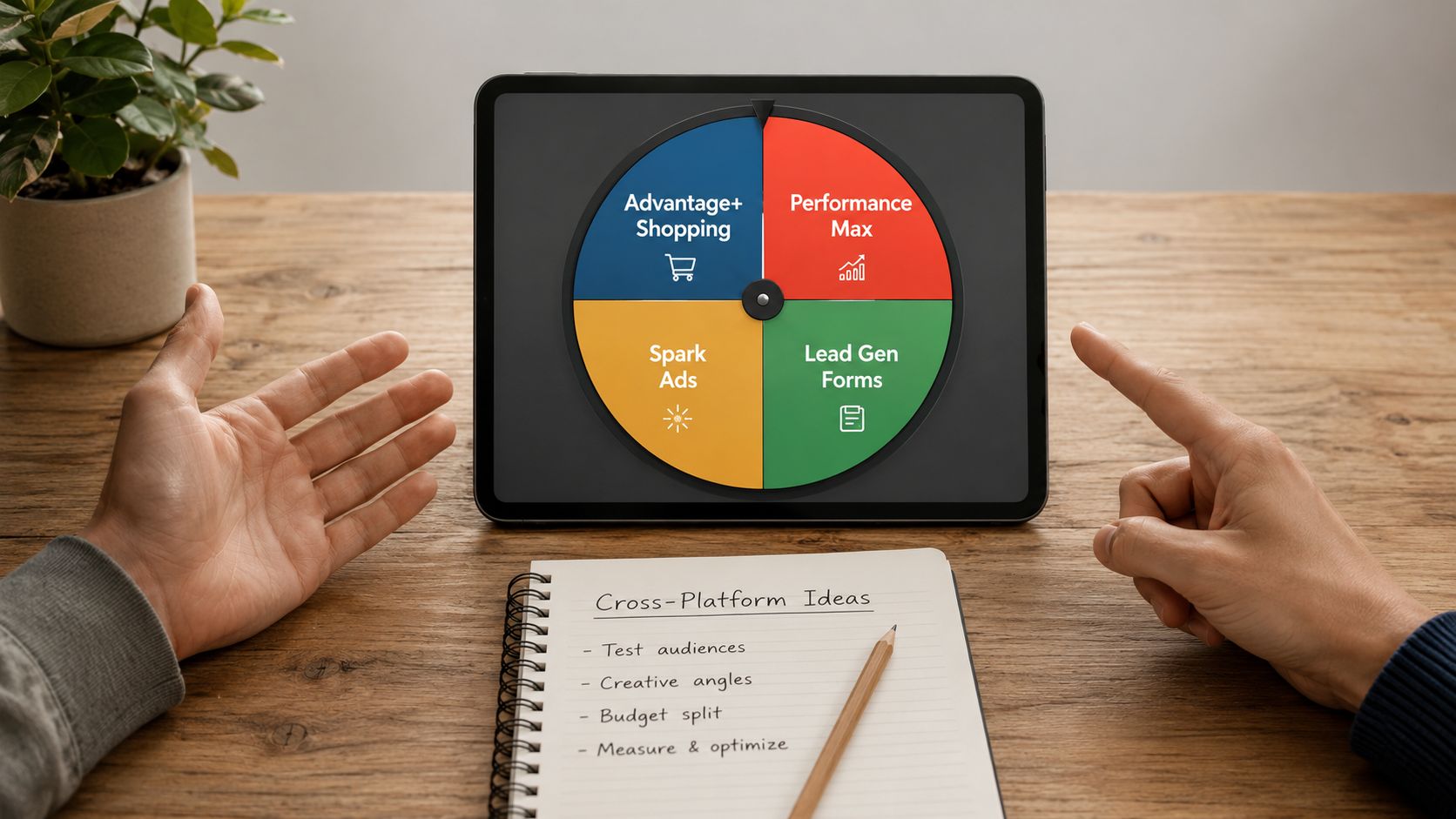
Want to know whether your team understands platforms outside their comfort zone? Spin the wheel. Whatever feature lands, that's the assignment. Advantage+ Shopping. Performance Max. Spark Ads. Lead Gen Forms. Pick the feature, hand over a client scenario, and give the team a tight clock.
Then make someone argue the opposite case. Not "this might work." I mean, "here's exactly why this could fail and what it would break."
That second part matters more than people think. Too many media buyers fall in love with tools just because the platform wrapped them in shiny product marketing. Roulette forces range. It makes a Meta specialist think like a TikTok buyer and a Google buyer admit when a feature is a bad fit.
Remote teams often confuse activity with alignment. That's why relationship-building games can fall flat if they never connect to work. Research discussed in NIH coverage of task and relationship interactions in virtual teams highlights that virtual teams struggle to balance the work itself with trust-building, and many activities don't improve productivity when they isolate bonding from task collaboration. This format fixes that by making people collaborate around real decisions.
A few ways to run it well:
If your team only feels comfortable discussing the platforms they already buy on, you don't have a flexible team. You have a specialization trap.
Nothing exposes strategic thinking faster than budget allocation. Give five buyers the same scenario and you'll get five different answers, all delivered with the confidence of a person who has definitely been wrong before.
That's why this game works. Hand your team a realistic brief. New DTC brand. Tight margin. No brand awareness. Seasonal pressure. Or B2B SaaS with a longer sales cycle and ugly handoff points. Everybody submits their split across channels blind, then you reveal the spread and force them to defend it.
The number matters less than the logic. One buyer may overweight search because they trust intent. Another may push harder into paid social because they know the offer needs demand creation before capture matters. That discussion is the game.
Run it in practical settings like these:
Show the allocations side by side in a simple chart. Then ask "why?" before declaring a winner. If someone picks the closest split for the wrong reasons, that's not a win. That's luck dressed up as strategy.
Creative opinions are cheap. Everybody has them. Most are vibes wearing business casual.
So strip the names off five ads and make your team score them blind. Hook strength, visual clarity, CTA strength, offer sharpness. Then reveal where each came from and how it performed. You'll learn very quickly who can evaluate creative and who just likes pretty things.
This game is especially useful for teams that test constantly but rarely debrief their assumptions. A DTC brand can use it to compare seasonal winners and losers. An agency can use it to train junior buyers before they start giving clients very expensive opinions.
Keep it clean:
The point isn't to crown a creative genius. It's to build a shared language for critique. Once your team can explain why an ad might work, briefs improve, feedback gets tighter, and meetings get shorter. A small miracle.
This one sounds goofy because it is goofy. Good. Teams loosen up when the format feels playful. But underneath the silliness, you're teaching persuasion mechanics.
Start with a framework from a real ad structure your team already respects. Fill-in-the-blank style. Problem, desire, promise, proof, CTA. Then hand everyone a fictional product or awkward niche and make them write inside the frame. Anonymize the entries and judge them on clarity, persuasion, and brand fit.
Most copy reviews reward the loudest editor in the room. Mad Libs levels the field. Suddenly your ops manager writes the sharpest angle of the day and your senior buyer, toot, toot, realizes they've been leaning on the same stale hooks for six months.
A few strong use cases:
And yes, if a submission wins, test it. Otherwise it's just improv theater for marketers. Fun, but self-indulgent.
Give the winner a small live test budget. Nothing humbles a room full of opinions faster than the market.
Platforms break. Tracking goes weird. Approvals stall. Entire channels go sideways at the worst possible moment, usually right before somebody promised a client things would be "smooth from here."
So practice the pivot before you need it. Tell the team a platform is down for 48 hours. Then force a response. Where does budget go? What gets paused? What gets communicated to the client? What assumptions can no longer hold?
A crisis game without client messaging is fake realism. Have one person write the client update while the others build the tactical plan. That's where you'll spot another common failure. Teams often know what they want to do, but they can't explain it calmly when the pressure is on.
Run scenarios like:
A quarterly run is enough to keep the skill fresh. More than that and people start gaming the simulation. Less than that and everyone forgets what they decided last time.
Remote media buying teams love to argue about attribution like it's philosophy. It isn't. It's an operating decision that shapes budget allocation, reporting, and platform strategy.
That's why this game works. Build a messy, realistic customer journey across channels, then force each buyer to assign credit and defend the logic in front of the team. Include upper-funnel spend, branded search, remarketing, direct traffic, and one annoying touchpoint nobody knows how to value properly. Now you've got a useful exercise instead of another abstract debate.
If your team needs a sharper shared language for attribution modeling across paid channels, use this format. It teaches people to explain tradeoffs clearly, which matters a lot more than memorizing attribution terms.
Use journeys that look like your real accounts. A DTC path should feel fast and impulse-driven. A B2B path should include longer gaps, more revisits, and at least one touchpoint that influenced the deal without closing it. If the scenario feels too clean, the discussion gets lazy.
Then press on the parts buyers usually gloss over:
The payoff is practical. You'll find out who can reason across Meta, Google, YouTube, LinkedIn, and CRM data without collapsing into channel favoritism. You'll also catch a common remote-team problem fast. Some buyers can make decent decisions, but they cannot explain those decisions well enough for clients, managers, or finance to trust them.
Keep the debrief tight. Pick the strongest argument, the weakest argument, and the assumption that would break first in a live environment. That gives your team something useful to carry back into live accounts.
Skip the fluffy team game nonsense. If you run a remote media buying team, this is the one that sharpens the work.
Put a real account issue in front of the team and set a hard ten-minute timer. CAC jumped. Lead quality fell off. Spend increased and conversion volume stayed flat. Each person has to write several clear hypotheses and pair each one with a test that could prove it right or kill it fast.
This works because media buyers love pet theories. Speed strips away the polished meeting talk and shows how people think under pressure. You find out who can isolate variables, who confuses symptoms with causes, and who reaches for the same tired fix every time.
Keep the rules strict. "Test audience" is lazy. "Refresh creative" is lazy. Make them specify the variable, the platform, the audience segment, the measurement window, and the success signal.
A good response sounds like this: performance dropped after spend scaled on Meta prospecting, so test capping frequency on the top two ad sets while holding creative constant for seven days, then compare CPA, CTR, and first-purchase rate against the prior spend level. That is a hypothesis. The vague stuff is just account cosplay.
Use this challenge for three jobs:
It also fits the point of this whole list. These are not generic virtual team games. They are work-integrated drills for remote media buyers. This one improves how your team forms tests, prioritizes experiments, and defends budget moves without hiding behind platform jargon.
End with a fast debrief. Ask which hypothesis was strongest, which test was badly designed, and which assumption would fall apart first in a live account. That discussion is where the value shows up.
| Activity | Implementation complexity | Resource requirements | Expected outcomes | Ideal use cases | Key advantages |
|---|---|---|---|---|---|
| Async Trivia Tournaments with Paid Ads Twists | Low–Medium, curate questions & scoring | Low, forms/platform + leaderboard, minimal admin | Improved platform knowledge, identified skill gaps, steady engagement | Distributed media buyer teams, async onboarding, weekly refreshers | Async-friendly, low time cost, ties learning to real incentives |
| Live Campaign Teardown Poker | Medium, prepare anonymized campaigns & scoring | Medium, campaign data, facilitator, 30–45 min session | Practical strategic insights, reveals decision styles, immediate learnings | Teams with live campaigns and analytic culture, short meetings | Uses real data, highly engaging, immediate applicability |
| Scavenger Hunt: Hidden Insights Edition | Medium–High, design clue flow across dashboards | Medium, dashboard access, prep time, testing clues | Better tool navigation, surfaced actionable insights, onboarding wins | Onboarding, discovery work, distributed teams doing async hunts | Trains platform use, uncovers real performance issues, engaging |
| Platform Feature Roulette | Low, randomize features and set timers | Low, feature list, timer, brief facilitator | Cross-platform ideas, sharper debate skills, tactical tests | Cross-training multi-platform teams, agencies, idea generation | Fast, breaks silos, generates testable tactics with minimal prep |
| Budget Allocation Blind Bet | Low–Medium, craft scenarios and benchmarks | Low, submission tool, benchmark data, facilitator | Alignment on media mix, exposes risk appetites, pitch prep | Strategic alignment, onboarding, pre-pitch war-gaming | Prevents groupthink, surfaces allocation philosophies, practical |
| Creative Critique Roulette (Blind Round) | Low–Medium, collect, anonymize creatives, score | Low, creative assets, performance data, scoring sheet | Calibrated creative instincts, stronger briefs, test ideas | Teams doing frequent creative tests, training juniors | Removes bias, links gut to outcomes, builds taste standards |
| Ad Copy Mad Libs Tournament | Low, create templates and anonymous submission | Low, templates, voting, small test budget | Testable ad copy backlog, uncovers hidden writers, fun morale boost | Teams producing lots of copy, async creativity sessions | Low-friction creativity, produces real copy to test, democratizes input |
| Platform Outage Simulation (Decision Tree) | Medium, develop scenarios & decision trees | Medium, cross-functional participants, facilitator, docs | Contingency readiness, identified vulnerabilities, better comms | Teams needing crisis prep, leaders stress-testing readiness | Practical crisis practice, exposes interdependencies, builds confidence |
| Attribution Detective: Multi-Touch Mystery | Medium, design journeys and model formats | Low–Medium, journey data, modeling templates, facilitator | Better attribution intuition, documented frameworks, alignment | Teams debating attribution, building reporting frameworks | Encourages tradeoff discussion, scalable to business types |
| Rapid-Fire Hypothesis Testing Challenge | Low, prepare prompt and timebox format | Low, scenario, note-taking, follow-up tracking | Faster hypothesis generation, experimental discipline, test backlog | Teams improving diagnostics and test velocity, short meetings | Time-efficient, builds experimentation muscle, yields actionable tests |
Here's the blunt truth. Remote teams do not need more fluffy bonding sessions. They need better reps on the work that makes money.
That is the whole point of these games for virtual teams. For media buying teams, a good exercise should sharpen judgment on spend allocation, creative feedback, platform choices, attribution calls, and response under pressure. If the activity cannot improve how your team thinks inside an account, cut it.
The payoff is practical. You spot who can defend a budget shift with logic instead of platform bias. You see who can critique ads without turning the room weird. You find the people who stay clear-headed when results get messy, reporting breaks, or a platform outage forces fast decisions.
That kind of visibility matters more than whether everyone had a nice time on Zoom.
A lot of remote companies make the same mistake. They separate team bonding from team performance, then wonder why morale events feel disconnected from the job. For a media buying team, that split is expensive. You end up with people who know each other socially but still cannot pressure-test a forecast, challenge weak creative, or align on channel strategy without friction.
Work-integrated games fix that because the bonding happens inside the work. Your team learns how each person reasons, where judgment is strong, where bias shows up, and which skills need help. That is useful trust. It carries into campaign planning, client communication, and post-mortems.
You also get a cleaner read on hiring gaps. One team may be strong on execution and weak on attribution. Another may know platform mechanics but struggle to write sharp hooks or give useful creative feedback. Once the weakness is visible, you can train it, reassign around it, or hire for it.
If you need that last option, HireMediaBuyers.com is built for exactly this problem. The platform focuses on pre-vetted media buyers and paid ads specialists across Meta Ads, Google Ads, LinkedIn, TikTok, Microsoft/Bing, Apple Search, Pinterest, YouTube, and more. Companies get a curated shortlist fast, can hire remote talent in their time zone, and get support for HR, payroll, compliance, and replacements without building the whole recruiting machine themselves.
Good team games should leave you with something tangible. Better briefs. Better tests. Better decision-making. Better clarity on who belongs in which seat.
That is how games turn into gains.


