

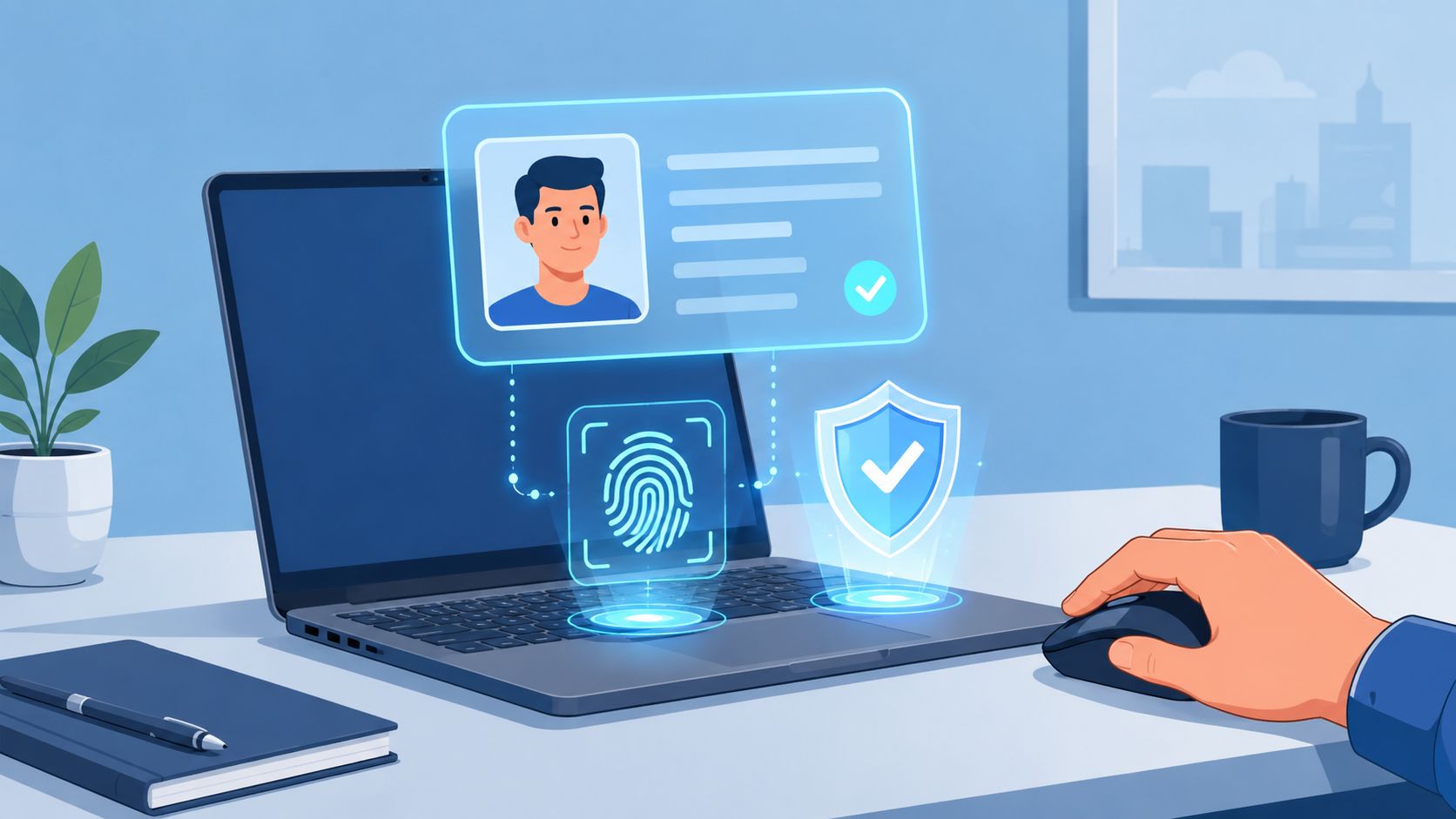
You're hiring a remote media buyer, the inbox looks polished, the portfolio sounds expensive, and the candidate says all the right things about ROAS and creative testing. Great. Then three weeks later you're staring at a locked Meta account, a suspicious billing trail, and a team chat full of “How did we miss that?” Classic.
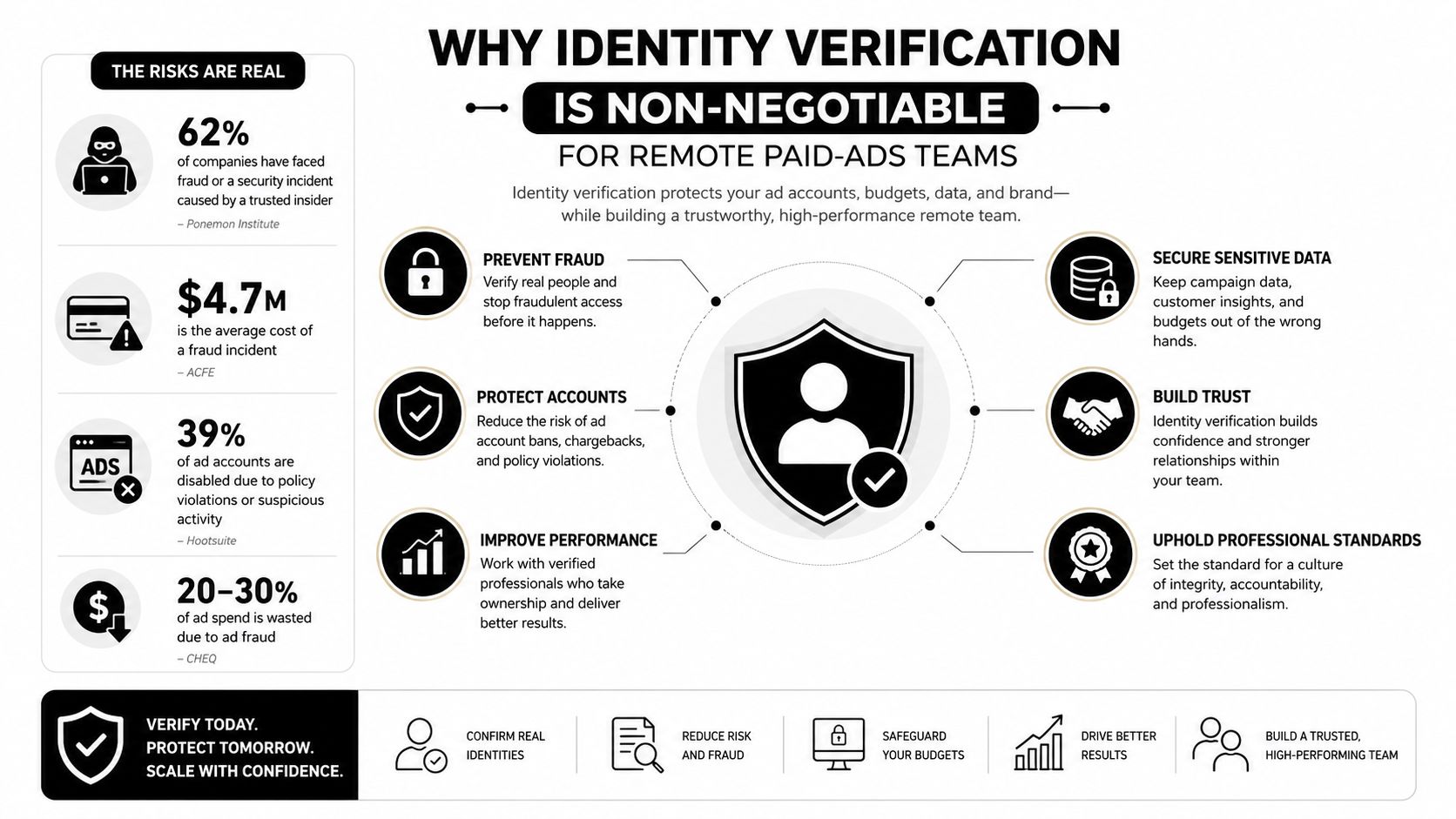
That's why identity verification matters here. Not as compliance wallpaper, not as a procurement checkbox, but as the difference between a real operator and someone who's very good at borrowing trust. In paid media, a bad hire doesn't just waste time. They can burn cash, poison accounts, and drag your acquisition engine through a ditch.
The actual questions are simple. Is this person real? Are they who they claim to be? And can I trust them anywhere near ad budgets, billing, or admin access?
A U.S. agency hires a remote media buyer fast because the client wants launch support next week. The profile looks tidy, the interview goes fine, and the team skips the annoying parts. No real verification stack. No hard proof. Just a couple of calls, a resume, and a “we'll sort the paperwork later” shrug.
Then the damage starts showing up in the usual ugly places, account oddities, strange billing behavior, weird logins, and creative requests that make no sense. By the time someone connects the dots, the contractor wasn't just sloppy. They were operating through a synthetic identity, and the budget trail had already been used like a public restroom.
That's the modern trap. Remote hiring feels lightweight until the wrong person gets keys to your ad ecosystem. Then you're not evaluating talent anymore. You're doing forensic cleanup with your finance team breathing down your neck.
Practical rule: if a media buyer can touch spend, change account settings, or request billing access, they need to be treated like someone handling cash, because that's basically what they're doing.
The marketplace for identity verification isn't growing because companies got bored and started adding process for fun. It's expanding because digital onboarding, anti-fraud controls, and compliance needs are everywhere, with one major estimate putting the market at USD 9.87 billion in 2022 and projecting USD 33.93 billion by 2030 (Grand View Research).
So no, this isn't a banking-only topic. It's a hiring survival issue for agencies and DTC teams that don't want their billing dashboard treated like a vending machine.
If you're already comparing candidates, the right move is to use a stronger screening path, not a prettier interview process. Client references that provide real value can help, but only if you know what identity risk you're trying to flush out.
The cleanest definition is the one most vendors try to bury under marketing fluff. Identity validation checks whether the evidence is authentic, accurate, and current. Identity verification checks whether the live person is the same individual to whom that evidence was issued, which is the part that matters when someone is asking for access to your ad accounts (NIST digital identity proofing guidance).
Airport security serves as a useful comparison. Scanning a passport is validation. Confirming the traveler standing in front of you is the rightful owner is verification. If you stop after the scan, you've checked a document, not a person.
A lot of tools sell “verification” when they really mean OCR plus a file upload. That's not the same thing. NIST SP 800-63A says identity verification is about binding validated evidence to the physical, live person presenting it, and for higher-assurance levels that binding has to happen through a physical comparison or a biometric comparison against live capture (NIST verification guidance).
That matters because a nice-looking ID image can be fake, reused, or stolen. If your process only proves the file exists, you've built a very expensive screenshot checker. Toot, toot, your security team just bought theater.
A real verification flow doesn't ask, “Does this document look fine?” It asks, “Is this the same human who owns the identity on the document?”
For remote media-buyer hiring, that means the bar should be higher than email OTP and a smiling Zoom face. A serious flow needs document authenticity, a live biometric or face match, and some kind of backend signal that helps confirm the person and the evidence belong together. Anything below that is just a confidence costume.
For teams trying to formalize the process, this compliance check guide is worth keeping nearby, because the part people skip is usually the part that bites them later.
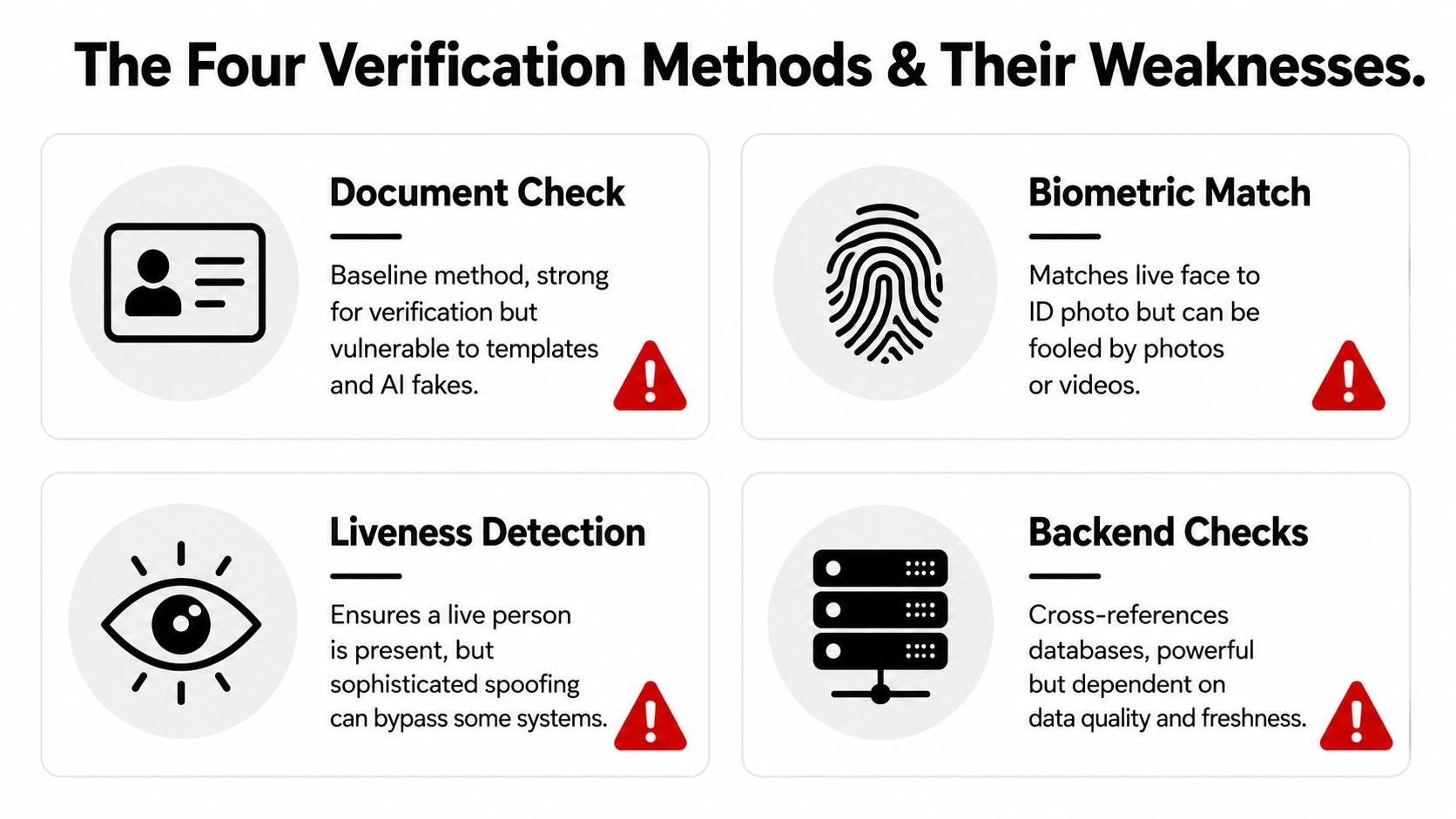
A document check is the easiest place to start, which is exactly why so many teams stop there. That mistake is expensive. A passport or driver's license can be photographed, templated, replayed, or AI-generated, so the file can look clean while the person behind it has nothing to do with the identity on screen.
Biometric matching with liveness does more to bind the live person to the identity evidence. In a remote hiring flow, that is the test that matters. Still, don't turn it into a magic wand. Accessibility can be a real problem, and visual workflows can block candidates who cannot complete them on their own.
Database checks and knowledge-based authentication still matter, but only as support signals. They work best when the applicant has enough history for the system to recognize normal patterns. Thin-file applicants are a different story, and these tools can become blunt instruments dressed up with a polished interface. For teams that need a clear paper trail, Canada's FINTRAC guidance shows the standard of care well, because the verifier must keep the name, date of verification, type of document, document number, issuing province or state and country, and expiry date if applicable, while also confirming the document is authentic, valid, current, and matched to the person's name and photo (FINTRAC guidance).
That level of recordkeeping is also why identity checks belong inside your payroll compliance process. If you cannot connect the person, the document, and the payment trail, you are leaving a gap open for fraud.
Phone and email checks are baseline hygiene. Use them. They do not prove identity. A burner inbox and a VoIP number can pass both checks while telling you nothing useful about who is on the other side.
| Signal Layer | What It Catches | Typical Friction |
|---|---|---|
| Document check | Fake or expired ID images, obvious mismatches | Low |
| Biometric match plus liveness | Stolen IDs, impersonation, replay attacks | Medium |
| Database or KBA check | Inconsistent identity history, weak claim validation | Low to medium |
| Phone and email check | Bad contact details, sloppy applicants | Very low |
The recommendation is straightforward. Stack at least two methods. Use a biometric step-up for anyone who will touch ad budgets. Do not rely on KBA alone for global hiring, especially if your candidate pool includes markets where thin credit files are common. That is how you end up congratulating yourself for clearing the wrong person.
Paid media is not a spreadsheet exercise. It's access to billing, pixels, account history, creative approvals, and the kind of trust that takes months to earn and minutes to wreck. If a contractor can resell access to a verified ad account, run cloaked affiliate spam on your dime, or share one team login across multiple operators, you've got fraud exposure before anyone on the compliance side even opens a ticket.
That's why this belongs in fraud prevention first and compliance second. The business pain lands immediately. You don't need a regulator to show up before you feel it. A drained prepaid balance or a disabled Google Ads account is already a real loss, and it tends to arrive right when the client is asking why performance looks “weird.”
The market numbers tell the story. Identity verification has become a major global category, not a niche admin chore. One estimate puts it at USD 9.87 billion in 2022 with a path to USD 33.93 billion by 2030, while another puts it at USD 14.34 billion in 2025 and USD 29.32 billion by 2030 at 15.4% CAGR (Grand View Research). That growth tracks the fact that onboarding, fraud controls, and compliance are now baked into digital operations.
In plain English, remote paid-ads hiring has joined the same trust problem. A founder used to rely on references and a decent Zoom call. That was fine when the worst outcome was a mediocre contractor. Now the downside includes account takeover, billing abuse, and a clean-looking liar with a billing card on fire.
If someone can get into your ad stack without being properly verified, you've built a budget leak and called it hiring.
For agencies and DTC brands hiring globally, verification is table stakes. It's what email two-factor authentication became years ago. Nobody wants to talk about it until the first bad access event lands, then suddenly everyone's a believer.
The strongest flows are boring in the right way. They do not hang everything on one signal. They stack proof until a fake contractor has to burn too much time, too many tools, and too much coordination to get through. Start with government-ID capture, use NFC chip reading where the document supports it, then run liveness checks and a selfie-to-document biometric match. Add device and phone intelligence so you can sanity-check whether the session looks like the claimed country and the claimed applicant. For remote paid-ads hiring, that matters because one bad operator can move from “candidate” to “account access” before anyone notices the fraud pattern.
A one-time IDV flow is not enough anymore because modern fraud does not always arrive as a static document upload. AI-generated identities can show up in live interviews, and that is exactly why step-up checks belong at contract signing and before any access escalation. A media buyer who is about to receive admin rights or billing permissions should pass through a harder gate than a junior creative who only needs project access.
Use the hiring week to separate access levels, not just identities. The first pass should clear the person. The second pass should clear the risk they pose to your ad stack.
| Layer | What it does | What it misses |
|---|---|---|
| Government ID capture | Checks document details and structure | Good fakes, spoofed scans |
| NFC chip read | Confirms embedded document data where available | Documents without chips |
| Liveness plus selfie match | Links a live person to the ID | Advanced replay and spoof attempts |
| Device and phone intelligence | Flags country mismatch and suspicious setup | Clean devices used by the wrong person |
| Continuous signals | Detects drift after onboarding | Events that never trigger an alert |
Each layer closes a different hole. ID capture catches obvious document fraud. NFC raises the bar on documents that support it. Liveness and selfie match stop a static image from walking through your process as a real person. Device and phone intelligence expose the kind of setup that looks polished on a call but does not fit the claimed location or hiring story. Continuous signals matter because fraud does not always announce itself on day one, and bad access often shows up after the contractor has already touched budgets, pixels, or billing.
The point is not to put every candidate through a clown show. The point is to match friction to risk. A media buyer with budget authority deserves more friction than a junior designer. A contractor who can change bids, billing, or account ownership should face the hardest checks in the stack. That is how you keep the verification process pointed at the blast radius.
Identity verification should not end when the offer letter is signed. Authentication and authorization are separate from onboarding, but they should reference the verified identity established earlier, especially at high-risk moments. A contractor who changes device, changes country, or suddenly asks for a privilege jump should trigger another check before access expands.
That same rule applies inside the ad account. If a new login pattern shows up before a billing change, or if someone who passed onboarding starts behaving like a different operator, treat it as a security event, not a training issue. Remote paid-ads teams lose money when they wait for certainty. They keep control when they step up verification as soon as the risk changes.
A vendor demo is where polished claims go to hide. The dashboard looks clean, the graphs are calming, and the salesperson starts tossing out words like “smooth” with the confidence of someone who has never had to untangle a fraud incident after a fake media buyer got access to Meta or Google Ads. Ignore the theater. Buy for coverage, signal quality, and operational fit.
Start with geography. If your hiring funnel pulls from Latin America, South Africa, or the Philippines, the vendor needs to handle those document types and identity patterns without turning a large share of applicants into false positives. That matters in remote paid-ads hiring, because the worst outcome is not a slow review, it is rejecting a strong contractor while a bad actor slips through on a cleaner-looking profile.
Liveness and anti-spoofing depth matter next. Cheap tools fail fast here, especially when a candidate is using a recycled ID, a screen replay, or a borrowed face to get through a check. If the vendor cannot explain how it stops that kind of fraud, the product is built for presentation, not protection.
Integration matters too. If the verification flow cannot plug into the ATS or HRIS you already use, your ops team will end up doing manual copy-paste work, which is a lovely way to waste time and create fresh failure points. Pricing should be per verification, not some “attempt” model with step-up fees hiding in the small print. And if the vendor will not give you data residency details, subprocessors, or clear security artifacts, they are asking you to trust the vibes.
Vendor rule: if they cannot show a coverage map, explain their accessibility model, and summarize their security posture without an NDA obstacle course, walk away.
Ask for SOC 2 Type II material and penetration-test summaries, then see how they respond. A serious vendor answers directly. A vendor that dodges those questions is telling you the product is easier to demo than to defend. The same goes for false negatives. If they cannot explain how their published metrics treat the applicants who should have passed but did not, the numbers are doing marketing work, not security work.
For a hiring team, the disqualifiers are blunt. No published coverage map. Opaque pricing. No documented accessibility plan. If any of those show up, stop the conversation. Slick demos do not protect your ad spend.
Verification brings legal and ethical responsibilities with it, and pretending otherwise is how teams create avoidable messes. If your flow touches payment setup, account opening, or onboarding tied to regulated activities, KYC and AML questions show up fast. If you're handling applicants in the EU or California, GDPR and CCPA expectations are in the room too, whether procurement likes it or not.
The accessibility side is the part that is often missed. A recent preprint on blind and low-vision users says common verification steps like selfie facial recognition, document photo capture, image CAPTCHAs, and liveness checks can be hard to complete independently (arXiv preprint). That means a flow can be “secure” and still be unfairly exclusionary.
Public-sector guidance also warns that overreliance on visual or document-based checks can exclude people with thin credit files, limited English proficiency, or low digital literacy (arXiv preprint). That matters in global hiring, especially when strong candidates live in markets where the default verification assumptions don't fit neatly.
The practical fixes are not exotic. Use non-digital fallback paths where appropriate. Make the flow mobile-responsive. Keep consent screens clear and plain. Retain only the minimum data you need, and make sure someone can explain why each field is being collected.
Practical rule: if your legal team can't tell the candidate what data you're collecting, why you need it, and how long you keep it, the workflow isn't ready.
A lot of “security-first” teams reveal themselves as process-first and user-last. Don't be that team. The best verification program protects you without turning half your applicant pool into collateral damage.
Day 1 and 2, audit every point where an unverifiable person could touch ad spend, credentials, billing, or admin settings. Day 3 and 4, pick a vendor that covers your hiring geographies and negotiate pricing that's transparent per verification, not buried under usage theater. Day 5, define a step-up policy so anyone with ad-account or billing access gets an extra biometric check.
Day 6, train hiring managers on social-engineering tells and on documenting verification outcomes properly. Day 7, pilot the new flow with the next three media-buyer candidates and watch three things closely, time-to-clear, false-positive rate, and candidate feedback. If the process feels like a brick wall, you overcorrected. If it feels like a speed bump, you probably underbuilt it.
A strong hiring team doesn't need to build all of this from scratch if speed matters more than perfect internal tooling. The better shortcut is a vetted marketplace that already screens for the stuff you'd otherwise spend weeks policing yourself. That's especially useful if you want a shortlist fast and you'd rather focus on campaign strategy than become a part-time identity analyst.
The test is simple. Can a stranger get near your ad budget without you being certain they are a real, matched, accountable human? If the answer is maybe, you already know what to do next.
If you want a faster path to vetted remote paid-ads talent without turning your team into amateur fraud investigators, visit HireMediaBuyers.com. They help US companies find pre-vetted media buyers and paid ads specialists fast, with a model built for the exact trust problems that make weak verification so expensive.


