

Are you asking whether Google Ads is worth it, or whether your business can afford the cost of acquiring one more customer? Those aren't the same question. A campaign can report healthy ROAS while buying customers you would've won anyway, or produce leads that never survive contact with your sales team.
Google Ads remains one of the most established paid acquisition channels because it launched as Google AdWords in 2000, giving advertisers more than two decades of auction-based search inventory to test intent-driven acquisition at scale. Google Ads history and benchmark context matter, but history won't rescue bad unit economics. Rising CPCs, mixed success stories, leaky tracking, and enthusiastic platform dashboards have made the simple yes-or-no answer practically useless.
My answer is blunt: Google Ads is worth testing when your margin, conversion rate, and customer value can absorb the click price. It isn't worth funding because a platform representative says your account has “great potential.” Your spreadsheet gets the final vote.
This guide gives you the decision path I use before putting budget into search. You'll see how the auction sets costs, which campaign types deserve priority, how to calculate a CPA ceiling using LTV and AOV, and how CPC inflation changes the verdict. You'll also get practical kill criteria, ramp expectations, and the point at which hiring help beats learning through expensive mistakes.
The question isn't whether Google Ads works. It's whether your economics work after Google takes its cut.
Google Ads isn't a vending machine where the biggest bid automatically buys the best position. It's an auction that weighs your bid alongside real-time quality signals, which means two advertisers can pursue similar placements and pay very different actual CPCs.
Google describes Quality Score as a diagnostic score, not a direct input in the ad auction. The auction instead uses real-time quality signals to calculate Ad Rank, and stronger relevance can improve position while reducing the amount you pay for a click. Google's explanation of Quality Score and ad quality is worth reading before you raise a bid out of panic.
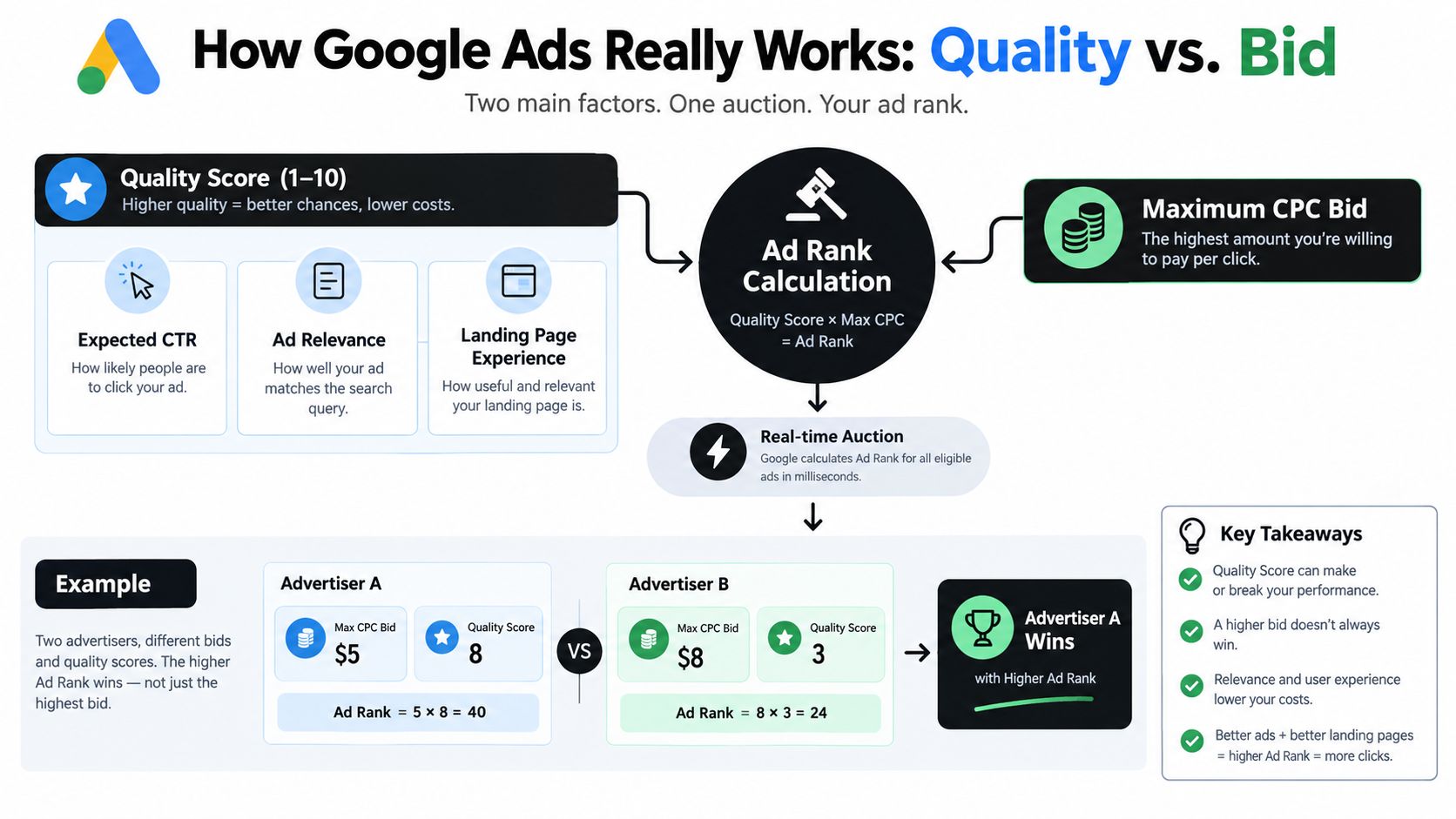
The familiar Quality Score diagnostic uses three components:
That gives you a practical optimization order. Tighten the keyword-to-ad-group relationship, write copy that answers the actual query, then send the click to a page built for that intent. A generic homepage is usually where good intent goes to die.
Landing-page speed and mobile usability matter because the auction's relevance signals don't stop at the headline. If your ad says “emergency commercial plumbing” and the landing page opens with a vague company slogan, you're asking Google to charge you for the privilege of confusing people.
Practical rule: Fix relevance before increasing bids. A better-matched ad and page can improve Ad Rank and lower actual CPC without simply throwing more money at the auction.
Account structure matters too. Separate brand, non-brand, services, products, and locations when their economics or intent differ. That separation lets you see which searches create incremental demand instead of blending everything into one cheerful, meaningless average.
If you need deeper execution guidance, use this Google Ads bidding strategy guide to pressure-test bidding, tracking, and campaign structure. The important point is simple: relevance is a cost-control lever, not a decorative score buried in the interface.
Campaign type sets the distance between your budget and active buying intent. Search Non-Brand reaches people expressing a need. Display often reaches people reading an article or watching a video, with no immediate buying signal. Treating those placements as equal is how marketers celebrate cheap clicks that never become revenue.
The strongest evidence favors high-intent formats. An independent benchmark analysis reported median incremental ROI of 5.21x for Search Non-Brand, 4.64x for Performance Max, and 4.14x for Search Brand. The 2026 incremental ROI analysis separates incremental return from last-click credit, a distinction that matters when deciding whether ads created demand or merely claimed it.
A separate benchmark report found median ROAS of 3.52x across Google Ads campaign types, with 5.17x for search campaigns and 0.12x for display. The Google Ads PPC benchmark report makes the practical point clear: “Google Ads” is too broad a label for a budget decision.
| Campaign Type | Median Incremental ROI / ROAS | Best Use Case |
|---|---|---|
| Search Non-Brand | 5.21x incremental ROI | Capturing high-intent demand from new prospects |
| Performance Max | 4.64x incremental ROI | Ecommerce and broader conversion coverage after tracking is reliable |
| Search Brand | 4.14x incremental ROI | Protecting branded demand and controlling the results page |
| Search overall | 5.17x median ROAS | Intent-led acquisition across relevant search campaigns |
| Display | 0.12x median ROAS | Selective remarketing or awareness, not your first profitability test |
The table is a starting point, not a forecast. Start with Search Non-Brand if you sell a clearly understood service or solution and buyers actively search for it. Local service businesses should isolate high-intent location and service terms. B2B teams should prioritize problem, category, and solution searches connected to a real sales process.
Ecommerce brands can test Performance Max earlier, especially when product data and conversion values are clean. Keep control of the measurement first. Do not hand the entire account to automation while purchases, qualified leads, or revenue are still being recorded incorrectly.
Brand Search protects branded demand and controls the results page, but it can flatter performance reporting. People already searching for your company may click an ad they would have found organically. Keep the campaign visible, then judge it by incremental contribution instead of allowing it to carry the account's reputation.
Display attracts volume and weakens the first profitability test. Use it for remarketing or awareness with a separate objective. Prove demand capture through search before funding colder placements. Your campaign mix should follow your CPA ceiling, not whichever format produces the cheapest click.
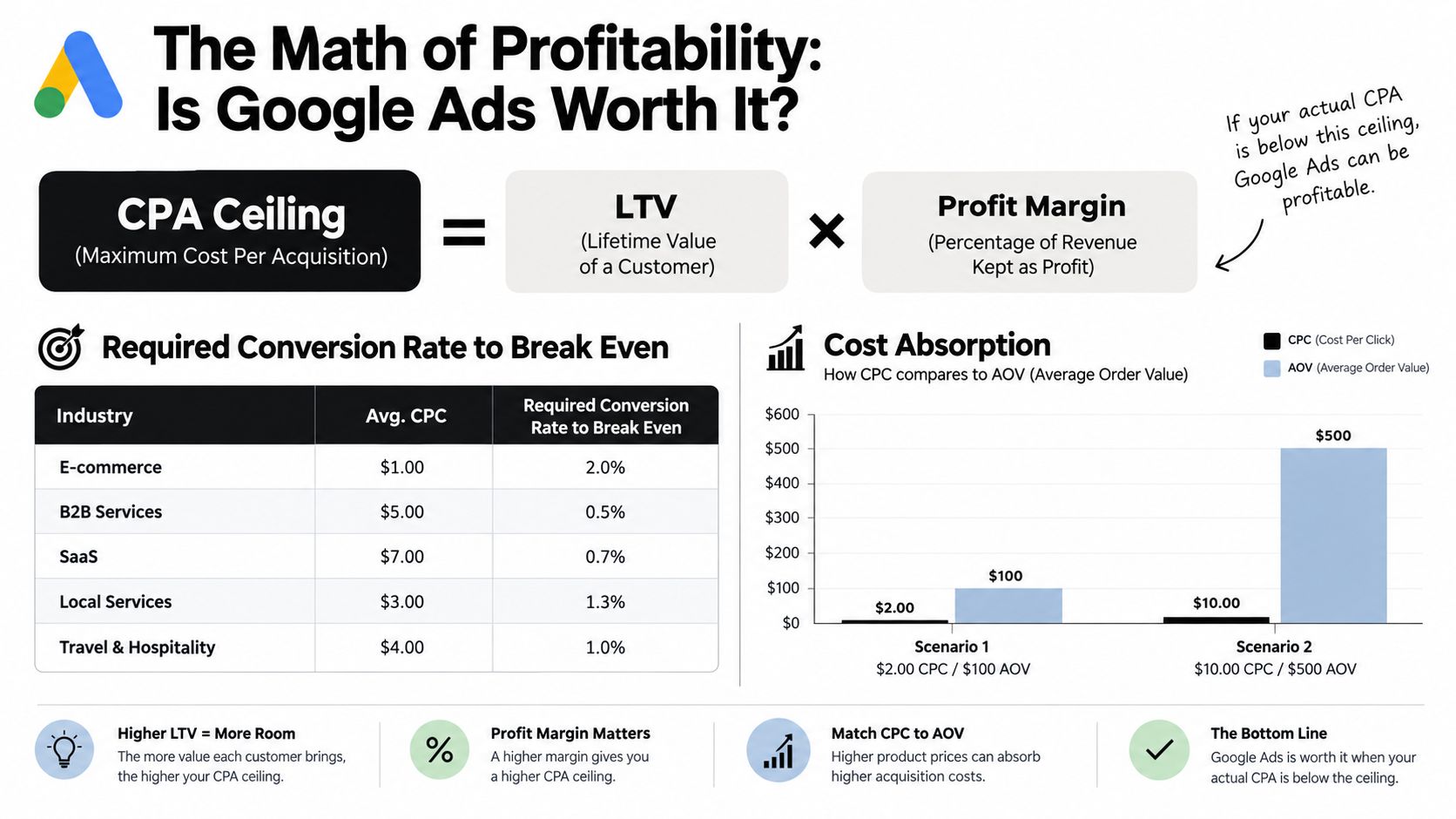
Is Google Ads worth it? The useful answer starts somewhere else: What is the most you can pay to acquire a customer or qualified opportunity before profit disappears? CPC inflation makes that CPA ceiling the decision point. Set it before spending, then test whether each campaign type can reach it.
Start with customer value. For a one-time ecommerce purchase, combine AOV, gross margin, and realistic repeat-purchase contribution. For B2B, estimate gross profit from a closed customer and multiply it by a defensible lead-to-close rate. That produces an LTV-based acquisition limit instead of a vanity ROAS target.
A practical starting formula is:
CPA Ceiling = LTV × Profit Margin
Refine the result by subtracting fulfillment, sales labor, onboarding, refunds, agency fees, and other variable costs. Only the remaining contribution profit is available for acquisition. A lead below the ceiling can still lose money if it produces poor customers. Cheap junk is not a business model.
Use this sequence:
A benchmark set covering 13,474 U.S. campaigns reported average search CPC of $5.42, average CTR of 6.64%, average conversion rate of 8.18%, and average CPL of $66.69. The benchmark source provides context, not a forecast. Your category may sit far above or below those averages.
Category differences can be just as sharp. In 2026, reported average Search CPC ranged from $1.16 in ecommerce to $6.75 in legal services. The industry CPC breakdown shows why an ecommerce offer and a legal intake funnel need different budget assumptions.
Suppose an ecommerce business has an AOV of $100 and limited contribution margin available for acquisition. A $2 click can work with a strong conversion rate and repeat value. It becomes dangerous when the business counts revenue instead of contribution profit.
B2B requires funnel math. A $500 lead may be excellent if qualified opportunities close into high-margin accounts. It may be disastrous if the CRM counts students, vendors, and job seekers as conversions. Feed qualified outcomes from sales back into reporting, then judge campaigns by closed-customer economics.
Use attribution modeling guidance to compare last-click reporting with incremental return. If your CPA ceiling sits below the market's realistic CPC-to-conversion economics, do not launch yet. Fix the offer, landing page, conversion rate, or sales process first. That is the answer your spreadsheet should deliver before Google gets a dollar.
A tiny budget doesn't create a low-risk test. It creates a test too starved to produce a useful signal, then invites an emotional verdict after a handful of clicks. The famous “$500 Hello” sounds prudent until you realize it may only buy a thin slice of data in a competitive category.
Use the budget guidance in this Google Ads benchmark coverage to anchor expectations around CPC, then match spend to your actual CPA ceiling. A high-CPC category needs enough budget to encounter meaningful search volume and conversion opportunities. A low-CPC category can learn with less, provided the audience and offer are clear.
The supplied planning model uses these starting floors:
Those are testing floors, not guarantees of profitability. If your allowable CPA is narrow, even a larger budget only helps you discover the problem faster.
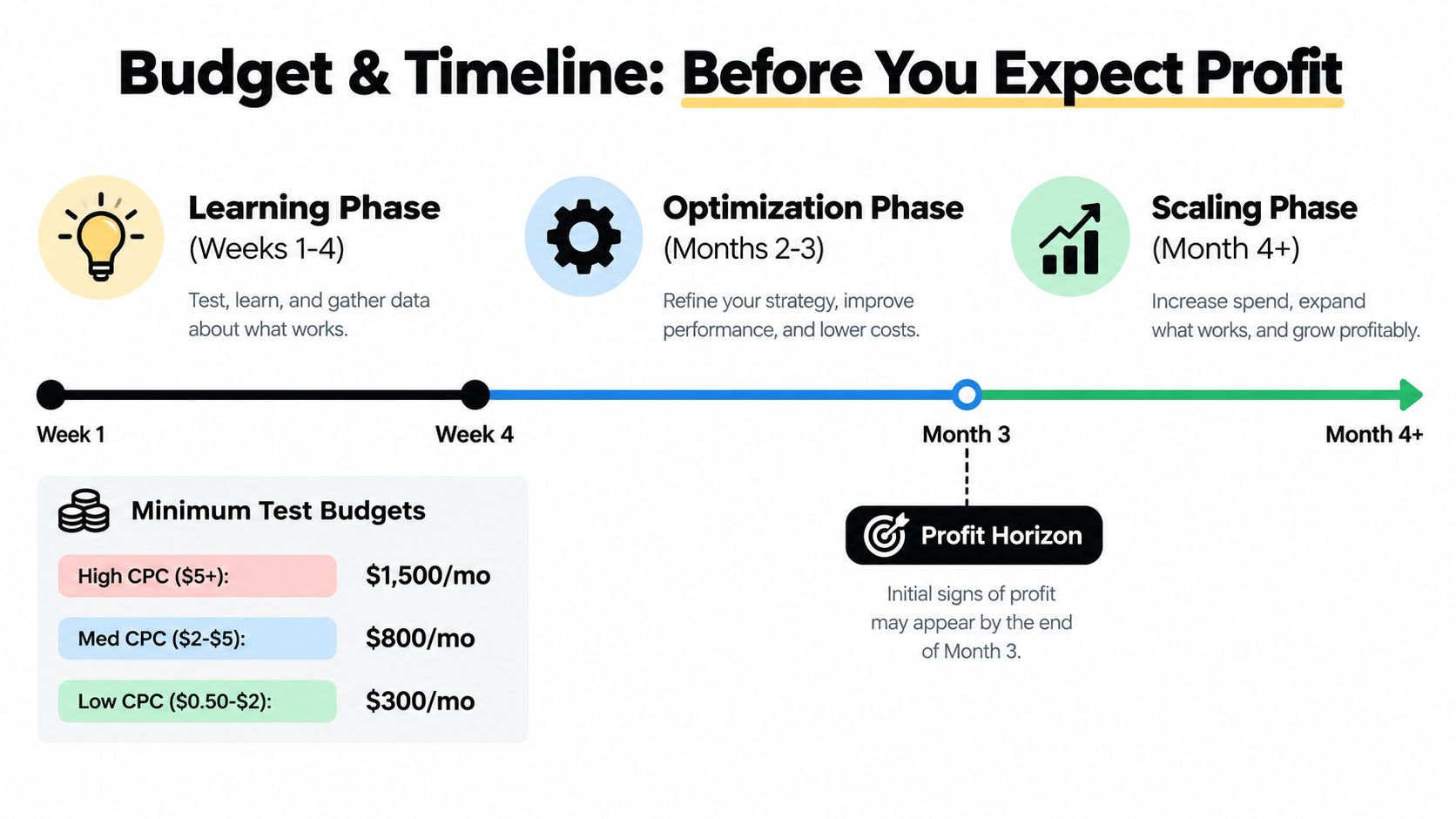
Weeks 1 to 4 are for learning. Confirm search terms, conversion actions, location settings, devices, and auction behavior. Don't make daily bid changes because Tuesday looked ugly.
Months 2 to 3 are for optimization. Tighten negatives, improve weak ads, repair landing-page mismatches, and separate profitable intent from noise. You should be able to identify which themes deserve more budget and which ones need a quiet burial.
Month 4 onward is for scaling. Increase exposure only when CPA remains below your ceiling and the incremental quality holds. Scaling a campaign that works only because brand traffic props it up is just buying a larger problem.
Write down the conditions that stop spend before you get attached to the campaign. Examples include a conversion action that fails quality checks, search terms that remain irrelevant after refinement, or CPA that exceeds your ceiling once enough data exists to judge it.
Also define scale signals, such as profitable non-brand conversions, qualified pipeline, stable tracking, and a landing page that converts without heroic sales intervention. You don't need perfect certainty. You do need rules written before the dashboard starts whispering sweet nonsense.
Most failed accounts don't fail because Google Ads is mysterious. They fail because someone skipped a basic control, then tried to solve the resulting mess with a higher bid.
A common pattern looks like this: broad targeting brings in searches for free tools, jobs, definitions, or unrelated services. The owner sees clicks but no sales, then blames the channel. The actual culprit is a search-term report nobody reviewed.
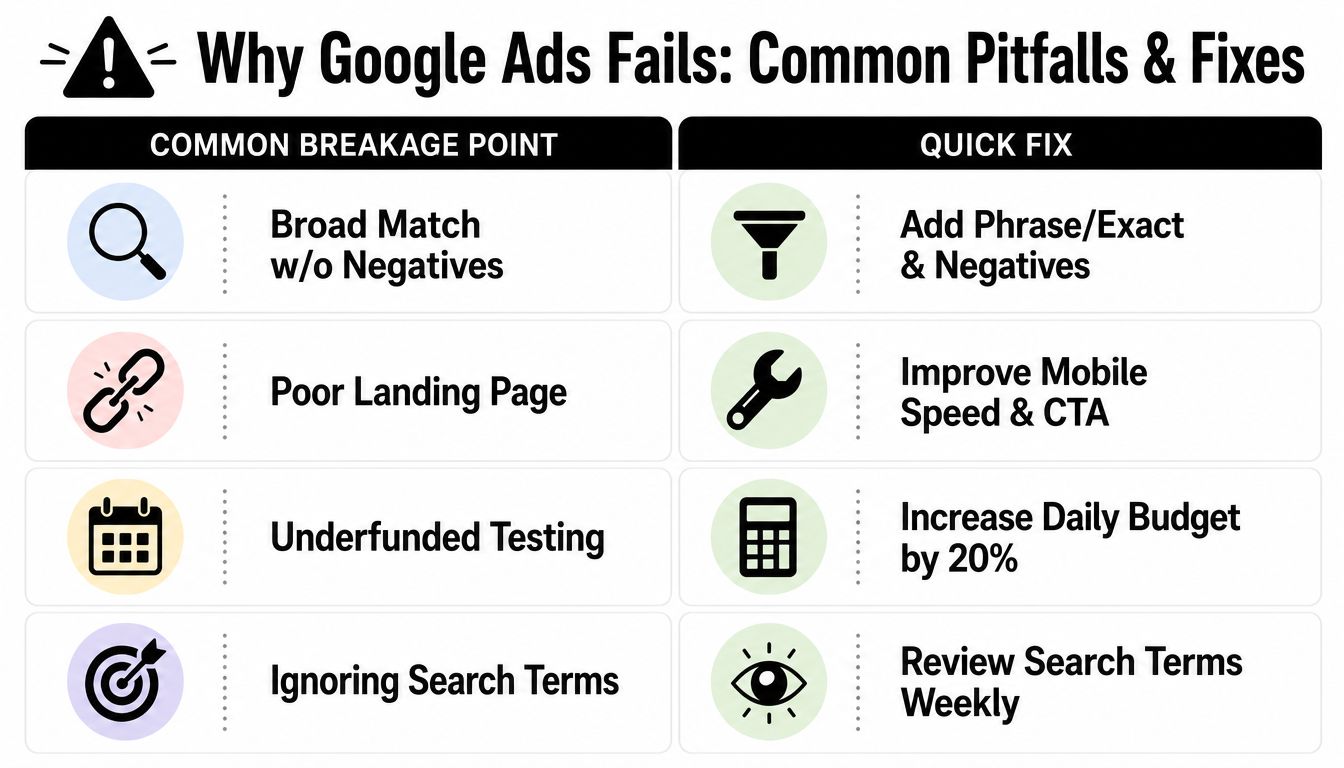
Mobile deserves special attention. A 2026 summary reported mobile receiving 52% to 62% of Google Ads click share, compared with 38% to 48% for desktop. The mobile click-share summary makes the operational point clear: a landing page that works only on a large monitor is not finished.
Brand-heavy structures can report strong ROAS while adding little net-new revenue. Compare brand and non-brand separately, then inspect whether conversions were already in motion before the ad click. If your account celebrates every branded click as acquisition, your dashboard is wearing makeup.
Bad tracking creates an even uglier illusion. A form submission isn't automatically a qualified lead, and a phone click isn't automatically a sale. Import CRM outcomes or revenue where possible, and audit your setup with a practical conversion tracking guide.
Audit order: Check conversion quality first, search terms second, mobile landing-page behavior third, and bids last. Raising bids before fixing those items is paying extra to repeat the same mistake.
Google Ads is worth testing when three conditions line up: buyers actively search for your offer, your CPA ceiling can tolerate the relevant CPC, and you can measure qualified outcomes. Start with high-intent Search, keep brand separate, and delay broader formats until the fundamentals earn that privilege.
Pause when the economics fail after a fair test, not merely because the first few days look uneven. If the offer has weak margins, the landing page can't convert, or the sales team rejects the leads, another bidding strategy won't perform CPR.
DIY makes sense when someone on your team can review search terms, maintain tracking, write relevant ads, analyze landing pages, and make decisions from margin-adjusted data. If nobody owns those tasks, the account will drift. Google won't send a sympathy card.
Management quality is the dividing line. Teams that need specialist support can use HireMediaBuyers.com to find pre-vetted media buyers and paid ads specialists, including professionals with Google Ads, Google Tag Manager, and Google Analytics experience. The platform offers full-time and part-time remote hiring, a shortlist within 24 to 48 hours, and a five-stage vetting process described by the company.
Don't hire to make a bad offer look better. Hire when the economics are promising and execution is the bottleneck. That's when skilled structure, tracking, bidding, and landing-page feedback can turn a plausible channel into a controlled growth system.
If you're ready to stop guessing at your CPA ceiling, visit HireMediaBuyers.com to review vetted Google Ads talent for full-time or part-time support. Bring them your margins, funnel data, and campaign mess, then ask for a shortlist built around the economics that decide whether Google Ads is worth your next dollar.


