


A U.S. in-house media buyer costs roughly $115,000 to $165,000 per year in fully loaded TCO, while a vetted remote media buyer typically lands at $1,500 to $4,000 per month all-in, creating a structural 70% to 85% reduction that compounds every quarter you stay lean. The cheaper option isn't automatically weaker. In paid media, it often means you've stopped paying for employment infrastructure that never improved a campaign.
Most operators still compare an $85,000 to $120,000 salary with a monthly contractor rate and call the difference “savings.” That's amateur math. Payroll taxes, benefits, recruitment, compliance, office space, software, management time, and replacement risk all sit behind the paycheck. The ad account doesn't care how impressive the org chart looks. It cares whether someone can control CPA, test creative, protect tracking, and make profitable decisions quickly.
I've hired media teams across time zones, watched expensive generalists burn through testing budgets, and inherited campaigns where nobody could explain the attribution model. Low operating cost isn't about squeezing skilled people until they leave. It's about building a paid-media operating model that puts more money into accountable execution and less into fixed overhead.
A U.S. in-house media buyer is not a salary line. The annual fully loaded TCO is roughly $115,000 to $165,000, even when the paycheck looks far smaller. That total covers the employment machinery required to keep the role staffed, compliant, equipped, and managed.
The visible costs are familiar: base salary, payroll taxes, health insurance, benefits, workers' compensation, and unemployment insurance. The quieter charges hurt more than many budgets admit. Recruitment fees, interview time, onboarding, benefits administration, HR compliance, manager oversight, and allocated office overhead consume cash before the buyer launches a campaign.
Marketing leaders often build the budget around salary because salary is easy to find. Finance pays the complete bill.
A new hire may require recruiting support, job-board spend, interview coordination, account provisioning, training, and campaign handoff time. If the hire fails, the company repeats much of that process while absorbing missed testing cycles and a disorganized account history. That is how a media role turns into an unpaid recruiting and technical-interview assignment for the marketing team.
Practical rule: Calculate media headcount using fully loaded TCO, then compare operating models. Never compare a salary with an invoice.
Paid media makes the mismatch especially expensive because labor overhead competes directly with demand-generation spend. Money tied up in employment infrastructure cannot fund creative production, landing-page testing, conversion research, or controlled channel expansion. Review the operating principles behind ad performance metrics, but do not mistake better measurement for a fix to an inefficient staffing model.
A remote media buyer priced at $1,500 to $4,000 per month all-in can reportedly create a 70% to 85% reduction in labor cost compared with the loaded U.S. model. The range reflects a different operating structure, not a temporary discount or spreadsheet trick.
The savings come from lower labor-market costs and removing domestic employment infrastructure from the staffing equation. That still leaves performance standards in place. The buyer must control campaigns, maintain account discipline, and report clearly. The company stops paying for unused office capacity, benefits administration, payroll complexity, and the replacement risk attached to a traditional hire.
Judge the role by campaign output and operating discipline, then price every cost required to support it.
Low operating cost means more productive media execution per dollar of team TCO. The benchmark is accountable campaign output, not the lowest hourly rate. A buyer who can press “publish” but cannot control tracking, testing, pacing, or reporting creates a cheap role with an expensive failure rate.
A capable paid-media team needs channel fluency, clean measurement, sound testing logic, reliable reporting, and a clear explanation when performance changes. The operating model should protect those standards while removing overhead that does not improve decisions.
Start with the cost drivers that salary comparisons leave out:
That list is the comparison between an in-house US media buyer and a vetted remote one. The remote option does not erase collaboration software, reporting, secure access, documentation, or management. It can remove the domestic employment infrastructure and office burden that inflate fixed TCO.
The right model starts with diligence. Verify platform knowledge, inspect how the candidate reasons through a campaign, check references, define ad-account ownership, and establish reporting before spend begins. Put one person on your side in charge of approvals and performance review.
A fractional work model for paid media fits uneven demand when the scope is defined and internal ownership is clear. It gives the business access to specialized execution without forcing a full-time structure onto a variable workload.
The strongest lean teams treat the media buyer as a performance multiplier, not a headcount trophy. They fund talent, measurement, and review while cutting costs that do not improve campaign decisions. That is disciplined TCO management, not underpaying a specialist or pretending compliance and replacement risk are free.
A low-cost media team starts with a complete cost ledger. Compare the same drivers across an in-house U.S. buyer, a U.S.-led hybrid, and a remote team through HireMediaBuyers.com. The figures below are illustrative planning estimates, not quotes. Replace them with your offers, benefit rates, office allocations, software costs, and compliance invoices.
| Cost Driver | In-House U.S. example ($/yr) | Hybrid U.S.-Led example ($/yr) | Remote via HireMediaBuyers example ($/yr) |
|---|---|---|---|
| Base salary or service fee | $120,000 salary | $90,000 U.S. lead plus $36,000 remote support | $48,000 contracted team fee |
| Payroll taxes | $10,000 employer cost | $7,500 for U.S. lead | Included or separately confirmed |
| Benefits | $25,000 health, retirement, and leave | $18,000 for U.S. lead | Included terms confirmed in contract |
| Recruitment | $18,000 search and onboarding | $14,000 U.S. search plus remote sourcing | $3,000 sourcing or setup fee |
| Office overhead | $12,000 workspace and equipment | $8,000 U.S. workspace plus distributed setup | $4,000 equipment and collaboration allocation |
| Tooling | $18,000 platforms, reporting, and workflow tools | $21,000 shared stack and coordination tools | $18,000 shared stack and access governance |
| Compliance admin | $15,000 HR, filings, and policy administration | $11,000 employment compliance and vendor oversight | $6,000 provider and internal review |
| Management load | $30,000 supervision and coverage planning | $24,000 lead coordination and execution management | $12,000 account ownership and reporting |
| Replacement exposure | $20,000 search and transition reserve | $14,000 shared replacement reserve | $6,000 replacement and continuity reserve |
| Illustrative annual TCO | $268,000 | $237,500 | $97,000 |
The hybrid model works when a U.S. strategist owns positioning, yet the domestic leadership premium can erase much of the expected saving. Choose it when strategy requires daily internal proximity, not because the label sounds efficient.
A remote-first arrangement can reduce the fixed cost of U.S.-based employment infrastructure. The contract still needs clear HR, payroll, classification, access, ownership, reporting, and replacement terms. Review agency versus in-house economics through TCO, not a salary headline.
The quality controls remain straightforward. Use a structured vetting process, paid assessment, reference checks, and a defined probation period. Assign one internal owner for approvals, account access, and performance review. A remote team without those controls creates management work instead of removing it.
Use the table in your finance review. Ask who handles payroll, worker classification, tax administration, secure access, continuity, and replacement. If the provider cannot answer plainly, the quoted fee excludes costs your internal team will absorb. That is not low operating cost. It is an incomplete invoice.
A lower media-team bill becomes valuable only when it improves margin, extends testing runway, or adds acquisition capacity without increasing fixed employment exposure. It will not repair weak creative, broken tracking, or an unwanted product. The numbers below show how to calculate the operating case before a switch, using concrete assumptions rather than a salary headline.
These are illustrative operating cases, not reported customer results. Validate each assumption against your payroll burden, provider fee, media budget, CPA, contribution margin, and switching costs. The useful output is the annual difference after every employment and administration line is included.
| Scenario | Setup | Monthly TCO Before | Monthly TCO After | Payback Period | 12-Month Savings |
|---|---|---|---|---|---|
| B2B SaaS | $12,000 monthly Google Ads budget, one senior U.S. buyer replaced by a vetted remote team | $12,000 | $3,600 | Switching costs recovered in under 60 days | $100,800 |
| DTC brand | Meta and TikTok expansion, two remote buyers replacing the capacity of one U.S. hire | $18,000 | $7,000 | About 55 days against $20,000 switching costs | $132,000 |
| 25-person agency | Q4 surge capacity without converting contractors to W-2 employees | $24,000 seasonal internal and contractor cost | $10,000 temporary remote capacity fee | About 43 days against $20,000 avoided cost | $14,000 seasonal avoided cost |
A B2B SaaS team spending $12,000 per month on Google Ads replaces one in-house senior buyer with a vetted remote team. Assume loaded in-house TCO of $12,000 per month and a remote team fee of $3,600 per month. The annual operating difference is $8,400 each month, or $100,800 across twelve months. If onboarding, access migration, and account review cost $10,000, the switch pays back in roughly five weeks, inside the target of under 60 days.
The performance target is a 28% reduction in blended cost per qualified lead. Track that result separately from the staffing ledger. The media scorecard should cover blended CPL, qualified-lead rate, sales acceptance, and pipeline contribution. A cheaper buyer who sends sales unusable leads has reduced a line item, not improved the business.
At six months, review cumulative TCO savings alongside lead quality and pipeline contribution. At twelve months, decide whether the lower cost survived onboarding and continued to produce qualified demand. If performance holds, the saved cash can fund testing or protect margin. If it does not, the model needs correction before expansion.
A DTC brand scaling Meta and TikTok adds two remote buyers for the price of one U.S. hire. Use a loaded U.S. cost of $18,000 per month and a two-buyer remote fee of $7,000 per month. That produces $11,000 in monthly savings, or $132,000 over twelve months, before switching costs. With $20,000 in setup and transition expense, payback arrives in about 55 days.
The operating ambition is to lift monthly ad spend from $80,000 to $210,000 while holding CPA flat, then direct the recovered margin into paid-social testing. Divide ownership clearly. One buyer can own Meta structure and creative testing; the other can manage TikTok, audience analysis, and reporting. Shared responsibility for every task creates gaps, duplicated work, and arguments over attribution.
Track spend, CPA, contribution margin, creative refresh rate, and test velocity by channel. The six-month review should show whether extra capacity produced more useful learning. The twelve-month review should show whether that learning created durable efficiency rather than a temporary improvement.
A 25-person agency can spend $10,000 on temporary remote capacity instead of carrying $24,000 in seasonal internal and contractor cost during Q4. The immediate avoided cost is $14,000. If the temporary arrangement requires $20,000 in transition and coordination expense, the agency needs preserved billable work and recovered revenue to complete the payback case.
Measure billable utilization, delivery deadlines, client retention signals, and gross margin by account. The model earns its place when the agency accepts profitable seasonal work, protects delivery quality, and ends the capacity commitment without creating permanent paid-media payroll.
HireMediaBuyers.com reportedly delivers 80 to 90 percent savings through a combination of labor-market arbitrage, bundled administration, faster matching, and reduced fixed overhead. That claim only holds when the comparison includes the full cost of an in-house U.S. media buyer, including HR, payroll, compliance, and office overhead.
A disciplined vetting funnel reduces the cost of a poor hire before that buyer receives access to a client account:
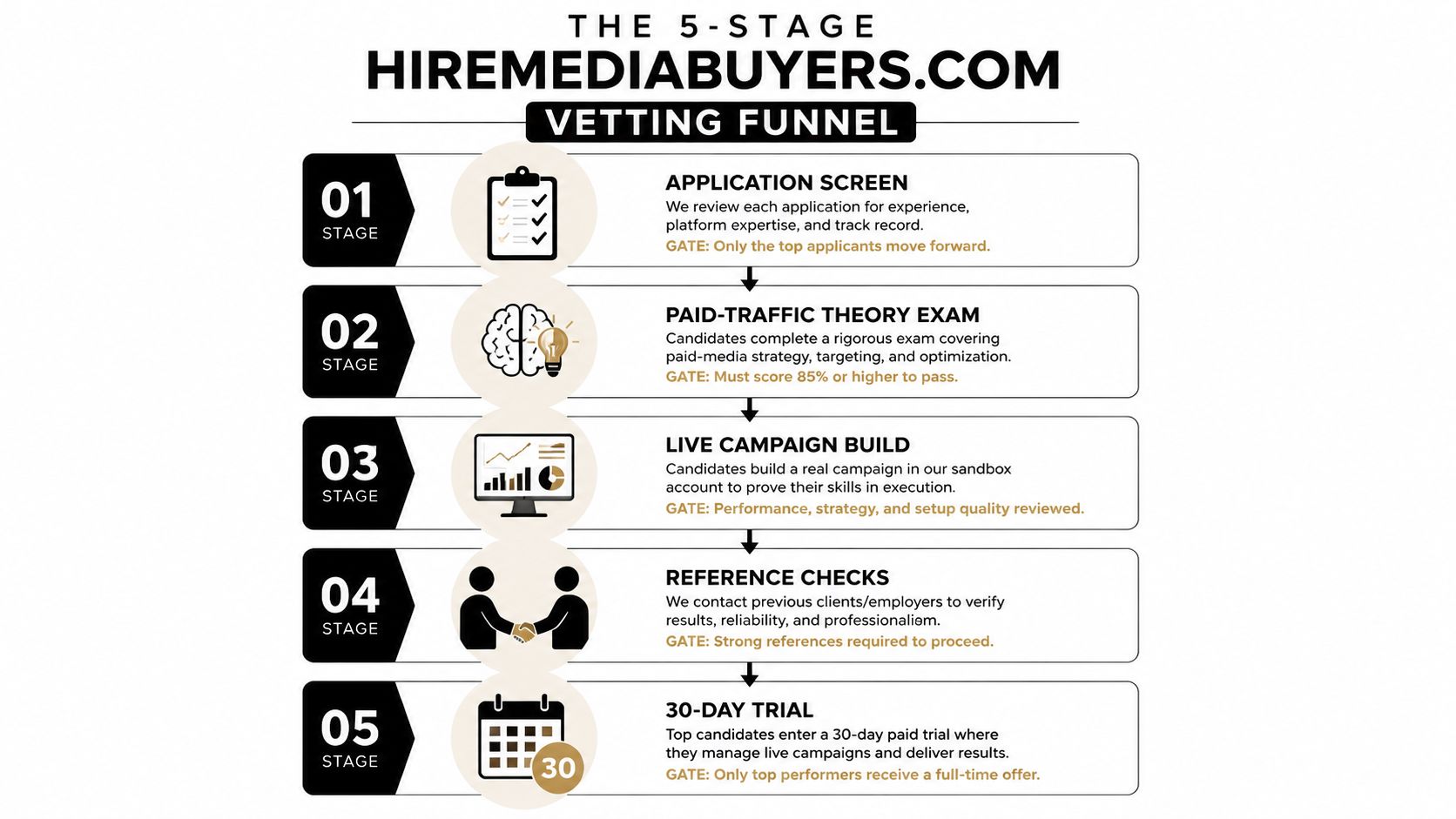
The platform says it can provide a shortlist in 24 to 48 hours, compared with a typical recruiter-led search that can take six weeks. Faster matching limits the period when campaigns remain under-optimized, reporting falls behind, or internal leaders absorb work they never planned to handle.
Bundled HR, payroll, tax, and worker-classification support removes administrative work that a U.S. employer would otherwise manage directly. According to the supplied benchmark, that package can remove roughly 12% to 18% of hidden loaded cost. Verify the exact inclusions before signing.
You can interview finalists, while retaining ownership of the ad accounts, analytics properties, creative libraries, and business data. Set access controls, provide a clear brief, maintain creative supply, and keep conversion tracking accurate. A decision-maker must also answer questions quickly.
The structural savings come from removing unnecessary employment overhead while maintaining performance standards. A sound engagement should let you scale to a full team or reduce to one buyer in a week, subject to the contract terms.
The risk isn't paying a lower rate to a disciplined operator. The risk is paying senior prices for work nobody can measure.
I've seen three-person in-house teams spend more time in status meetings than in accounts. A single accountable remote buyer with a clean brief, direct access, and authority to act can outperform that arrangement because responsibility stays visible. Low operating cost becomes dangerous only when leaders confuse low supervision with low standards.
Keep the cadence simple enough that people follow it:
A lean team needs a short KPI set. Use a blended CPA target tied to contribution economics, test velocity per channel, creative refresh rate, spend pacing, and qualified conversion quality. The exact targets belong to your business, because a DTC purchase, a SaaS qualified lead, and an agency client delivery milestone aren't interchangeable.
The cheapest media team is expensive if nobody knows whether it works.
Document standard operating procedures for campaign naming, budget changes, creative testing, reporting, and incident response. Use shared dashboards in Looker Studio, Triple Whale, Northbeam, or your existing analytics stack, but don't buy software to compensate for unclear ownership.
Lean doesn't mean silent. The buyer should report what changed, why it changed, what happened next, and what decision is required. That's enough structure to protect output without surrounding one operator with a committee.
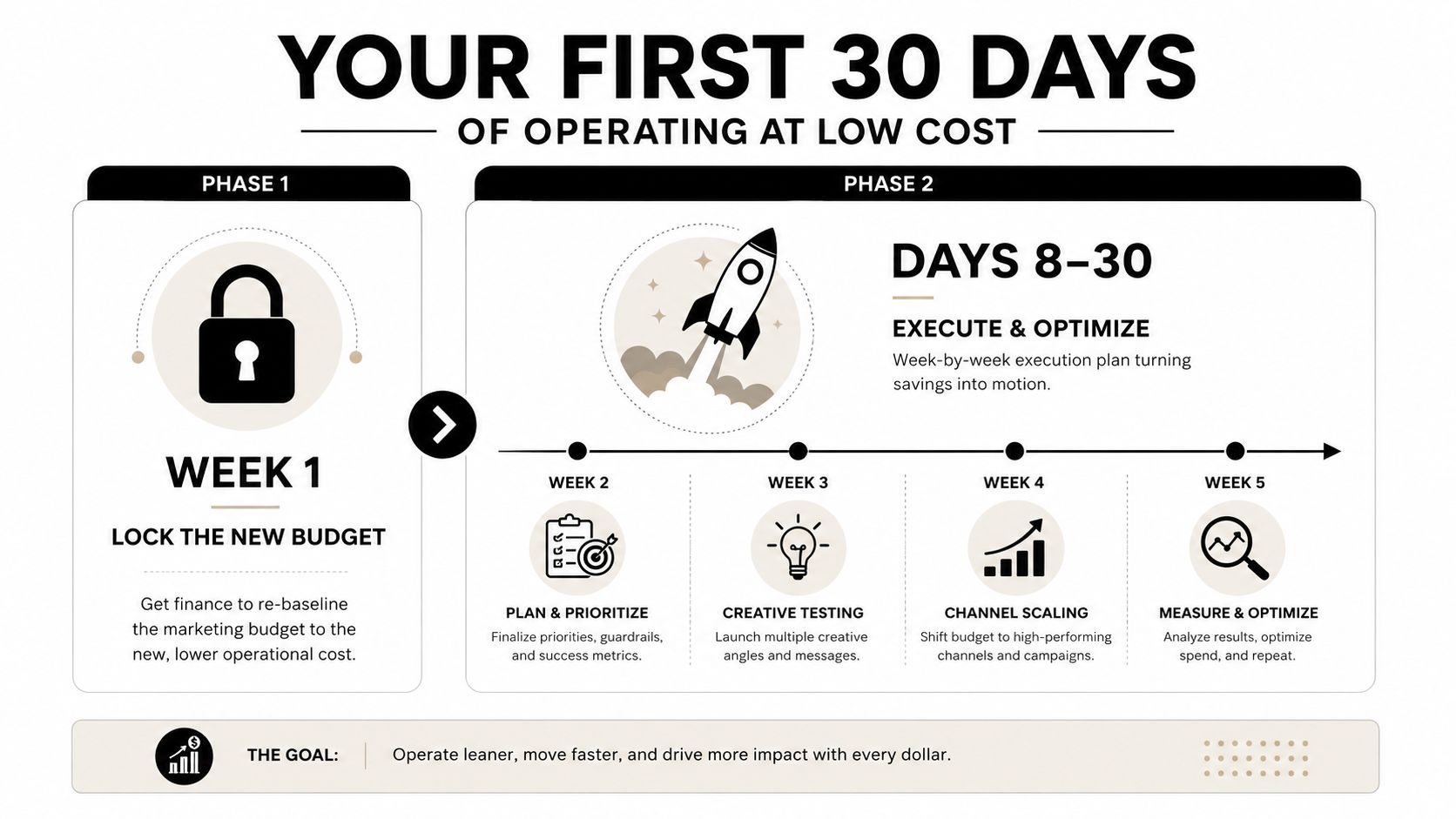
The first month should feel boring. Boring is good. A sequenced staffing change beats a founder panic-hiring from LinkedIn at midnight.
Set the new budget envelope with finance. Re-baseline the P&L line so the savings don't vanish into general spending. Then write a one-page brief covering channels, spend tier, offer, conversion event, reporting owner, access requirements, and KPIs.
Keep the brief practical. A buyer can't optimize “growth” as a slogan. They can optimize a defined account with an agreed conversion event, a known approval path, and a realistic creative pipeline.
Shortlist and interview through the chosen hiring channel. Ask candidates to diagnose a real or sanitized account, explain a failed test, identify a tracking risk, and describe what they'd do during a sudden CPA spike.
Red flags include guaranteed outcomes, vague platform experience, refusal to show decision logic, no referenceable work, and a plan that starts with changing everything. The strongest candidate usually asks uncomfortable questions about margins, attribution, creative volume, sales quality, and landing-page friction.
Handle contracting, payroll, compliance, and tooling before the first working day. Prepare:
Launch the first campaign or optimization sprint, then allow a 14-day optimization window before judging every fluctuation. Report on spend pacing, conversion quality, test results, tracking issues, and the next decision. Don't demand a miracle report on day two and then complain when the buyer stops taking intelligent risks.
The mistake I see most often is founders DIYing the vetting process on LinkedIn, skipping reference checks, and inheriting six months of cleanup. Low operating cost isn't a fire drill. It's a deliberate model with verified talent, controlled access, explicit metrics, and a finance line that reflects the true TCO.
HireMediaBuyers.com offers access to pre-vetted media buyers and paid ads specialists through flexible remote engagements, with support for hiring, HR, payroll, compliance, and replacements. If your paid-media team is carrying domestic overhead that doesn't improve campaign output, visit HireMediaBuyers.com and compare a structured remote model against your actual fully loaded TCO.


