

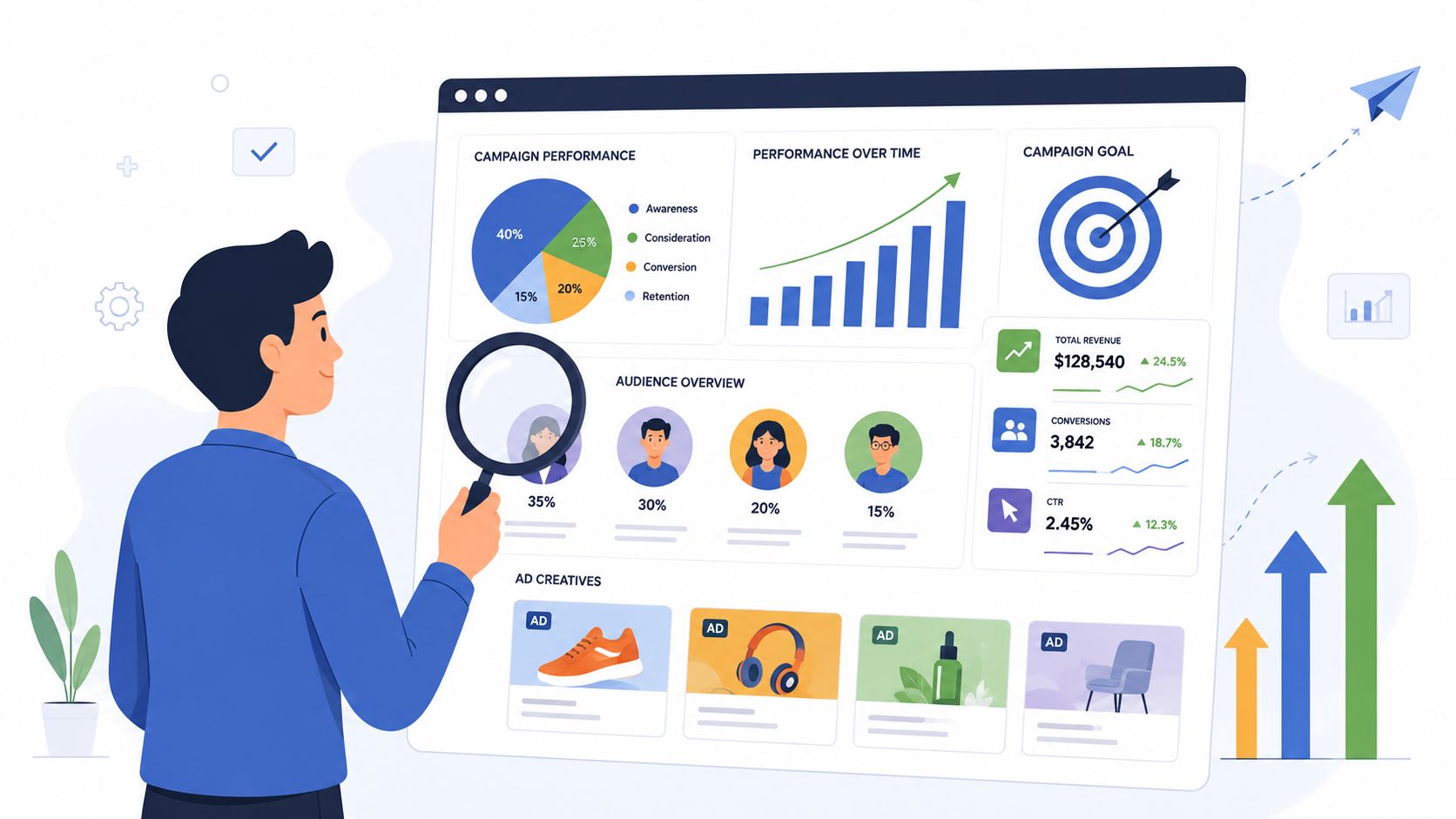
You're probably staring at a pile of personas, a few half-believed survey screenshots, and a media plan that still feels like it was built by committee. The agency wants a cleaner brief, the founder wants lower CPA, and everyone wants the ads to “just work.” Cute. That's not a strategy, that's a budget with anxiety.
Market Research for Advertising only matters when it changes what you buy next, what you say first, and what you stop wasting time on. If the research can't hand off cleanly into a creative brief and a media plan, it's theater with nicer slides. The good news is the playbook is simple, even if the execution isn't. Start with the business question, define the audience, pick the right mix of methods, tear into competitors and creative, sequence the tests, then hand the whole thing to a buyer who can run with it.
The most common failure mode is painfully familiar. Someone commissions a glossy deck, the agency presents a stack of personas with stock-photo confidence, and nobody in paid media changes a thing. That's because the research was treated like a deliverable, not fuel for spend.
Good research answers a spending decision. It tells you who to target, what to say, which channel deserves the first dollar, and what evidence would make you stop. If the output can't influence a bid strategy, a creative angle, or a landing page claim, it's decorative.
There's also a bigger reason this matters now. Global marketing research was valued at $67.5 billion in 2023 and is projected to grow at a 7.4% CAGR from 2024 to 2032 (worldwide marketing research market data). That's not a niche support function, it's infrastructure. And in a market where ad spend is approaching $1 trillion by 2026, with digital taking about 50% of ad spending and search making up nearly 40% of digital budgets (advertising spend and format mix), lazy research gets expensive fast.
Practical rule: if the finding wouldn't change the next media buy, you don't need to research it.
The rest of this playbook is about making research behave like a production asset, not a branding souvenir. We'll start with goals and KPIs, then audience definition, then method mix, competitive and creative work, channel testing, the brief handoff, and finally who should execute it without turning your calendar into a crime scene. If you want the incrementality angle, keep incrementality testing in view as a check against vanity readings.
Start with the business question, not the survey tool. If you skip that step, you'll collect a pile of opinions and still not know whether to spend on awareness, consideration, or conversion. That's how teams end up mortgaging their office ping-pong table for “insights” nobody can act on.
A usable research objective sounds like this, “Find which message and audience combination should get the next test budget for a paid social launch.” A useless one sounds like, “Understand customer perceptions.” One points to a media decision. The other points to a meeting.
That objective should map to the stage of the funnel. Awareness work usually cares about recall and message clarity. Consideration work cares about interest, intent, and objection handling. Conversion work cares about CTR, CPA, and ROAS, because at that point the question is not whether people liked the ad, it's whether they bought after seeing it. If you want a crisp check on metric selection, ad performance metrics is the right rabbit hole.
A good guardrail is brutally simple. If the answer won't change your media plan, your creative brief, or your landing page, it doesn't deserve budget. That filter saves you from research cosplay.
The research method should follow the KPI, not the other way around. Pre-launch concept testing can support awareness and consideration questions because you're trying to see what gets remembered, understood, or preferred before money goes out the door. Post-launch measurement belongs on conversion questions because the test is whether the market moved.
Simple filter: one research project, one primary decision, two KPIs max.
Keep the KPI list tight enough to be useful. For awareness, that might be recall plus one diagnostic metric like clarity. For conversion, it might be CPA plus ROAS. Anything beyond that starts to look like dashboard confetti.
And yes, the research objective should fit on one sentence. If it needs a paragraph, you don't have a sharp question yet. You have a fog bank.
Most advertisers say they know their audience, then proceed to target “small business owners” like that means anything. It doesn't. A useful segment is something you can buy against, write to, and test. A vague audience is just a prayer with a budget.
Demographic segmentation gives you the first cut, age, location, role, maybe household or company profile. It's blunt, but it's a decent starting net. The mistake is stopping there and pretending the net is the strategy.
Psychographic segmentation adds values, motivations, and lifestyle cues. Behavioral segmentation tells you what people do, purchase patterns, engagement habits, site visits, or repeat actions. The strongest advertisers layer them in that order, because the demographic pass finds the field, the psychographic pass finds the angle, and the behavioral pass finds the money.
That layered method also helps uncover underserved audience segments, which too many briefs treat like a footnote. Behavioral signals often expose them first. A cluster that keeps engaging but never converts, or converts through an odd path, is usually trying to tell you something the broad segment missed.
One practical workflow is dead simple. Cast a wide demographic survey, look for favorability clusters, then overlay psychographic questions on the groups that stand out. After that, validate with behavioral patterns from site data, lead history, customer service notes, or purchase frequency. Pollfish's segmentation guidance points in this direction by recommending wide demographic surveys first, then psychographic layering to find who's most likely to buy, which is the right sequence for ad work (Pollfish advertising research guide).
A media buyer doesn't need poetry. They need a segment they can translate into targeting, exclusions, creative angles, and test order. That means your worksheet should include the segment name, the core motivation, the likely objection, the channel fit, and the proof point that matters.
The best audience research also notices who's being ignored. If a segment keeps showing a different behavior pattern, don't file it under “miscellaneous.” Build a separate test around it. That's how you find whitespace instead of shouting at the same people everyone else is chasing.
Don't confuse “reachable” with “worth buying.” The market is full of reachable people who have zero reason to care.
For a tactical framing of this work, the audience segmentation page is useful if you're trying to turn raw audience insight into a hiring or execution plan.
Primary and secondary research aren't rivals, they're instruments. Surveys and interviews tell you what people think. Social listening, competitor pages, and platform-native analytics tell you what they're already responding to. If you only use one, you'll end up defending a creative decision with a blindfold and a spreadsheet.
Quantitative work earns its keep when you need pattern recognition. Surveys can show which messages rise to the top across a broader sample. Tests can rank concepts, headlines, or offers. That's the right move when you need confidence before spending real money.
Qualitative work earns its keep when the “why” matters. Focus groups and interviews reveal the language people use, the objections they hesitate to write down, and the friction you'd never guess from a clean chart. Social listening can do a similar job at scale, especially when you're scanning for recurring complaints or shorthand around a category.
Amazon's guidance on marketing research keeps it grounded, define the goal first, then use surveys, feedback, and observations to understand the audience and market (Amazon marketing research guide). That's the right attitude. Start with the question, then choose the instrument. Not the other way around.
Competitor ad-library teardowns are useful when they show you hooks, proof points, and offer patterns. They're useless when the output is five logos and a mood board. If the teardown doesn't surface a new hypothesis, it's just a conference room exercise in pretending to be busy.
A tight method mix usually looks like this.
The rule is straightforward. If you can't act differently because of the data, don't collect it. That one line saves a shocking amount of nonsense.
A good workflow also avoids biased-source worship. One survey response, one founder opinion, or one platform dashboard should never get to veto the rest of the evidence. Blend the sources, then decide.
Most competitor research is a waste of time because it stops at obvious surface area. Someone screenshots the top five ads in a category, adds a line about “clean design,” and calls it strategy. That's not strategy. That's a scrapbook.
Real competitive research starts by asking what the category keeps saying and what it keeps missing. Scan ad libraries, landing pages, reviews, and comment sections for repeated claims, repeated proof, and repeated frustration. The pattern matters more than any single ad.
You're looking for three things. First, the hook, the thing that gets attention. Second, the proof, the thing that makes the claim believable. Third, the gap, the thing nobody is saying well. That gap is where new creative usually wins.
A lot of teams miss underserved angles because they're too busy copying the loudest competitor. That's how you end up with ten ads saying the same thing in slightly different fonts. Charming. Also expensive.
Creative research should split into pre-launch screening and post-launch readouts. Pre-launch work is where you test concept fit, message hierarchy, and objection handling. Post-launch work is where you watch actual behavior and separate the ad that looked smart from the ad that made money.
| Stage | Goal | Common Methods | Output |
|---|---|---|---|
| Pre-Launch | Pick the strongest message and concept before spend | Surveys, interviews, concept testing, ad-library review | Creative brief inputs and test hypotheses |
| Post-Launch | See what the market actually did with the ad | Platform analytics, landing page analysis, cohort review | Optimization notes and next-round changes |
The hypotheses worth testing are rarely exotic. Try “problem-first vs outcome-first,” “proof-led vs emotion-led,” “expert voice vs customer voice,” or “broad promise vs specific use case.” Then log them in one place so the media buyer can sequence tests across platforms instead of launching a headline war on day one.
Creative rule: test one new idea at a time, or you'll never know which variable carried the lift.
A clean log should show the hypothesis, the segment, the channel, the creative angle, and the decision rule. That keeps the work from turning into a pile of screenshots with amnesia.
Research does not matter until it changes where you spend first. The job is not to collect every possible insight. The job is to pick a channel, assign a sane learning budget, and sequence creative so the test produces a clear answer instead of a muddy shrug.
A useful research readout should tell you where to start, what to test first, and what to ignore until later. If it cannot do that, it is just a stack of observations.
Your audience research should already point to channel fit. If the segment shows clear search intent, do not start with a video-heavy brand push and act surprised when the numbers look sleepy. If the objection is comparison-heavy, search or review-driven placements will usually tell you more than broad social prospecting.
For smaller teams, a sane 30/60/90 rhythm works better than a chaotic everything-at-once launch.
Set guardrails before spend starts. Define kill criteria. Set up a holdout if you need a clean read. Keep the creative waves small enough that you can tell which message did the work. You do not need ten headlines fighting each other on day one. That is how you buy confusion at scale.
A research insight should land in a brief like this.
The media buyer then maps that to budget pacing, placements, and sequencing. If the research says the message needs comparison proof, the buyer should not throw the first budget at a cold awareness placement and hope for enlightenment. If the segment responds to urgency, the buying plan should reflect that.
Use a vetted buyer who can read research and turn it into media decisions without a week of hand-holding. A platform like HireMediaBuyers.com fits that workflow because it connects you to pre-vetted media buyers and paid ads specialists who can take the segment, the creative hypothesis, and the test order and run the campaign. Fancy decks do not launch ads. People do.
The whole thing either becomes useful or dies in a folder. A one-page research summary should feed two documents, the creative brief and the media plan. If it doesn't, the research was a very expensive form of journaling.
A strong creative brief includes the audience, the single-minded message, the proof points, the objections, and the tone. It does not need an essay. It needs a decision. The writer, designer, and buyer should all be able to look at it and know what to build, what to test, and what to ignore.
Your media plan should mirror that same logic. It needs the channels, the formats, the audience segments, the test budget, and the success criteria. If those inputs aren't explicit, the campaign will drift and somebody will blame “the algorithm,” which is the marketer's favorite way to avoid a postmortem.
The ad ecosystem is leaning harder into platform-controlled and modeled measurement. Google is moving away from Universal Analytics in favor of GA4, and Meta has kept pushing modeled conversions and aggregated event measurement. That means research has to do more pre-launch work, because you won't always get deterministic, user-level truth after the fact. Marketers are also leaning more on first-party data and MMM-style thinking, especially when the tracking picture is messy (measurement and privacy shift overview).
MRI-Simmons is unusually clear on one thing advertisers keep getting sloppy about, data sourcing. If you use market research data in a claim, you need to name the specific data product, include the date and time period, add “Courtesy of MRI-Simmons,” and give enough detail to validate the point, such as the base population or target segment (MRI-Simmons data sourcing guidelines). That's a good standard for internal discipline too. Know what you can prove before launch, and know what you'll only be able to interpret after spend.
The handoff should be fast. Research findings go to creative, creative turns into a brief, the brief goes to a vetted buyer, and the campaign gets out the door. If that chain takes weeks of translation, you've already lost the advantage.
HireMediaBuyers.com helps US companies find pre-vetted media buyers and paid ads specialists who can turn audience research into a real media plan without the usual hiring drama. If you've got research but need someone to run the test sequence, visit HireMediaBuyers.com and use the insight before it goes stale.


