

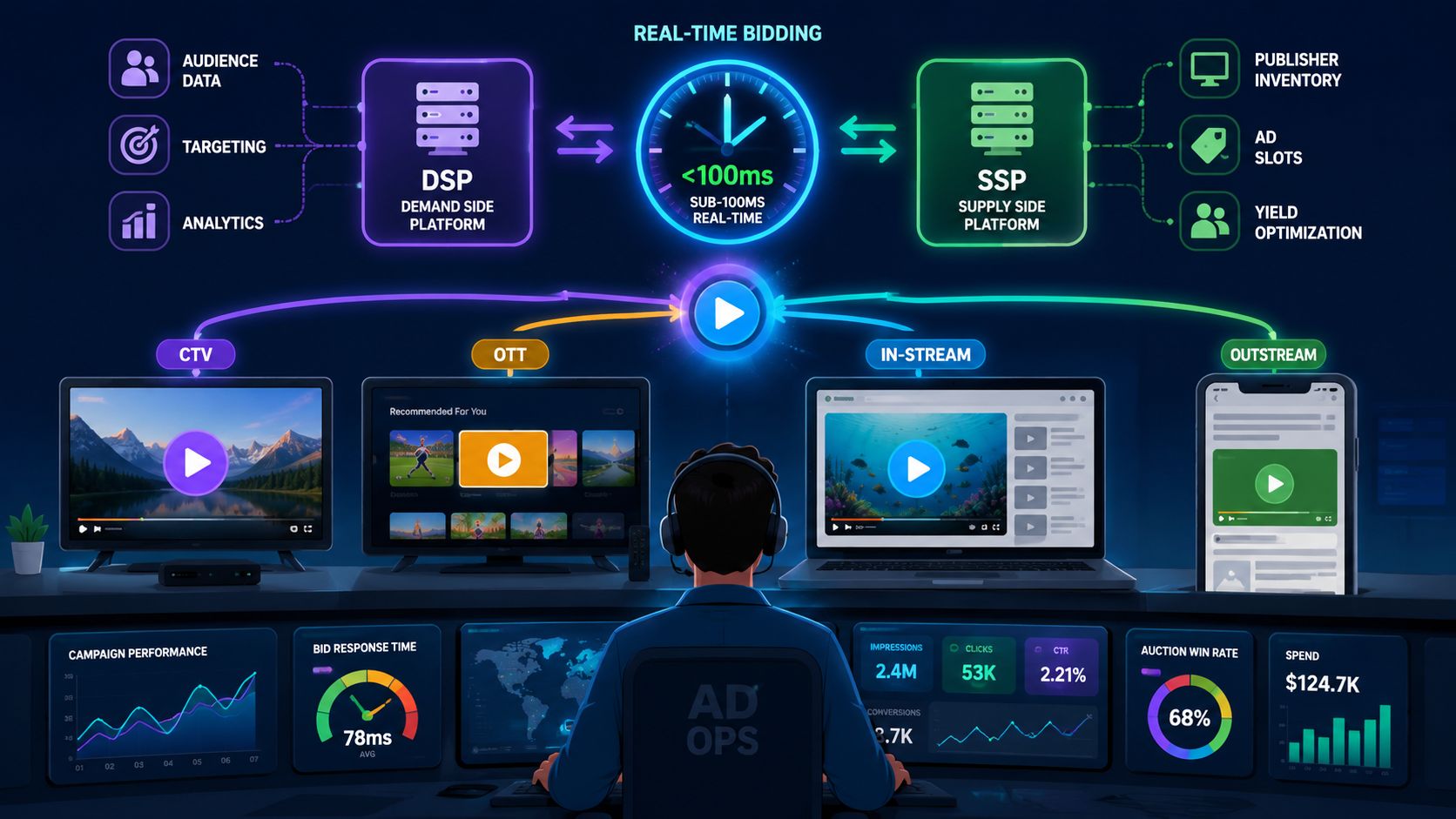
Everyone loves to sell programmatic video advertising as the tidy answer to modern media buying. Set the audience, let the machine do the work, enjoy the scale, collect your victory lap. In reality, a decent chunk of spend can vanish into invalid traffic, misrepresentation, and low-value placements, which is why the smartest buyers don't start with optimism, they start with a clipboard and a suspicious face.
That's the part most guides skip. They talk about automation like it's magic, then shrug when the inventory turns out to be less “premium streaming” and more “please enjoy this auto-play thing nobody watched.” If you've ever paid for impressions that looked beautiful in a dashboard and did absolutely nothing in the world, you're in the right neighborhood.
The biggest lie in this channel is that efficiency comes free. It doesn't. The moment you buy video through automated pipes, you inherit the supply chain, the reporting quirks, and the unpleasant habit of paying for placements that look active in a dashboard and do little in the world.
A lot of the waste shows up in supply quality, not just weak creative or sloppy targeting. Analysts and industry reporting have pointed to a meaningful share of programmatic video spend being lost to invalid traffic, misrepresentation, and low-quality placements. That is money spent on inventory that looks legitimate on paper but does not deliver the attention, context, or brand-safe environment buyers think they bought.
CTV and streaming buys can be especially slippery because the inventory often looks premium on the surface while giving you very little clarity underneath. Buyers need to know whether a player is buyable, whether the ad auto-plays or mutes, and whether the placement lives inside meaningful content or some low-value outstream wrapper with better branding than behavior. AdExchanger on CTV transparency issues
Practical rule: if the seller can't explain where the ad ran, what it played beside, and how it was verified, assume the spreadsheet is prettier than the reality.
The other mistake is treating programmatic CTV as the whole TV strategy. It isn't. Programmatic is one piece of a broader TV plan, and smart teams still weigh direct streaming buys and linear alongside it, especially when the audience is fragmented and the buying paths aren't equally transparent. AdExchanger on why programmatic CTV isn't enough If the pitch sounds like “just move everything here,” your alarm bells should be doing calisthenics.
A lot of buyers look at a CPM and stop there. That's rookie behavior, and I say that with love. The quoted rate often ignores fees, verification, and other bits that show up later like uninvited relatives.
The ACA/ANA study found an average CPM of $12.64 for programmatic video ads, built from $9.34 in working or inventory cost plus $3.30 in demand-side fees, and those fees added 35% to advertiser cost (ACA/ANA Programmatic Study). That's why the cheapest-looking buy can become the most expensive mistake.
The fix isn't glamorous. Audit supply paths, ask for all-in pricing, and treat every “premium” claim like it needs a passport. If the answer is fuzzy, your budget probably is too.
Programmatic video advertising is just the automated buying and selling of video ad inventory through auctions powered by DSPs, SSPs, and ad exchanges (Amazon's programmatic video guide). That's the clean definition. The messy part is everything that happens between the moment a user opens a page and the moment your ad either wins or disappears into the void.
A useful way to think about it, the DSP is your shopper, the SSP is the publisher's checkout counter, and the ad exchange is the marketplace in the middle. The DSP decides what to bid, the SSP makes inventory available, and the exchange runs the auction. No one is manually haggling over video slots like it's a flea market in 2009.
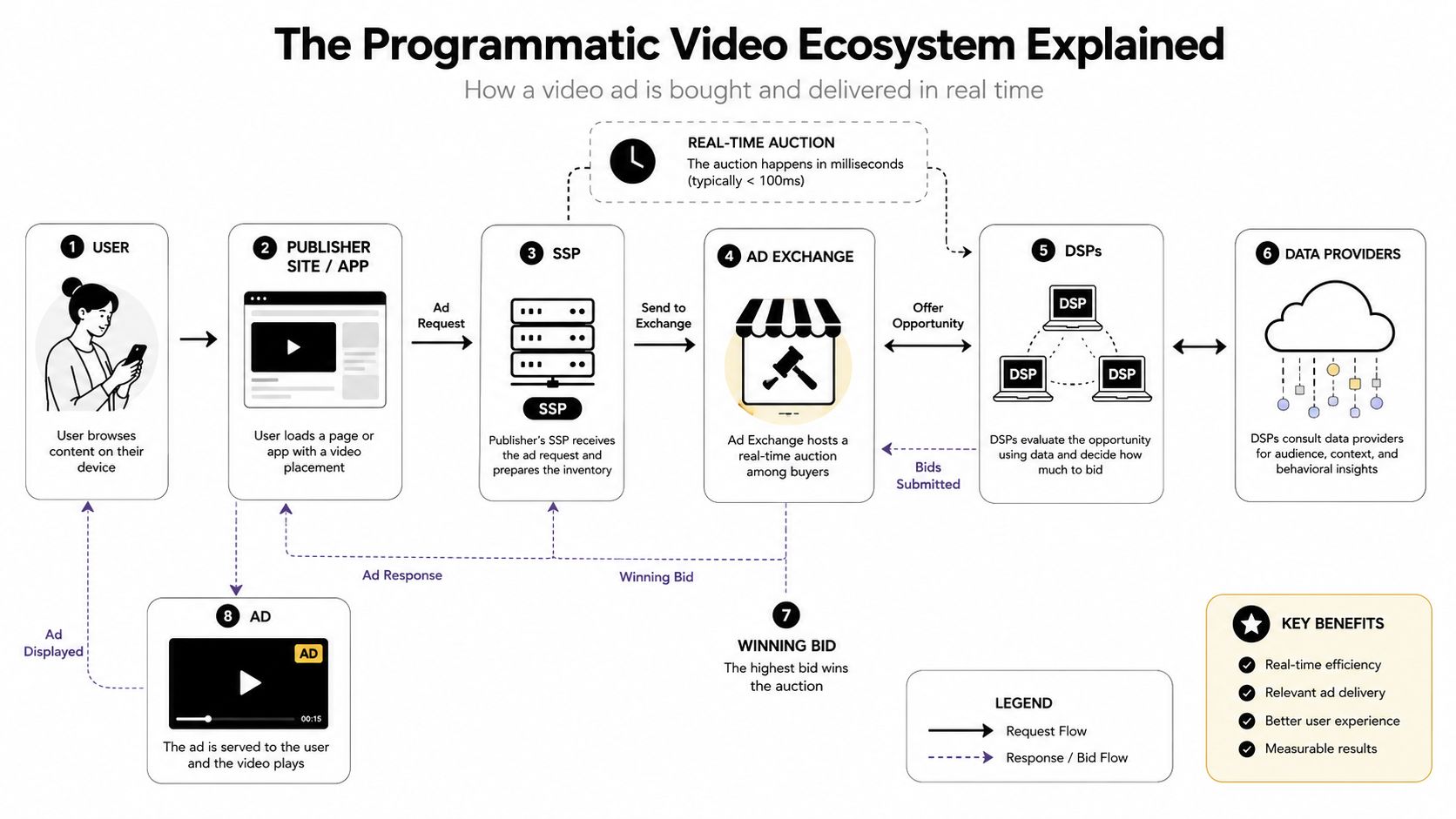
The auction completes in under 100 milliseconds, which is faster than a webpage load (Aidigital). That's why all the work has to happen before the impression request arrives. Bid logic, audience matching, and creative choices can't be improvised after the fact. They have to be ready to go, because the machine is not waiting around for your brainstorm.
This speed is also why setup quality matters so much. If your audience definitions are sloppy or your creative rules are vague, the auction still runs, just with your money attached to a weak decision.
Open auctions are the broadest pool, which sounds nice until you realize broad can also mean messy. Private marketplaces, or PMPs, give buyers more control over access and quality, while guaranteed deals still matter when reach and reserved access are the priority. The right mix depends on whether you care more about scale, control, or predictable delivery.
The point isn't to worship one buying type. It's to know what problem each one solves. Open exchange can be efficient, PMP can be cleaner, and guaranteed can be the right answer when certainty beats scavenger hunting.
The fee stack matters because you're not just paying for impressions. You're paying for access, decisioning, measurement, and sometimes a lot of middlemen with nice dashboards. That's why the loaded cost can drift far above the rate card, especially when verification and data layers are added.
If the platform won't show the all-in number, it's not being helpful. It's being strategic at your expense.
The practical takeaway is simple. Learn the machinery, then ask every vendor to describe it without buzzwords. If they can't explain where your bid travels, they probably don't want you looking too closely.
Not every video impression has the same job. Buying them like they do is how budgets go to die politely. CTV, OTT, in-stream, and outstream each serve different purposes, and the wrong match can make a campaign look active while doing very little useful work.
The IAB's 2024 video ad spend report says digital video accounts for 64.7% of total TV and video ad spend, with CTV alone at 28.6% (IAB Video Ad Spend Report). That explains why everyone's suddenly an expert in streaming inventory. It doesn't mean every format is right for every goal.
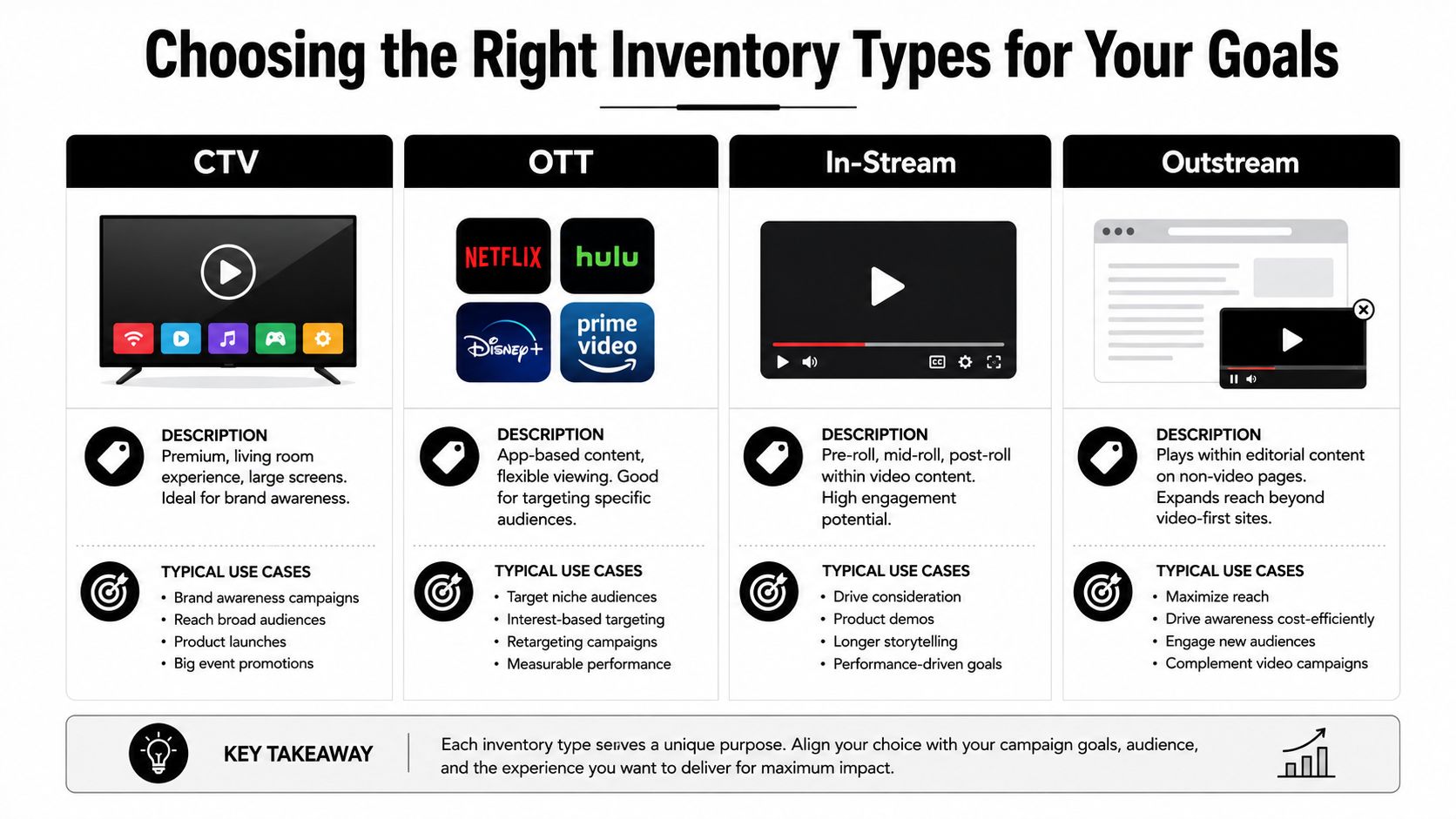
CTV is the living-room play. Big screen, shared attention, and usually better fit for brand building. OTT overlaps heavily with streaming viewing, but the buying reality can differ by app, device, and supply path, so don't assume all streaming inventory behaves the same.
CTV tends to command premium pricing because advertisers want the screen, the context, and the association with premium content. That premium can be worth it when the campaign needs stature and reach. It becomes a problem when teams assume premium automatically means transparent.
In-stream ads, especially pre-roll, still have a place because the placement is attached to video consumption rather than bolted onto a text page with hope and prayers. Users may find them annoying, sure. So do people at airport security, and yet the line still exists because it works for certain jobs.
For awareness or consideration, in-stream can be solid when the creative is built for the format and the supply is clean. For direct response, it can work too, but only if you're measuring beyond clicks and treating the viewer like a person, not a stray pixel.
Outstream makes sense when you want reach outside video-first environments. It can be useful for awareness campaigns that need extra scale across editorial pages. It becomes a money pit when you mistake auto-play muted exposure for attention.
Auto-play muted placements are especially sneaky because they can inflate viewability while delivering very little actual focus. The ad technically appeared. The human brain technically filed it under background noise.
| Format | Best use | Main risk |
|---|---|---|
| CTV | Brand awareness, premium reach | Less transparency than many buyers expect |
| In-stream | Pre-roll and video-led engagement | User annoyance, wasted spend on weak supply |
| Outstream | Broader reach beyond video sites | Fake attention, inflated metrics |
The honest answer is that format choice should follow the job, not the vendor deck. Start with the outcome, then buy the inventory that can support it.
Targeting didn't die when cookies got messy. It just got more expensive to be lazy. The teams that still win are the ones that combine first-party data, contextual signals, and privacy-compliant identity layers instead of chasing phantom precision with third-party scraps.
A good audience plan starts with what you already know. Your CRM, site behavior, product usage, and lifecycle segments usually tell you more than some overengineered “high-intent” blob that was assembled by a vendor with a nice logo.
If you're building a B2B campaign, the segment should map to buying roles, company signals, and funnel stage. If you're running DTC, product affinity and repeat-buyer behavior tend to be far more useful than broad demographic slicing. SMB campaigns usually need tighter geography or category relevance because blanket reach burns cash fast.
If you need a clean framework for this, use a proper segmentation plan rather than piling on random filters. This audience segmentation resource is a useful starting point for shaping those layers without turning the campaign into a junk drawer.
More granular isn't always better. That's one of those truths buyers learn after spending too much money on tiny segments that never scale. A narrow audience can look brilliant in theory and then collapse under frequency pressure or tiny delivery volume.
A broader segment paired with a smarter contextual environment can outperform a “perfect” micro-audience that never sees enough inventory. The trick is to balance reach and precision without worshipping either one.
Cross-device frequency capping sounds simple until the same person appears on a laptop, a connected TV, a tablet, and a phone. Then it becomes a coordination problem across systems that don't always agree on identity. That's where the neat plan turns into a little operational mud fight.
The buyers who survive privacy changes aren't the ones with the most IDs. They're the ones with the cleanest data habits.
The practical move is to test layered audiences, use contextual signals where identity is weak, and reserve the most restrictive targeting for the campaigns that need it. Everything else should be optimized for useful reach, not targeting theater.
A video campaign can look busy and still accomplish almost nothing. Viewability and completion rates are basics, not victory banners. If they're the only numbers getting celebrated, you're probably funding a beautiful lie.
The better question is whether the spend created incremental reach, conversion lift, or real downstream business value. If it didn't move one of those, the campaign might have been popular with the reporting tool and irrelevant to the P&L.
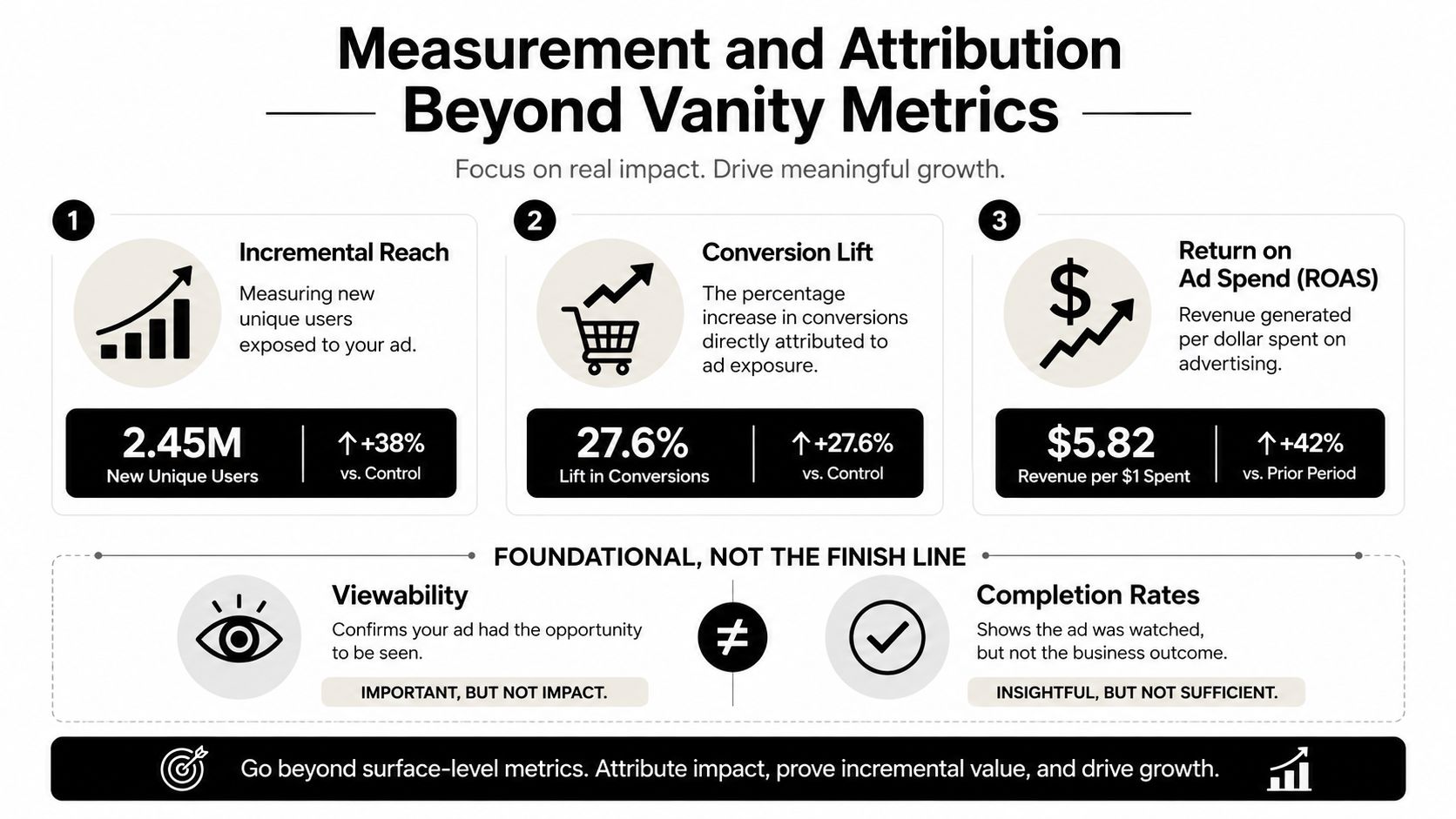
If you're buying video for awareness, test whether the campaign is adding new unique users rather than just hitting the same people again and again. If you're buying for performance, look for lift that survives scrutiny, not just a conversion that happened after someone happened to see an ad.
Holdout testing is the cleanest way to answer the annoying but important question of causality. It's also the fastest way to find out which platform claims are made of cardboard and which are made of something sturdier. View-through attribution can overstate impact, especially when the customer journey is long or the conversion would've happened anyway.
Measurement without supply quality is just spreadsheets with confidence issues. Verify that placements are viewable and audible, and keep an eye out for traffic that looks real until you inspect the path. That's where the waste hides.
The transparency gap matters because a reported impression isn't the same thing as a meaningful exposure. Some inventory can be technically delivered while being practically useless, and that distinction is expensive. If the vendor only wants to show you aggregate numbers, ask for placement-level detail and supply-path clarity.
For teams that need a tougher attribution lens, this multi-channel attribution guide is a useful companion to the video-specific checks.
Last-click attribution is still a bully in too many rooms. Video often starts interest, shapes preference, or nudges the decision long before the final click. If you only reward the final interaction, you'll keep starving the upper-funnel work that made the click possible.
The better approach is to combine incrementality, assisted conversion analysis, and practical business reporting. That won't make every answer pretty, but it will make them real. And real is cheaper than self-deception.
Most programmatic video ads are repurposed TV spots wearing a digital costume. That's a problem. The viewer's attention window is different, the context is different, and the old “just shrink the commercial” approach usually produces a very expensive shrug.
Creative has to match the format. If the ad feels like it was dragged in from a different medium, the audience notices even if they can't quite articulate why. They just move on, which is the most honest feedback you'll ever get.
For CTV, lean into visual clarity, strong branding, and messaging that survives a living-room screen. For mobile in-stream, keep the opening tight and the value proposition obvious. If your first few seconds waste time on a logo dance number, you're paying for the privilege of being ignored.
Dynamic creative optimization can help, but only if the underlying assets are good. Personalization is not a substitute for a weak offer. It's a way to make a good message land harder.
Sequential messaging works when you have enough volume to tell a story in pieces. Start with broad awareness, then shift to proof, then to a direct action. That's cleaner than asking a cold viewer to marry you on the first impression.
A few rules save a lot of money:
The most common mistake is over-optimizing for the creative review room instead of the person on the couch or the commuter on the phone. Those are different humans with different patience levels. Radical, I know.
The winning version of personalization feels helpful, not stalker-ish. Use product category, geography, lifecycle stage, or prior site behavior, and keep the message relevant enough that people don't feel like they're being shadowed by a discount banner. If it feels creepy in the strategy doc, it'll feel creepier on screen.
The best creatives tend to be simple, specific, and built around one job. Fancy production can help, but clarity closes the gap more often than cinematic ambition does.
You've basically got two roads here. Build an in-house buying function, or work with specialists who've already paid the tuition on expensive mistakes. Neither path is automatically better, but pretending they're equivalent is how teams end up with bloated tech, undertrained buyers, and a pile of reports nobody trusts.
The cheapest CPM usually isn't cheap at all. If the inventory is messy, the reporting is weak, or the team can't interpret what the platform spits out, the savings evaporate fast. That's before you even count the time spent cleaning up bad decisions.
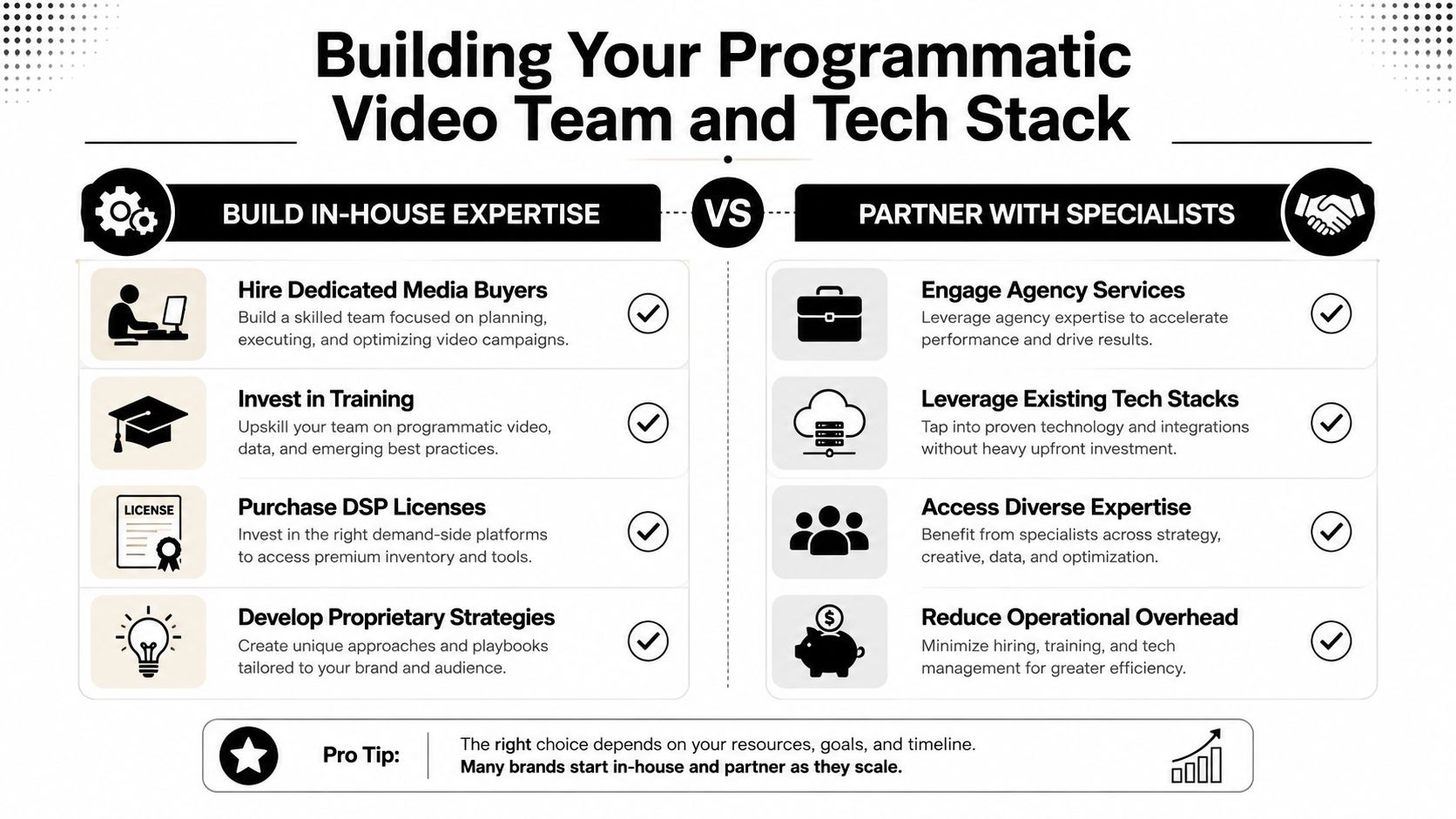
If your team has steady spend, enough channel complexity, and people who want to live in a DSP, in-house can make sense. If you're still figuring out audience structure, verification, and measurement, outside specialists can save you from buying a very expensive education.
A practical split looks like this.
Vendors love to sell features. Ask about supply source, reporting granularity, incrementality, fee transparency, and who owns the data when the contract ends. If the answer to any of those sounds slippery, keep walking.
Use this first-party data strategy guide to pressure-test how your data will be used before you hand over access. First-party data is valuable, which means it's also easy to misuse if the contract language is fuzzy.
A good stack makes it easier to make smart decisions. It doesn't make the decisions for you. That means choosing tools that show placement-level detail, make reporting legible, and don't bury the fee structure under layers of “advanced optimization.”
The right team and tech setup should reduce guesswork, not create a new religion around the platform. If the vendor expects you to trust the machine without asking what's under the hood, that's not automation. That's a trust fall.
HireMediaBuyers.com helps companies find pre-vetted Media Buyers and Paid Ads Specialists quickly, which is exactly what matters when you're trying to clean up a leaky programmatic video stack or build one that doesn't leak in the first place. If you need sharper execution, better auditing, or a buyer who won't confuse a pretty dashboard for real performance, visit HireMediaBuyers.com and start with people who already know where the bodies are buried.


