


You know the feeling. It's 11:47 p.m., the report lands in your inbox, and on paper everything looks gorgeous. CTR's up, spend's “efficient,” the dashboard is wearing its best suit, and yet your gut says somebody's been cooking the books with a very confident spoon.
That's the core job of transparency in marketing. Not the glossy version. The version where you can see what got bought, what it cost, what it did, and what got clipped off the top before the numbers reached you. If you've ever burned cash on an opaque agency, a slippery media buyer, or a platform report that seemed a little too polished, you already know why this matters.
The old “just trust the dashboard” routine stopped being cute years ago. The FTC's updated .com Disclosures guidance made it clear that material terms need to be communicated clearly and prominently, close to the claim they qualify, in a way people can read on the device they're using. That's the spirit here, plain and simple. If the context changes the decision, the context belongs in the decision flow, not buried in the fine print like office junk mail.
The worst reports are the ones that look expensive. Plenty of charts, a few tidy deltas, maybe even a cheerful green arrow or two. Then you ask one question, like where the placements came from or what fees were retained, and suddenly everybody's “checking with ops.”
That's the trap. A polished report can hide a messy buying process, fuzzy attribution, or a fee stack nobody wants to talk about before renewal. In U.S. advertising law, the FTC says an ad is deceptive if it contains a representation, omission, or practice likely to mislead a reasonable consumer, and the misleading part is material. In normal human language, if the missing detail changes the buying decision, it's not a harmless omission.
Practical rule: if a report makes it easy to celebrate and hard to audit, it's not transparent enough.
The urgency isn't theoretical. A 2026 consumer trust survey cited by AMRA & ELMA reported that 85% of consumers require visible trust signals before completing an initial purchase, and 66% ranked transparency as their single most important brand trait, ahead of price competitiveness. That's not a soft branding preference. That's a buying filter. The same research also found that brands which proactively disclosed pricing structures, ingredient sourcing, or AI tool usage saw a 23% higher customer satisfaction score than those that didn't, which is exactly the sort of thing that makes a founder sit up straight and say, “Right, so honesty is not just for the mood board.” AMRA & ELMA trust and transparency statistics
For a solo founder, this usually shows up as “I can't tell if the agency is actually helping.” For an agency owner, it's “my client keeps asking for raw data.” For enterprise demand gen, it's “the CFO wants proof, not vibes.” All three are really asking the same thing, who touched the budget, what happened next, and can I verify it without playing detective at midnight?
Transparency in marketing is not a personality trait. It's an operating condition. If the people spending money, the people measuring it, and the people approving it can't all see the same chain of evidence, then you've got a trust problem dressed up as a reporting problem.
First is messaging transparency. That's the brand-facing layer, honest claims, clear pricing, visible policies, and proof that isn't doing backflips to stay believable. If the offer only works when the footnotes are ignored, it's not transparent, it's theater.
Second is measurement transparency. You need to know how results are calculated, which metrics are being used, and whether the math is repeatable. Reporting should be standardized and auditable, with calculations that stay consistent and variance explained in context so stakeholders can separate short-term lift from durable outcomes. That's the difference between a report and a persuasion deck.
Third is money transparency. Many “transparent” setups fall apart here. You should be able to see what was bought, who bought it, what intermediaries kept, and how the final numbers were produced. Imagine a restaurant kitchen with a line-by-line bill. You can see the ingredients, the prep, the table service, and the receipt. If the chef says the meal was excellent but the kitchen won't show you the invoice, you're not in a restaurant, you're in a magic show with appetizers.
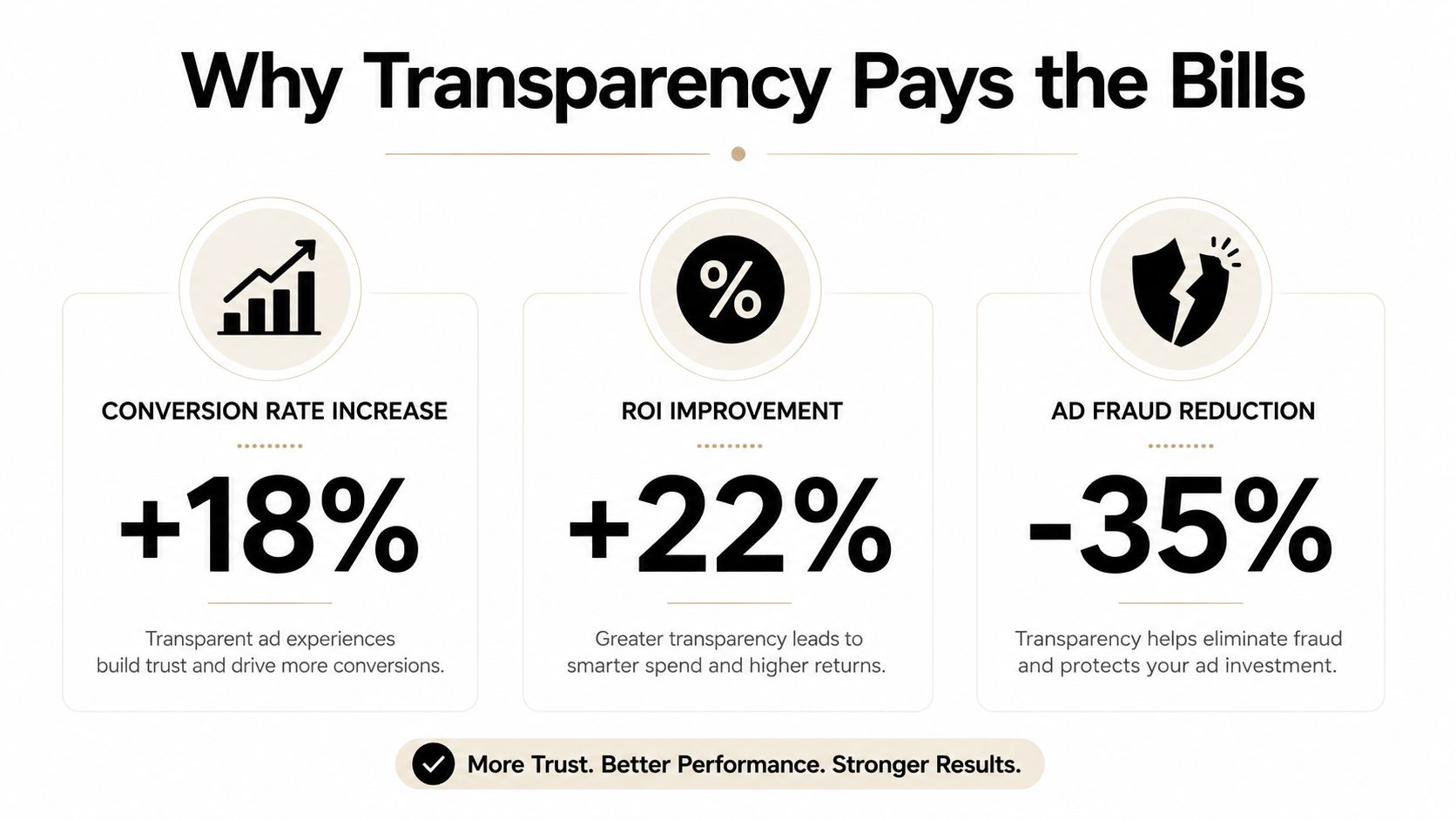
The practical takeaway is simple. A transparent relationship should let you answer three questions without argument, what was promised, what was measured, and what was kept in the middle. If you can't answer those three, you don't have transparency, you have optimism with a login.
A lot of teams treat transparency like a virtue signal. Nice on the website, optional in the budget meeting. That habit gets expensive fast.
If buyers need visible trust signals before they'll purchase, then transparency is sitting in the conversion path, not floating around in the brand deck. That's why the AMRA & ELMA findings matter. When consumers want clear data practices, transparent policies, and upfront disclosure, they're telling you the purchase decision is partly an evidence test. AMRA & ELMA trust and transparency statistics
The same logic shows up across B2B, SaaS, DTC, and SMB buying. A SaaS trial that hides pricing until the last click creates suspicion. A DTC brand that buries return rules in a footer creates hesitation. A B2B buyer who can't see how lead quality is being scored starts discounting the whole pipeline. None of that is glamorous, but all of it leaks revenue.
Proactive disclosure also helps after the click. The same 2026 AMRA & ELMA research found a 23% higher customer satisfaction score for brands that disclosed pricing structures, ingredient sourcing, or AI tool usage. That's a useful reminder that transparency doesn't stop at acquisition. It keeps working during onboarding, fulfillment, and support, where overpromising usually comes back wearing a complaint ticket.
Buyers don't need perfect brands. They need brands that don't act weird when asked a direct question.
For performance teams, the upside is operational too. Transparent pricing, cleaner expectations, and better reporting usually make it easier to spot waste, which means less spend slipping into the “we think this channel is working” bucket. If you want a deeper grip on why incrementality matters here, the logic pairs well with incrementality testing, because platform lift and business lift are not the same creature.
The blunt truth. Transparency doesn't just feel better. It reduces buyer hesitation, supports satisfaction, and gives your team cleaner signals to optimize against. That's a revenue lever, not a poster slogan.
A transparent paid-media setup should be boring in the best way. No drama, no mystery line items, no “we'll share that later.” If a buyer flinches at basic visibility, you already know enough.
A credible engagement starts with the basics: who owns the accounts, who can export the data, how often reporting comes in, and what happens if performance drifts. If the team can't answer those without a meeting about the meeting, the contract's already doing too much heavy lifting.
The smartest operators also insist on one thing that gets overlooked: a clean path from spend to outcome. That means your buyer can explain the logic of the campaign, the reporting cadence, and the decision rules without using mystical platform language as camouflage. If you're comparing approaches, attribution modeling only matters when the inputs are honest enough to trust.
This is also where good teams separate from merely polite ones. Polite teams say “no problem” and then send you screenshots. Good teams send the raw stuff, explain the trade-offs, and don't act offended when you ask how the sausage got made.
This is the part most transparency content tiptoes around. Everyone wants to talk about honesty in ads. Fewer people want to talk about what happens after the media buyer clicks buy.
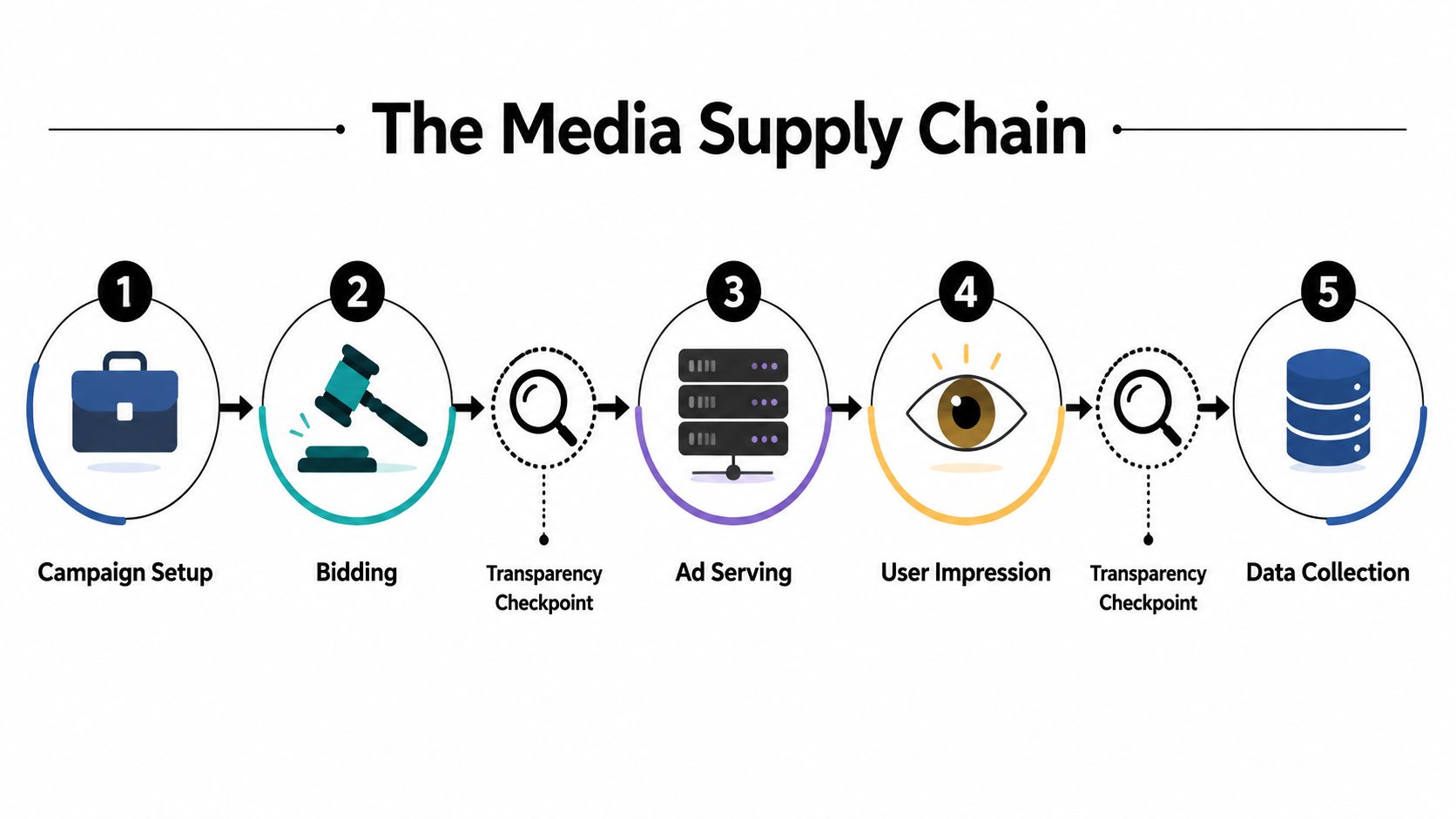
A real supply-path view should show inventory sourcing, intermediaries, fee allocation, and how impressions and conversions are calculated. That's the operational core, and it's exactly where a lot of teams get fuzzy. Industry analysis points out that most general marketing content never answers the actual questions advertisers need, like what data should be demanded from DSPs and SSPs or how platform-reported metrics should be verified. Transparency in advertising analysis
That matters because platform dashboards are not the same thing as independent verification. They're useful, sure, but they're still the house view. If you only check the scoreboard kept by the team selling you the seats, don't act shocked when the game looks a little too favorable.
Ask where inventory came from. Ask which intermediaries touched the spend. Ask how conversions were counted, and whether the same rules apply across channels. Ask for log-level data if the buyer claims they're confident in the setup. If they say the answer is “proprietary,” that's not a strategy, it's a velvet curtain.
A clean supply chain isn't just about fraud prevention, although that's part of it. It's about knowing whether performance is being driven by useful placements, lazy retargeting, or reporting that flatters the dashboard more than the bank account. That's why the most serious buyers care about independent measurement, not just platform summaries.
If your media plan can't survive a basic provenance check, it's not transparent. It's decorative.
The practical standard is simple. The buyer should be able to show the path from budget to impression to outcome without hiding behind jargon. If that sounds hard, good. Marketing is supposed to spend money, not create an escape room.
Pretty reports don't calm finance teams. Clear ones do. If you want transparency to survive contact with leadership, the reporting stack has to be tight enough that nobody needs a decoder ring.
Start with a small set of business-aligned KPIs, not a museum of every metric the platform can spit out. Keep the calculations repeatable, then add variance context and long-term impact notes so short-term spikes don't get mistaken for durable growth. That approach makes reporting auditable instead of ornamental. Transparent reporting guidance
A good report should answer, in plain English, what happened, why it happened, and what changed because of it. It should also make clear when the answer is “we don't know yet.” That's not weakness. That's how adults manage budgets.
Weekly snapshots keep the noise down. Monthly deep dives expose patterns. Quarterly reviews force strategy instead of performance theater. The cadence matters because teams drift when nobody makes them explain the same number twice.
Here's the part people skip and regret later. A board-ready format usually works best when it starts with a one-page summary and then backs into the appendix. The summary tells the story. The appendix proves you didn't make it up in a taxi. And if the team needs a clean way to think about which metrics belong in the first place, the logic pairs well with conversion tracking, because bad tracking turns every dashboard into a confidence game.
CFO rule: if a metric can't be tied to a business decision, it doesn't belong on page one.
That's the whole trick. Transparent reporting isn't about more data. It's about fewer excuses.
You can't outsource judgment, but you can absolutely hire people who make it easier to trust the numbers. The interview process should make that obvious fast. If it doesn't, you're probably funding somebody's lifestyle brand.
Ask how they define scope. Ask who owns the ad accounts and the data exports. Ask how often they report, what gets included, and what happens when performance slips. Ask whether fees are fixed, performance-based, or mixed, and whether any part of compensation is tied to spend levels. Ask what a replacement process looks like if the fit goes sideways.
The answer quality matters more than the buzzwords. A serious buyer answers directly, names the trade-offs, and doesn't treat documentation like a personal insult. A weak one talks a lot about “alignment” and somehow never gets around to the invoice or the raw data.
Start with a narrow scope and a real trial. The first month should prove three things, that the buyer can track the right events, that the reporting cadence works, and that account ownership stays with you. If they want a broad, open-ended launch before those basics are clear, that's usually code for “we'll sort it out later,” which is how budgets go to die.
| Transparency Signal | In-House Buyer | Traditional Agency | Vetted Marketplace |
|---|---|---|---|
| Account ownership | Usually clear | Often negotiable | Clear by design |
| Fee visibility | High | Varies widely | Usually explicit |
| Reporting cadence | Team-defined | Agency-defined | Pre-agreed |
| Data access | Direct | Can be partial | Typically straightforward |
| Replacement speed | Internal HR timeline | Contract-dependent | Faster and more flexible |
A vetted marketplace can be the fastest route when speed matters and you don't want to spend a quarter auditioning strangers. That said, the model only works if the operating rules are clean from day one. A well-run search should also make it easy to compare how tracking gets handled, which is why conversion tracking belongs in the checklist before anyone touches spend.
The punchline is simple. Hire the person who makes visibility normal, not exceptional.
This doesn't need a rebrand. It needs a cleanup.
Week one, pull every report, every fee schedule, and every KPI definition into one place. If you can't find the original agreement quickly, that's already a signal. Week two, compare what was promised to what was delivered, then amend the contract or start replacing the vendor.
Week three, rebuild the reporting format into one page plus appendix, with a fixed cadence and variance notes. Week four, decide whether the human layer deserves another month. If the buyer can't explain the numbers, won't share the data, or gets defensive when asked for proof, the problem isn't performance. It's fit.
The three most impactful fixes are intentionally straightforward. Write the scope down. Share the raw data. Standardize the report. If you do only those three things, you'll eliminate most of the nonsense that makes transparency feel hard in the first place.
Don't chase perfect honesty like it's a philosophical hobby. Chase usable visibility. That's what keeps budgets alive, meetings shorter, and midnight reports a lot less theatrical.
If you want a faster way to find paid-media talent that already understands clean reporting, clear ownership, and sane operating discipline, HireMediaBuyers.com is built for that exact mess. It's a practical way to hire media buyers and paid ads specialists without spending weeks untangling who owns what, who reports to whom, and why the dashboard smells funny.


