


You're probably here because project work is getting old.
One month, your agency is slammed and your media buyer is triaging Slack messages like an air traffic controller. The next month, a couple of campaigns end, one client “wants to reassess,” and suddenly everyone's pretending cash flow isn't a group hallucination. I've lived that cycle. It's exhausting.
That's when the word retainer starts sounding magical. Predictable revenue. Priority support. Fewer awkward “can you send the invoice again?” emails. Lovely in theory. In practice, a retainer can be a smart operating model or a beautifully packaged mess.
If you've been asking what is a retainer in business, the short answer is simple. The useful answer is not. Especially in marketing and media buying, where clients think they're buying outcomes, providers think they're selling capacity, and both sides get annoyed when nobody defined the line in between.
I used to think project work was “flexible.” That's a cute word for financial whiplash.
A brand hires you for a launch. You build the Meta Ads account, fix the tracking, write briefs, set up reporting, clean up creative naming, and survive three rounds of feedback from someone's cousin who “gets performance marketing.” The project ends. Everyone's happy. Then two weeks later they're back with “just one quick thing,” but there's no agreement, no reserved time, and no clean way to prioritize them without bumping someone else.
That's the trap.
Project work looks efficient on paper because you only pay for a defined output. But in paid media, the work rarely stays tidy. Campaigns need monitoring. Creatives fatigue. Tracking breaks. CAC drifts. Your “finished” project starts behaving like a needy subscription.
That's why retainers became the grown-up answer to recurring business needs. They sit in the middle ground between a one-off contract and hiring someone in a more ongoing capacity. If you're also weighing more flexible staffing models, it helps to understand what fractional work looks like in practice.
Three reasons usually drive the decision:
Retainers promise stability. They only deliver it if both sides agree on what's actually being reserved.
That's the part often skipped. They hear “monthly fee” and assume the mechanics will sort themselves out. They won't.
A business retainer is a fixed sum paid in advance by a client to a service provider to guarantee ongoing access to services, creating a stable, recurring partnership. It typically runs on a monthly billing cycle, and for mid-tier agencies it's often between $1,000 and $5,000 to reserve a dedicated team or a specific number of hours, according to Indeed's explanation of business retainers.
That's the formal definition. Here's the plain-English one.
A retainer is a subscription to an expert's brain.
You're not only paying for finished deliverables. You're paying so that when the account goes sideways, when the ROAS drops, when creative stalls, or when the landing page change tanks conversion rate, the right person is already in the room. Or at least already in your Slack.
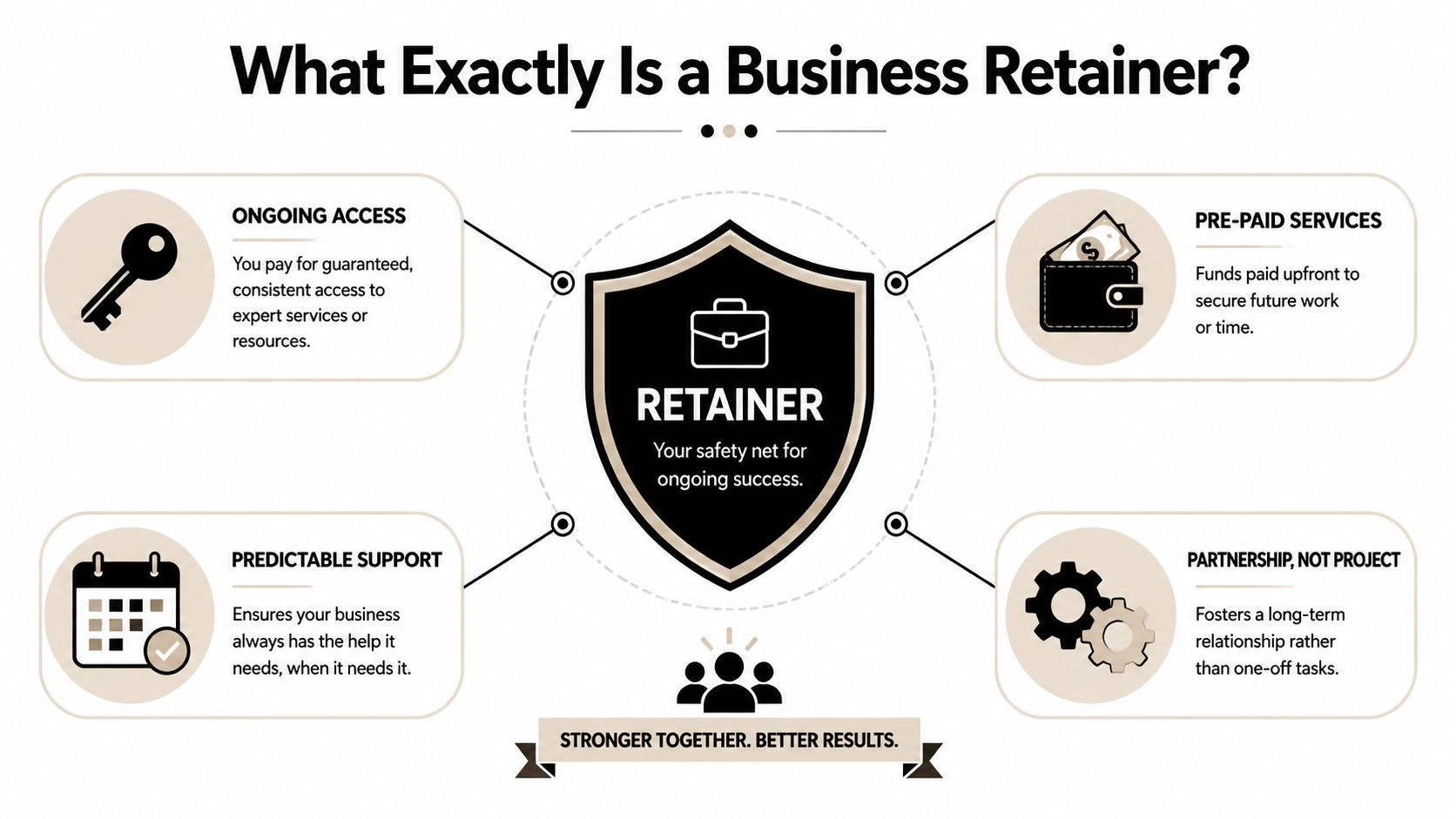
The key shift is this. With project work, you pay for an output. With a retainer, you often pay for reserved capacity.
That sounds subtle. It isn't.
If you retain a media buyer, strategist, or agency, you're buying some combination of:
Marketing retainers are common because marketing work compounds when the same people stay close to the account. A recurring arrangement usually includes a defined scope, regular reporting, and ongoing support rather than isolated tasks, as described in NetSuite's overview of marketing agency retainers.
In media buying, that continuity matters more than people admit. A new operator can launch campaigns. A retained operator understands why the old campaigns failed, which tests were fake wins, and which audience insights matter. Big difference.
You're not paying only for labor. You're paying to avoid re-explaining your business every month.
A retainer is not a magic bucket where unlimited requests go to die.
It's also not employment-lite. It lives in the middle. More committed than a one-off job, less embedded than a permanent hire. That's why the agreement matters so much. Scope, timing, communication rules, and what happens to unused capacity cannot be fuzzy. Fuzzy is expensive.
Not all retainers are built the same. Some are fair. Some are lazy. Some are basically project chaos wearing a monthly invoice.
Here are the three models you'll see most often, plus who they really help when things get messy.
This is the classic setup. A client prepays for a set amount of time every month. For freelancers and independent contractors, that often looks like a minimum monthly charge such as 20 hours × $50/hour = $1,000, billed upfront, with extra time charged separately at an agreed rate, as discussed in this freelancer retainer example.
This model is clean because everyone understands hours. It's also dangerous because everyone starts staring at the clock.
If you're the client, you worry about paying for unused time. If you're the provider, you start logging every Slack reply like it's billable surgery. Nobody relaxes.
Hourly retainers work well when the work is operational and variable. Media buying support, account monitoring, weekly optimizations, reporting, and ad hoc troubleshooting can fit this model.
The minute nobody defines what counts as an hour, things get weird. Strategy call? Billable. Reviewing a Loom? Billable. Emergency account issue at 7 p.m.? Also billable, probably with resentment attached.
This is the “pay for priority” version. The client isn't buying a neat block of hours. They're paying to reserve access to expertise, response time, and general availability.
In theory, this is perfect for founders who don't want to count minutes and providers who don't want to commoditize their thinking.
In practice, clients start asking for “quick favors” and providers start muttering at their laptops.
The provider usually does, unless the agreement is unusually sharp. Access is valuable, but “access” without limits becomes infinite interpretation.
This is the grown-up model. Instead of anchoring on hours alone, the retainer ties to clear responsibilities, business context, and meaningful outputs. Not vague “results,” because that's how you end up in clown court. I mean clearly owned work tied to strategic value.
For a media buyer, that might include account stewardship, creative testing coordination, reporting rhythm, planning input, and response standards. The fee reflects the weight of the role, not only the stopwatch.
It gives the client a better sense of what they're buying, and it lets the provider price for judgment, not just motion.
If you use value-based pricing as an excuse to avoid specifics, you've built a premium mystery box. That's not strategy. That's laziness with nicer branding.
| Model Type | Pricing Logic | Best For | Biggest Risk |
|---|---|---|---|
| Hourly | Client prepays for a set block of time each month | Ongoing execution and support tasks with variable demand | Time policing, underuse fights, surprise overages |
| Access | Client pays for priority, responsiveness, and reserved availability | Advisory-heavy relationships and fast-moving teams | Unlimited-request creep disguised as “partnership” |
| Value-based | Fee reflects strategic ownership and defined recurring responsibilities | Senior specialists, media buyers, and agencies with clear operating roles | Vague deliverables and mismatched expectations |
If you're the client, don't buy pure access unless you need senior judgment on call and you trust the operator.
If you're the provider, don't sell a loose hourly retainer forever unless you enjoy explaining invoices like a hostage negotiator.
The strongest deals usually blend structure. A minimum commitment, a defined scope, a clear service rhythm, and rules for overflow. Not sexy. Very effective.
Retainers get sold as a win-win. Predictable revenue for the provider. Budget stability for the client. Better partnership. Faster turnaround. Nice slide deck. Nice coffee. Nice promises.
But the main problem isn't whether retainers are good or bad. It's whether the agreement handles the ugly tension at the center of every retainer: reserved capacity versus scope creep.
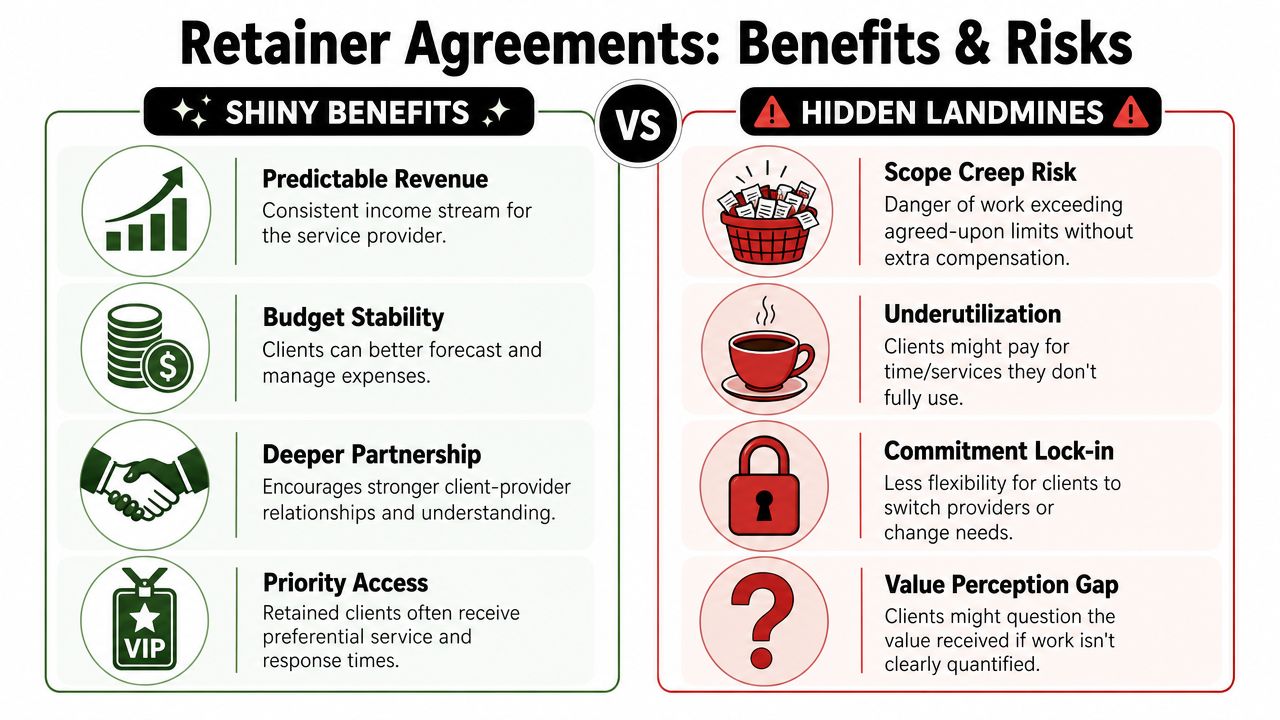
When a retainer is built well, both sides get something valuable.
That's the shiny side. Toot, toot.
The biggest source of conflict is usually not price. It's ambiguity.
According to Productive's retainer analysis, 68% of service disputes in retainers stem from undefined hourly caps or untracked deliverables. That number doesn't surprise me at all. I'm surprised it isn't higher.
If the client thinks they bought “ongoing support,” and the provider thinks they sold “up to a reasonable amount of support,” congratulations. You have purchased future annoyance.
Undefined scope is where polite partnerships go to die.
A client signs for ongoing paid media support. Sounds clear enough. Then the month starts.
Now the “retainer” includes campaign management, reporting, creative feedback, landing page suggestions, offer strategy, tracking QA, call reviews, emergency troubleshooting, launch planning, and “can you also jump into our agency Slack?” Nobody agreed on boundaries, so everything becomes implied.
That's when both sides start feeling cheated.
If you're hiring external marketing talent, this same boundary problem shows up in broader social media contracting arrangements, where support expectations gradually expand faster than the contract.
Retainers fail when people confuse friendliness with clarity.
You can have a warm relationship and a hard-edged agreement. In fact, you should. The best retainers feel easy because the paperwork did the hard work upfront.
Most bad retainers are not born bad. They start with good intentions and lazy drafting.
A founder wants support without hiring full-time. A media buyer wants stable monthly income without becoming pseudo-staff. Both sides say yes before defining the boring stuff. Then month two arrives, and everyone rediscovers the meaning of regret.

A lot of smaller businesses hesitate because upfront retainers can feel like parking cash in a spot you might not fully use. That concern is real. According to Helcim's guide on retainer payments, 29% of new SMB contracts now include usage-based retainer clauses, where clients pay for hours used minus a minimum fee.
I like this trend.
Rigid monthly retainers are old-school. They can still work, but they're not the only sane option anymore. If your workload fluctuates, a flexible structure is often the better trust-builder.
If you want optionality in your talent setup more broadly, there's a reason more teams prefer cancel-anytime hiring models over long lock-ins.
If I'm signing a retainer, these are firm requirements:
Practical rule: If a clause depends on “common sense,” write it down. Common sense disappears the second performance dips.
Don't negotiate the retainer as a single price. Break it into parts.
Ask:
That last one matters. Build in a regular review. Not a dramatic quarterly showdown. Just a recurring check on workload, responsiveness, and whether the agreement still reflects reality.
For marketing and media buying, I usually prefer a hybrid. Small base commitment. Clear recurring responsibilities. A stated cap or service boundary. Pre-agreed pricing for overflow.
It protects the provider from being slowly eaten alive by “quick asks.” It protects the client from paying for a mystery bundle. And it keeps the relationship commercial instead of emotional, which is healthier for everyone.
So, what is a retainer in business?
It's not just a monthly fee. It's an agreement to reserve expertise, capacity, and continuity. Done well, it replaces project chaos with a real working rhythm. Done badly, it creates a standing appointment with disappointment.
My opinion is simple. The quality of a retainer depends less on the price and more on the precision. If scope is vague, tracking is sloppy, and “priority” is undefined, the deal will rot no matter how friendly the kickoff call felt.
Read the notice clause first. If the contract is silent, that's already a red flag. The cleanest path is written notice, a transition period, and a list of what gets handed off. No drama, no disappearing act.
A fair rate depends on the scope, seniority, channel mix, reporting burden, and how much strategic ownership you expect. If you need execution plus planning plus fast response times, don't try to price it like simple task support.
Sometimes yes, sometimes absolutely not. A retainer is better when you need specialized expertise and flexibility without adding headcount. Part-time hiring is better when you need deeper daily integration and tighter operational control.
Choose whichever version creates fewer assumptions. If your work is variable, hours may be cleaner. If the recurring output is stable, deliverables can work well. If you need both strategic input and execution, a hybrid is often the least annoying option.
The best retainer isn't the cheapest or the fanciest. It's the one both sides can explain the same way, in one sentence, without arguing.
That's the standard.
If you need paid media talent but don't want to stumble into another vague retainer, HireMediaBuyers.com is a practical place to start. They help companies find pre-vetted media buyers and paid ads specialists quickly, with flexible monthly arrangements that are easier to understand, easier to manage, and a lot less likely to turn into contract theater.


