

The worst advice on YouTube watch time is still the most popular: make longer videos.
No. Make better viewing sessions.
A bloated twelve-minute video that people abandon early is not a strategy. It's a slow-motion waste of production budget, editing time, and whatever optimism you had left after reviewing last month's content calendar. If you want a real YouTube watch time increase, stop treating each upload like a lone soldier and start building a system that keeps people moving from one video to the next.
Let's start with the obvious thing people keep ignoring. YouTube is not starving for attention. It already has more attention than most media companies can comprehend. Viewers spend over 1 billion hours watching YouTube every day, and average daily usage sits around 48.7 minutes according to Blank Spaces' YouTube screen time roundup. That's not a traffic problem. That's an opportunity problem.
If your channel isn't growing watch time, the issue usually isn't “people don't watch YouTube enough.” They absolutely do. The issue is that your videos aren't earning enough of that daily habit.
That changes how you should think.
You are not fighting for a click. You are fighting for a session.
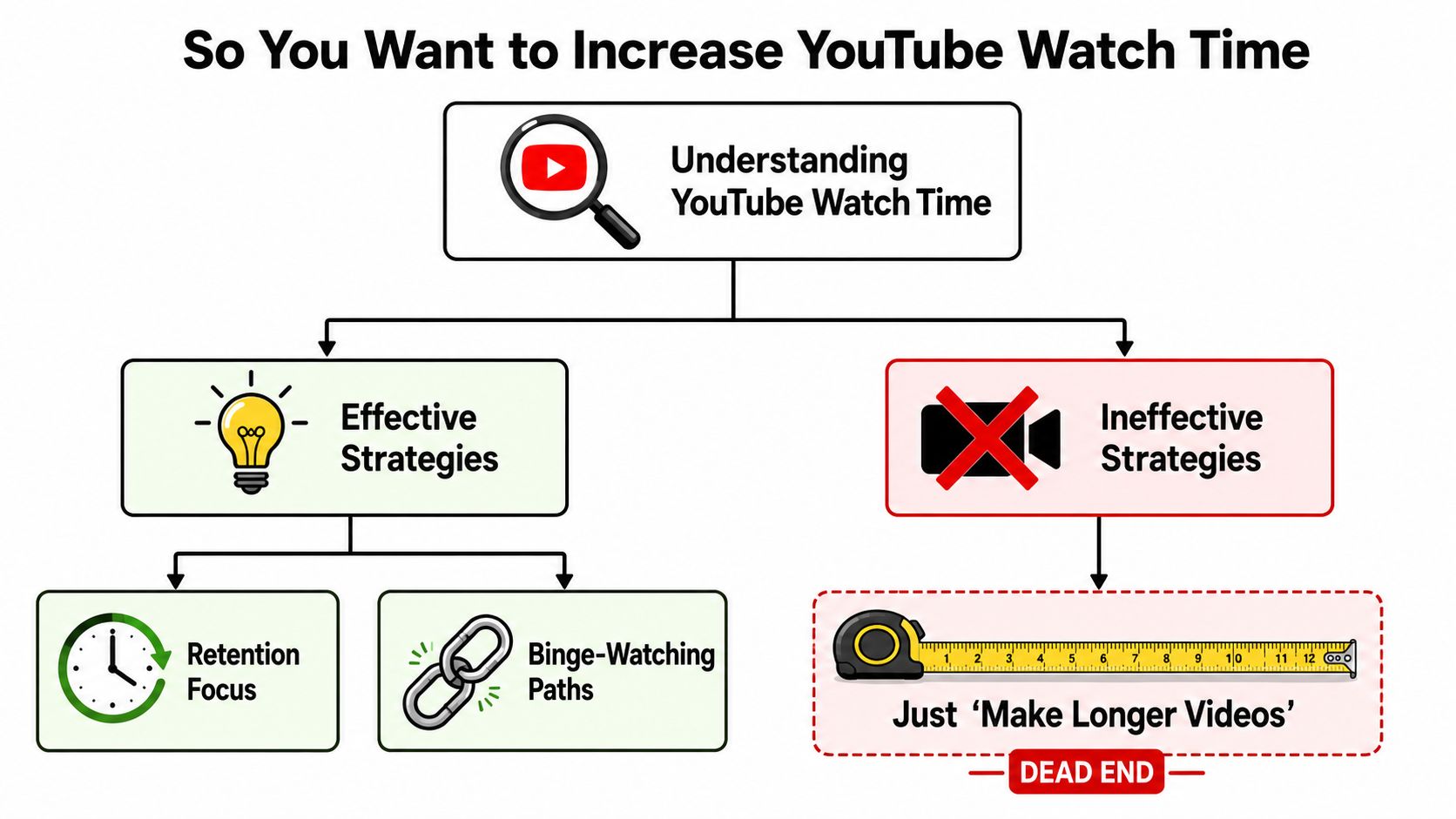
Many creators approach YouTube watch time increase like this:
That's not a strategy. That's a coping mechanism.
Longer videos can help if the content holds attention. If it doesn't, the extra runtime just gives viewers more places to leave. You don't get bonus points for padding.
Stop asking, “How do we make this video longer?” Ask, “Why would someone keep watching this, then watch another one?”
A smart channel does three things well:
| Focus | What it actually means |
|---|---|
| Retention | Get people through the opening and keep attention from leaking |
| Session depth | Give viewers a clear next step inside your channel |
| Content architecture | Publish videos that connect, not random one-offs |
That's the playbook.
A founder's version of this is simple. Build content like a product funnel. Your thumbnail and title earn the click. Your first moments earn the stay. Your structure earns the completion. Your internal linking earns the second video. That second video is where watch time starts compounding.
If you want a YouTube watch time increase without wasting months on fluffy tactics, focus on these levers first:
That's the difference between “we're posting consistently” and “we're building a channel that grows.”
Consistency matters. But consistent mediocrity is still mediocrity. Toot, toot.
Your opening is where most YouTube videos die.
Not with drama. Not with a catastrophic production mistake. Just with a weak hello, a rambling setup, and a viewer clicking on something else before you've even gotten to the point. YouTube's own guidance puts heavy emphasis on the first 30 seconds, along with visual variety and recurring changes every 30 to 60 seconds, as covered in this YouTube creator guidance video.
That's the game. Earn the first half-minute, or don't expect the rest of the video to save you.

You do not need a theatrical cold open. You need clarity and momentum.
A strong first 30 seconds usually follows this order:
Hook
Open with the most interesting outcome, tension point, or mistake. Skip “hey guys, welcome back.” Nobody clicked for your greeting.
Problem
Name the pain fast. Tell the viewer what's broken, expensive, confusing, slow, or underperforming.
Promise
Tell them what they'll get if they stay. Not vague value. Specific value.
Here's the rough shape:
That's it. Clean. Fast. Useful.
The intro is not where you prove you're personable. It's where you prove you're worth listening to.
Bad openings usually include some combination of:
Practical rule: If your first spoken sentence could be deleted without changing the viewer's understanding, delete it.
People hear “pattern interrupt” and assume they need a full-time editor with caffeine issues. You don't.
You need changes that reset attention. A tighter crop. A text callout. A chart. A quick cut to an example. A visual switch. A sentence that reframes the point. The point isn't decoration. The point is to stop the viewer's brain from slipping into autopilot.
Use them with intent. Not every few seconds like you're editing for toddlers. But if the screen and rhythm stay unchanged too long, attention drifts.
A lot of teams sabotage retention because they “just talk naturally” on camera. That works if you're unusually sharp, unusually charismatic, or unusually lucky. Few possess such attributes when needed.
Write the opening first. Not the whole video if you don't want to. But at least the first section.
A solid opening script should answer:
| Question | What the viewer needs |
|---|---|
| Why click? | Immediate relevance |
| Why stay? | Clear payoff |
| Why trust you? | Competence through clarity, not chest-thumping |
You don't need clickbait. You need precision.
The first 30 seconds are your $500 hello. Sometimes more. If you paid to get someone into that video, wasting the opening is like buying a lead and hanging up when they answer.
One strong video helps. A connected channel wins.
Most creators still think upload by upload. They publish a decent video, maybe even a very good one, and then leave the viewer at a dead end. No path. No sequence. No reason to keep going. That's like opening a nice restaurant and forgetting to put doors between the dining rooms.
Watch time grows from session depth, not just the runtime of a single video. The most useful tactical summary I've seen on this point recommends themed playlists of 5 to 10 videos, strong end screens, and warns that a 50% retention rate is considered ideal, all in this vidIQ guide on generating watch time.
That's the shift. Stop publishing isolated assets. Start designing routes.
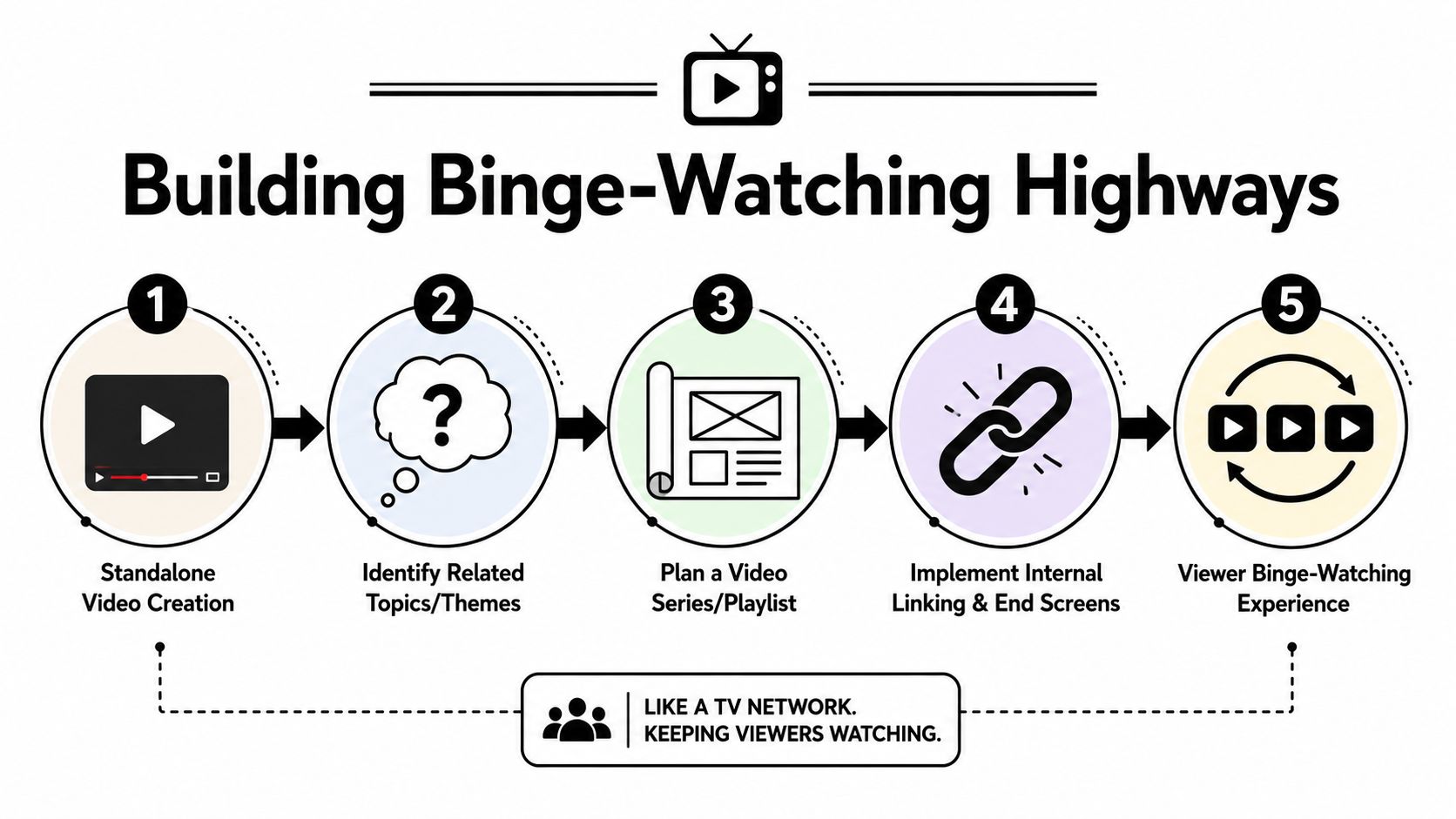
A good channel has content relationships. Each video should logically lead to another one.
That can look like:
If your uploads feel random to a new viewer, your watch time ceiling stays lower than it should.
A binge chain has three parts working together.
A playlist isn't a storage bin. It's a journey.
Group videos around one problem or one skill set. Then order them so the next one feels inevitable. Beginner to intermediate works well because people like momentum. They want to feel they're making progress, not sorting through your channel like a thrift store.
Too many channels treat end screens like junk drawers. A few options, a subscribe button, maybe some vague hope.
Pick the next best video and make that recommendation obvious. One relevant option beats a buffet of mediocre choices.
This is the sneaky one often underused.
Don't wait for the end screen to do all the work. Tell viewers what to watch next while they're still engaged. Not with a robotic “smash subscribe and click this video.” With a real continuation.
“If this helped, the next thing you need is the follow-up video that shows how to turn that structure into a repeatable series.”
That line works because it answers the viewer's next question.
Let's be blunt. A longer video with weak retention is just a bigger leak.
If attention falls apart halfway through, adding more runtime won't rescue watch time. It often makes the problem more expensive. More shooting. More editing. More review cycles. Same core issue.
A cleaner way to evaluate videos is this:
| If this happens | Then do this |
|---|---|
| People finish and want more | Link them into a related series |
| People drop early | Fix structure before increasing length |
| People stay on one topic | Build a playlist cluster around that topic |
A proper YouTube watch time increase comes from connected satisfaction. One video delivers. The next one extends it. The viewer barely has to think.
That's what “binge-worthy” means. Not flashy. Not loud. Frictionless.
A thumbnail and title that get the click but wreck retention are not good assets. They're expensive lies.
That's the part people miss. Click-through rate gets all the attention because it's visible, easy to obsess over, and makes everyone feel productive in meetings. But YouTube watch time increase doesn't come from seductive packaging alone. It comes from aligned packaging.
Your title and thumbnail should make a promise your video can cash.
Plenty of teams build titles and thumbnails like bait. Big emotion, vague claim, dramatic face, mystery piled on mystery. Then the viewer lands on a video that takes forever to explain what was supposedly so urgent.
That mismatch creates immediate disappointment. And disappointment kills retention fast.
If you care about performance beyond the click, treat your packaging like the first line of the script. It should prepare the viewer for the experience they're about to get.
A good title-thumbnail combo should accomplish three things:
That last part matters more than is often admitted.
If your title says you'll reveal the one fix that changed channel performance, the opening better address that fast. If your thumbnail implies a teardown, don't spend the first minute on personal backstory. You're not building suspense. You're burning trust.
Performance marketers usually have an edge. They already understand that a high click means very little if the rest of the funnel collapses. Same principle here.
If your team needs a refresher on how misleading front-end metrics can distort judgment, this breakdown of ad performance metrics is worth the read. Different platform, same trap. The first visible metric often gets too much credit.
A thumbnail should qualify the click, not just attract it.
Before publishing, ask three blunt questions:
That third question is where ego usually sneaks in. Broad curiosity can inflate clicks. Relevant curiosity tends to produce better viewing behavior.
And better viewing behavior is what you're after.
A thumbnail earns attention. A title directs it. The video has to deserve both.
YouTube Studio is less a dashboard and more a brutally honest witness.
Teams often still open analytics, glance at views, maybe check comments, then wander off with a half-baked conclusion about “what the audience likes.” Meanwhile, the retention graph is sitting there with the actual answers. Not opinions. Not vibes. Answers.
If you want a YouTube watch time increase, spend more time with Audience Retention than with view count. Views tell you who showed up. Retention tells you where you lost them.
That line is a second-by-second behavior report.
It tells you:
That's not abstract. It's editorial feedback from actual viewers who had no reason to be polite.
The first part of the graph is where the biggest mistakes usually live.
If you see a hard early decline, your packaging and opening probably don't match, or your intro took too long to deliver value. Sometimes it's as simple as too much throat-clearing. Sometimes the first sentence didn't earn the click your title promised.
Your correction is usually creative, not technical:
| Retention issue | Likely cause | Fix to test |
|---|---|---|
| Sharp early drop | Weak or delayed hook | Rewrite the opening line and get to the point faster |
| Steady slide | Low energy or repetitive pacing | Tighten edits, vary visuals, remove repetition |
| Mid-video cliff | Confusion, tangent, or dead segment | Cut or rebuild that section around one clear point |
| Late drop before CTA | Ending arrives too slowly | Move the recommendation earlier |
That table alone can save you a lot of pointless meetings.
Not every dip is a disaster.
Some drop-off is normal. People click around. They get distracted. Their dog throws up on the rug. Life happens. Don't overreact to every little wiggle in the line.
Look for cliffs. Big, obvious points where viewers bail in bunches. Those moments usually map to something concrete:
The retention graph doesn't care what you meant to say. It shows where viewers stopped caring.
The mistake isn't failing to get every video right on the first try. The mistake is publishing ten videos with the same flaw because nobody translated analytics into production changes.
A simple review loop works:
If your team tracks campaign performance elsewhere, the logic is similar to disciplined conversion tracking. You're looking for the exact point where expected behavior breaks. Then you fix the break, not the whole machine.
Ask it for instructions.
If viewers keep leaving during long setup sections, cut setup. If they stay when you show examples, use more examples. If they drop when your CTA starts, move the recommendation before the ending stretch.
The audience is already telling you how to improve. Most channels just refuse to listen because the answer is usually “edit harder” and “stop indulging yourself.”
Annoying. True.
Organic fixes come first. Always.
If your videos can't hold attention on their own, paid distribution won't save them. It'll just help you waste money faster, which, speaking as someone who has absolutely lit budget on fire before, is a very educational experience right up until accounting asks questions.
But once retention is solid, packaging matches the content, and your channel has real binge paths, you gain access to the final levers. Paid promotion and specialized operators.
Do not throw ad spend at weak content and call it testing.
Paid YouTube distribution is useful when you already know a video can keep people watching. At that point, promotion stops being vanity and starts becoming amplification. You are putting a proven asset in front of more relevant viewers.
That's the order:
If you reverse it, you'll spend money learning what your audience would've told you for free.
This is one of the few tactical moves that still feels underused. Recent creator guidance has emphasized manually updating the related video on your best-performing Shorts so they point to a new long-form upload, as explained in this YouTube creator video on Shorts funneling.
That matters because Shorts can function as a discovery layer, while long-form does the heavy lifting for deeper viewing sessions.
Here's the practical version:
That last part is a common pitfall. If the Short completely resolves the idea, fewer people need the longer video. Give them enough value to trust you, but leave a natural next step.
A lot of founders stay in DIY mode too long because it feels disciplined.
It isn't always disciplined. Sometimes it's just control dressed up as prudence.
If you're handling scripts, thumbnails, edits, promotion strategy, audience analysis, campaign setup, targeting, budget allocation, and creative testing yourself, congratulations. You've built yourself a full-time job you probably shouldn't be doing.
That's especially true once paid growth enters the picture. Running YouTube ads well takes channel judgment, creative judgment, audience targeting skill, and the stomach to kill underperforming ideas quickly.
Not at the first sign of effort. Not because you're bored. Bring in a specialist when the economics make sense.
A media buyer becomes useful when:
| Sign | What it usually means |
|---|---|
| You have strong organic videos | There's something worth amplifying |
| You know which topics retain best | Creative testing can start from evidence |
| You're spending too much founder time on execution | Opportunity cost is now the real expense |
| You need repeatability | Process matters more than improvisation |
A good operator doesn't just “run ads.” They help decide which assets deserve budget, which audience segments make sense, what creative angle to test, and when to pull back before spend gets stupid.
If you're specifically at the point where scaling YouTube distribution needs an actual expert, hiring a vetted YouTube ads specialist is usually smarter than making your content lead moonlight as a media buyer.
The expensive mistake isn't hiring too early. It's pretending specialist work is simple because the interface has a blue button.
Your channel grows watch time when three systems work together:
Miss any one of those and growth gets fragile.
Get all three right and watch time starts behaving less like luck and more like infrastructure.
That's the whole game. Not hacks. Not random uploads. Not “just post more.” A system.
If you're ready to stop duct-taping YouTube growth together and want a specialist who knows paid media, HireMediaBuyers.com is a practical place to start. They help companies hire pre-vetted media buyers fast, so you can stop spending your week juggling campaigns, creative tests, and bid tweaks like that was ever a good use of your time.


