

You're probably here because your YouTube ads look busy, not useful.
The dashboard says people are watching. The agency says awareness is building. The freelancer says the algorithm is “learning.” Meanwhile, sales are flat, lead quality is weird, and you're starting to suspect you've been paying for a very expensive magic trick.
I've seen this a million times. Founders don't usually hire a YouTube ads specialist because things are going great. They hire one after they've wasted enough money to become emotionally allergic to the word “views.”
That's fixable. But only if you stop hiring for campaign setup and start hiring for business judgment.
Monday morning. You open the ad account, see a pile of views, a decent watch rate, and a report full of “engagement.” Then you check the pipeline. Nothing moved. Sales did not get easier. CAC did not improve. You paid for activity and got theater.
I've seen this a million times. A weak YouTube hire knows how to launch campaigns, pull screenshots, and explain away bad results. They hide behind top-of-funnel numbers because those numbers sound impressive to anyone who is not tracing spend to revenue.
That is why this hire goes wrong so often. Founders ask for a YouTube ads specialist and end up with a campaign manager. Someone who can push buttons, test audiences, and talk about creative fatigue. Fine. That person still may have zero business judgment. Zero ability to decide where YouTube fits in your funnel, what success should look like, or when to cut spend before more money disappears.
YouTube is too big and too expensive for that kind of amateur hour. As of early 2026, the platform reached roughly 2.7 billion monthly active users, and its ad business generates tens of billions in annual revenue, as noted earlier in the article. Serious companies advertise there. Serious competition lives there. If your operator is still “figuring it out” on your budget, you are funding their education.
You're paying for judgment under pressure, not campaign setup.
The pattern is predictable. Bad hires chase cheap views, report soft metrics, and call motion progress. Good hires ask harder questions first. What is a qualified lead worth? Where does YouTube assist versus close? Which audience should never see this ad? How long can the account stay inefficient before the economics break?
Use that standard from day one.
Three mistakes keep showing up:
A real YouTube ads specialist reduces waste, sharpens the offer, and explains the tradeoffs in plain English. A real growth partner goes further. They protect your budget like it is their own and can tell you, without hand-waving, how this channel should produce ROI. If they cannot do that, do not hire them.
You hire a YouTube specialist after three bad months. Spend is up. Sales are flat. The agency says view rates look strong and the freelancer says the account needs more time. I've seen this a million times. You do not have a traffic problem. You have a judgment problem.
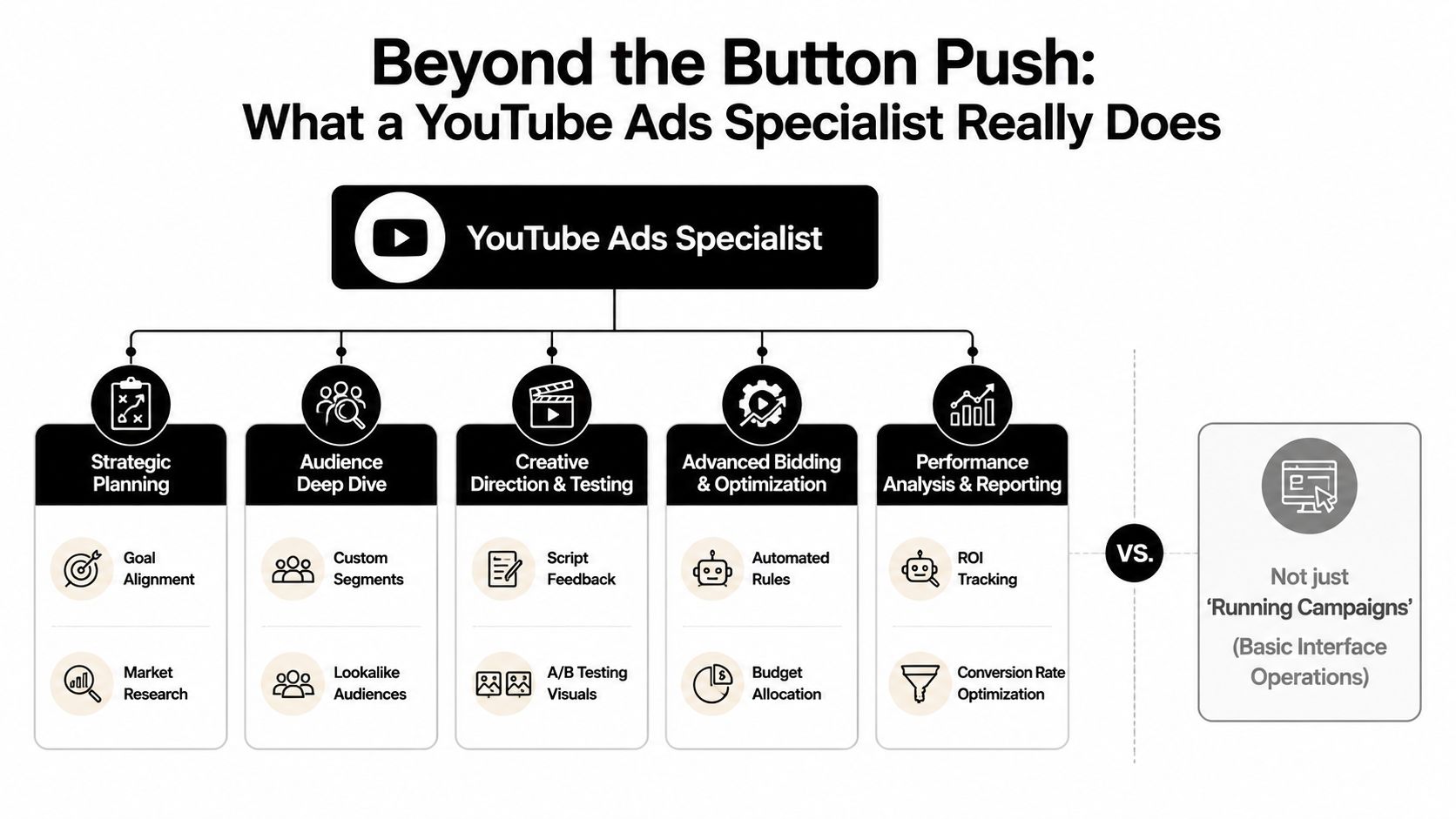
A real YouTube Ads Specialist does four jobs at once, connecting them directly to profit. If they cannot explain how YouTube should produce ROI in your business, they are a campaign manager with a nicer title.
The first question is simple. How does this business make money?
A serious operator wants to know your margins, sales cycle, lead-to-close rate, payback window, and what a qualified action is worth. They want to know whether YouTube should acquire demand, warm it up, or assist branded search and retargeting. That is the baseline for skills-based hiring for performance roles. Hire for business judgment first. Tool fluency is table stakes.
I've seen this mistake over and over. Founders hire someone who knows the interface, gets a few campaigns live, and starts talking about CPMs before they understand the offer. That person can spend your money. They cannot help you grow.
YouTube is a mature ad channel with enormous reach and serious competition, as noted earlier. That cuts both ways. The upside is real. So is the cost of being wrong.
A weak operator reports surface metrics and waits for the algorithm to save them. A strong one can tell you where the breakdown is. Wrong audience. Weak first five seconds. Offer mismatch. Landing page friction. Bad follow-up after the lead comes in. They do not treat media buying like a self-contained task because it isn't one.
This is the shift that matters. You are not hiring somebody to buy impressions. You are hiring somebody to find the constraint that blocks revenue and fix it fast.
Bad hires talk about production value like they are casting a film. Good hires care whether the message grabs the right person, makes a clear promise, and gets a response.
That usually means direct hooks, fast pacing, clear relevance, and iterations built around actual objections. The point Amanda AI makes about YouTube being an underrated channel is useful here. Teams that win tend to respect the platform, test quickly, and focus on message-market fit instead of vanity production.
Pretty ads do not rescue weak offers. Clear ads expose whether the offer is worth buying.
I have watched companies burn five figures on polished creative that looked expensive and sold nothing. Then a rougher version with a sharper hook cut acquisition cost in half. Creative taste matters. Revenue taste matters more.
Media buying on YouTube requires restraint. Good specialists know when to let data mature, when to cut spend, when to segment intent, and when a bad week is a tracking problem in disguise.
They also know what not to do. They do not chase cheap views that never convert. They do not broaden targeting just to make the dashboard look active. They do not keep feeding a weak landing page because the ad metrics look passable.
Here is the distinction that saves people a lot of money:
| Hire Type | How they think | What happens to your business |
|---|---|---|
| Campaign manager | Runs the platform, reports activity, waits for data | Spend continues, lessons stay shallow, ROI stays fuzzy |
| Growth partner | Starts with economics, finds bottlenecks, makes tradeoffs | Spend gets sharper, waste drops, scaling decisions get easier |
That is what you are hiring for. Better decisions under uncertainty, tied to business outcomes. Everything else is admin.
Resumes for YouTube roles are full of the same recycled terms. Google Ads. Testing. Optimization. Analytics. I've seen this a million times. A polished resume gets someone into the room, then they light a budget on fire because they know the interface and not the business.
The people worth hiring bring judgment.
If a candidate cannot explain how they validate conversion tracking, attribution, and lead quality, end the conversation.
I do not mean “yes, I can install tags.” I mean they should walk you through how they confirm events are firing, how they compare platform-reported conversions with CRM outcomes, how they catch duplicate or missing data, and how they decide whether a result is trustworthy enough to scale. That is the standard.
Practical rule: If they talk about views, CTR, or creative concepts before they ask how success is measured, they are telling you they manage campaigns, not growth.
Bad hires report whatever the ad platform makes visible. Strong hires pressure-test the measurement system before they trust a dashboard.
A serious operator can tell you what they are testing, why that variable matters, what result would count as a win, and what they will do next if it loses.
That sounds basic. It isn't. I've seen this a million times. Someone changes the audience, the hook, the offer framing, the landing page, and the bid strategy in one sprint, then claims they “learned a lot.” No, they created noise.
Good specialists run controlled tests because they understand the cost of confusion. They know when to test angle before offer. They know when a creative loss is really a landing page problem. They know when a test needs more time and when it is dead. If you want a better filter for this kind of judgment, skills-based hiring for media buyers beats resume worship every time.
A slick portfolio fools a lot of founders.
The candidate talks about editing style, pacing, transitions, and production quality. None of that matters if they cannot diagnose why a message will or will not convert. You are not hiring a film student. You are hiring someone to find a hook, match it to intent, and turn attention into revenue.
The best YouTube operators keep creative simple and testable. They know the first few seconds carry most of the burden. They write scripts that sound like sales arguments, not brand mood boards. They respect the platform because viewers can skip fast, ignore faster, and punish weak messaging immediately.
Look for three habits:
Plenty of candidates can recite CTR, CPV, watch time, and retention. That tells you almost nothing.
The useful ones can explain how those numbers connect to qualified pipeline, booked calls, purchases, or whatever your business uses to make money. If view rates are strong and sales quality is weak, they do not celebrate. If click-through rate is mediocre but downstream conversion quality is excellent, they do not panic and kill the ad. They can look at partial data, spot the actual bottleneck, and choose the next move with discipline.
That is the dividing line.
A campaign manager watches the dashboard. A growth partner reads the economics underneath it. Hire the second one.
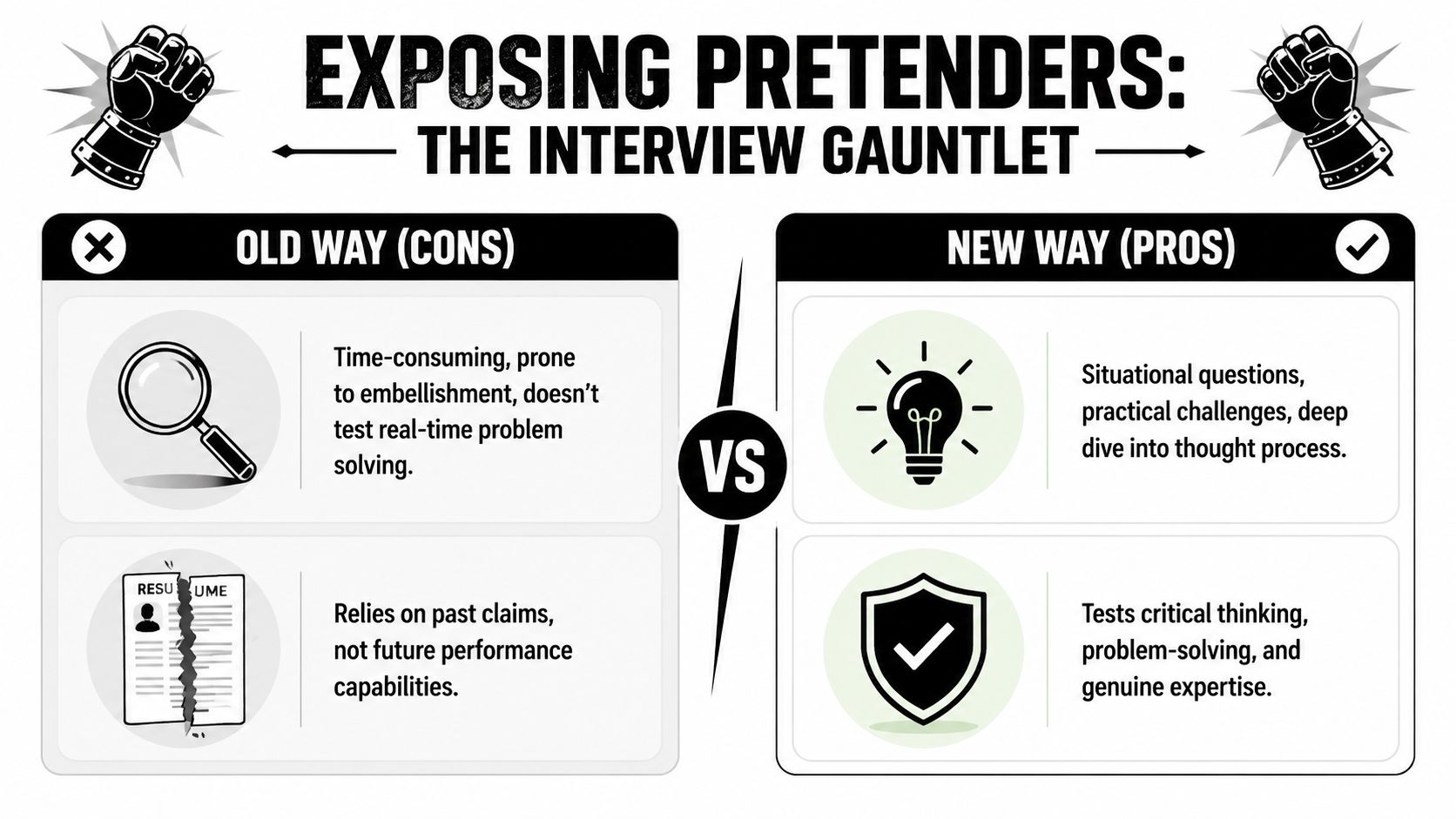
Standard interviews are almost useless for this role.
Ask a candidate about strengths, weaknesses, teamwork, or “how they stay current,” and you'll get polished mush. Everyone claims to be data-driven. Everyone says they love testing. Everyone is apparently “performance-focused.” Amazing coincidence.
You need questions that force the candidate to think in real time.
A proven YouTube workflow is to start broad, then narrow toward the best-performing topics, placements, and creative. That's why one of the best interview prompts is to ask how they'd structure that process and listen for a clear methodology, not guesswork, as described in Quality Score's direct-response YouTube workflow.
Good interview questions sound like this:
“You're launching YouTube for us from scratch. What does your first week look like?”
Listen for tracking checks, offer understanding, audience hypotheses, creative assumptions, format choices, and a test structure. If they jump straight to campaign setup, they're probably tactical, not strategic.
“An ad is getting views, but sales quality is poor. What do you check first?”
Strong candidates will talk about intent mismatch, hook-to-offer alignment, landing page continuity, and conversion tracking integrity. Weak ones will mumble about “letting the algorithm optimize.”
“When do you start broad, and when do you go narrow?”
This is a gold question. A real operator will talk about avoiding early over-optimization, gathering signal before slicing too hard, and narrowing based on observed winners.
“A top ad starts to lose steam. What's your next move?”
You want to hear about isolating fatigue, refreshing angles, swapping hooks, testing a new CTA, or changing placement strategy. Not panic. Not endless bid fiddling.
The best answers sound boring in a good way. Calm. Sequential. Specific.
A solid candidate usually talks in sequences.
They'll say things like: first I confirm tracking, then I review audience quality, then I compare retention and click behavior by creative, then I adjust one major variable at a time. That's the music you want.
A bad candidate speaks in slogans. “I'm always testing.” “I like to move fast.” “YouTube is great for awareness.” Sure. And rain is wet.
Here's a quick cheat sheet:
| Interview signal | Good sign | Bad sign |
|---|---|---|
| Campaign planning | Starts with goal, tracking, audience, creative hypothesis | Starts with platform settings |
| Optimization style | Structured testing, controlled changes | Random tweaks and “best practices” |
| Failure analysis | Diagnoses hook, targeting, placement, landing page | Blames algorithm or seasonality |
| Reporting mindset | Connects media metrics to business outcomes | Hides behind views and reach |
Some responses should save you the rest of the interview.
If you want one more layer of protection, be sure to speak with client references who can confirm how the candidate thinks and performs. Not just whether they were nice. Whether they improved decision-making.
Never hire a YouTube ads specialist off interviews alone.
Talk is cheap. Confidence is free. And some candidates can discuss account structure like they invented paid media, then proceed to light your budget on fire by Tuesday.
That's why I like the paid test project. Small scope. Real thinking. Low drama.
I call it the $500 Hello because it's the cheapest serious insurance policy you'll ever buy.
Don't ask them to build an entire live campaign. That just rewards whoever has the most spare time or the highest tolerance for unpaid labor disguised as enthusiasm.
Ask for a mini strategy instead. Give them a product, a target customer, a goal, and a reasonable amount of context. Then ask for:
An understanding of format sensitivity is vital. YouTube performance varies a lot by format. Average platform CTR is about 0.65%, while in-feed ads can reach 1.0% to 3.0%, according to Marketing LTB's YouTube ads benchmark summary. That's exactly why your test should force the candidate to explain format selection for a business goal. Someone optimizing for clicks should not think the same way as someone optimizing for views.
Send something like this:
You're marketing a B2B software product with a clear demo request goal. Create a lightweight YouTube acquisition plan. Recommend initial audience angles, two to three ad concepts, your preferred formats, and your first testing sequence. Keep it practical. No giant deck. We care more about tradeoffs than polish.
That prompt does two useful things. It rewards judgment, and it exposes fluff.
The candidate who sends twelve slides of generic persona jargon is probably not your person. The candidate who explains why they'd test one educational in-feed angle against one direct-response in-stream concept, and what result would change their next move, now we're talking.
Founders love to say they trust their gut. Fine. Your gut also once approved that “brand awareness” contractor. Let's not repeat history.
Use a scoring rubric.
| Criteria | What to Look For (1-5 Score) | Weight |
|---|---|---|
| Strategic thinking | Clear connection between business goal, audience, format, and creative | High |
| Testing logic | Sequenced plan with controlled variables and decision points | High |
| Creative judgment | Strong hooks, relevant messaging, practical concepts | High |
| Measurement quality | Focus on meaningful signals, not vanity reporting | Medium |
| Communication | Clear, concise, commercially useful recommendations | Medium |
Pay for the test. Good people notice when you respect their time.
You're not trying to get free work. You're trying to reduce hiring risk. The best candidates usually appreciate that. It shows you're serious, and it gives them room to show how they think when the brief is messy, which is exactly what the actual job looks like.
A good hire can still fail in a bad setup.
This happens constantly. A company finally finds someone sharp, then hands them a half-broken account, patchy access, muddy goals, old creative, and a reporting process built by committee. Three weeks later everyone's annoyed, and nobody knows whether the problem is the specialist or the circus.
Set the role up properly.
A YouTube ads specialist shouldn't have to spend their first week chasing logins and guessing what happened before they arrived.
They need access to Google Ads, YouTube, analytics, landing pages, CRM visibility, historical performance, and existing creative assets. They also need the ugly truth. Which offers have worked, which audiences have disappointed, what sales says about lead quality, and where attribution gets fuzzy.
If you hide the mess, they can't fix the mess.
One of the biggest onboarding mistakes is using shallow KPIs because they're easy to read in a slide deck.
A strong specialist should judge success with a full measurement stack that includes view count, watch time, CTR, conversion tracking, and brand lift, not views alone, as explained in JDR Group's guidance on measuring YouTube ads. The practical point is simple: focus your KPI framework on conversion evidence, then use the rest of the stack to diagnose why performance is good or bad.
Here's a sensible way to view it:
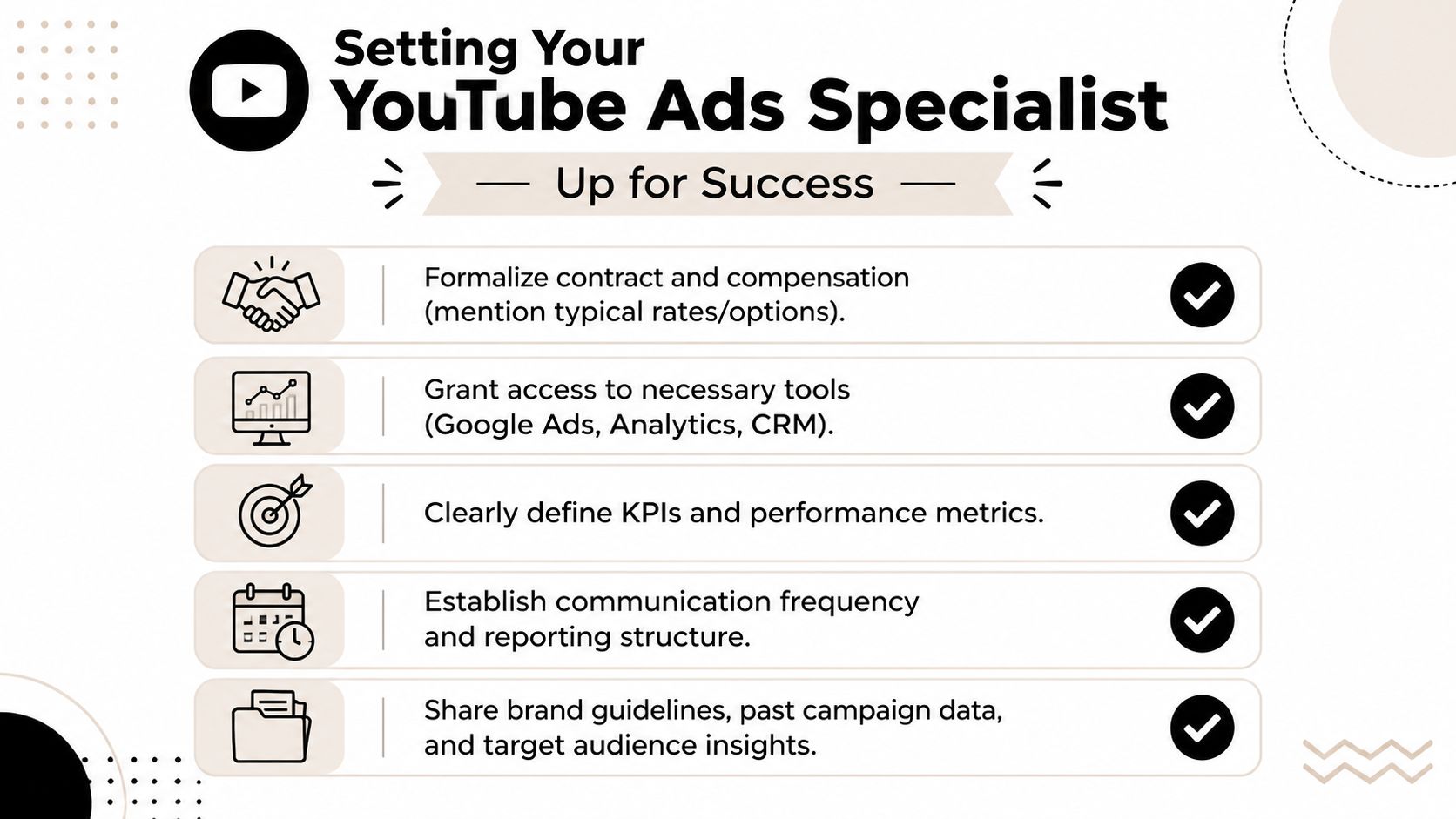
This role works best when expectations are explicit.
Agree on how often they report. Agree on what they own and what they advise on. Agree on how creative gets approved, who can change budgets, and what happens when a campaign underperforms. If five stakeholders can randomly rewrite ads or kill tests halfway through, don't act surprised when the account becomes soup.
A useful onboarding checklist looks like this:
The right YouTube ads specialist won't just manage campaigns. They'll improve the quality of your decisions. But only if you give them a setup that allows honest measurement, fast iteration, and zero nonsense.
If you want to skip the resume theatre and meet pre-vetted paid media talent fast, HireMediaBuyers.com is built for exactly that. You can find YouTube ads specialists and other paid ads operators without turning your week into a full-time screening project.


