


You're probably in that dangerous phase right now. The media buyer interviews well, throws around acronyms like confetti, shows polished screenshots, and somehow makes burning five figures a month on ads sound like a personality trait.
Then the ugly part starts.
Your Meta account gets hit for repeated policy violations. A stock photo owner sends a nasty letter. A former contractor still has access to your Google Ads account and your customer list. Or your “freelancer” starts looking suspiciously like an employee right when tax and labor questions show up. That's when founders realize a compliance check isn't HR theater. It's asset protection.
I learned this the hard way. The expensive part of a bad media buyer hire usually isn't weak performance. You can survive mediocre ROAS for a while. The primary damage comes from platform bans, data misuse, IP disputes, and sloppy documentation that turns one bad hire into legal and financial fallout.
Most hiring advice is useless here. It tells you to “verify experience” and “check references.” Cute. That won't save your ad account, your customer data, or your ownership rights over the campaigns you paid for.
This is the founder's version of a compliance check. Not the fluffy version. The version you build after you've had enough of avoidable chaos.
It starts on a normal Tuesday. Spend is up. Results look good. Then Legal forwards an email about unauthorized image use, your Meta rep flags repeated policy issues, and someone realizes a freelancer still has access to your ad accounts and customer audiences.
That is the actual failure mode with media buyers.
A weak hire wastes budget. An undisciplined hire can get your accounts restricted, your data mishandled, and your business dragged into an expensive mess you could have prevented with basic controls.
Founders miss this because they screen for performance theater. The candidate knows the jargon, has polished dashboards, and can explain testing strategy without blinking. Fine. None of that tells you whether they know how to run paid media without creating legal exposure.
The questions that matter are uglier and far more useful:
One sentence should make you nervous every time: “I just focus on performance.”
That usually means they treat compliance as somebody else's cleanup job.
A real compliance check looks at behavior. Did this person leave behind account warnings, access confusion, undocumented asset use, or audience sourcing nobody can explain clearly? Did they create clean systems that survive after they leave? Those are operating habits, not interview answers.
Media buyers touch the parts of your business that break expensively. Ad accounts. Customer data. Creative rights. Brand claims. If you skip compliance because the candidate looks sharp and talks fast, you are not hiring talent. You are buying a bigger blast radius.
Your media buyer is crushing CAC. Then a platform suspension hits, a customer list shows up in another ad account, and your lawyer asks a basic question you should have answered months ago. Who owned what, who had permission, and what were they allowed to do?
If your answer is buried in DMs, invoice notes, and a freelancer template you downloaded at 11:40 p.m., you built risk into the role from day one.
Start with classification, because a sloppy setup poisons everything that follows.
Founders love calling media buyers contractors because it feels fast and cheap. That only works when the arrangement behaves like contract work. If you set their hours, dictate their process, fold them into daily management, and treat them like staff, papering it over with invoices is amateur hour.
Use this rule. If the person operates as part of your company, classify and document them accordingly. If they deliver a defined scope with real independence, a contractor setup can work. If you need help structuring that correctly, review these social media contractor agreement models and classification basics before your lawyer drafts anything.
| Relationship | Usually fits when | Risk if you fake it |
|---|---|---|
| Contractor | Specialized work, defined scope, limited control over how the work gets done | Misclassification arguments, tax mess, contract gaps |
| Employee | Ongoing role, direct supervision, embedded in your workflow and decision chain | Higher admin load, labor law obligations, more formal management burden |
Classification matters. But media buying risk gets expensive in places standard HR paperwork barely touches.
Generic freelancer agreements are useless here. “Marketing services” is not a real scope. It does nothing when a buyer walks off with account access, reuses your audience logic somewhere else, or claims the winning creative system belongs to them.
Write the agreement around the assets and permissions that create risk:
This is the stuff that saves you when performance turns into a legal bill.
A signature helps in a dispute. It does not run the business.
You still need basic compliance mechanics tied to the role. Who approves list uploads. Who can create audiences from first party data. Where creatives are stored. Who can connect domains, pixels, and conversion events. How fast access gets cut when the relationship ends.
That is what protection looks like in media buying. Clear documents backed by real operating procedures.
Your paperwork should lock down four things:
Miss one, and the contract becomes decoration.
A portfolio is a sales document. A live ad account is evidence.
That's the shift. Stop asking media buyers to impress you with screenshots and start asking them to walk you through the guts of a real account. Read-only access beats a polished deck every time.

ROAS can hide a lot of sins. So can screenshots with nice date ranges.
When you review a current account, look for operational discipline:
A serious operator will have war stories. They'll explain what happened, what policy issue triggered it, what they changed, and how they prevented a repeat. A reckless one will either claim they've never had an issue or blame the platform for everything. Neither answer is comforting.
I like asking questions that make bluffing painful:
That last one matters more than people think. Good media buyers build repeatable guardrails. Bad ones rely on instinct until the account gets throttled.
If they can explain optimization but can't explain account safety, they're not a growth asset. They're a volatility asset.
There's a broader reason to run this kind of scrutiny before problems appear. In alcohol enforcement research, a compliance check in the prior 30 days was associated with a 61% reduction in the odds of pseudo-underage sales, according to the study on compliance check deterrence effects. That matters because proactive checks don't just catch bad behavior. They change behavior.
The same principle applies to media buying. When people know you inspect account structure, rejection history, claim substantiation habits, and tracking integrity, the cowboys tend to self-select out. Good. Save the theatrics for TikTok.
Not “perfect.” That's fake.
A clean account looks like someone competent has been making deliberate decisions, documenting them, and respecting platform boundaries while still getting work done. There will be rejections sometimes. There will be policy friction. The question is whether the media buyer treats those moments like operational signals or personal insults.
That's the compliance check. Not shiny slides. Not charisma. Evidence.
Here, founders get robbed politely.
A media buyer doesn't need to steal your bank login to damage your business. They just need loose rules around data, audiences, pixels, creative assets, and account access. If ownership isn't nailed down and operational behavior isn't checked, you can end up paying to build an asset that walks out the door.
A candidate can say all the right things about GDPR, CCPA, consent, suppression lists, and acceptable use. Nice. I've heard excellent compliance language from people who handled data like it was a communal snack bowl.
The issue is the gap between policy and operations. The U.S. Department of Labor warns that plans can look compliant “on paper” while failing “in practice,” and recommends validating operations through sampling, pattern review, and decision analysis in its mental health parity self-compliance tool.
That same logic belongs in paid media.
Don't ask, “Are you familiar with privacy rules?” That's a useless interview question. Ask operational questions that force specifics.
If they answer vaguely, they either don't know or don't want you looking too closely. Neither option is hireable.
You want a simple ownership map, not legal poetry.
| Asset | Should be owned by |
|---|---|
| Ad accounts and business manager assets | Your company |
| Pixels, tags, analytics properties | Your company |
| Customer lists and audience inputs | Your company |
| Creative produced under your contract | Your company, unless explicitly carved out |
| Campaign documentation and testing history | Your company |
Notice what's missing. “Whoever set it up.” That myth has caused more nonsense than any founder should tolerate.
If the media buyer creates the account under their own business profile and “shares access later,” you've already lost leverage.
A real compliance check here looks like spot testing:
This is not paranoia. This is normal adult supervision for a role that touches your acquisition engine and customer information.
The silent killer in paid media isn't always bad performance. Sometimes it's discovering that the person you paid to grow your business built an advantage for themselves out of your data and IP.
By this point, the obvious stuff should already be handled. Contract signed. Scope defined. Access plan mapped. Good.
Now pay attention to the softer signals. Here, future compliance headaches start whispering before they start billing you.
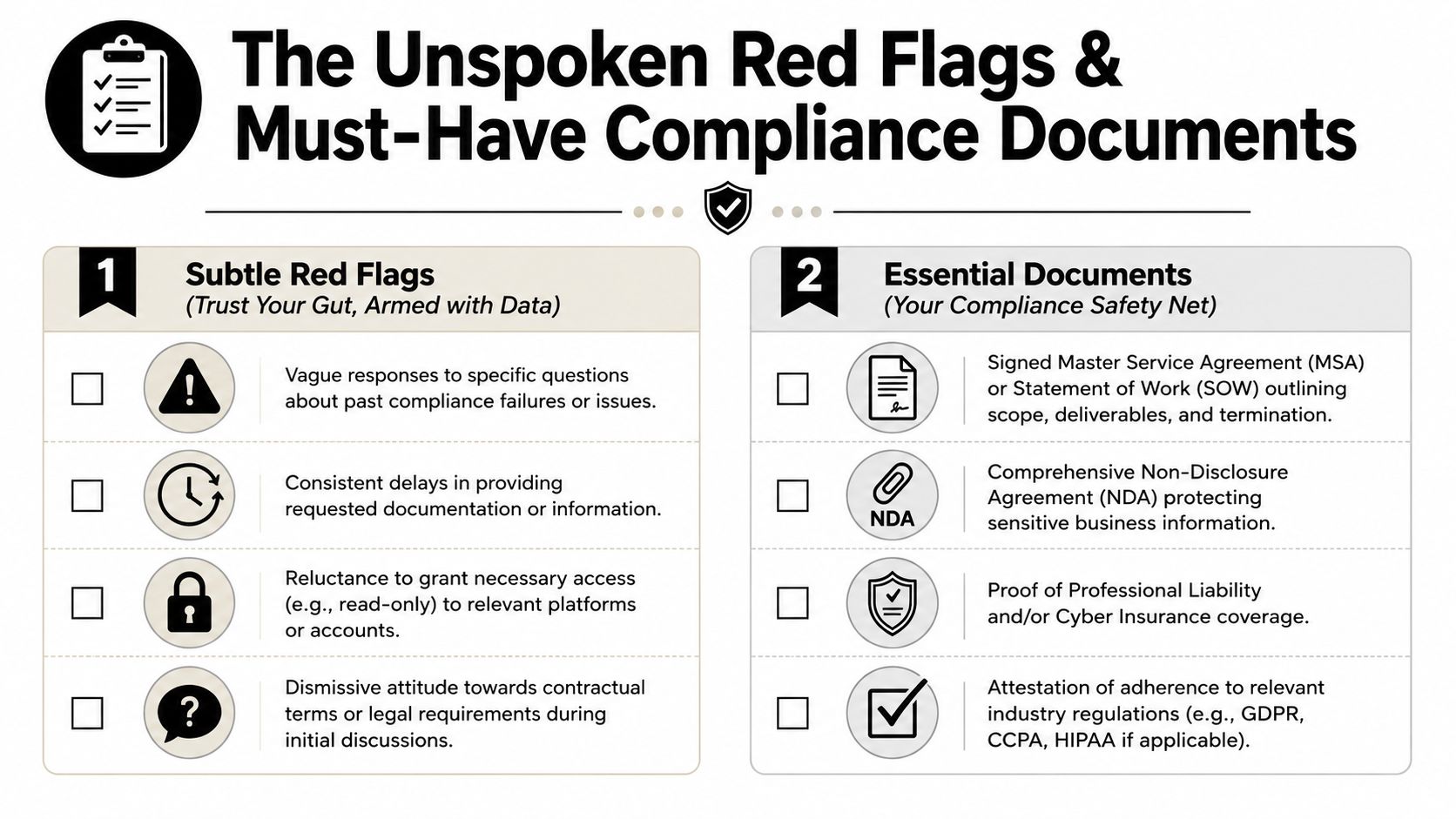
You're not looking for one dramatic smoking gun. You're looking for patterns.
Some of my least favorite signals:
None of these prove fraud. Together, they often predict operational pain.
Frequently, most hiring processes get lazy. They collect documents and mistake completion for safety.
A stronger model tracks leading indicators like control test failure rate, incident volume, and mean time to issue resolution. The key benchmark isn't whether boxes were checked. It's whether failures and resolution times are improving over time, as explained in this guide to compliance risk metrics.
That translates well to media buying. If someone takes forever to resolve access issues, policy clarifications, billing errors, or tracking discrepancies during hiring, don't expect them to become magically organized once they're inside your accounts.
You don't need a bloated admin ritual. You need a clean file.
Use this checklist:
Slow compliance during hiring usually becomes slower compliance after access is granted.
If a media buyer is hard to verify before they have your money, data, and account access, they'll be harder to manage after they have all three.
That's not cynicism. That's pattern recognition.
Your new media buyer launches fast, performance looks good for two weeks, then Meta freezes the ad account, your pixel is firing into the wrong properties, and a former client emails claiming they found their creative running in your campaigns. Now you are not dealing with a hiring mistake. You are dealing with platform risk, privacy exposure, and a paper trail that may or may not protect you.
You can build your own compliance process. Plenty of founders do. You can write classification rules, tighten contracts, review account history, test how candidates handle data, verify asset ownership, collect documents, and set up recurring checks. You can also spend half your week doing account forensics because one smooth-talking operator knew how to sell confidence better than discipline.
That is a bad use of founder time.
Founders miss risk when they screen by instinct. Good talkers get extra credit. Busy teams skip checks. Urgency lowers standards. Then the mess shows up inside your ad accounts, your CRM, and your billing stack.
A system catches what charisma hides.
The EPA's Office of Enforcement and Compliance Assurance explained that agencies use random sampling and selective random inspections to measure compliance across large groups in its report on statistical methods for measuring compliance. The lesson is simple. Real oversight uses repeatable inspection logic. It does not depend on memory, vibes, or whether the founder had enough sleep before the interview.
That is the shortcut. Use a repeatable screen that tests the same failure points every time, especially the expensive ones in media buying: policy violations, sloppy data handling, and asset theft.
Keep the parts that prevent operational damage:
A one-time review is weak protection. Media buying risk is operational. It shows up in the daily work.
If your hiring process treats compliance like HR paperwork, you are screening for the wrong problem. The damage usually comes later, inside platform terms, consent flows, audience handling, creative ownership, and account permissions. That is where fines, bans, disputes, and ugly client conversations start.
The media buyer who respects platform rules, documents decisions, keeps data clean, and leaves every asset under company control is easier to scale. The one who treats compliance like a nuisance will cost you money long after the ROAS screenshot stops looking cute.
Founders who ignore this pay twice. Once for the hire. Once for the cleanup.
If you want the fast version without building your own compliance machine, HireMediaBuyers.com is built for exactly this problem. It helps companies hire pre-vetted media buyers without getting dragged into tax confusion, contract sloppiness, or account-risk roulette. You get a curated path to talent, with the hiring and compliance heavy lifting handled upfront, so you can focus on growth instead of cleaning up someone else's mess.


