


The worst advice in marketing right now is also the most popular: “Just collect more first-party data.”
No. That's how teams end up with a bloated CRM, three half-configured tools, a popup nobody likes, and a media buyer exporting CSVs like it's 2013. Data by itself doesn't fix paid acquisition. Useful data, connected to bidding and creative decisions fast enough to matter, does.
That's the problem. Most companies don't have a first party data strategy. They have a storage problem dressed up as strategy. They unify data in a dashboard, pat themselves on the back, then wonder why Meta and Google still feel blind.
I've seen this movie enough times to know the villain. It's not privacy changes. It's not the cookie funeral parade. It's the gap between data collection and data activation. Your site knows someone viewed a product twice, started checkout, and chatted with support. Your ad platforms know… basically none of that in a way they can act on cleanly.
Every conference deck says the same thing. Cookies are fading, privacy is tightening, and brands need owned data. Fine. We all agree. But “go collect first-party data” is still lazy advice.
According to EMARKETER coverage cited by StackAdapt, 27% of marketers are specifically focusing on using first-party data to enhance paid advertising campaigns in 2026. That tells you where the market is heading. It does not tell you how to stop your paid team from flying blind next quarter.
The common assumption is that collecting more customer data automatically makes your ads better. It doesn't. If that data sits in Shopify, HubSpot, Klaviyo, Zendesk, GA4, and a CDP that nobody has piped into Meta Conversions API or Google audience workflows, you've built a museum. Nice exhibits. Zero urgency.
Practical rule: If your media buyer has to manually pull a list before launching a “personalized” campaign, your first party data strategy is still broken.
A real first party data strategy does three things:
That last part is often where many stumble.
Media buyers get frustrated for good reason. They're told “we have great first-party data,” then they log into ad accounts and find broad audiences, stale exclusions, weak seed lists, and no reliable signal for purchase intent. Hope you enjoy spending your afternoons cleaning lists and apologizing for blended performance reports, because that's now your side hustle.
A working first party data strategy isn't about hoarding more rows in a database. It's about making paid channels smarter, faster, and less wasteful.
Before you launch another popup, add another tracking script, or buy a shiny CDP demo, stop.
Many organizations collect data like they're preparing for a digital apocalypse. Email. Scroll depth. Quiz answers. Support logs. Coupon clicks. Wishlist behavior. Great. Why? Silence. Just vibes.

A first party data strategy should start the same way a good road trip starts. Pick the destination before you pack the trunk. If the business goal is to increase average order value, your data priorities are different from a SaaS company trying to reduce sales-qualified lead waste. If the goal is retention, your media team needs totally different signals than if the goal is prospecting efficiency.
Don't ask, “What data can we collect?”
Ask, “What does the paid team need to know to make a better decision?”
That usually boils down to a short list:
That's it. Not sexy. Very profitable.
You do not need every possible event under the sun. You need the smallest useful set of data that can improve acquisition decisions. I call this the minimum viable signal set.
Here's a simple way to map it:
| Business goal | Paid signal you need | Likely data source |
|---|---|---|
| Increase average order value | Product affinity, bundle interest, repeat purchase behavior | Shopify, CRM, on-site behavior |
| Reduce lead waste | Job role, company fit, demo intent, disqualifying actions | Forms, CRM, sales notes |
| Improve retargeting | Cart stage, category viewed, support objection | Site events, support platform |
| Improve prospecting | Seed list of best customers, not all customers | CRM, order history |
| Improve retention | Time since purchase, product usage, support satisfaction | CRM, app data, support logs |
Notice what's missing. Vanity data. “Someone read three blog posts” is occasionally useful, but it's not sacred. A lot of teams are drowning in data points that never change a bid, budget, or audience rule.
The right question isn't “Can we collect this?” It's “Will a buyer do anything differently because this exists?”
Most brands already have enough raw material to make their paid campaigns better. They just haven't sorted it by usefulness.
Review the systems you already own:
Then make one ruthless decision. Keep only the signals tied to a measurable ad use case.
Discipline matters. A founder or CMO has to say no. Otherwise engineers spend weeks piping low-value events into a warehouse while your ad account still can't distinguish a loyal buyer from a coupon goblin.
Your first party data strategy should fit on one page:
If it can't be summarized that straightforwardly, it probably isn't a strategy yet. It's a project backlog.
Customers aren't dumb. They know their data has value. They also know when a brand is offering a sad little discount in exchange for way too much information.
That old playbook is tired.
A study by Jack Morton, referenced by Contentful's write-up on first-party and zero-party data, found that 48% of customers are comfortable sharing their personal data when they perceive a clear, transparent value exchange, such as receiving exclusive discounts or personalized content. That number matters because it tells you trust is earned at the moment of ask, not buried in your privacy policy footer.
Most data capture fails for two reasons:
If someone lands on your site cold and your first move is “Give us your email for updates,” don't act shocked when conversion stinks. That isn't a value exchange. That's administrative paperwork.
A better ask matches the visitor's intent.
For example:
Different moments. Different asks. Different payload.
The best first party data collection feels like a service. It helps the user make a decision, reduce risk, or get a better experience.
Try these instead of the tired “10% off” trap:
If your tracking setup is messy, clean that up while you're here. A value exchange only matters if the resulting data feeds usable measurement. Sane conversion tracking systems save a lot of pain later.
Ask for the minimum information needed to improve the next interaction. You can always earn the right to ask for more later.
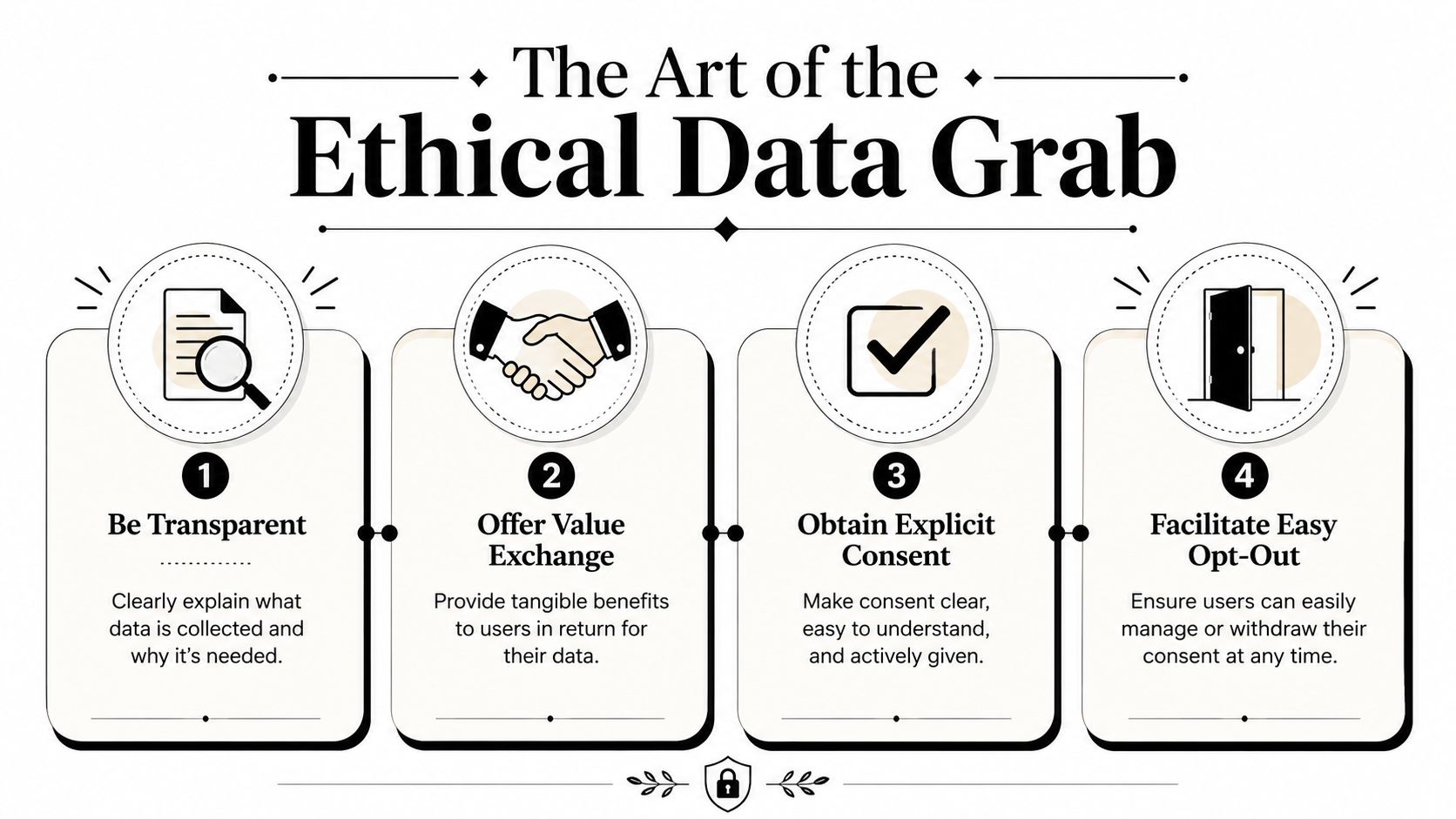
A lot of brands talk about ethics and then deploy dark patterns with a smile. Don't.
Here's the tighter version:
Be plain about the ask
Say what you're collecting and why. Normal human language. No legal fog machine.
Give something specific back
“Personalized recommendations” is better than “join our newsletter.” “Early access to the category you browsed” is better than “stay updated.”
Use explicit consent
If people can't tell what they're agreeing to, your setup is sloppy.
Let people opt out without a scavenger hunt
If unsubscribing feels like escaping a hedge maze, you're burning trust for short-term list growth.
Here's the irony. Ethical collection usually performs better because it lowers resistance. People don't mind sharing when the exchange is obvious and respectful. They mind being tricked.
And yes, this takes more thought than slapping a popup on every page. That's the point. Cheap shortcuts create junk data. Junk data creates bad segments. Bad segments waste budget.
Let's talk about Jane.
Jane clicks a Google Shopping ad, browses two products, leaves, comes back from an email, starts checkout on her laptop, chats with support on her phone, buys in store, and later opens a loyalty email. In most companies, Jane now exists as a pile of disconnected records.
She's an anonymous browser in GA4.
A contact in HubSpot.
A customer in Shopify.
A support ticket in Zendesk.
An email profile in Klaviyo.
To a media buyer, that fragmentation is brutal. You can't suppress her from acquisition properly, can't retarget her based on real status, and can't build quality audiences from a full customer picture because there isn't one.
Identity resolution earns its keep. The job isn't glamorous. It's just the hard, necessary work of deciding which events, emails, devices, and transactions belong to the same person.
A lot of teams think buying a CDP solves this automatically. Sometimes it helps. Sometimes it just gives you a more expensive place to admire the mess.
A useful system should do more than stitch email addresses together. It should help connect anonymous behavior to known customer records once someone identifies themselves, and it should make those profiles accessible to the teams that need them.
According to Fullstory's discussion of first-party data strategy, 85% of marketers rely on first-party data as their primary source, yet unifying that data remains a common pitfall. The same piece notes that email lists can deliver a 29% higher engagement rate compared to third-party alternatives. That's the giveaway. Direct data is powerful, but fragmented direct data still leaves money on the table.
Not every field deserves a seat at the table. The profile should answer questions your paid team can act on.
Think in layers:
Identity layer
Email, customer ID, device or session linkages where appropriate and consented
Behavior layer
Viewed categories, cart actions, content interest, repeat visits
Commercial layer
Purchase frequency, average basket patterns, refund flags, subscription status
Lifecycle layer
New lead, qualified prospect, first-time buyer, repeat buyer, churn risk
Activation layer
Which ad audiences this person belongs in, and which ones they must be excluded from
For teams trying to understand what influenced a conversion across channels, this work gets far easier when you have cleaner multi-channel attribution tied to resolved identities rather than channel-specific guesswork.
A customer journey isn't messy because customers behave badly. It's messy because companies store truth in too many places.
Seasoned operators, myself included, get a little grumpy when too many companies buy enterprise tooling before deciding what identity problem they're solving.
If you only need to unify ecommerce behavior, CRM status, and email engagement, don't build a moon base. Start with the systems that influence revenue fastest. Get one high-value identity graph working. Then expand.
The smartest path usually looks like this:
You're not trying to create the world's most beautiful customer record. You're trying to give your ad platforms a cleaner version of reality.
That's a very different brief.
Here's where most first party data strategies die.
The brand finally unifies data. The CDP looks polished. Dashboards are gorgeous. Everyone says “single customer view” in meetings like they've joined a very expensive wellness retreat. Then the paid team still uploads stale lists by hand.
That's the Data Silo Intersection Paradox. Teams solve storage and reporting, but not activation. So the customer profile gets smarter while the ad account stays dumb.
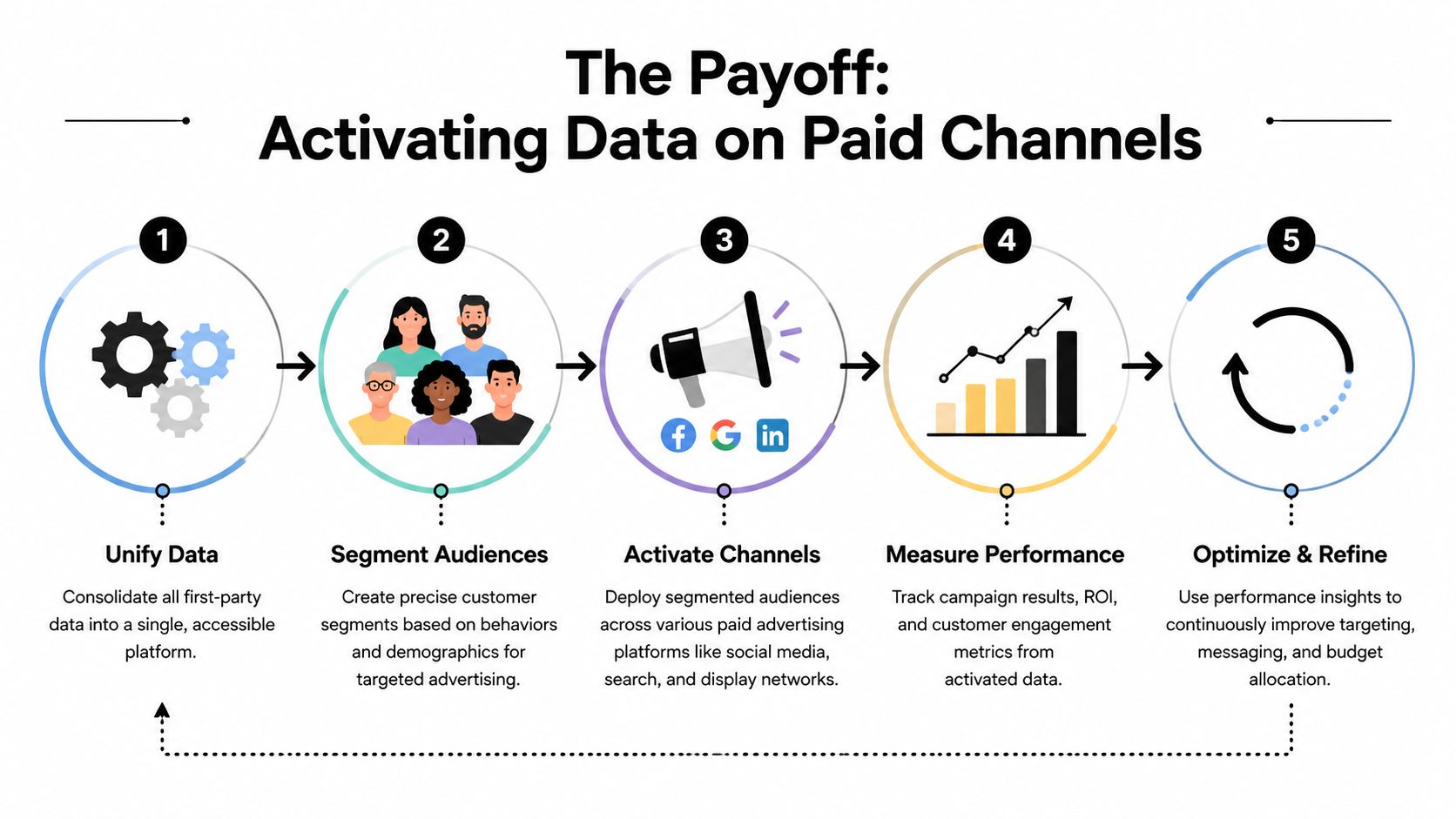
If you want a first party data strategy that improves paid media, the handoff into Meta, Google, and the rest can't be an afterthought. It has to be part of the design from day one.
Activation is simple to describe and annoyingly hard to operationalize. A real customer signal should trigger a real paid media action.
Examples:
This is why the “we have the data in our warehouse” line is useless to media buyers. Warehouses don't buy impressions. Platforms do.
You do not need a thousand automations. You need a small number of reliable ones.
A sane activation flow looks like this:
The weak point is usually step four. Manual exports break cadence. Naming gets sloppy. Match rates drift. Buyers stop trusting the segments. Then everyone slides back to broad targeting and vibes.
According to The Marketer's Guide to First-Party Data, first-party data can improve ROAS by up to 30% when offline and online data are connected for cross-channel strategies. That “when” matters. The lift doesn't come from owning data. It comes from connecting and activating it.
Don't boil the ocean. Start with use cases that have immediate buying impact.
Suppression of existing customers from acquisition
One of the dumbest leaks in paid media is paying to reacquire someone who already bought and should be in retention.
High-LTV seed audiences
Build prospecting inputs from your best customers, not your entire customer file.
Cart and browse retargeting by category or margin
Not all abandoners deserve the same follow-up. Segment by product type, price sensitivity, or purchase history.
Lead quality feedback loops
Push CRM outcomes back into platform signals so bidding learns from actual quality, not just form completions.
Creative personalization using declared preferences
If a user told you what they want, use that to shape the ad angle instead of pretending all traffic is interchangeable.
If you're refining these segments for paid social, stronger audience segmentation workflows usually beat bigger audience lists. Bigger is often just sloppier.
The ad platform doesn't need your whole database. It needs the right signal, mapped to the right action, at the right time.
That's the payoff. Not another dashboard. Better bidding inputs, cleaner exclusions, smarter retargeting, and more relevant creative.
Toot, toot.
Strategy is lovely. Execution pays the bills.
If you want your first party data strategy to start working this week, don't wait for a full replatform. Start with the assets already sitting in your business and force them into a few practical workflows.
First, the table your media buyer needs.
| Quick Win | What You Need | Expected Impact |
|---|---|---|
| Exclude existing customers from prospecting campaigns | Customer list from CRM or ecommerce platform, refreshed on a set schedule | Cleaner acquisition spend and less budget wasted on people who already converted |
| Build a best-customer seed audience | A defined list of high-value or repeat customers | Better prospecting quality than using all purchasers as a seed |
| Split cart abandoners by product category | Basic ecommerce event data and product taxonomy | More relevant retargeting messages and offers |
| Feed CRM lead status back to paid channels | Sales-qualified and disqualified status mapped to campaign source | Better optimization toward quality, not just volume |
| Add a post-purchase survey | Simple survey tool and one or two useful questions | Richer zero-party data for retention and upsell messaging |
| Audit duplicate and missing profile fields | Access to CRM, CDP, or spreadsheet export | Cleaner segmentation and fewer activation errors |
None of these require a battalion of data engineers. They require ownership.
Many teams struggle at this point. Everyone likes the upside of first-party data. Nobody wants the operational chores.
Assign clear ownership:
Marketing lead or founder
Chooses business priorities and approves the use cases that matter
Media buyer
Defines which audience segments, exclusions, and feedback loops improve campaign performance
Ops or analytics person
Handles data mapping, field hygiene, and sync logic
CRM or lifecycle owner
Maintains source-of-truth customer statuses and preference data
If one person wears three hats, fine. That's normal. Just don't leave it floating between teams like a group project nobody volunteered for.
A first party data strategy should be judged by operating metrics, not by how many fields your CDP contains.
Track things like:
And then keep cleaning. According to Supermetrics' guidance on first-party data strategy, a successful approach is not “set and forget”. It requires constant optimization and regular audits because incomplete data can produce biased insights. That's not glamorous work, but it's where durable performance comes from.
Good data decays. Good systems catch the decay before your campaigns pay for it.
If I were setting this up from scratch, I'd run a cadence like this:
Weekly
Review segment syncs, broken mappings, and audience exclusions
Monthly
Check lead quality by source, customer suppression logic, and creative relevance by segment
Quarterly
Audit profile fields, remove junk properties, and reassess which signals deserve activation
That's enough to stay sharp without turning your team into full-time spreadsheet archaeologists.
The teams that win here aren't the ones with the most data. They're the ones that turn a few reliable customer signals into faster, smarter paid decisions.
If your team has the strategy but not the hands to execute it, HireMediaBuyers.com can help you find pre-vetted media buyers and paid ads specialists who know how to turn first-party data into actual campaign performance, not just prettier reporting.


