


Most advice on how to hire a copywriter is terrible. It tells you to post a vague job ad, collect a pile of shiny portfolios, and trust your gut. That's how you end up paying for elegant sentences that do absolutely nothing for your pipeline.
Good copy changes how prospects understand you, trust you, and buy from you. Bad copy does the opposite. It muddies your offer, weakens your positioning, and makes your brand sound like it was assembled by committee after a long lunch.
I've hired enough writers to know the pattern. The failure usually starts before the first interview. The role is fuzzy. The brief is fluffy. Nobody agrees on what “good” means. Then everyone acts shocked when the writer misses the mark. Toot, toot.
Here's the blunt version. Hiring a copywriter is not a content task. It is a revenue decision, a positioning decision, and a brand control decision rolled into one.
Bad copy does not sit politely on the page. It confuses prospects, weakens paid performance, drags down conversion rates, and makes your company sound less credible than it is. Then the team blames traffic, the offer, the funnel, or the market, because admitting the messaging is broken hurts people's feelings.
A strong writer fixes more than wording. They tighten how you explain value, shape how buyers judge your competence, and give sales and marketing a cleaner path to conversion. That is why this hire punches above its weight.
The failure usually starts earlier than people think.
Companies rush into interviews before they run a pre-audit of the assets that already exist. They skip the ugly but useful work of identifying which page, funnel, or campaign is bleeding. They refuse to set a test budget, so they gamble on portfolio samples and chemistry instead of seeing how someone works. If you want a better system, use a skills-based hiring process for marketing roles and judge people on outcomes, not polish.
You also need to stop pretending all copywriters are interchangeable. The writer who can sharpen a homepage message is not automatically the one who can build a sales sequence, repair onboarding copy, or write ads that survive paid traffic scrutiny. Add AI to the mix and the mess gets worse. Now you are not just hiring for writing skill. You are hiring for judgment. Can this person use AI for research, variants, and speed without giving you generic sludge? That question belongs in the hiring process from day one.
Hire for one business problem, one primary asset, and one standard of proof.
That discipline saves money.
It also exposes the hidden costs of a sloppy hire. You do not just lose the writer's fee. You lose review time from marketing, revisions from product, approval cycles from leadership, wasted design handoffs, delayed launches, and performance spend sent to pages that were weak from the start. A cheap writer who needs endless fixing is expensive. A pricey writer with a clean process, a sharp diagnostic eye, and fast ramp-up is often the bargain.
Here's what chaos looks like in the wild:
The fix is simple. Run hiring like an operator, not an optimist.
Before you choose anyone, decide what asset matters most, what business problem it has, what a paid test should cover, and who approves the work. Set aside a real test budget. Ask candidates how they use AI, where they refuse to use it, and how they verify claims. Score them on clarity, diagnosis, revision logic, and reliability. Save the templates, scoring rubrics, and interview questions for the later stages of this process, but get the operating logic right here.
If you miss on this hire, your brand gets noisier, weaker, and harder to trust. If you get it right, everything downstream gets easier.
Most job posts for copywriters read like someone dumped a marketing glossary into a blender. “Need a rockstar storyteller who understands SEO, performance, brand, email, CRO, paid social, web strategy, UX, and thought leadership.” Lovely. You're not hiring a copywriter. You're writing fan fiction.
The fastest way to hire a copywriter well is to decide what kind of writer you need.
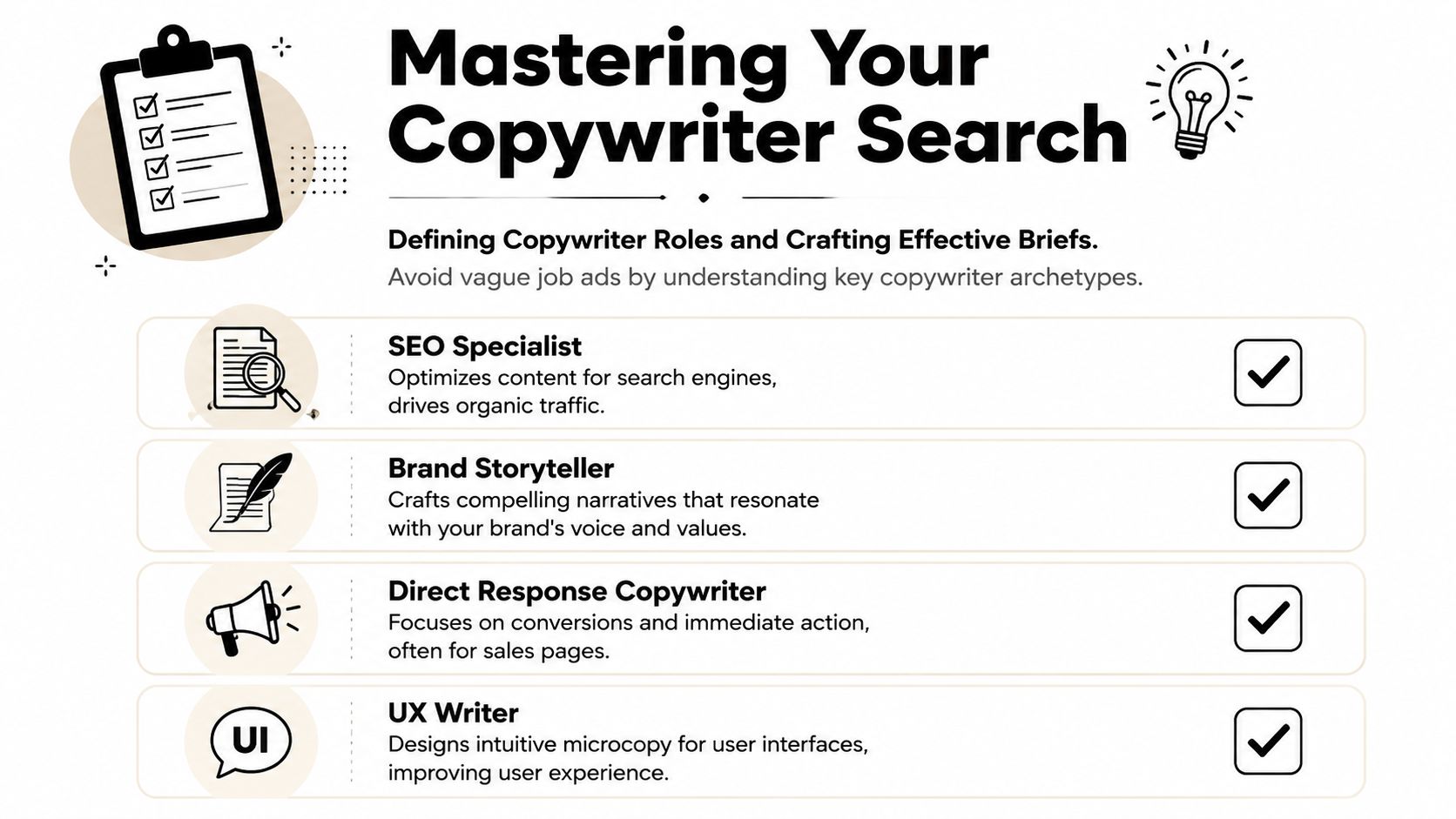
Here's the practical version:
SEO specialist
Best when you need search-focused articles, category pages, and content that answers demand already in the market.
Brand storyteller
Best when your company sounds generic and needs a sharper voice, clearer narrative, and stronger differentiation.
Direct response copywriter
Best for sales pages, landing pages, email promos, and campaigns where the copy must push action now.
UX writer
Best for product flows, onboarding, tooltips, form fields, and all the little words users only notice when they're terrible.
If you're trying to build a cleaner hiring process, a skills-based hiring approach is the sane move. Fancy resumes and clever bios don't tell you whether someone can write a pricing page, tighten a checkout flow, or structure a landing page that doesn't wander off into the woods.
A strong brief beats a clever ad. Every time.
Use language like this:
Role focus
We need a conversion-focused copywriter to rewrite our core landing page. Success means clearer audience targeting, stronger CTA flow, better objection handling, and copy that our paid traffic can hit without confusion.
That's useful. This isn't:
Need a versatile copywriter to elevate our content across channels.
Improve it where? Toward what? With whose voice? Based on what evidence? That sentence should be tried at The Hague.
Give candidates a short working brief with blanks they can fill in mentally before they ever pitch.
Business model
What you sell, who buys it, and how the buying decision usually happens.
Asset being rewritten
One page, one sequence, or one campaign. Keep it narrow.
Audience
Name the buyer, not “everyone.” If your audience line sounds like a conference badge, rewrite it.
Main problem
One sentence per page. Be blunt.
Desired action
Click, book, buy, reply, start trial, request demo. Pick one.
Brand voice guardrails
What you should sound like, and what you absolutely shouldn't.
Known objections
Price, trust, switching pain, confusion, internal approval. Bring the specifics.
Reference material
Existing pages, call transcripts, founder notes, customer language, support logs.
Three things make briefs worse:
A tight brief doesn't limit a strong writer. It gives them something worth solving.
The lazy hiring move is posting on a giant freelance board and calling it a search strategy. What you bought is a review queue. If you want a copywriter who can sharpen positioning, protect brand voice, and ship work without a babysitter, go where strong operators already have a reputation to lose.
The best hires usually come from smaller circles with tighter feedback loops. Writers who are good at conversion work, lifecycle email, technical SaaS, or founder-led brand copy rarely depend on public cattle calls. They get passed around by people who have already seen them hit deadlines and improve revenue pages.
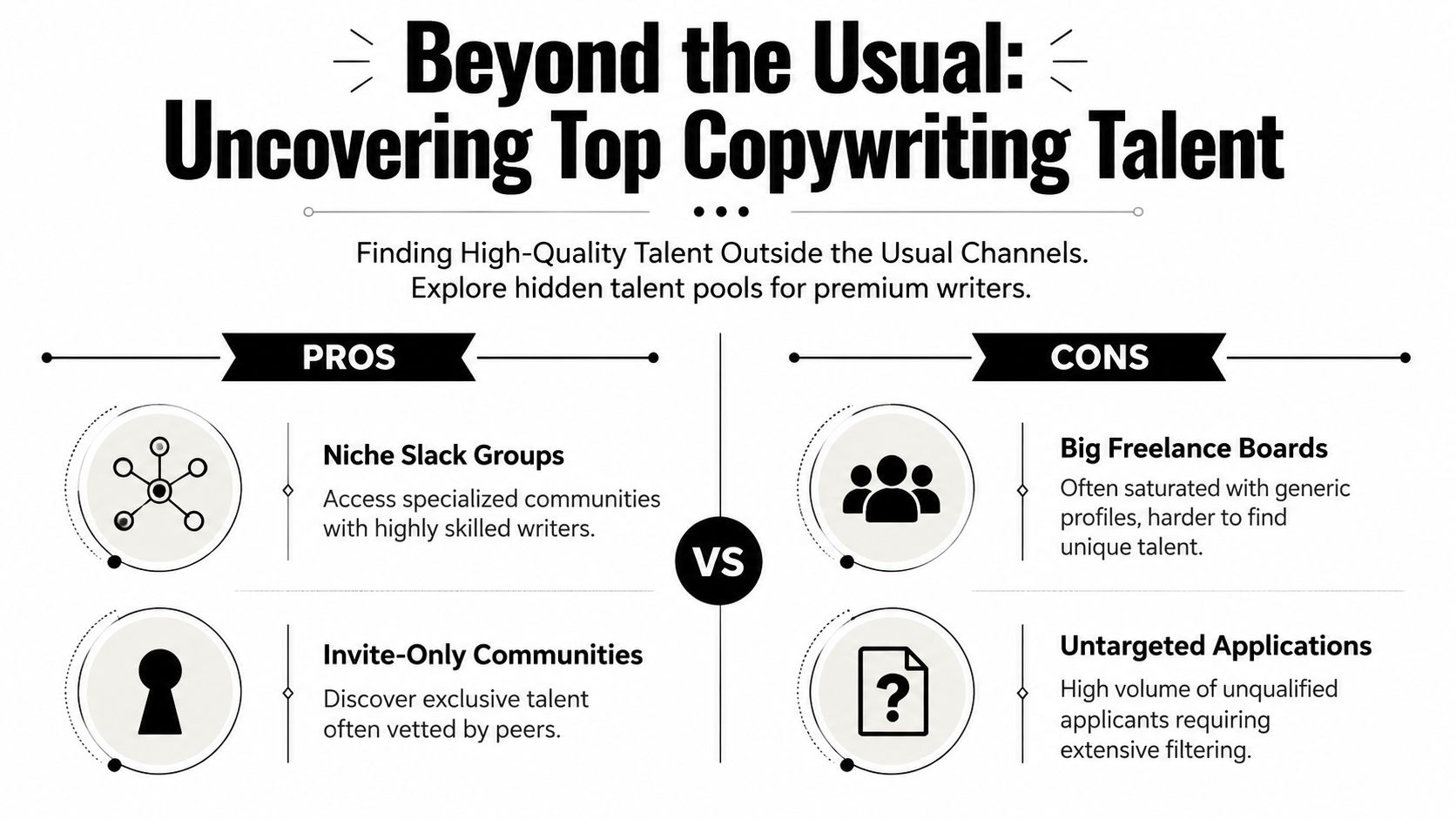
If I were hiring for an agency roster or building an in-house bench, I'd search in four places first.
Niche Slack groups
Good writers show their thinking in public. You can see how they critique copy, what problems they obsess over, and whether they sound like adults or slogan generators.
Private communities with some gatekeeping
These groups are imperfect, but they cut down on spam and reward consistency. That matters.
Referrals from adjacent specialists
Ask designers, email operators, growth leads, and media buyers who they trust with conversion work. Skilled people tend to know exactly two or three writers they'd hire again without drama.
Open marketplaces for controlled tests
Use them to source options, not to make the final call. They're top-of-funnel. Treat them that way.
For teams deciding whether to build internal filtering muscle or hand some of it off, this guide to outsourcing marketing companies gives a useful frame. Your sourcing channel changes how much screening work lands on your team.
Founders love to say they're saving money by hiring directly. Sometimes they are. Sometimes they've inadvertently created a part-time recruiting job, a project management job, and a cleanup job after the wrong hire misses the mark.
The hidden cost is time spent reviewing weak portfolios, chasing replies, running paid tests, rewriting unclear assignments, and dragging internal stakeholders into avoidable debates. Then there's the test budget. Set one before you start. A small paid assignment with clear scope is cheaper than weeks of meetings with the wrong candidate. So is a pre-audit pass on your existing copy, because it tells you whether you need a conversion writer, a brand voice specialist, or both.
That distinction saves money fast.
Direct outreach works if you act like a buyer, not a beggar. Good copywriters ignore vague requests because vague clients create messy projects.
Keep your note short and specific:
Why you picked them
Reference one sample, one niche, or one angle they handled well.
What you need
Name the asset and the business context. “Rewrite onboarding emails for a product-led SaaS” beats “need help with copy.”
What you're paying for first
Mention the paid test or pilot scope up front. Serious candidates care about process.
What success looks like
State the goal. More demo bookings, cleaner activation, stronger sales call quality, fewer confused leads.
What you won't ask for
No unpaid spec campaign. No ten-page proposal. No scavenger hunt.
Agencies and in-house teams should source differently. Agencies need writers who can switch voices fast, handle client feedback without sulking, and price for margin. In-house teams need writers who can pull insight from product, sales, and customer calls, then turn that mess into clear assets.
Use different pressure tests for each.
One more thing. Ask candidates how they use AI before you pay for a test. Not to ban it. To see whether they use it for research support, draft variation, and speed, or whether they hide behind it because they can't think. That answer tells you a lot about where to find them, too. Writers doing serious work tend to hang out in places where craft still gets discussed, not just output volume.
By now, you can't hire a copywriter without thinking about AI. Ignoring it is lazy. Panicking about it is also lazy.
The core question isn't whether candidates use AI. Plenty do. The question is whether they use it as a tool or as a replacement for thought. There's a big difference, and your brand will feel it.
The clearest datapoint I've seen is this: 82% of marketers now use AI tools for drafting, but only 12% of hiring guides explicitly address how to vet whether a copywriter uses AI responsibly or relies on it entirely (Dark Roast Copy on copywriter vetting). That gap explains a lot of the mush flooding inboxes and landing pages right now.
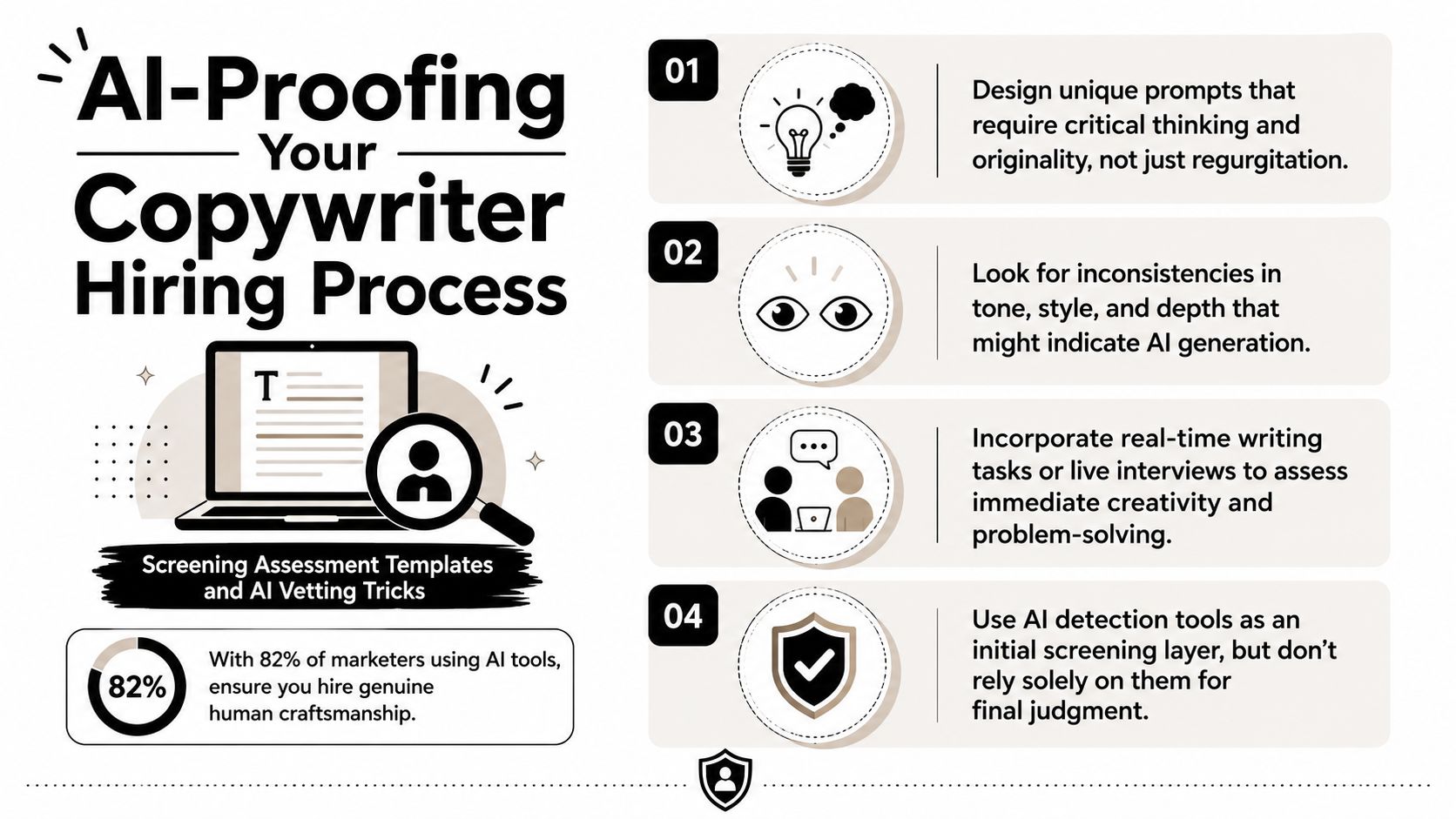
Don't start with samples. Start with friction.
Ask candidates to answer a few short questions in writing. This saves time and surfaces how they think.
What inputs do you require before drafting?
Bad answer: “I can get started with minimal direction.” No, thanks.
Better answer: they ask for customer voice, offer details, objections, goals, and current asset context.
How do you use AI in your workflow?
You want specifics. Brainstorming, outlining, contrast checks, variant generation. Not “I use it for efficiency” and a cloud of mystery.
Show one sample and explain the decision-making.
Ask why the hook, structure, CTA order, and objections were handled that way.
If you're building a hiring process that accounts for automation, this guide on AI hiring is useful for thinking through what should be automated and what absolutely should not.
I'm not anti-AI. I'm anti-lazy.
A solid copywriter might use ChatGPT, Claude, or another drafting tool to pressure-test angles, organize research, or speed up rough outlines. Fine. But the strategic work still needs a human brain attached.
Look for these signs:
They can explain their prompts and their edits
If they can't tell you what they changed and why, they probably didn't shape much.
Their language has texture
Human-first copy usually sounds grounded in a real buyer, real objections, and a real offer. AI-heavy copy tends to float above the business.
They can write live
Give them a short real-time exercise in a call or workshop setting. Not to torture them. To see whether they can think without a machine doing the heavy lifting.
Use AI detection tools as a tripwire, not a verdict. A hiring decision made off one tool output is just bad management with software on top.
Watch for candidates who:
The best writers won't get defensive here. They'll welcome the conversation because they know the difference between assistance and automation.
Interviews are where good hiring processes go soft. Founders get charmed by clean portfolios, big brand logos, and a confident voice on Zoom. Then they hire a writer who can talk about copy all day and still miss the brief by a mile.
Run the interview like an operating review. You are hiring judgment, commercial sense, and execution under constraints.
Skip vague prompts about creativity or tone. Ask for receipts.
Use questions like:
Good candidates answer with process, tradeoffs, and business context. Weak ones hide behind adjectives.
One more test. Ask them to critique one of your live assets on the call. A homepage hero, a nurture email, a product page. Give them five minutes to read it, then ask what they would change first. You will learn more from that than from ten polished case studies.
Use a paid test. Keep it tight.
A bloated assignment attracts desperate candidates, annoys strong ones, and gives you fake certainty because nobody writes under normal conditions in a take-home marathon. A short paid test gets you what you need. How they clarify the brief, how they make decisions, how they hit a deadline, and whether their draft improves the asset in front of them.
Budget for a test before you start hiring. If you are comparing three serious finalists, set aside enough cash to pay all three without flinching. That is cheaper than one bad hire and two months of cleanup.
Use a test that matches the actual job:
The annotation matters. Strategy hidden in their comments often tells you more than the final copy.
Score the test on five things:
If you want a simple benchmark, a serious candidate should ask smart clarifying questions before drafting. Silence at the brief stage usually means trouble later.
A lot of teams botch copywriter pricing because they only compare the writer's fee. That is amateur math.
The total cost includes sourcing time, test budget, editing time from your team, recruiter fees if you use them, and the productivity lag before the writer understands your product well enough to ship strong work without hand-holding. That is the hidden bill. Ignore it and the “cheaper” option often becomes the expensive one.
You also need to price the role by what you are buying.
A copywriter who punches up blog drafts is not priced like a conversion writer who can shape offers, messaging, landing pages, email flows, and launch assets. A writer who needs tight direction is not priced like one who can run with a brief, interview customers, and hand back publish-ready copy.
For hiring cost context around adjacent marketing roles, Near reports that US media buyer salaries often land between $96,000 and $120,000 annually, while Latin American hires can cost materially less, often in the $24,000 to $36,000 range depending on role and setup, according to Near's media buyer hiring breakdown. Jetfuel notes that recruiter fees for US marketing hires commonly run 15% to 25% of first-year base salary, with 20% being typical, plus months of internal ramp time, based on Jetfuel's cost breakdown.
Those numbers are not copywriter rate cards. They are a reminder that hiring cost is bigger than salary or freelance project fees.
Do not use a global pricing table stuffed with “it depends.” That is filler dressed up as guidance.
Use this rule set instead:
If you need a clean decision, use a three-bucket budget before interviews start:
That framework saves you from the dumbest mistake in copy hiring. Picking the lowest visible number while ignoring the rest of the bill.
A signed agreement doesn't solve a messy operating model. It just means the mess is now billable.
When you hire a copywriter, the work gets easier only if the contract, onboarding, and measurement are all bluntly clear. Otherwise you get revision loops, ownership confusion, and that special kind of recurring meeting where nobody knows who's supposed to decide anything.
Your contract should protect the business without turning the relationship into a hostage note.
Include the basics:
Scope boundaries
Name deliverables clearly. “Website copy” is too broad. List the actual assets.
Revision rules
State what counts as a revision versus a new brief.
Timeline and review windows
If your team sits on drafts for days and then screams about speed, that's not a writer problem.
IP ownership and confidentiality
Boring, necessary, and paramount.
AI use disclosure
Spell out what's acceptable. Draft support? idea generation? no confidential inputs into public tools? Put it in writing.
A writer can't hit the voice if you drip-feed context like it's state secrets.
Give them a compact starter pack on day one:
Message docs
Positioning, offers, audience notes, objection lists.
Voice examples
Good pages, bad pages, founder comments, sales call snippets.
Access to people
One owner, one marketer, one product or sales contact. Not twelve random opinions.
Definition of done
What approval looks like, who gives it, and what happens after draft one.
Don't judge copywriters by word count. That's warehouse logic.
Measure things that reflect the actual job:
Strategic fit
Does the copy name the audience clearly and support the intended action?
Process quality
Do they ask sharp questions, hit deadlines, and manage feedback cleanly?
Sales usefulness
Can your team use the copy without rewriting half of it in Slack?
Asset performance where applicable
For conversion work, look at before-and-after movement on the target asset when you have clean enough attribution to do so.
Bad onboarding creates bad performance, then managers blame the writer. Convenient. Wrong, but convenient.
A few warning signs deserve immediate attention:
Missed deadlines early
If this starts in week one, it usually gets worse, not better.
Scope creep disguised as helpfulness
“I also rewrote the other pages” sounds proactive until billing and alignment implode.
Voice drift
The copy sounds polished but not like your company. Fix fast.
AI overreach
If output starts sounding generic, repetitive, or suspiciously frictionless, ask to review workflow and draft notes.
Course-correct early. A short reset meeting with concrete examples can save a good relationship. Waiting because you “don't want to be difficult” is how mediocre work becomes your new baseline.
If you're also hiring paid media talent and want a faster path than drowning in resumes, HireMediaBuyers.com helps US companies find pre-vetted media buyers and paid ads specialists quickly, with flexible remote hiring options and strong talent pools across Latin America and beyond.


