

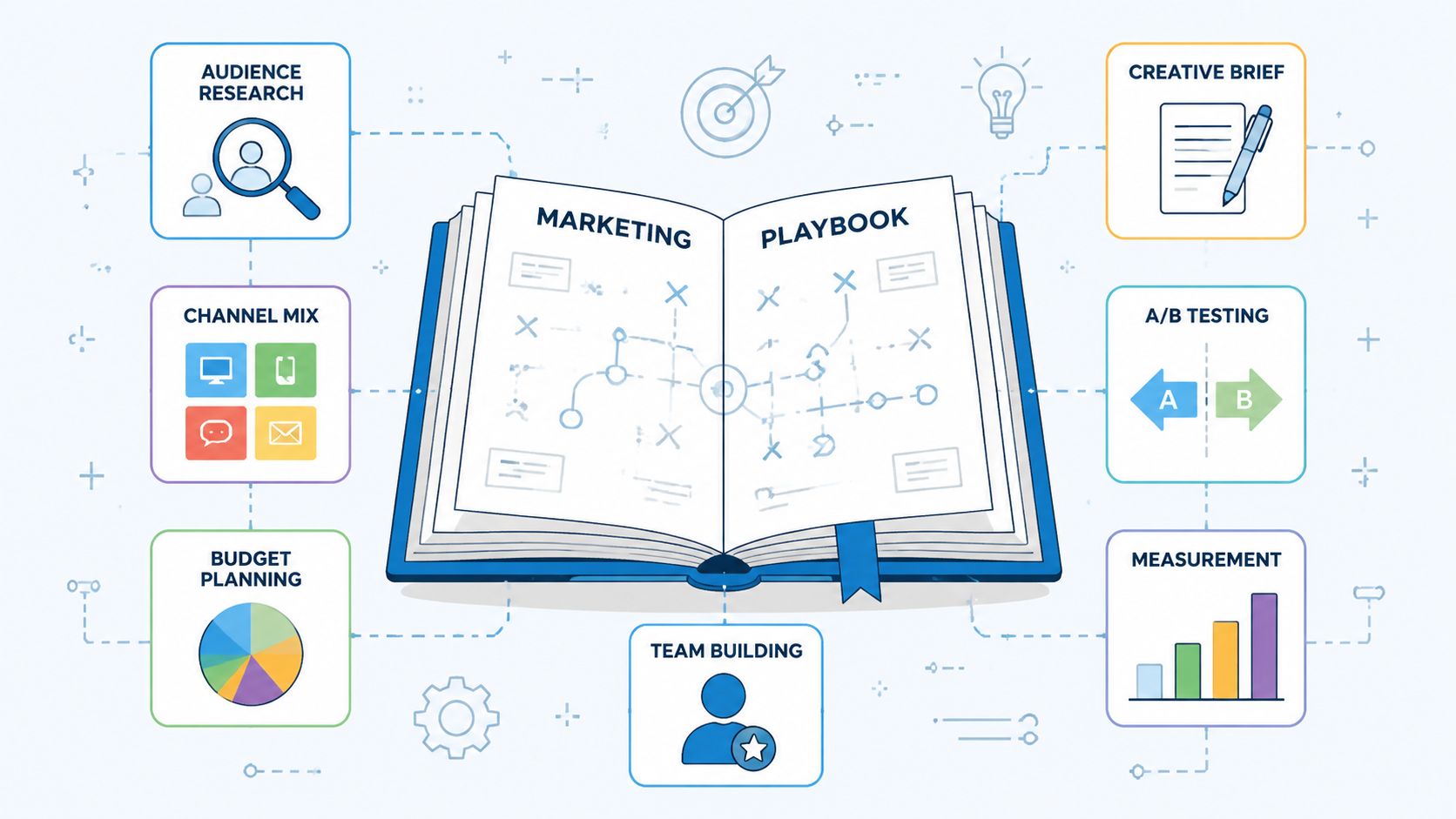
Most media plans fail for a stupid reason. Someone bought channels before they knew the business problem, then spent six weeks worshipping dashboard confetti while revenue sat there like an uninterested houseguest. That's not media strategy development. That's expensive improvisation with a nicer spreadsheet.
A real strategy starts with the commercial objective, the measurement framework, and the channel role, in that order. If you can't say what success looks like, how you'll measure it, and why a channel deserves budget, you're not building a plan, you're funding chaos. Amazon's media strategy guidance is blunt on this point, define specific, measurable goals, research the audience, analyze the market, set KPIs, then build the mix and optimize continuously (Amazon media strategy guide).
By 2025, most planners already know the game has changed. They prioritize market research, and 57% say defining the budget is one of the most effective strategies, while 57% also cite rigorous results analysis as critical, with 55% calling out clear goals and KPIs and 48% using calendars to schedule content (Improvado media planning strategy). That's the difference between a media plan and a hope trap.
A random channel mix looks busy right up until the CFO asks why it didn't move anything. Then the room gets awkward, everyone stares at the deck, and somebody mutters about “top-of-funnel awareness” like that pays the invoices. A serious media strategy development process cuts through that nonsense by tying spend to a business objective, not to whatever platform happened to look shiny that quarter.
The modern framework is built around Mission, Money, Message, Media, and Measurement, because media buying without structure is just expensive noise. Recent planning guidance says media planners most often prioritize market research to understand target demographics, and the strongest strategies are the ones that define budget, analyze results, and set goals before launch (Improvado media planning strategy). That lines up with the practical truth, often learned through difficult experience, campaigns fail when people optimize to platform metrics instead of business outcomes.
Practical rule: if a channel can't earn its place in your revenue story, don't buy it.
The bigger shift is philosophical, and it matters. Media strategy used to be about buying reach. Now it's about managing campaigns as measurable systems with explicit objectives and continuous optimization, which means the person steering the work has to care about the plan after launch, not just before the kickoff call.
The old way breaks because attention is fragmented and assumptions age badly. By 2025, 65.7% of the global population were active social media users, and the average user actively used or visited 6.84 different platforms each month (Sprinklr social media statistics). In January 2026, global average time spent on social platforms was about 2 hours and 21 minutes per day, which is exactly why broad, lazy demographic targeting keeps getting punched in the face by reality (Sprinklr social media statistics).
That's the operating environment. Multiple platforms. Multiple intents. Multiple moments. A good strategy earns clarity by choosing where to show up, what to say, and how to prove it worked.
I once watched a brand insist its audience was “everyone who likes fitness.” That's not an audience, that's a wish with a protein shake. The useful version is messier, because real segment discovery starts with names, needs, barriers, and behavior, not with a vague age bracket and a prayer.
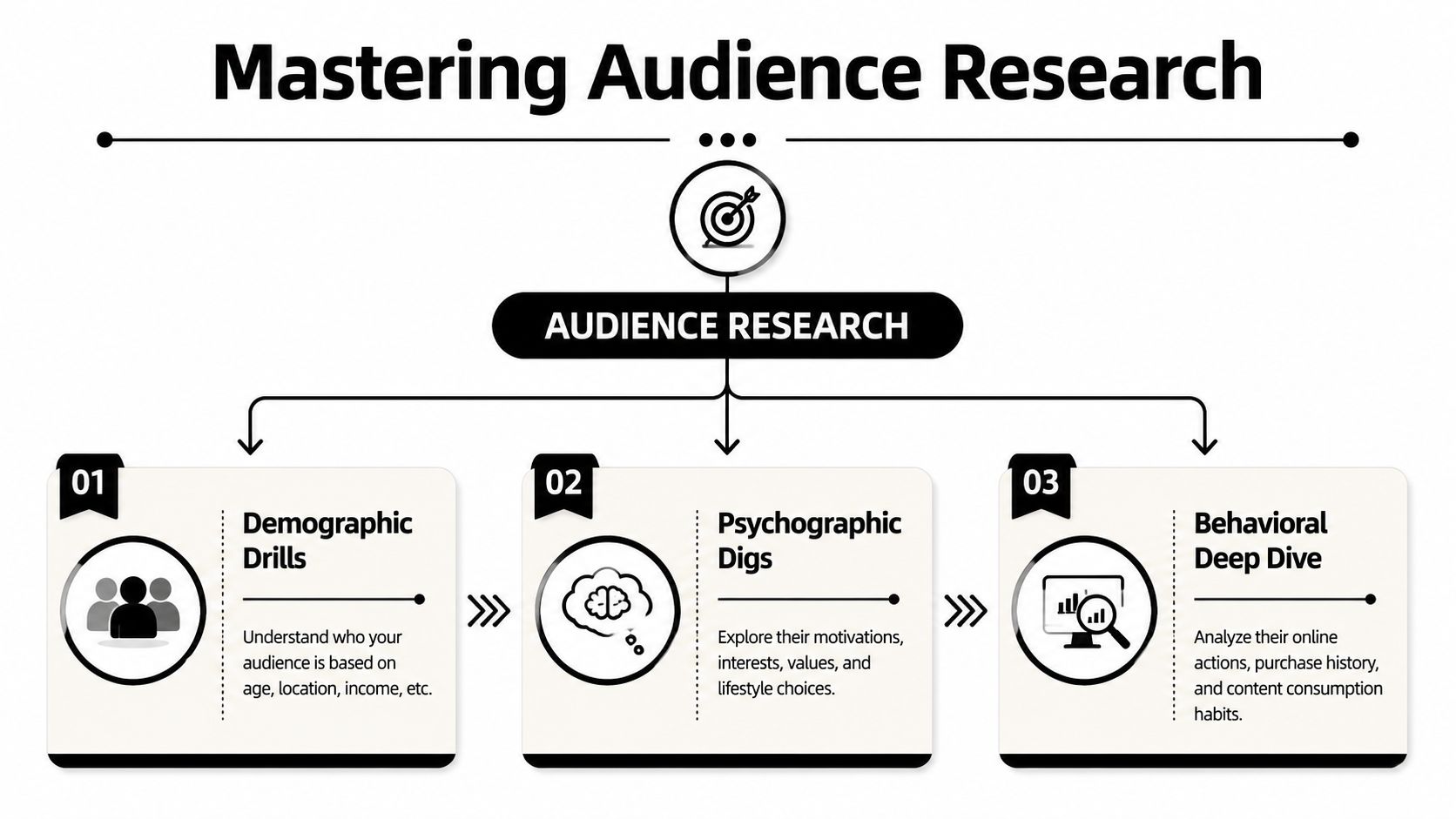
Before you touch paid social, search, or anything else, build a prioritized audience matrix. List the segments, the pain points, the trusted sources, and the media habits that shape each one. If a segment is hard to reach, don't default to generic demographic targeting and call it a day, because that usually misses the actual barrier.
That's especially true for underserved audiences. The underlying issue is often trust, language, geography, or accessibility, not just “we need more impressions.” A useful operational question is whether a segment needs a trusted intermediary, localized placement, or a different format, because those constraints change the channel mix and the budget split.
You can keep the work grounded with this sequence:
The average user spent 2h21m daily on social platforms and visited nearly seven apps each month by January 2026, which means the audience map needs to be channel-specific, not generic (Sprinklr social media statistics). That doesn't mean every segment needs every platform. It means each segment needs a documented path from problem to channel to creative angle to conversion point.
Use surveys for explicit needs, social listening for language patterns, and third-party data for validation. Then translate all of it into a decision grid. If you can't tell which segment belongs on which touchpoint, you're still in research mode, and that's fine, because bad targeting is more expensive than slow targeting.
A solid reference point for segment work is this audience segmentation guide, especially if your team keeps confusing “broad reach” with “smart reach.”
A channel plan without budget logic is just a shopping cart full of optimism. Teams love to say they'll “be everywhere,” which is adorable right up until the monthly burn starts eating the floorboards. The sharper move is to choose the mix based on what each channel does best, then pace spend so the campaign can learn before the money runs out.
The biggest mistake is judging media by platform vanity metrics instead of business outcomes. Practitioners warn that many plans fail because strategy gets measured on the wrong scoreboard, and defining objectives plus measurement first is what keeps the budget from wandering off into the woods (Why media plans fail). That matters because paid search, social, programmatic, and connected TV do very different jobs.
| Channel | Strengths | Budget Range | Pacing |
|---|---|---|---|
| Paid Search | High intent, captures demand already in motion | Best for focused, intent-heavy spend | Keep spend steady, protect top queries, don't let bids spike on weak terms |
| Paid Social | Fast testing, audience discovery, creative iteration | Useful for segmented testing and demand creation | Start controlled, then widen only after the winning angle is obvious |
| Programmatic | Scale, reach, audience sequencing | Better when you need broader delivery and frequency management | Watch frequency closely, avoid flooding the same people |
| Connected TV | Bigger-screen storytelling, broad awareness support | Fits upper-funnel reach plays and brand lifts | Pace conservatively, because overexposure gets expensive fast |
A conservative scenario protects learning and keeps the spend tight. A balanced scenario gives you room to test channels without mortgaging your office ping-pong table. An aggressive scenario makes sense only when the funnel is already proven and the team can absorb the pacing risk.
Use the audience matrix from the prior section to decide where each scenario should lean. If a segment is niche and trust-sensitive, the mix may need more precise placements and slower pacing. If the segment is broad and high-intent, search may deserve a stronger starting role.
Budget rule: don't spread money across every shiny platform just because the sales rep was polite.
The pacing part is where money is often lost in slow motion. Front-loading spend kills late-cycle conversions, while dragging your feet leaves the campaign without enough signal to optimize. Pick daily and weekly thresholds, then stick to them long enough to learn something useful. If a channel underperforms, cut it. If a channel wins, fund it. That's the job.
Good creative doesn't rescue a bad strategy, but bad creative will absolutely sabotage a good one. People love to blame the media buyer when the ad flops, then you open the brief and find three messages, four audiences, and no clear job for the channel. That's not a brief. That's a cry for help.
A brief should force decisions. Use this skeleton:
If you can't state the objective, the KPI, and the channel role, you're just buying expensive noise, and yes, that line deserves repeating because it saves money (Amazon media strategy guide).
A/B testing works because it's boring. You change one variable, then you learn what caused the shift. Keep the tests isolated so the variable is clean, and don't run five headlines, two audiences, and three landing pages at once unless you enjoy pretending correlation is a strategy.
A test roadmap usually needs three layers:
Don't “kill the winner” the day it starts looking good. Let the test breathe long enough to confirm the pattern.
The schedule matters as much as the idea. Put the tests on a calendar, assign ownership, and write down what success means before launch. If the team waits until the campaign is live to decide what counts, they'll spend the whole month arguing with each other instead of learning from the market. That's how “optimization” turns into a group chat with invoices.
Most campaigns don't fail because nobody tracked anything. They fail because people tracked the wrong thing, too late, and with the emotional energy of someone checking a smoke alarm after the fire's already in the curtains. If you want clean optimization, set the measurement structure before launch and treat it like a live system.
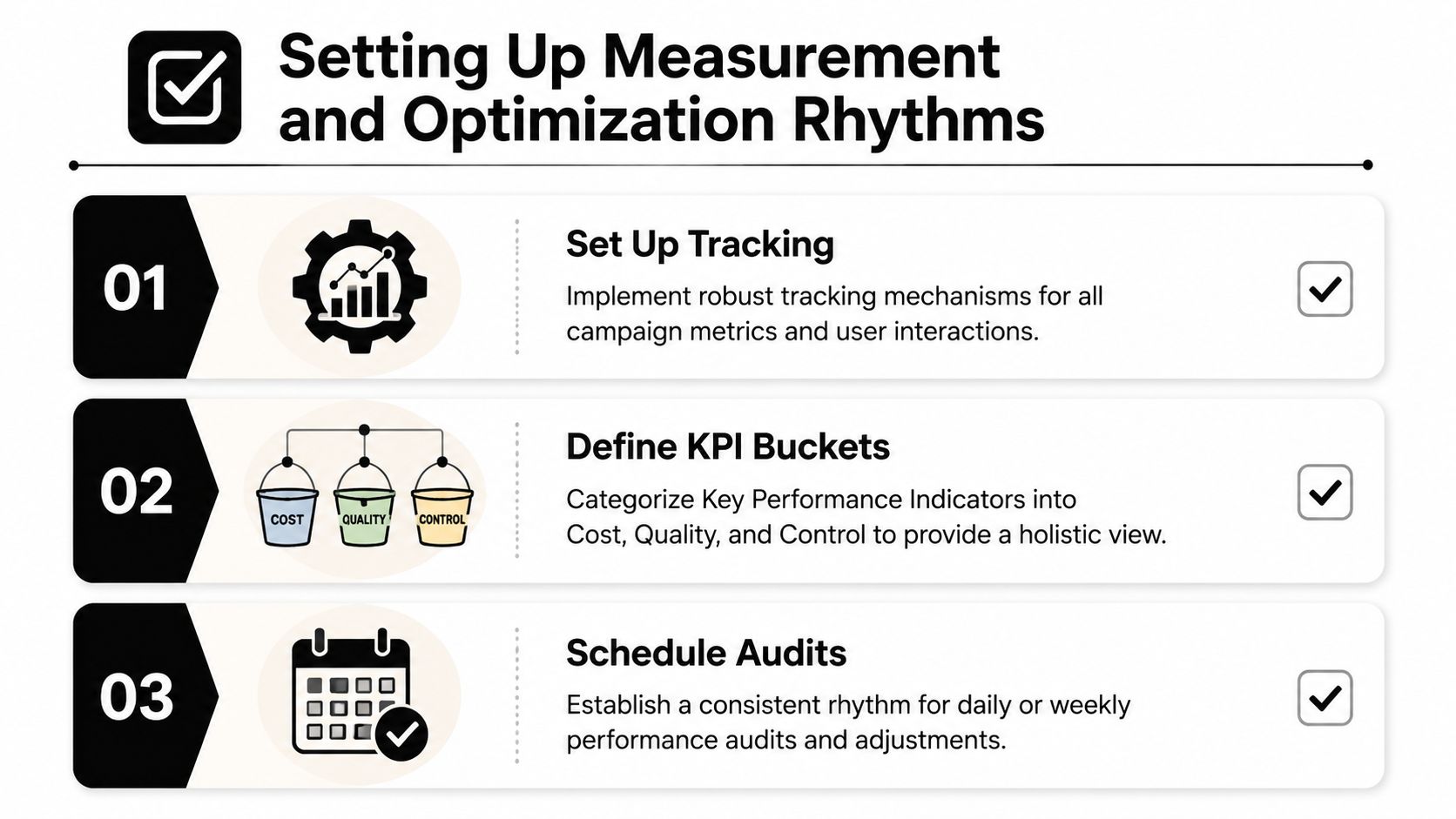
MediaSense breaks KPIs into cost, quality, and control buckets, which is exactly the kind of structure teams need when dashboards start looking like a slot machine with better branding (MediaSense measurement best practice). Cost KPIs include things like CPC and CPL. Quality KPIs capture viewability and brand safety. Control KPIs cover reach and frequency.
That setup matters because a cheap click means very little if the traffic is junk or the ad ran so often it annoyed the same person into oblivion. Prioritize the critical KPIs first, set targets for each one, and document what triggers action. If a metric doesn't lead to a decision, it's decoration.
Your tracking setup should also be ready before launch, with ownership assigned for monitoring and budget shifts. YourTenet's planning guidance is blunt about this, write down the primary objective, KPIs, numeric targets, and time horizon, then keep the reporting cadence visible in the plan (YourTenet media planning). That's not bureaucracy. That's how you keep the team from freelancing with the budget.
No single model tells the whole story. Robust measurement should combine marketing mix modelling, attribution modelling, and controlled experiments to separate channel contribution from causal lift (Why media plans fail). If you only use one lens, you'll over-credit some channels and starve others.
Add conversion tracking setup into the workflow before spend scales, because weak tracking turns every later debate into a guessing contest. Then run daily or weekly audits, depending on spend velocity and decision volume.
The most useful monitoring rhythm is simple:
Experts recommend treating optimization as a live process, track KPIs daily, reallocate budget from underperformers, and keep A/B tests isolated so one variable changes at a time (Major Tom media planning updates). That's the rhythm. Everything else is window dressing.
There comes a point where the founder, the marketer, and the spreadsheet all start lying to each other. The founder says the team can “handle it in-house.” The marketer says the channel mix is “basically under control.” The spreadsheet says the spend has become a small, angry nation. That's usually the moment to bring in dedicated media talent.
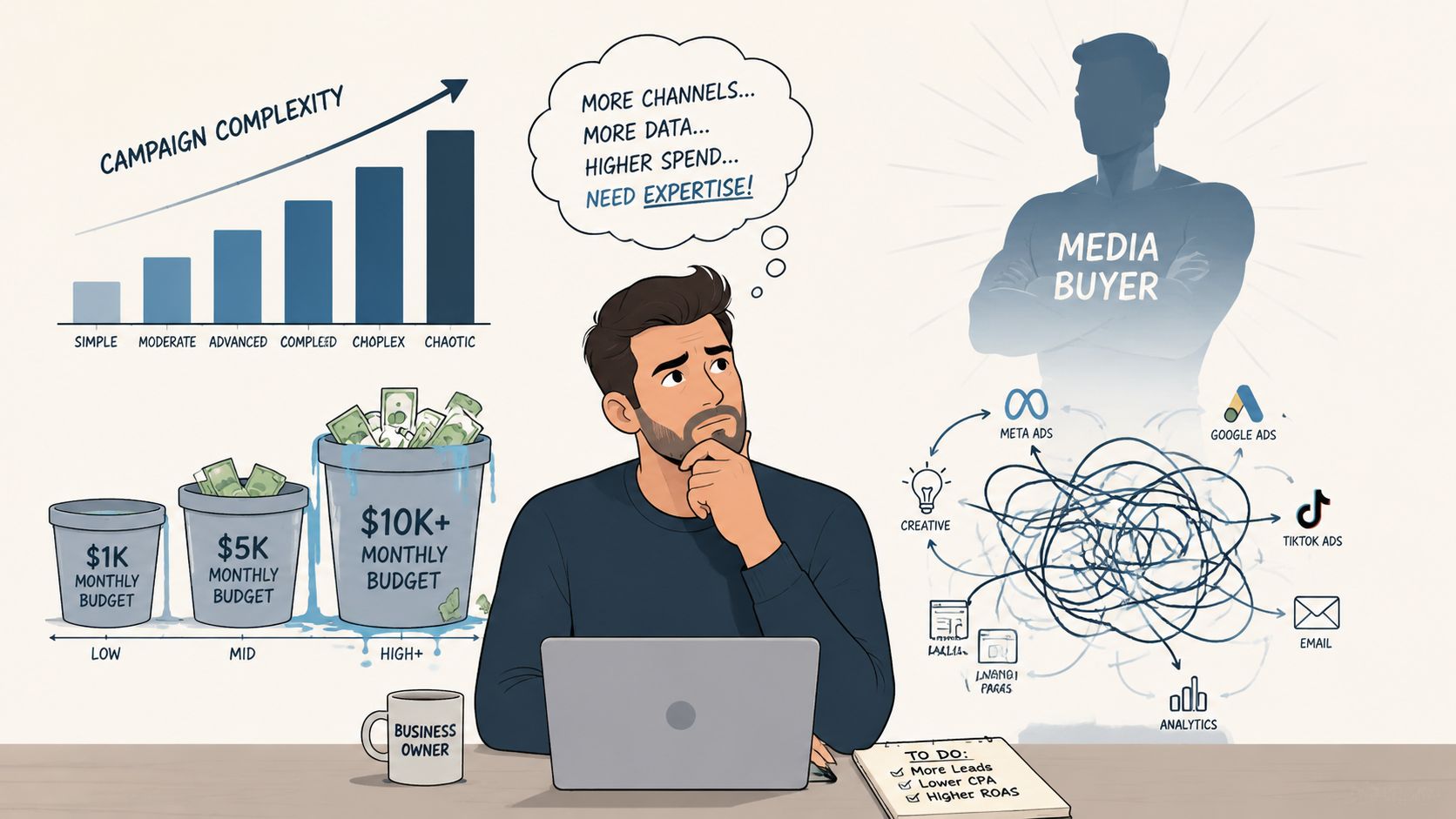
The signal isn't just budget size, it's complexity. If you're running multiple channels, multiple audiences, or multiple reporting expectations, the work stops being a side task and becomes a discipline. A strong media buyer can plan placements, manage budgets, and track performance with real KPIs, which is exactly the kind of operational muscle strategy needs once the basics are working.
Look for three skills first. Strategic thinking, because anyone can press buttons. Measurement fluency, because a buyer who can't read the data is just expensive optimism. Creative judgment, because ad performance lives or dies on what people see, not just where it appears.
If you're building the team and want a structured hiring path, a media buyer job description keeps the role grounded in goals, platforms, and performance expectations instead of fluffy nonsense.
New hires fail when they inherit a mess disguised as “context.” Give them a handoff doc with these fields:
That handoff template matters even more if you're scaling across time zones or using flexible remote talent. HireMediaBuyers.com is one option for teams that want pre-vetted media buyers and paid ads specialists with a structured screening process, but the point isn't the marketplace. The point is removing ambiguity before the new hire touches spend.
Hiring rule: don't ask a media buyer to invent strategy from scratch if the business hasn't already written the goals down.
The handoff should also include what success looks like in the first reporting cycle. That keeps everyone honest. No one needs another onboarding call where the first action item is “figure out the dashboard.”
The whole playbook comes down to one thing, build the system before you scale the spend. Research the audience, choose the channel roles, write the brief, define the KPI buckets, and set the monitoring cadence before launch. If you do that, the campaign has a chance to become a machine instead of a mood.
The fastest wins are boring, which is why people skip them. Get the objective in writing. Lock the reporting cadence. Assign one owner for budget shifts. Then review the first optimization loop without moving the goalposts midstream, because that's how teams accidentally turn learning into chaos.
Keep the roadmap visible, keep the dashboard honest, and keep the team small enough that everyone knows who owns what. When the plan is clear, hiring gets easier, scaling gets cleaner, and performance stops depending on heroic guesswork.
A CTA for HireMediaBuyers.com.


