


Cost in marketing is dominated by media buying, roughly 87% of the $1.30 trillion spent globally goes to paid distribution. So the key question is never how much you spend on paper, it's what each acquired customer costs after every fee, hour, and inefficiency.
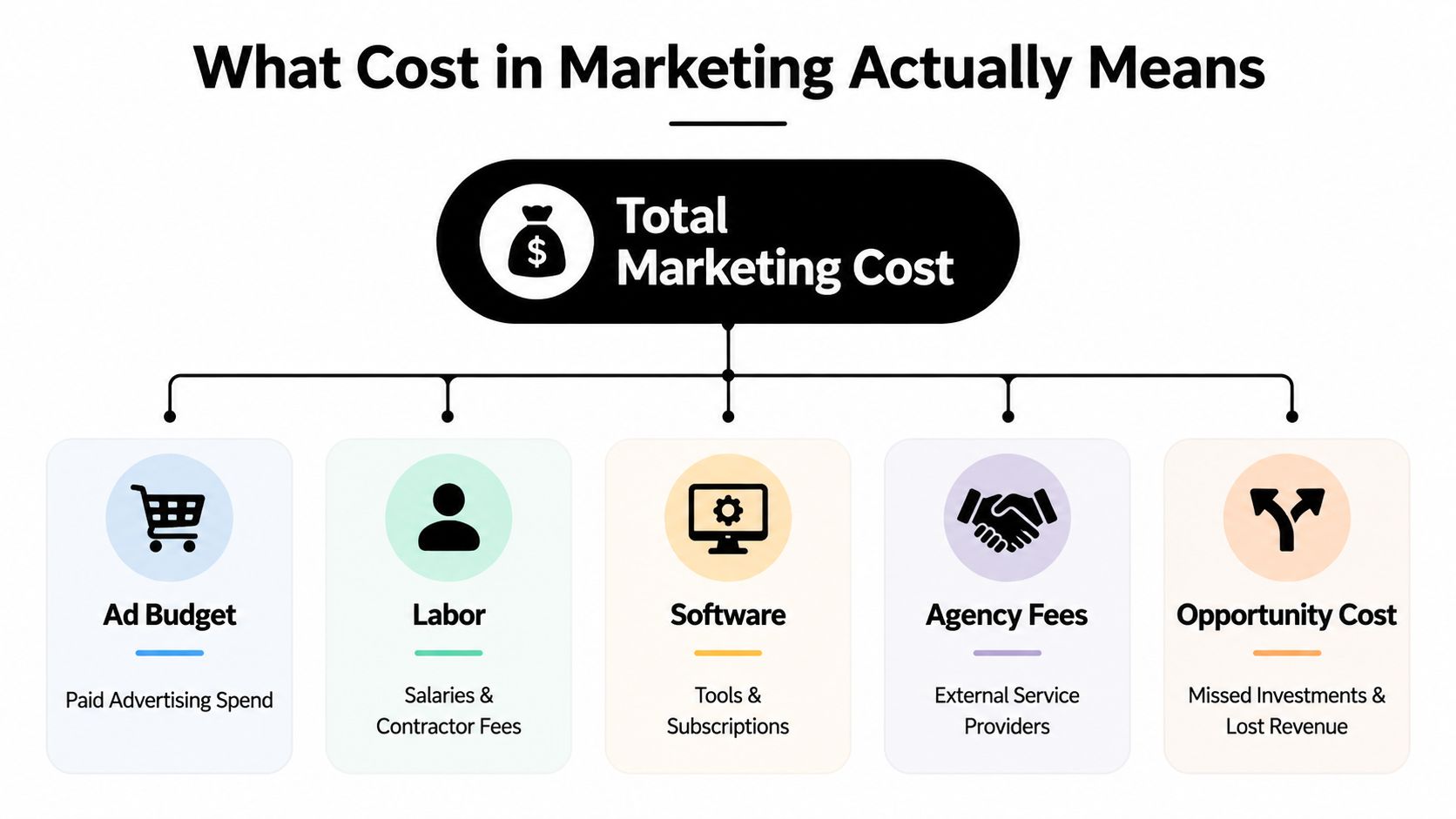
They ask the wrong question because they stop at the ad bill. That's cute, but incomplete. Cost in marketing is an all-in unit-economics problem, and if you ignore the labor, software, agency fees, and the cost of doing it badly, you're basically mortgaging your office ping-pong table for “growth.”
The money trail is pretty blunt. Of the estimated $1.30 trillion in worldwide marketing-related spend, about $1.088 trillion goes to media advertising, while $121 billion goes to martech tools and $45 billion goes to external labor like freelancers and contractors, which works out to roughly 87% media, 10% software/tools, and 3% labor (global marketing spend breakdown). That's why so many teams obsess over bids and CPMs, then wonder why the P&L still looks like a bar fight.
If you only count spend on platforms, you're missing the rest of the machine. The actual cost includes the people building campaigns, the tools keeping them alive, the agency or contractor layer, and the damage from wasted effort and weak execution. A “cheap” media program can still be expensive if it eats up senior time and produces junk leads.
Practical rule: if a marketing line item can't be tied to revenue, pipeline, or a clear learning loop, treat it as a cost center until it proves otherwise.
The right mental model is unit economics, not budget theater. Every dollar should be judged by what it produces, not what it looks like in a spreadsheet. That's the only way to avoid arguing about line items while the business bleeds.
You'll hear a lot of jargon in dashboards, but five measures do most of the heavy lifting, CPC, CPM, CPL, CAC, and ROAS. Add CLTV to that mix and you've got the basic cost lens every operator should use. The point isn't to worship the acronyms, it's to catch when one metric is lying and another is telling the truth.
The vocabulary is simple once you stop letting dashboards intimidate you. Each metric answers a different question, and none of them works well in isolation. If your team is judging media by one shiny number, somebody's probably hiding a mess in the funnel.
| Metric | Formula | What It Tells You |
|---|---|---|
| CPC | campaign cost / clicks | What you pay to get attention |
| CPM | (total ad cost / impressions) × 1,000 | What reach costs |
| CPL | total marketing cost / leads | What a lead really costs |
| CAC | total cost to acquire customers / new customers | What a customer costs |
| ROAS | revenue from ads / ad spend | How much revenue media returns |
| CLTV | average value of a customer over time | How valuable a customer is long term |
You can use the ad performance metrics guide as a quick reference if your team keeps mixing these up like they're interchangeable. They're not.
CPC is the cost of a click. If you spend $100 for 50 clicks, your CPC is $2. Plain enough. CPM is the cost of reaching 1,000 impressions. If $500 buys 250,000 impressions, your CPM is $2. CPL is what it costs to get a lead. If $1,000 produces 20 leads, your CPL is $50.
Here's the part people keep missing. A falling CPM does not automatically mean cheaper acquisition. If traffic gets cheaper but the landing page leaks like a sieve, CPL rises and your real economics get worse. That's not a media problem, that's a funnel problem wearing a fake mustache.
Cheap clicks are useless if the page converts like a broken vending machine.
CAC tells you what it costs to acquire one paying customer. If you spend $10,000 and win 50 customers, CAC is $200. ROAS is the blunt revenue check. If ads bring in $30,000 on $10,000 of spend, ROAS is 3:1. CLTV is the value of the customer over time, so you're not judging a first purchase like it's the entire relationship.
That's why ROI matters at the end of the chain. The basic formula is (revenue minus total costs) / total costs, and it's the final scorecard for whether your marketing made money. If you only know one number, know that one.
Decent operators separate from dashboard tourists. Low CPM plus high CPL usually means post-click conversion is weak. Low CPL plus terrible CAC means lead quality is garbage. Strong ROAS but weak CLTV means you're buying customers who don't stick around long enough to matter.
That's the whole game. The numbers have to agree with each other, or you're probably looking at a story your media buyer wanted you to believe.
There isn't one magic number, despite what the LinkedIn crowd wants you to think. A widely used benchmark puts marketing at 7.7% of company revenue in 2025, unchanged from 2024, and small businesses in the U.S. are often advised to spend about 7% to 8% of gross revenue (Gartner benchmark summary). That same source also notes that B2B firms may spend 2% to 5%, while B2C firms may spend 5% to 10%.
A mature B2B company with long sales cycles can run leaner than a consumer brand trying to stay visible in a noisy market. That doesn't mean lean is always better. It means the budget should match the economics of the business, not the ego of the founder.
For a company doing $10 million in annual revenue, the benchmark math is easy. At 7.7%, the marketing budget lands around $770,000. A more conservative B2B-style plan might sit closer to the low end of the range, while a more aggressive B2C-style plan can justify a bigger share if acquisition is the growth engine.
A budget is only useful if you know where it goes. In a conservative setup, more of the spend gets reserved for efficient channels, basic tooling, and tight testing. At benchmark level, you can fund a steadier mix of media, software, and support. In aggressive growth mode, the spend shifts toward paid distribution, creative throughput, and the people who can keep the machine from setting itself on fire.
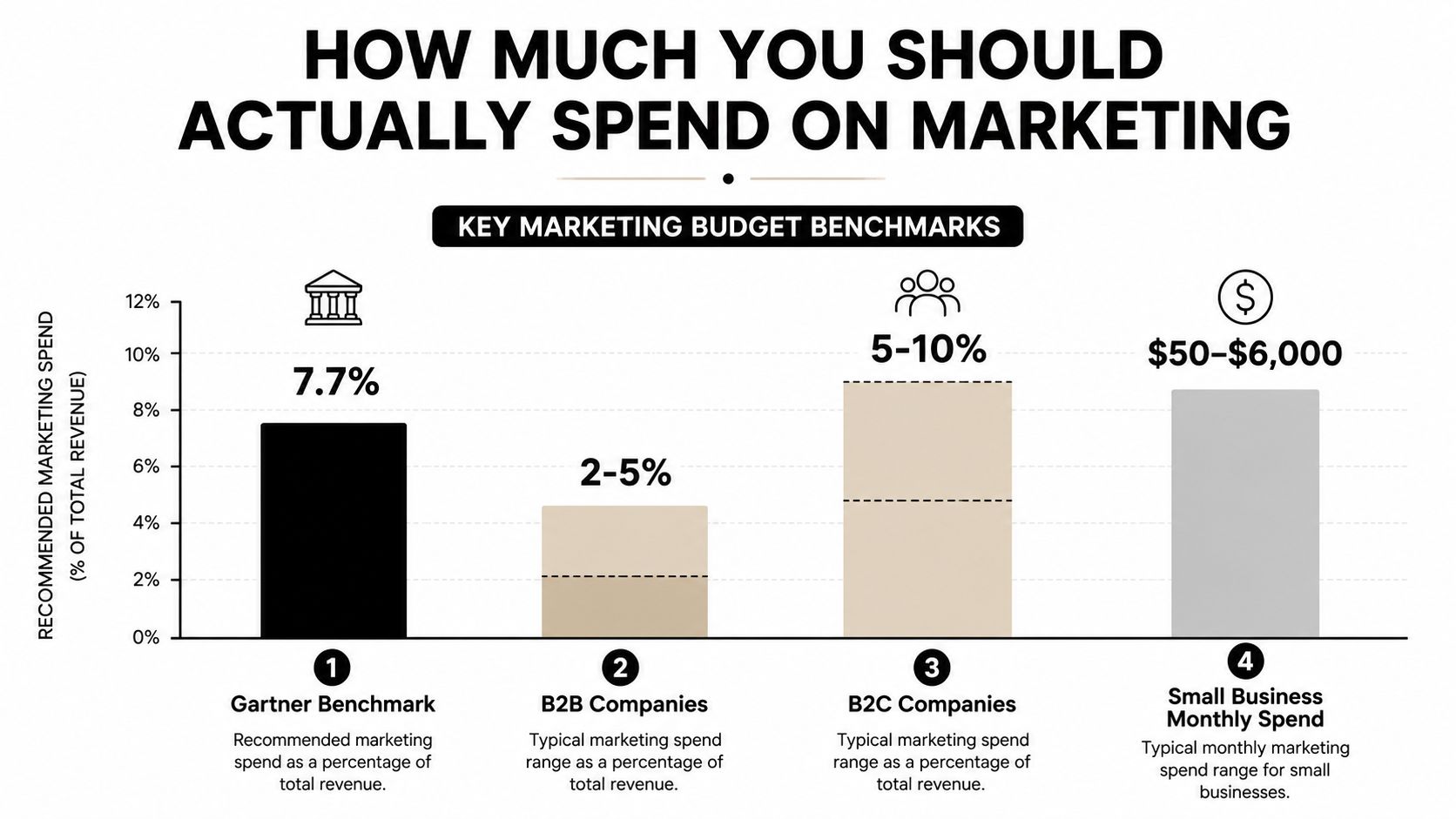
The useful move is to set a budget ceiling as a percentage of revenue, then reallocate monthly toward the channels with the best validated economics. The Business Development Bank of Canada guidance cited in the brief says B2B companies commonly spend 2% to 5% and B2C companies often spend 5% to 10% of revenue, with many small businesses also living in a broad $50 to $6,000 monthly range (BDC marketing budget benchmark).
That range doesn't mean every number is equally good. It means the right spend depends on growth stage, margin structure, and how hard you're pushing acquisition. Copying your competitor's budget is just an expensive form of fan fiction.
The cheapest media buy I ever saw was also one of the most expensive campaigns on the books. The CPM looked nice, the dashboard was clean, and everyone patted themselves on the back. Then the team had to spend weeks fixing targeting, rebuilding the landing page, and explaining why the “low-cost” leads never turned into anything useful.
The hidden-cost framework is ugly in the best way because it tells the truth. Real marketing cost includes time spent on strategy, research, analysis, campaign creation, implementation, measurement, outside help, training, opportunity cost, lost sales from poor execution, and long-term brand damage (hidden costs framework). That's the stuff people ignore when they're flexing a low CPM in Slack.
A campaign can look efficient while consuming senior attention. If your best operator spends half their week babysitting weak creative or cleaning up bad tracking, that's not efficiency. That's leakage.
A small in-house team sounds lean until you add up everything they touch. They're building ads, checking data, reviewing copy, troubleshooting attribution, and answering the same questions over and over again. The cost isn't only payroll, it's the opportunity cost of not doing the high-value work they were hired to do.
The bad version of this is familiar. A founder hires one marketer, expects full-stack miracle work, then wonders why the funnel stalls. The marketer is busy, the ad account is active, and growth is still flat. That's usually not a talent issue, it's a resourcing problem dressed up as strategy.
Good marketing is expensive when it's real. Bad marketing is expensive twice, once in spend, once in cleanup.
A lot of “cheap” campaigns go to die here. If the click-to-lead path breaks, or the lead quality is weak, the apparent savings evaporate. The media may look affordable, but the all-in cost rises because the business pays for waste in other places.
That's why the question isn't whether a channel is cheap. It's whether the whole system, from impression to revenue, works.
The human running the spend is usually the biggest cost lever in marketing. Not the platform. Not the headline. The human. If that person is slow, inexperienced, or drowning in admin, the account will bleed cash in creative ways.
An in-house senior media buyer looks straightforward on a salary sheet, then the hidden costs show up wearing work boots. You've got compensation, benefits, tools, management overhead, onboarding time, and the risk that one person can't cover every platform, format, and angle the business needs. For many teams, that quickly turns into a six-figure fully loaded reality, even before you count the learning curve.
If you want a detailed comparison framework, the agency vs in-house breakdown is the right place to pressure-test the tradeoffs.
The outsourced model is simple. You get someone who has already seen the messiest versions of the problem, and you don't spend months training them to stop making rookie mistakes. The publisher brief says the marketplace can save companies up to 80% to 90% on salaries and deliver a custom shortlist in 24 to 48 hours. That matters when every slow hire is another month of wasted spend.
For SMBs and growth-stage teams, that usually makes the decision easier. If you need velocity, cross-channel skill, and less fixed overhead, outsourcing is the cleaner move. If you're massive, highly specialized, and ready to manage a larger bench, in-house can make sense. Many teams are not there, despite the heroic stories they tell themselves in planning meetings.
Pick in-house when the role needs deep internal product context and constant cross-functional access. Pick outsourced when the problem is paid media execution, speed, and cost control. If you're still arguing about whether one generalist can own everything, you're probably already paying too much.
My bias is obvious. Most growing companies don't need another expensive employee who “understands the brand.” They need someone who can buy attention, measure it properly, and stop wasting money.
Cutting spend blindly is how good businesses stop growing. The smarter play is to lower wasted cost while protecting the parts of the funnel that convert.
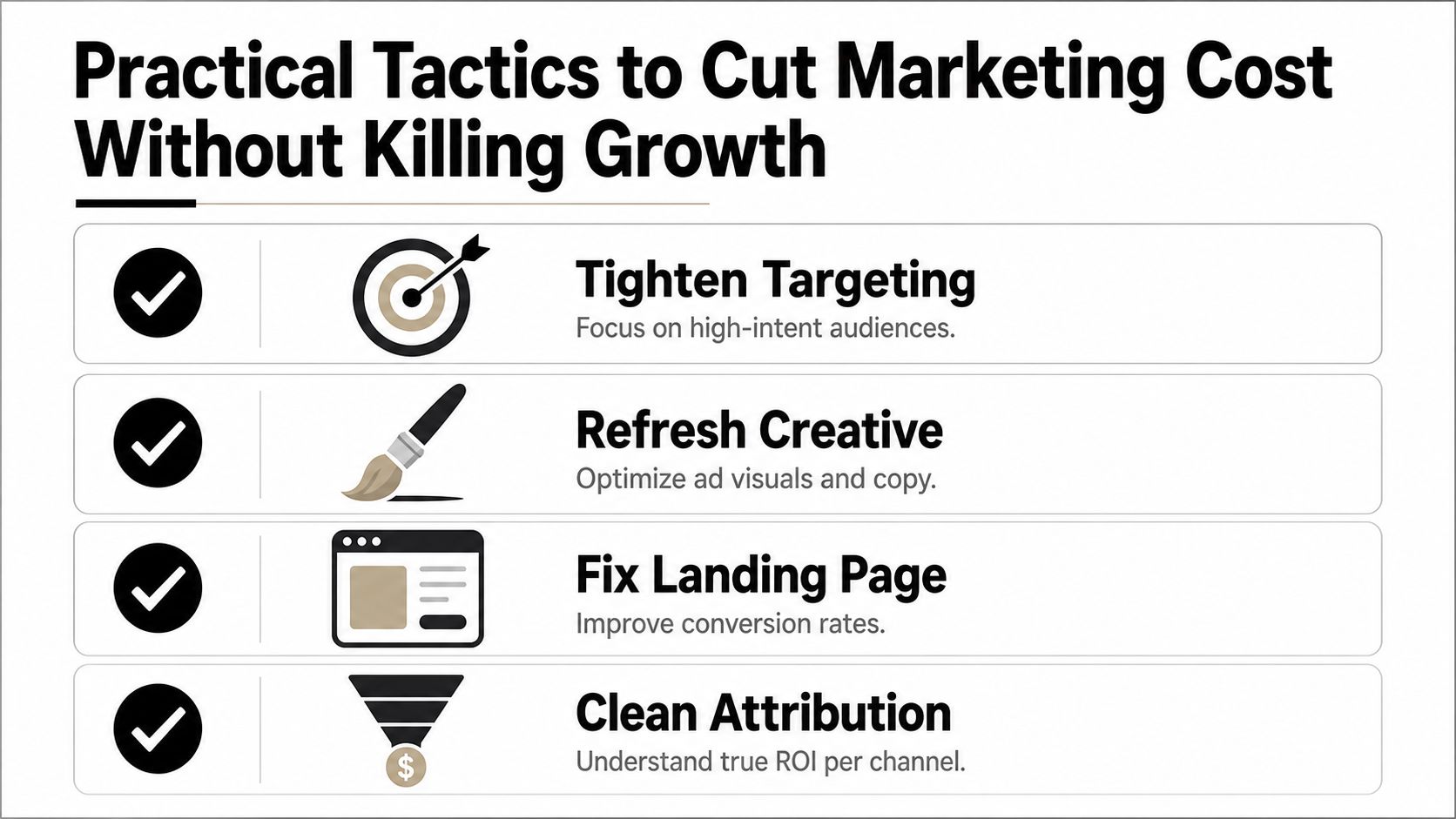
Tighten targeting first. If the audience is broad and sloppy, every downstream metric gets worse. Refresh creative next, because tired ads get punished fast. Then fix the landing page, since a weak page can make strong media look incompetent. Finally, clean up attribution so you're not making budget calls off broken data.
The Harvard Business School paper on the rising cost of consumer attention recommends an Attention-contingent Advertising Strategy in four steps: define the purpose of the communication, determine the quality of attention needed, assess the attention available, then choose media and execution accordingly (HBS paper). That's the grown-up way to buy media. Don't just ask what's cheap. Ask what kind of attention you need.
If the message needs real consideration, low-quality impressions won't save you. If the offer is simple and direct, you can buy more efficiently. Match the job to the channel, or enjoy your future as the proud owner of a very expensive guessing game.
Run this quick check before you approve another month of spend. Is your CAC below a sustainable 3:1 relationship against LTV. Is your MER healthy. Is CPL moving in the same direction as CPM. Are hidden costs tracked. Is your media buyer accountable to one source of truth?
If the answer to any of those is “I'm not sure,” you don't have a marketing problem, you have a measurement problem. And measurement problems always get expensive later.
Monthly cost in marketing = media spend + tools + labor + agency fees + opportunity cost
Then break it down by channel, and compare it to attributed revenue. That one line forces the conversation away from vanity metrics and back toward actual economics. If a channel can't justify its full cost, it doesn't deserve more budget just because it's “performing.”
For cleaner tracking, use the conversion tracking guide to make sure you're not rewarding the wrong campaigns.
Re-benchmark monthly if spend is moving fast, quarterly if the account is stable. If leads drop but CPL improves, don't celebrate yet, check quality before you high-five the dashboard. If the market turns ugly, cut waste first, not the channels that still prove their value.
If you're tired of guessing whether your marketing cost is healthy, HireMediaBuyers.com can help you find vetted media buyers who know how to control spend without wrecking growth. Visit HireMediaBuyers.com if you want a faster way to hire someone who can read the numbers, spot waste, and make your ad dollars behave.


