

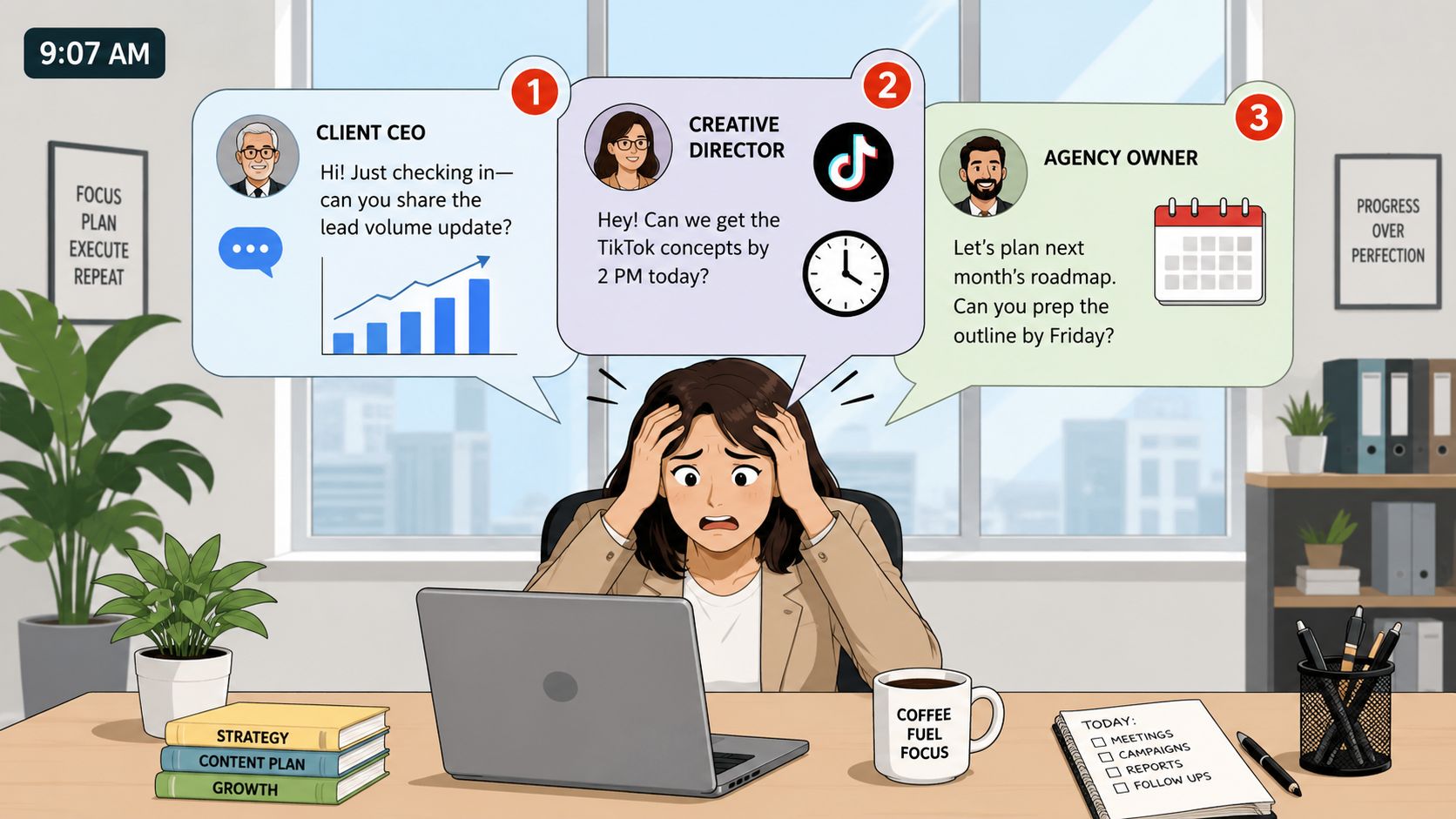
At 9:07 on a Tuesday, the inbox is already on fire. The client CEO wants to know why lead volume dipped yesterday, the creative director wants a new hook before lunch, and your agency owner wants next month's forecast like it's sitting in the microwave. Somewhere in the middle, your media plan is fine, your ads are fine, and the problem is that nobody knows who needs what, when, or why. That's communication with stakeholders in the wild, and it's usually less about talent than about missing the operating system.
The ugly truth is that most “communication problems” are really mapping problems, cadence problems, or decision problems. The fix isn't sending more updates into the void and hoping somebody salutes. It's building a system that treats stakeholders like actual humans with different jobs, different patience levels, and different reasons to care. If you're also wrangling remote teams, the operational side gets even messier, which is why a clean structure matters more than heroic improvisation, like the one outlined in this guide on managing distributed teams.
The four bets here are simple. Stakeholder communication is a system, not a personality trait. Relevance beats volume. Cadence saves accounts faster than panic does. And reporting without a decision prompt is just expensive journaling with better fonts.
You do not need another theory at 9 AM. You need fewer loose ends, fewer side conversations, and a clearer answer to one question, who needs to know what, by when, and for what decision. Media buying turns ugly fast because every stakeholder thinks their issue is the urgent one, and every channel, Slack, email, WhatsApp, shared docs, makes that urgency louder.
A client CEO does not want your raw platform dump. They want to know whether the account is healthy and what call they need to make. A creative lead does not need the finance summary. They need the signal that tells them which hook just died and what needs replacing before lunch. The failure point is usually the same, everyone gets the same update, and nobody gets the update they can use.
Practical rule: if a stakeholder cannot act on the message, they do not need that message at that cadence.
The old model was one-way reporting. The better model is structured, two-way, and a lot less theatrical. The UK Government's stakeholder engagement guidance treats the work as identifying the right people, tiering them by influence, choosing how the plan gets implemented, and checking whether the objective was met. It also calls out preferred medium, internal reporting, and whether the message landed, which is a cleaner way of saying stop improvising and start running a process.
That is why a media-buyer-specific system beats generic project management theater. You are not trying to make everyone equally informed. You are trying to get the right people informed enough to approve, unblock, or stay out of the way. If you have ever been stuck in a thread where seven people answer a question nobody owns, the cost of skipping prep work is already on your desk. For distributed teams, the friction gets worse fast, which is why a clean operating rhythm matters more than heroic improvisation, like the one outlined in this guide on managing distributed teams.
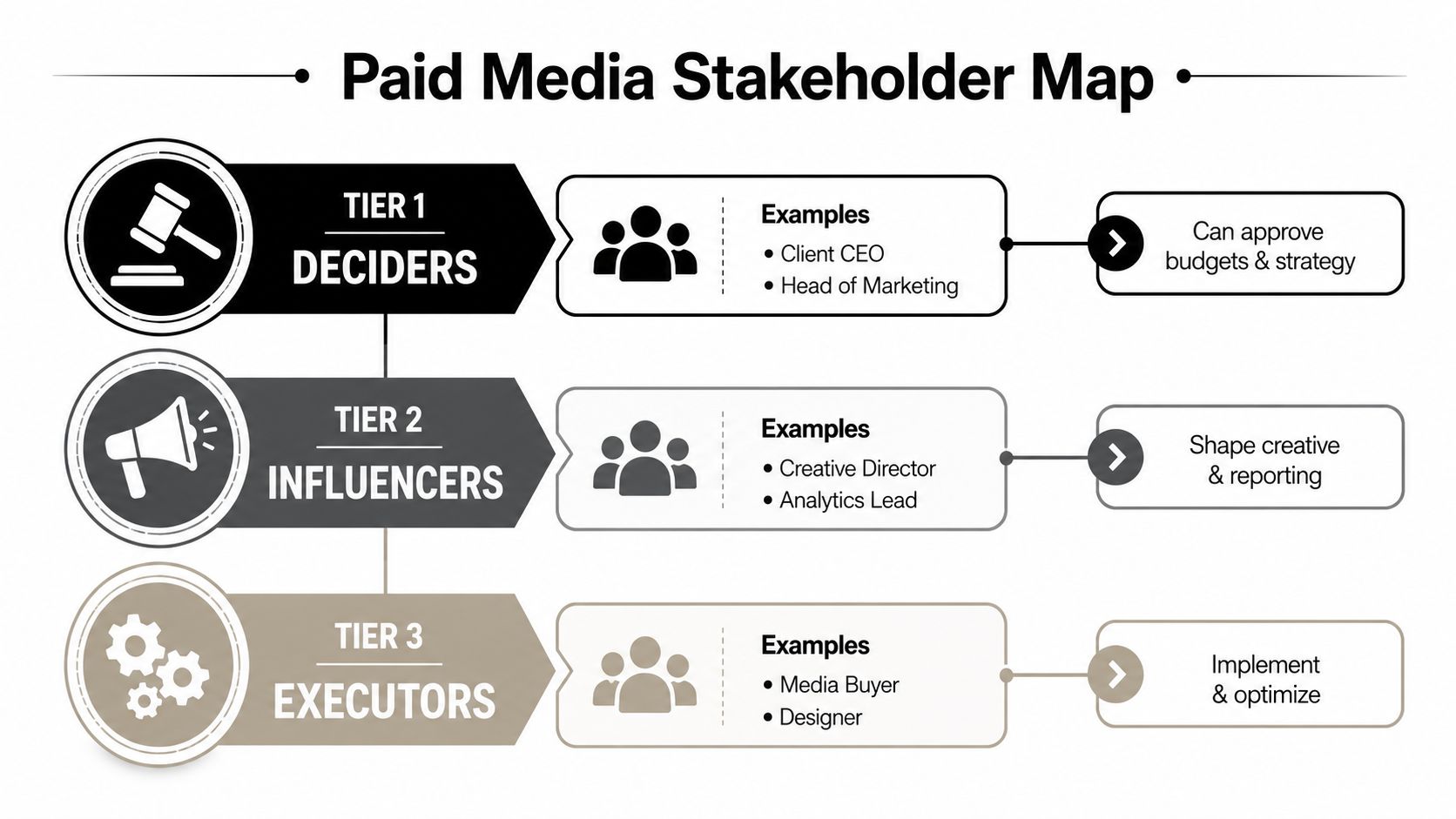
Most account blowups start before the first report goes out. They start when nobody bothered to map the room, so every Slack thread turns into a surprise audit. A proper stakeholder map keeps you from treating the client CEO, the finance contact, and the creative agency partner like they all need the same message at the same time.
Use two questions. First, can this person change budget, timing, or approval? That is influence. Second, does this person live in the dashboard or only check in when something looks weird? That is interest. Put them on the grid, then stop pretending every name deserves the same cadence.
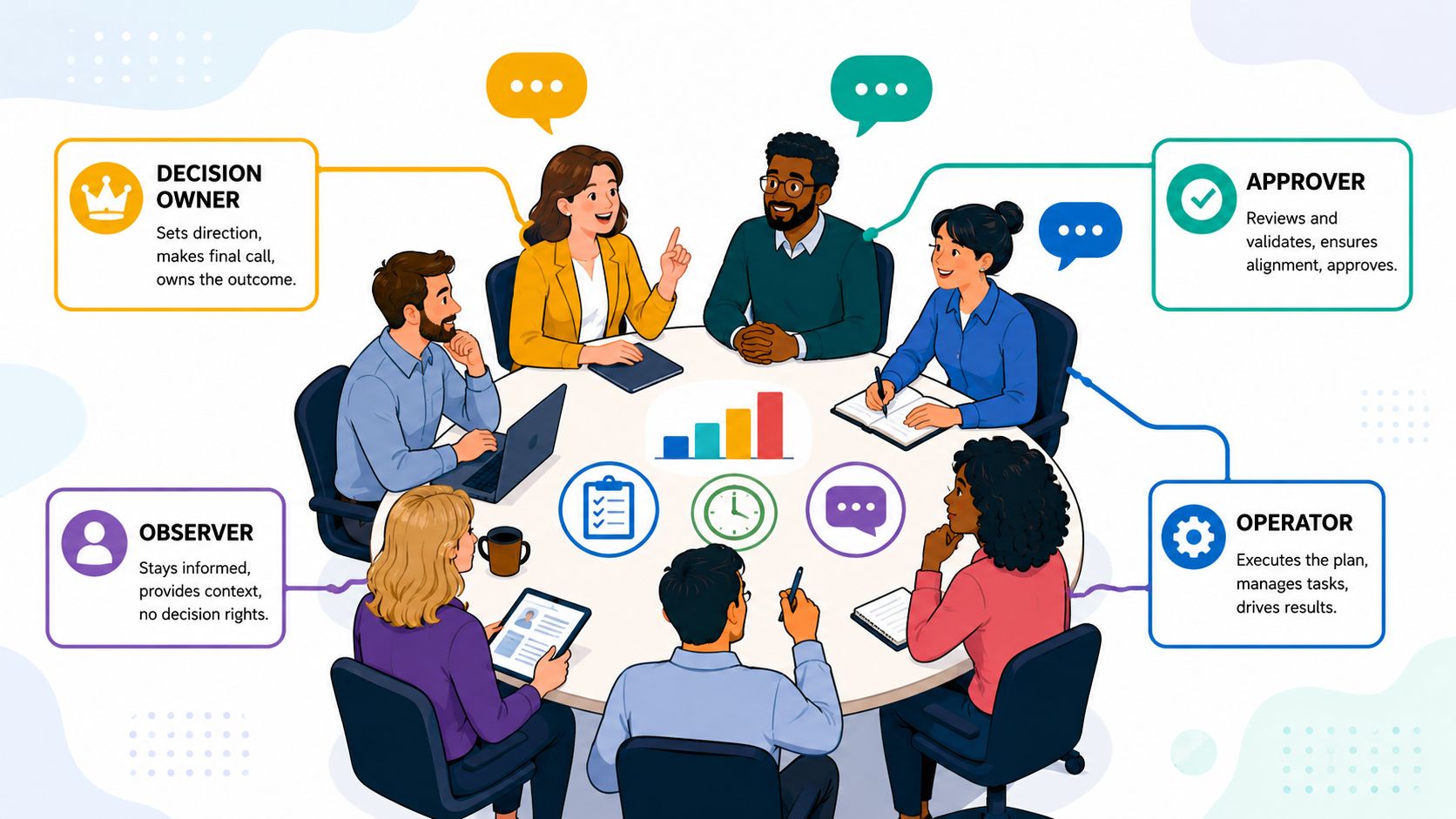
In a paid media account, the Decision Owner is usually the CMO, client CEO, or head of marketing. They want business impact, not platform archaeology. Approvers might be the finance contact or brand lead, and they need enough detail to approve spend, creative, or next steps. Operators are the media buyer, designer, and analyst, and they need fast, precise instructions. Observers can include adjacent stakeholders who want awareness but do not need to be in the weeds every day.
PMI's stakeholder communication model treats this as a five-step cycle, identify, prioritize, visualize or map, engage, and monitor, and it warns that treating all stakeholders the same is one of the most common failure modes in cross-functional projects PMI stakeholder communication model.
The hidden villains are usually procurement, legal, and that one senior operator who never speaks in meetings but kills momentum in email. They do not always introduce themselves at the start. They reveal themselves when a deliverable sits untouched for four days and everyone acts surprised. I have watched more than one account die by “we'll just get legal to review it later,” which is consultant language for “we have not met the actual bottleneck yet.”
A quick way to expose the noise pattern is to pull last quarter's email threads and tag every address by tier. You will see who gets overloaded, who gets ignored, and where the account really bottlenecks. That is the part nobody wants to do because it is slightly embarrassing, which usually means it is the right thing to do.
If you work agency-side, the difference between a tidy map and a messy one shows up fast. A lot of team structures look neat on paper and behave like a group chat after coffee. If you want a useful comparison of those working models, the breakdown in agency vs. in-house is worth a look, because the stakeholder sprawl changes depending on where the media buyer sits.
A communication plan isn't a mood board. It's a contract with yourself about who gets what, when, how, and why. PMI's planning guidance is blunt on this point, a real plan defines who needs what information, how often, and by what means, using audience, message, timing, channel, and format PMI communication planning guidance. If your plan can't answer those questions, it's not a plan, it's a shrug in a spreadsheet.
For operators, I like a daily async scorecard. It should be short, boring, and useful, spend pacing, major anomalies, actions taken, and what needs a human decision. For approvers, a weekly written recap works better than another meeting because it gives them context plus a decision prompt. For decision owners, a monthly business-impact memo is enough unless the account is in trouble, in which case the cadence changes.
| Communication Cadence by Stakeholder Tier | ||||
|---|---|---|---|---|
| Tier | Channel | Cadence | Format | Decision Prompt |
| Operators | Slack or shared doc | Daily or several times per week | Short scorecard | What changed, and what do you need from me? |
| Approvers | Email or Loom | Weekly | Written recap | Approve, revise, or hold? |
| Decision Owners | Monthly | Business-impact memo | Keep funding, adjust scope, or escalate? |
Slack is good for quick alignment and bad for anything that needs memory. Email is slower, but it leaves a trail. Loom works when you need tone and context without booking another meeting. Status meetings should be rare and deliberate, because too many of them turn into ritualized nodding, which is corporate theater with calendar invites.
Practical guidance from stakeholder-communication sources recommends regular and predictable outreach, with some channels updated daily or several times per week and others used as needed for urgent notices, while also tracking email opens, replies, shares, and sentiment over time Simply Stakeholders communication guidance. That's the part people miss. The benchmark isn't “did we send it.” The benchmark is “did the right people understand it, act on it, and respond?” A one-page cadence table does more for account stability than a bloated status deck ever will.
Copy-paste cadence template
One more thing. Document what was decided, not just what was discussed. I've seen too many accounts bleed time because the meeting notes said “aligned on creative direction,” which is useless when three people remember three different creative directions.
A report that gets ignored usually misses the core question. Build it backward from the decision. Start with what the stakeholder needs to fund, approve, or block, then cut the rest until the page only carries useful weight. Paid media gets sharper fast when the report stops trying to impress and starts trying to help someone act.
Decision owners need business metrics they can use without translation. That usually means revenue, MER, CAC payback, or whatever the company uses to decide whether a channel deserves more budget. Approvers need channel diagnostics, things like CPA, CTR, and creative velocity, because they're judging whether the current approach deserves another week. Operators need operational signals, such as pixel health, spend pacing, and delivery issues, because they're the ones who can fix the mess before lunch.
The dashboard is not the report. A dashboard is a tool. A report is a decision artifact. If you send a link and call it communication, you've handed someone a toolbox and asked them to assemble trust from spare parts. For a cleaner view of the ad-level numbers that belong in that toolbox, use ad performance metrics as the starting point and strip out anything that does not change a decision.
Every chart needs a line that says what changed and what it means. “Here's the trend” wastes space. “Spend held steady, but creative fatigue is showing up in the highest-volume ad set, so we need new variants before performance slips further” gives the reader a next move. That sentence does more work than a page of charts because it tells people what matters now.
The report header should answer four things:
That format also works as a meeting agenda, which matters when someone insists on discussing the report live. If you need a source of talent that understands this kind of client-facing rhythm, HireMediaBuyers.com is one option for finding pre-vetted paid media specialists who work across Meta, Google, LinkedIn, TikTok, and other channels.
The fastest way to waste a meeting is to start with “so, how's it going?” That opener invites everyone to be polite, vague, and unhelpful. A useful meeting starts with the decision, not the weather.
At kickoff, the job is to align on scope, owners, channels, and how communication will work when things get messy. I'd use a line like, “Here's what success looks like, here's who approves what, and here's how we'll handle changes before they become surprises.” That sets the tone without sounding like a compliance video.
Mid-flight calls are narrower. Try, “What changed since the last check-in, what's at risk, and what needs a yes from you today?” That one sentence cuts through 20 minutes of filler because it forces the room to pick a lane. If someone tries to wander, bring it back. That's your job, not theirs.
Quarterly business reviews need a different tone. You're not recapping every test. You're answering, “Did the channel earn its place, what did we learn, and what should we change next quarter?” That's the conversation senior stakeholders care about, and anything else is decorative.
Practical rule: the first ten minutes of any meeting should tell you whether the call can end early or needs a decision.
When budget gets cut, don't perform panic. Say, “If the budget drops, here are the campaigns we protect, the ones we pause, and the likely trade-off.” When creative fatigue shows up, say, “The strongest variants are flattening, so we need a new batch before the current winners decay.” When somebody emails, “Why is Meta CPC up?” answer with context, not defensiveness. “CPC moved, but the better question is whether the traffic quality and conversion path still support the spend. Here's what changed, and here's what I recommend.”
Async tools can remove a lot of pointless meetings. Loom plus a doc works well for walkthroughs. Shared dashboards work for people who prefer self-serve data. Voice notes can be fine for quick clarifications, though they become a liability fast if nobody writes down the decision. The rule is simple, no agenda, no meeting. No decision log, no memory. No owner, no follow-up.
Escalation should feel routine. If it turns dramatic, the team waited too long, skipped the warning signs, or kept pretending a small issue would sort itself out. The clean version is a pre-agreed decision tree that tells every stakeholder what happens when an account shifts from noisy to dangerous.
A yellow flag is a signal worth tracking, not a reason to light the room on fire. That could be tracking pixel loss, a small data mismatch, or a reporting issue that needs attention before it becomes a trust problem. The response is direct, notify the team lead, log the issue, and keep the client informed if the numbers they rely on are affected.
A red flag means the account needs action now. Creative fatigue across the strongest ads, a meaningful CPA spike, or a serious platform issue should move the account manager and client into the conversation quickly. At that stage, speed matters more than polish.
An account-at-risk event is exactly what it sounds like. It points to a real threat to retention or delivery, whether that is a major policy breach, a budget overrun, or a stakeholder signaling churn. At that point, everyone who can help should be in the room, including the agency owner if the call needs weight behind it.
That same discipline shows up in the UK Government stakeholder engagement guidance. Identify the stakeholders that matter, sort them by influence, set a plan for implementation and evaluation, know the preferred medium, report activity internally, and measure whether the objective was met. Different wording, same operating logic. Wait too long and you end up discovering authority in the middle of a crisis.
When you escalate, name the issue, the impact, and the fix you want to test. Don't blame the client. Don't blame the platform. Don't dump a screenshot into a group chat and disappear. If the problem sits inside the agency, say so plainly. If the client needs to choose between options, give them a real choice, not a fog machine.
The strongest escalation messages are short and usable. “We lost signal on one conversion event, the reporting view is partial, and we are checking whether spend needs to pause.” Or, “Performance softened across the top creative, we are shipping replacements and need approval to redirect budget.” That is the job. Sounding clever does not move the account. Getting the right people moving before the issue grows a personality does.
Some rituals survive purely because nobody wants to be the person who kills them. That's how you end up with 40-slide decks, dashboard-only check-ins, and surprise escalations that make everybody defensive. None of that is a communication strategy. It's just calendar clutter with better lighting.
Public-sector and health-engagement guidance leans hard toward early, transparent, two-way communication, feedback loops, and long-term relationship building, while also saying to keep materials simple and brief, use the right messengers, and choose the channels stakeholders use U.S. Department of Education stakeholder engagement guidance. That's the part to steal. Not the bureaucracy. The restraint.
If you want a diagnostic question, ask this. “Does this ritual help someone decide, approve, or unblock something?” If the answer is no, cut it or shrink it. If you're worried about losing visibility, you're probably mixing up visibility with volume.
A good reset is straightforward. Pick one ritual, write the cadence, run it for a month, and ask your bluntest client for feedback. Not the polite one. The one who tells you when the reporting is too long and the meeting should've been an email. That's how the system gets better.
If you're tired of babysitting chaos and want media buyers who know how to keep clients aligned without turning every account into a group therapy session, visit HireMediaBuyers.com. They connect companies with pre-vetted paid ads talent that already understands stakeholder communication, client cadence, and the difference between a report and a decision.


