


Most advice about a data warehouse specialist is stuck in a museum. It still treats the job like a glorified SQL ticket queue, as if someone's day is just dragging rows around and feeding dashboards like a very patient office hamster. That version of the role exists, sure, but it's only half the story now, and the half that gets people hired or fired depends on whether they understand the split between classic warehouse work and modern cloud analytics governance.
The market has made the split obvious. In the UK, IT Jobs Watch reported 707 permanent vacancies citing data warehouse in the 6 months to 4 Aug 2026, down from 843 in the same period of 2025 and 1,340 in 2024, with a median annual salary of £65,000 across 506 quoted salaries, and those roles represented 0.68% of all permanent UK jobs in the latest period, versus 1.70% a year earlier (IT Jobs Watch). In the US, Zippia estimates 12,315 employed data warehouse specialists, 119,990 active job openings, and 9% projected growth from 2018 to 2028, with an average salary of $78,418 in 2024 (Zippia trends). That's not a sleepy back-office niche. That's a real labor market with two different kinds of buyers.
Practical rule: if a job ad says “data warehouse specialist” and only mentions SQL, ETL, and nightly loads, you're reading a legacy role. If it also mentions governance, master data, or cross-functional platform ownership, you're looking at the newer version.
The old stereotype is lazy and wrong. A data warehouse specialist is not just a glorified ETL jockey, and anyone hiring that way is going to waste a lot of interview time discovering it the hard way. O*NET says the occupation is about designing, modeling, or implementing corporate data warehousing activities, and it also includes programming and configuring warehouse information, supporting warehouse users, and handling process models for sourcing, loading, transformation, and extraction (My Next Move).
The job title has split into two practical tracks. One track is the classic warehouse builder, the person who keeps models clean, pipelines reliable, and reporting sane. The other is a cloud analytics governance role, the person who owns master data, supports broad data environments, and makes decisions that affect how the whole platform behaves.
That's why so many job descriptions read like someone copy-pasted from three different hiring managers. They want SQL, ETL, Snowflake, data quality, stakeholder management, and cloud governance in one neat package, which is fine if they're hiring a senior platform owner. It's nonsense if they're looking for someone to stabilize daily loads and keep schema drift from turning the warehouse into a landfill.
The labor market reflects that split too. O*NET projects 7% or higher growth from 2024 to 2034 with 66,900 jobs and a 2025 median wage of $139,500 for the occupation as profiled in the U.S. market (O*NET). Meanwhile, the practical reality in many companies is that the title still gets used for a mix of classic warehouse work and modern data-platform ownership. That gap is exactly where bad hires happen.
Stop asking whether the title is “still relevant.” That's the wrong question. Ask which version of the role you're hiring for, then write the job around that version.
If you can't decide whether you need a warehouse builder or a governance owner, your interview panel can't evaluate candidates properly either.
The cleanest hiring teams separate the two in the job description, then test for them separately. The messy teams blend them together and wonder why every candidate seems either underqualified or over-specialized. Toot, toot, but this is one of those cases where clarity beats optimism every single time.
The job is less glamorous than the brochure and more important than the brochure. A competent data warehouse specialist spends the day moving data from operational RDBMS systems into structures analysts can trust, then shaping those structures with ETL/ELT and validation checks (Zippia role description). That work is disciplined, repetitive, and unforgiving. Good. Analytical data should be boring in exactly that way.
The day starts at the source, not in a dashboard. Someone has to pull data out of operational databases, sort out what is stable from what is full of edge cases, and map it into a structure analysts can trust. That mapping is where a lot of candidates fall apart, because they can write SQL but cannot explain why a schema mismatch breaks downstream reporting.
Transformation comes next. The job is to design models, move data through ETL or ELT, and run validation checks so bad records do not slip into analytical layers. That work does not impress people at demos, but it decides whether the warehouse supports decisions or produces polished nonsense.
A good specialist also handles query tuning, indexing, partitioning, compression, and execution-time monitoring so batch loads and analytics queries stay usable. A municipal technical specification frames warehouse work as a balancing act between access speed, batch loading, and resource use, while role specs also call out tuning, disaster recovery, and scalability as core duties (MPS Omaha specification PDF). That trade-off matters because warehouses are shared systems with competing demands.
The strongest candidates do not just say they improved performance. They tell you what they tuned, what got faster, what got slower, and what they chose not to touch. That separates engineering judgment from résumé decoration.
Practical rule: if a candidate cannot explain how they reduced transformation errors before data hit the semantic layer, they have not spent enough time in a real warehouse.
For a practical mental model, keep the day in three loops. Get data in. Make it correct. Keep it fast enough that users do not start building shadow spreadsheets like fugitives from the warehouse team.
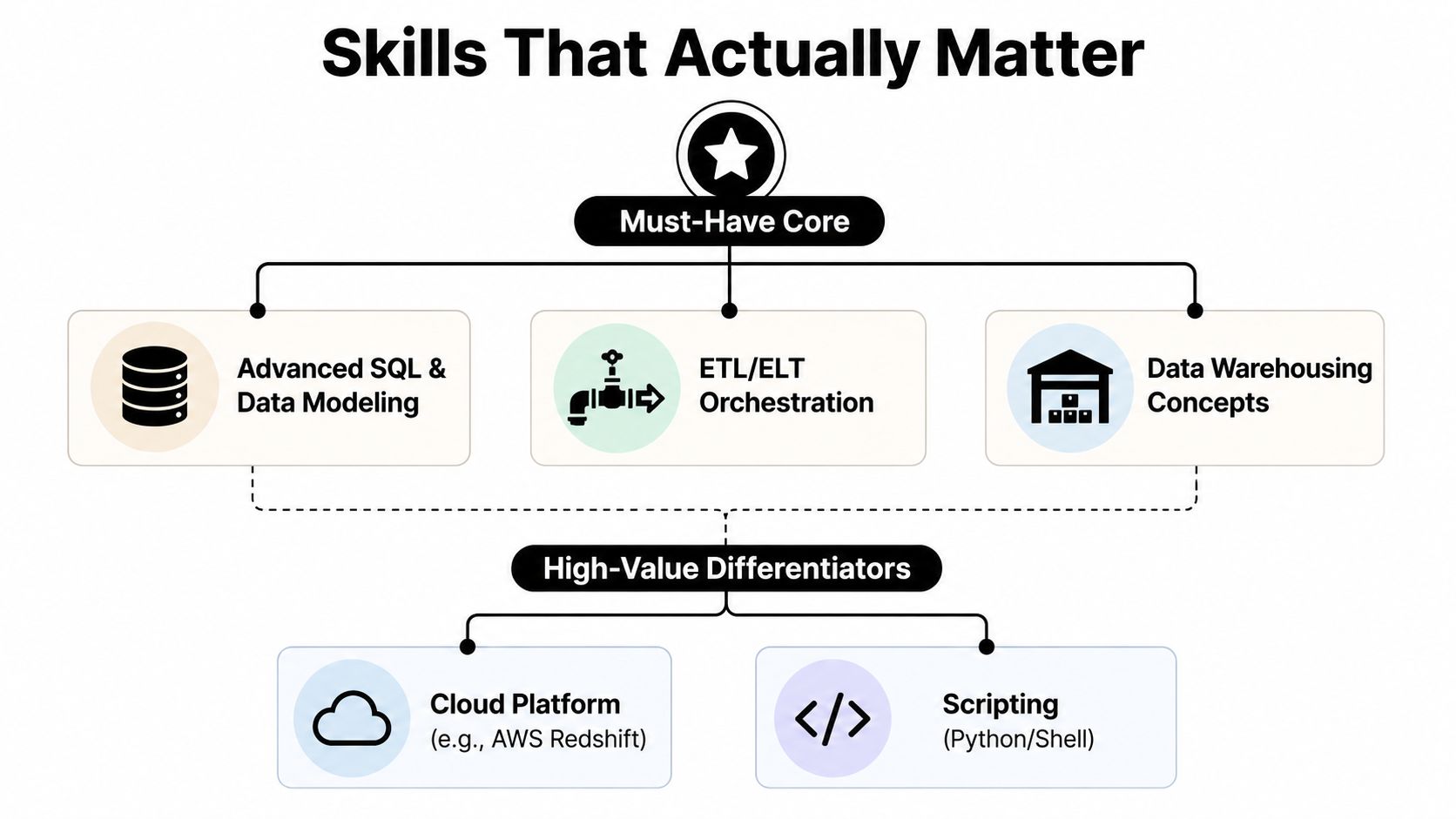
Forget the 47-skill laundry list. Nobody hires a data warehouse specialist because they can name every tool in the market or recite every governance framework from memory. Good hiring starts by separating must-haves from nice-to-haves, and a skills-based approach is the cleanest way to judge real production ability without turning the process into checkbox theater, as shown in this skills-based hiring guide.
Start with SQL mastery. I mean real SQL, joins, window functions, aggregation logic, and the discipline to debug broken transformations without blaming the source system for your own mistakes. Then add data modeling, because anyone who cannot structure facts, dimensions, and summaries cleanly is just turning future cleanup into a more expensive problem.
ETL/ELT proficiency comes next, along with a working understanding of cloud platforms. You do not need every candidate to be a platform architect, but they should understand how warehouse data moves, where quality checks belong, and why performance tuning exists. If they have never touched orchestration, metadata, or diagnostic testing, they are not ready to own production work. In a hiring market where the title now splits between classic warehouse operations and cloud analytics governance, those basics tell you which side of the split they can handle.
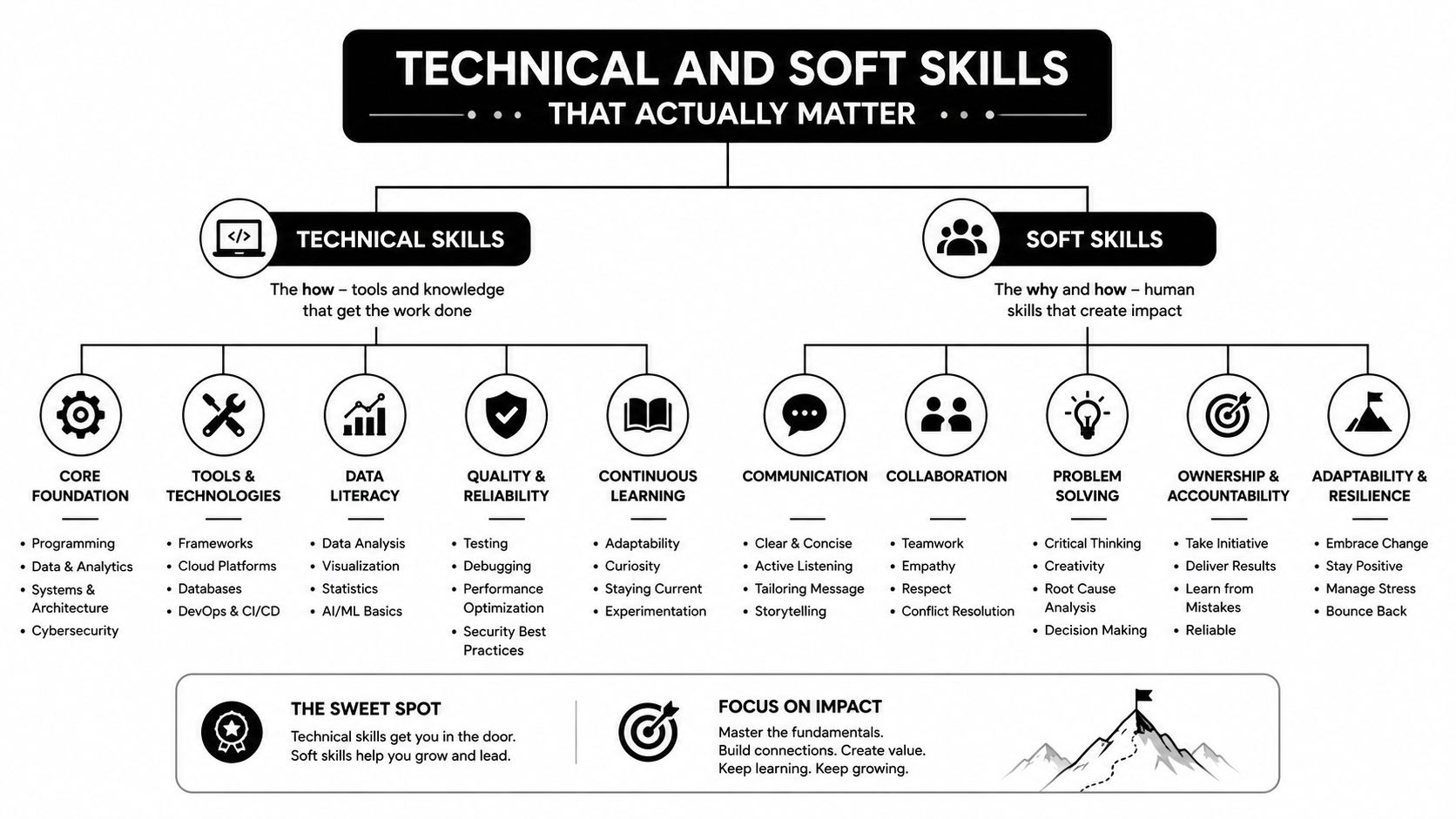
The soft skills are not fluff. They decide whether the hire survives the first quarter without becoming the person who is technically strong but impossible to work with. You want someone who can push back on bad data requests, explain trade-offs without sounding defensive, and keep stakeholders calm when a load fails at 6:12 a.m.
Here is the blunt version.
Junior candidates should show disciplined SQL and basic pipeline understanding. Mid-level people should explain modeling choices and quality controls. Senior candidates should talk about trade-offs, governance, and how they keep multiple teams from trampling the same data platform.
Ask one question and listen carefully. Can this person explain a data problem to finance, engineering, and sales without changing the facts? If the answer is no, keep looking.
The tool stack is where job descriptions turn into alphabet soup. Don't let that fool you. The important question is not “Have they used everything?” It's “Do they understand how the stack changes with company stage and infrastructure maturity?” A startup, a mid-market company, and an enterprise warehouse team are not solving the same problem, and they should not hire the same way.
| Category | Startup Tools | Mid-Market Tools | Enterprise Tools |
|---|---|---|---|
| Traditional ETL tools | Lightweight batch jobs, simple connectors | Mature ETL suites, managed connectors | Heavy-duty enterprise ETL platforms |
| Cloud-native ELT platforms | Hosted transformation workflows | dbt-centered pipelines | Governed transformation layers with policy controls |
| Data modeling tools | Basic SQL and warehouse-native modeling | dbt, schema documentation, modeling standards | Formal modeling governance and lineage tooling |
| Orchestration frameworks | Managed schedulers | Airflow, Dagster, similar orchestrators | Enterprise workflow orchestration with controls |
| Monitoring solutions | Basic alerts and logs | Pipeline monitoring, freshness checks | Observability, auditability, and lineage-driven alerting |
A Series A startup usually needs speed and simplicity, not a cathedral of tooling that requires three specialists to keep the lights on. A Fortune 500 with legacy on-prem systems needs integration discipline, governance, and a stack that can handle bureaucracy without collapsing under its own ceremony. Those are different worlds.
The same goes for the Snowflake versus BigQuery versus Redshift debate. Don't turn it into a loyalty contest. Pick based on your workload shape, existing cloud footprint, governance needs, and how much operational complexity your team can tolerate. If your candidate can't explain why they prefer one platform for a given environment, they're just repeating blog headlines with better posture.
Use the same skepticism with résumés. A long list of tools can mean depth, or it can mean the person watched a lot of demos and touched nothing hard. One honest platform with solid implementation detail beats a wall of vendor logos every time.
For teams that are also thinking about how their warehouse connects to the broader data strategy, the logic is similar to the principles in first-party data strategy. You want control, clarity, and clean ownership, not a pile of disconnected systems with nobody responsible when the numbers drift.
Rule of thumb: if the stack list looks impressive but the candidate can't explain the operational trade-offs, they're probably a tourist.
Money tells you what the market values, and the market is not confused here. In the UK, the latest data warehouse job market snapshot shows 707 permanent vacancies in the 6 months to 4 Aug 2026, a drop from 843 in the same period of 2025 and 1,340 in 2024, with a median annual salary of £65,000 across 506 quoted salaries. In the US, Zippia estimates 119,990 active job openings and an average salary of $78,418 in 2024, up 12% over the previous five years.
The market is split in plain sight. Classic warehouse work still pays for reliability and execution. The cloud analytics governance version of the role pays more because it touches more systems, more stakeholders, and more risk. If you are hiring only for ETL production work, do not pretend you are buying platform ownership. If you want platform ownership, expect compensation to reflect that scope.
The UK market looks material but volatile. Demand has not disappeared, but it is not a sleepy category either. The US market is much larger by openings, which tells you companies are still trying to staff analytics infrastructure faster than they can standardize it.
The salary spread points to two different hiring bets. One is a builder who keeps pipelines and models running without drama. The other is a broader operator who can handle governance, platform decisions, and the messy handoffs between engineering, analytics, and business users.
Employers should anchor offers to scope, not title. Candidates should ask what the job owns, pipelines, data models, user support, governance, or all of the above. If the answer is vague, the package usually will be too.
Use a real hiring timeline, not a wish. A clear sequence for screening, technical review, and decision-making keeps the process honest, and the hiring timeline framework is a better way to structure that work than improvising from one interview to the next.
The cleanest conversations happen when both sides name the work. No drama, no theater, just honest scope. That is rare enough that it still feels refreshing.
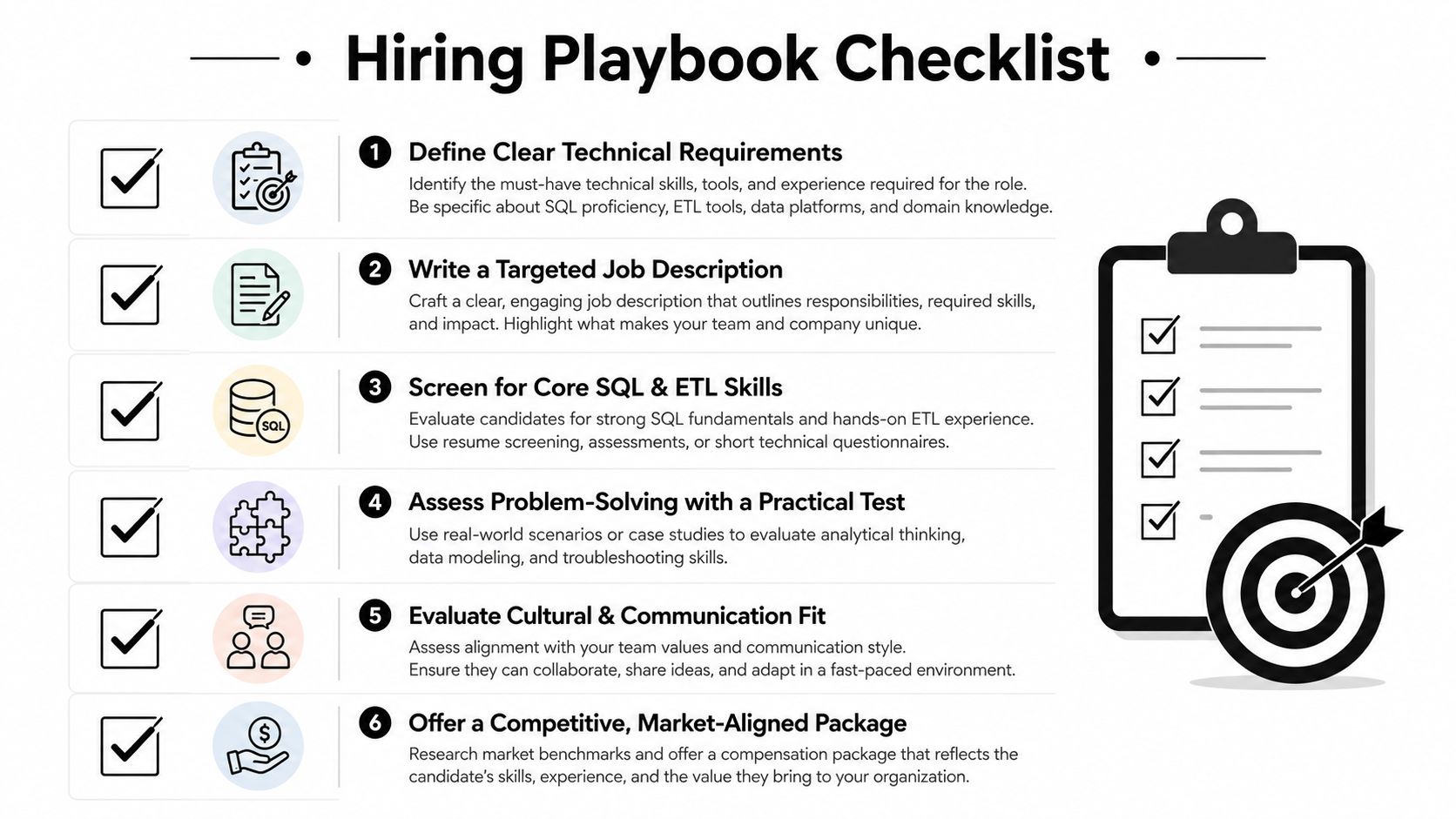
Bad hiring usually starts with a vague job description and ends with someone saying, “We thought the tools would matter more than the thinking.” That's how you end up interviewing people who can recite platform features but can't debug a broken transformation or calm down a stakeholder who's angry about inconsistent numbers. If you want a better result, write the role around outcomes, not buzzwords.
A good job description says what the person will own, what systems they'll touch, and what success looks like in production. It does not read like a shopping list of every warehouse tool your team has ever heard of. If you include too many platforms, you attract tool collectors, not operators.
Use direct language. Say whether the role is focused on classic ETL, data modeling, or cloud analytics governance. Say whether they'll support users, own data quality, and handle performance tuning. If the answer is “some of all of it,” make that explicit so you don't waste time later.
Skip the trivia trap. Asking someone to name every feature of a warehouse tool just tells you they can memorize docs. Ask them to walk through a broken load, explain how they'd isolate schema drift, or describe how they'd keep analysts from using an uncertified table for board reporting.
A practical loop works better than a pile of abstract questions:
For teams trying to tighten their process, the hiring rhythm matters as much as the questions. If you want to compress the draggy middle, compare your process with this hiring timeline and cut the dead air between stages.
Use a scorecard. Not vibes. Score SQL strength, data modeling, pipeline reliability, communication, and problem-solving separately. Then compare notes only after each interviewer has written down a judgment. This keeps the loudest person in the room from hijacking the decision because they “just got a good feeling.”
Practical rule: if two finalists look similar on paper, hire the one who asked sharper questions about your data quality, governance, and user base. That person is already thinking like an owner.
The common mistake is obsessing over tool-specific expertise and ignoring adaptability. Tools change. Teams reorganize. Bad communication survives everything if you let it.
The career path is broader than people think. A junior data warehouse specialist can grow into a senior warehouse builder, then move toward data architect, analytics engineer, or head of data platform depending on whether they prefer hands-on engineering, system design, or leadership. The strongest people don't just become more technical. They become more useful across the business.
Certifications can help, but they're not magic. Hiring managers care more about whether you can explain a clean data model, show how you protected data quality, and prove you've worked with real systems under real pressure. A portfolio with documented warehouse decisions will beat a stack of badges every time.
The role is heading toward convergence, not simplification. Warehousing, governance, and platform engineering are getting mashed together, and people who refuse to learn the adjacent skills will get stranded in the old version of the title. My blunt advice is simple, for both employers and candidates. Build around data quality, platform ownership, and cross-functional clarity now, because the teams that treat this role like “just SQL” are already behind.
If you're hiring a data warehouse specialist and don't want to waste weeks sorting signal from noise, HireMediaBuyers.com can help you build a sharper hiring process for specialized technical roles. It's a practical place to find vetted talent and move faster without lowering the bar, so visit HireMediaBuyers.com and see how they can support your next hire.


