

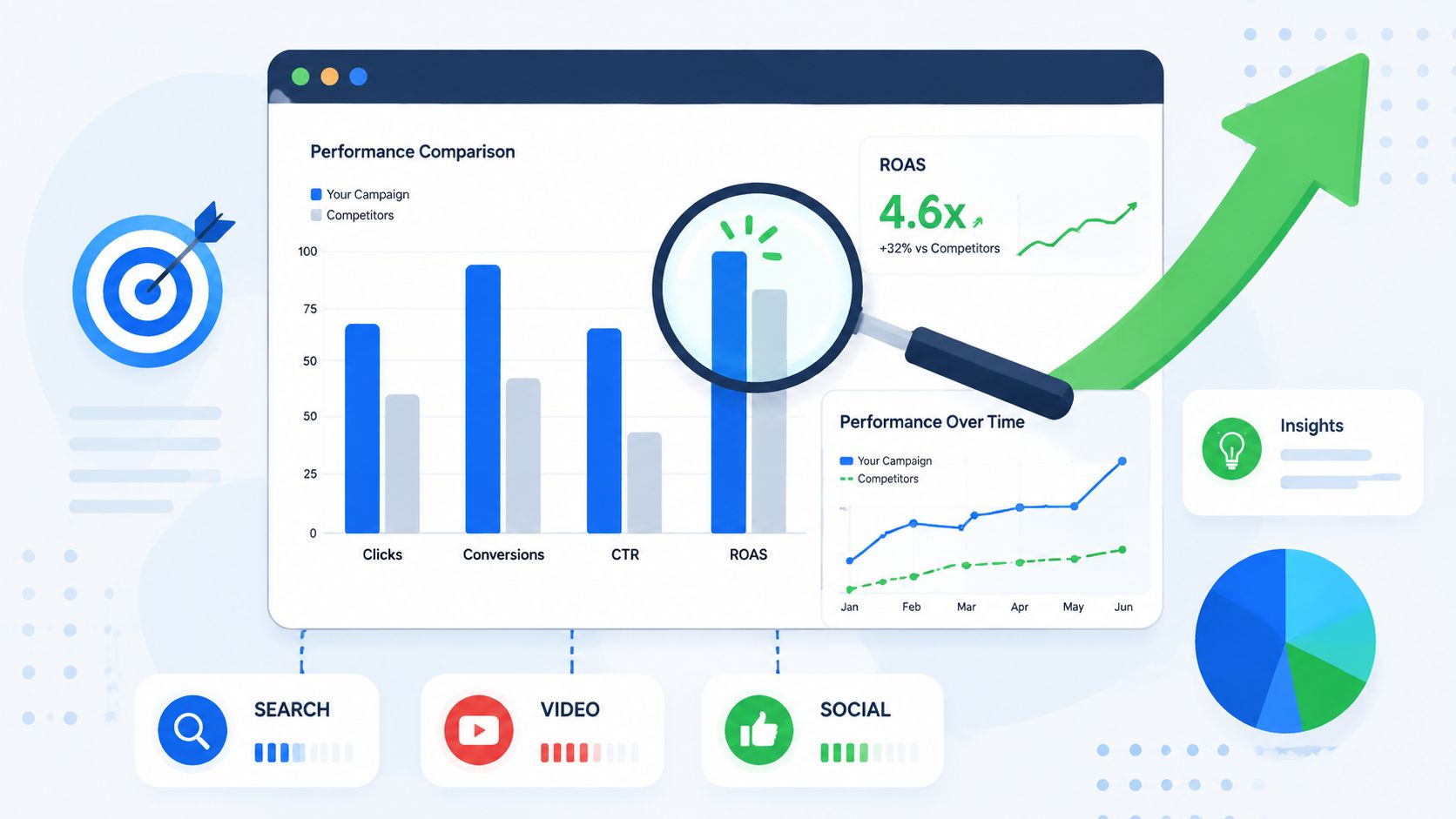
Your dashboard can look healthy while the business bleeds cash. That is the trap with industry benchmarking in paid media. A decent-looking CPA or ROAS can hide a team that is working in the wrong peer group, with the wrong playbook, and sometimes the wrong hire.
Generic averages are useful for one thing, and that is making people feel organized. They are a lousy decision tool. Real benchmarking starts with a peer set that resembles your business, then uses that comparison to sharpen choices about media, offers, and talent. Modern benchmarking has moved toward segment-specific comparisons by geography, establishment size, and NAICS code through federal datasets like CBP and QCEW. Vanta Insights on competitive benchmarking makes that shift clear, and it is the difference between guessing and knowing.
That matters because paid media problems rarely live in the dashboard alone. A weak ROAS can point to a bad offer, a weak media buyer, or a business model that should not be judged against a broad industry average in the first place. Benchmarking gives you a cleaner read on which specific problem you have, so you stop hiring for the wrong fix and stop paying for expensive guesswork.
A good CPA can still be a bad sign. If the number looks clean but the business is pulling the wrong kind of customers, the metric is doing PR work, not management work. That is how teams end up congratulating themselves while the pipeline steadily gets worse.
Here is the trap. A broad benchmark can make a weak acquisition strategy look respectable, and it can make a smart strategy look expensive. One guide flags that not every performance gap is a problem, because some differences are “by design or by default”, and broad category averages can mislead fast-scaling or niche businesses where higher acquisition costs are strategic, not wasteful (Feefo on industry benchmarking).
A better read starts with the shape of the business, not the vanity of the number. A premium brand that buys intent-heavy traffic, a lead gen shop selling a long-cycle service, and a low-margin ecommerce store are not playing the same game. If you judge them by the same CPA ceiling, you will hire the wrong person for the job. That is how a team with a conversion problem keeps hiring media buyers who are great at traffic and useless at fixing offer quality.
Practical rule: If a benchmark ignores your business model, size, or lifecycle stage, toss it.
The critical question is not whether your CPA is below average. It is whether your CPA is below the right average for the job your media buyer is performing. A number can look healthy while the account is under-optimized, the landing page is leaking, or the team is optimizing for cheap leads that never close. That is why first-party data strategy matters here, because it tells you whether the cheap acquisition is producing buyers, not just form fills.
industry benchmarking is useful when it helps you separate a real media problem from a business-model problem. It gives you a cleaner way to compare performance against peers using financial and operational ratios, then turn that comparison into a hiring call. If the benchmark says the account is fine but retention is trash, you do not need a miracle. You need a media buyer who understands audience quality, not just lower-funnel volume.
If your team is celebrating a clean CPA without checking who those customers are, the dashboard is lying by omission. Cheap clicks are easy. Cheap clicks that stay, buy again, and grow the account, that is the part worth hiring for.
Your peer set decides whether benchmarking helps or just feeds you bad confidence. Put a niche startup next to a giant marketplace and you get a comparison that belongs in a comedy sketch. Ultimately, the task is to find businesses with similar channel mix, margin structure, market maturity, geography, and hiring model.

Start with the obvious names, then get stricter. Your real competitors are not just the companies in your pitch deck. They are the ones bidding on the same keywords, buying the same attention, and fighting for the same conversion.
A lot of guides get lazy here. They stop at “find peers” and call it strategy. That is how a broad average makes a deliberate growth plan look sloppy, or makes a bloated operation look tidy. Same trap, different costume, and it hires the wrong media buyer every time.
The rule is simple. Keep only the comparators that share your operating reality, then ignore the rest. If your own conversion data is messy, fix that before you treat any benchmark like gospel. Incrementality testing helps you separate real lift from fake efficiency, which is exactly the kind of filter you want before you start comparing accounts.
Federal systems like CBP and QCEW still help when you need a grounded check on NAICS code, geography, and establishment size instead of industry folklore. That is a better starting point than random Slack opinions and “I heard from a guy at a conference” nonsense.
Benchmarking gets useful when you stop waiting for pristine data and start pulling together the evidence that helps you make a decision. The best teams I've seen work from three buckets, internal performance data, public competitor signals, and platform-level data from ad networks and analytics tools. No single source gives you the full picture. Together, they get you close enough to act without pretending you've found holy scripture in a spreadsheet.
Start with your own numbers. Internal data is the cleanest place to begin because you control the definitions, and that matters more than people admit. Pull the same KPI set across channels, campaigns, audiences, and time periods, then use it to spot where the gap lives. If your conversion tracking is shaky, fix the plumbing first with a first-party data strategy before you start treating any benchmark like a verdict.
Public signals are the next layer, not the main event. Earnings commentary, investor presentations, job postings, and product launches rarely hand you a neat benchmark, but they do reveal where competitors are placing their bets. That is the useful part. You are not trying to read their minds, you are trying to see where they are investing attention, budget, and talent.
Benchmarks are supposed to sharpen judgment, not replace it. If the data feels tidy but unhelpful, you probably collected the wrong stuff.
For market context, federal datasets still matter. CBP and QCEW can ground your analysis in segment-specific baselines instead of stale hearsay, especially when you are sanity-checking whether your business is an outlier by size or geography. But do not confuse market context with media operations. One tells you where the world sits. The other tells you what your team is doing with your budget.
Do not turn competitive research into cosplay espionage. Use public information, platform outputs, and your own data. Then normalize it so you are not comparing a weekly spend figure against a monthly one like a tourist trying to do calculus.
A better operating mindset is directional truth over fake precision. If the benchmark is close enough to guide a hiring decision, it is useful. If it looks elegant but lands too late to matter, it is dead weight. For a broader view of how teams compare themselves against peers in real operations, the overview on industry benchmarking makes the freshness problem clear.
Raw data is not insight. Raw data is a mess with a spreadsheet license. The job is to clean it, segment it, and calculate the gaps without confusing noise for signal. That is where teams either overcomplicate the process or skip the hard part and end up with a dashboard that looks smart and says nothing.
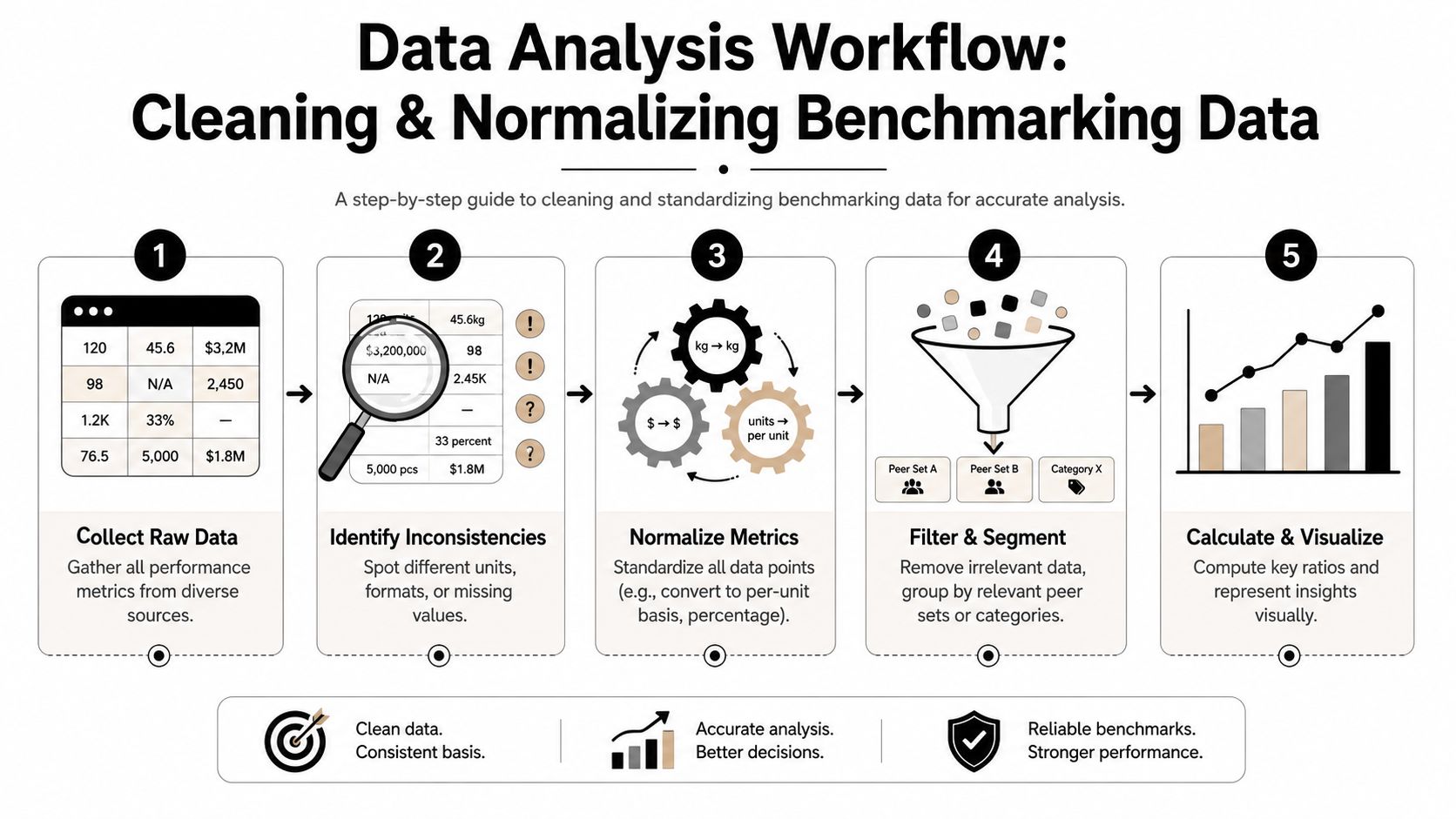
If you are comparing performance across channels, you need consistent units and timeframes. A clean benchmark workflow starts by defining the scope and KPIs, identifying the peer group, collecting and validating data, analyzing the gap, and then turning that into an action plan with owners and deadlines (The Conference Board benchmarking methodology). Skip validation and you will spend your afternoon optimizing against a measurement error.
A good dashboard tells a story in layers. First layer, overall business performance. Second layer, channel split. Third layer, segment or campaign type. Bad dashboards mash everything together and ask you to squint harder. That is not analysis. That is cardio for your eyeballs.
Once the data is normalized, compare like with like. Search gets its own lane. Meta gets its own lane. TikTok gets its own lane. Then look for the biggest deltas, not every tiny wobble. If a channel underperforms the peer set consistently, that is the clue. If it is just drifting around because of seasonality or a campaign launch, do not write a memo about it.
A primary danger is weak data discipline. If comparison groups are not reliable or refreshed regularly, the gap is just measurement noise pretending to be a business insight. Outdated benchmarks are like using last year's map to drive this morning's commute, which is a great way to end up in the wrong county.
If you are also sanity-checking whether a performance dip is coming from offer quality or media execution, incrementality testing helps separate real lift from platform self-congratulation. That matters, because paid media teams love claiming credit for everything right up until the numbers stop cooperating.
A benchmark gap is rarely just a metric problem. It is usually a capability problem wearing a metric costume. Low ROAS on Meta does not automatically mean Meta is broken. It can mean creative testing is weak, audience strategy is stale, or the landing page team is dropping the ball. Same chart, different diagnosis.
This is the move most companies miss. They see a gap, then hire a generic Paid Media Specialist and hope the universe sorts it out. Cute idea. Expensive habit. A better approach is to map each gap to the skill that would close it.
Direct rule: If the benchmark gap cannot be tied to a specific capability, you are not ready to hire yet.
The job spec becomes a strategy document. Stop writing vague qualifications. Write for the exact problem. “Build and scale X while maintaining Y” beats “must be a self-starter” every day of the week. One is operational. The other is corporate wallpaper.
For teams that need a tighter starting point, the structure in a strong media buyer job description is useful because it forces role clarity. That clarity matters more than flashy titles. Titles do not fix ROAS. People do.
There is one more trap. Benchmarks age fast in paid media, hiring, and anything else tied to market competition. The question is not whether you found a benchmark, but whether it is fresh enough to still deserve your attention. For fast-moving teams, stale benchmarks become decorative, and decorative data is just office wallpaper with extra steps.
Benchmarking is not a slide deck exercise. It is a decision engine. It shows you where money is leaking, where the team is underpowered, and which hire will move results instead of adding another name to the payroll spreadsheet.
Use industry benchmarking to separate real underperformance from a deliberate tradeoff. That matters because a gap is not always a failure, and a benchmark is not automatically wisdom. Good benchmarking uses segment-specific data, regular refreshes, and clear comparison groups, so you stop arguing with gut feel and start making cleaner calls.
If a performance gap shows up, do not patch the spreadsheet and call it strategy. Name the missing capability, then hire for that exact problem. That is how benchmarking stops being reporting theater and starts doing real work.
Your benchmark is only useful when it points to a hiring decision. If ROAS is lagging or CPA is drifting, stop staring at the dashboard like it owes you money. Find the most significant gap, then decide whether you need a sharper buyer, a stronger analyst, or someone who can clean up the account structure without turning it into a science project.
That is the whole point of industry benchmarking. It strips the debate down to a simple question, what capability is missing, and what kind of media buyer will close it. That is where paid media teams stop paying for guesswork and start paying for judgment.
HireMediaBuyers.com helps companies find pre-vetted Media Buyers and Paid Ads Specialists who can move the numbers, not just talk about them. If you're ready to connect your benchmark gaps to the right hire, visit HireMediaBuyers.com and get a shortlist built for performance, not theatre.


