

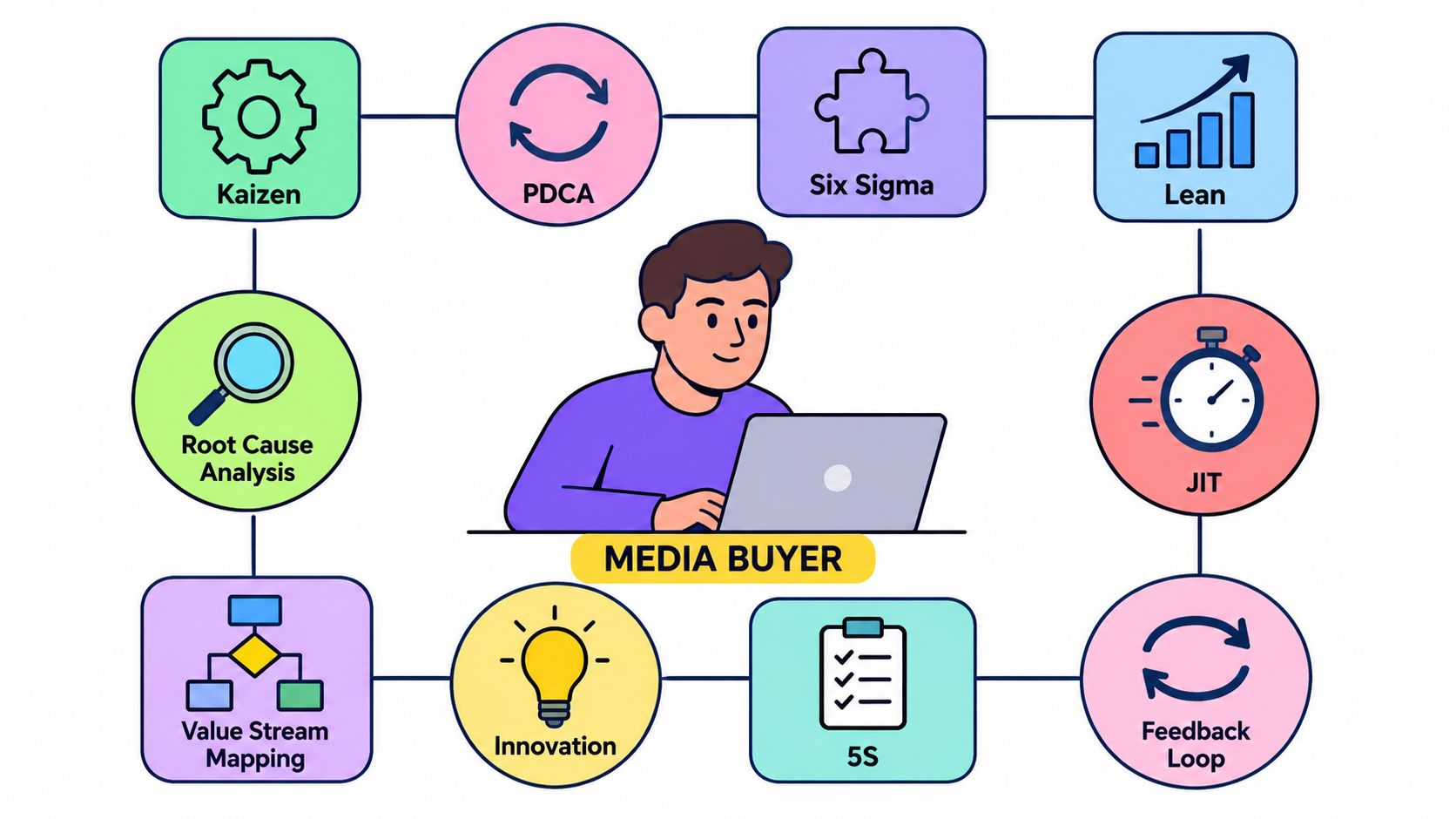
Sick of mortgaging your office ping-pong table to wasteful ad spend? Good. Because the ugly little secret is that continuous improvement methods are already the difference between teams that keep scaling and teams that keep explaining why last month's “best campaign ever” somehow turned into this month's problem child. The case for getting systematic is blunt. The PDCA cycle is built to identify an opportunity, test a change on a small scale, measure the result, and then standardize or repeat the cycle if it doesn't work, according to the American Society for Quality. That's not motivational fluff. That's a loop.
For media buyers, that loop matters because ad platforms don't care about your gut feel, your brand deck, or your last agency's excuses. They reward teams that measure variation, compare baselines, and prove that a change moved the needle. The old quality toolkit, control charts, histograms, and Pareto charts, exists for a reason; it helps teams see process variation instead of guessing at it, again in the ASQ's continuous improvement overview. In plain English, the right method saves you from blaming “the algorithm” every time performance goes sideways.
There's also real money on the table, and it's not distributed evenly. KaiNexus reports that the average user generates $6,000 in annual financial impact, only 1 in 4 improvements creates measurable financial value, over 80% of the savings recur annually, and just 1.4% of improvement ideas generate more than $100,000 in impact in their ROI of continuous improvement report. Translation, you don't need every idea to be brilliant. You need a steady pipeline, sharp filtering, and the discipline to keep testing. That's the game.
If your media buying team is still making changes based on whoever spoke loudest in Slack, start here. Lean Six Sigma combines waste reduction and variation reduction, which is exactly what paid media needs when campaigns are bloated with bad targeting, sloppy handoffs, and budget leakage dressed up as “learning.” The American Society for Quality places PDCA, Lean, Six Sigma, and Total Quality Management in the same continuous-improvement family, all focused on reducing variation, defects, and cycle time while involving employees in process improvement, in its continuous improvement resource.
The waste usually shows up in the boring places nobody wants to audit. Campaign builds get duplicated, naming conventions drift, exclusions get forgotten, and reporting turns into a weekly group therapy session. Lean Six Sigma forces a team to attack the root cause, not just slap another dashboard on the mess.
Practical rule: Start with your highest-spend campaigns. Small percentage gains there compound fast enough to make finance stop side-eyeing you.
For a media buyer, the best use of this method is on campaign setup, audience targeting, and budget allocation. Use historical performance as your baseline, create control groups, and test before rolling out changes everywhere. If your team has one person who can read a process, train them in a Green Belt or Black Belt program. Toot, toot, you've just hired your own internal copilot instead of another “strategy partner” with a nice LinkedIn banner.
A strong hiring move here is to pair method with muscle. If you need someone who can run rigorous media ops without turning every optimization into a science fair, HireMediaBuyers.com is built for that kind of search. That matters because continuous improvement falls apart when nobody on the team can execute the boring parts cleanly.
You're not buying a fancy vocabulary. You're buying a way to strip out waste, measure the process before and after, and make improvements stick. That is how a media buying operation stops turning into a graveyard of half-finished experiments and dashboard theater.
Kaizen is the no-drama version of improvement. It means small, continuous changes, not heroic overhauls that require a steering committee, three off-sites, and a prayer circle. CSU's Lean Six Sigma teaching material ties Kaizen to incremental improvement, employee involvement, process focus, and simplicity/cost-effectiveness, alongside tools like 5S and PDCA in its Kaizen philosophy and tools guide.
Paid media punishes teams that wait for quarterly miracles. Kaizen fits because media buying is a daily optimization sport, not a once-a-month reveal. Ask a simple question every week, like how to squeeze a little more efficiency from a campaign without breaking what already works. That mindset keeps teams from freezing every time performance shifts.
The value is cultural. Small wins create momentum, and momentum beats meetings. A weekly 30-minute improvement huddle, one KPI everyone can see, and a shared habit of trying tiny changes can be enough to stop your team from drifting into “we'll fix it next sprint” territory.
Kaizen only works if you make it safe to fail. Not every experiment pays off, and that's fine. The mistake is treating failed tests like personal embarrassment instead of data. If you're hiring for this style of team, look for media buyers who can talk through small, steady optimizations without dressing them up as genius. HireMediaBuyers.com is useful here because the best Kaizen operators are usually the ones who've spent time inside actual performance loops, not just pitch decks.
Failed experiments are cheaper than permanent bad habits. The trick is to keep the experiments small and the learning visible.
The manufacturing world has used Kaizen to cut waste and improve efficiency for decades, and research on Kaizen implementation reports measurable gains in productivity and efficiency, with lower cycle times and defect rates, in the SSRN study on Kaizen implementation. That's the kind of result media teams should want too, cleaner process, faster iteration, fewer faceplants.
OKRs are for teams that want focus without turning every manager into a hall monitor. The formula is simple: objectives say what you want, and key results say how you'll know you got there. The trap shows up fast, as teams start optimizing the easiest metric and calling it progress, while the underlying revenue problem sits untouched.
For media teams, OKRs keep paid social, search, and lifecycle work tied to business outcomes instead of vanity metrics. They are especially useful when one person is chasing CTR while another is being judged on pipeline quality, and neither is talking to finance. A clean OKR structure makes those tradeoffs visible before they turn into a bad quarter and a painful Slack thread.
The best practice is blunt. Keep company OKRs to three to five, write them in plain English, and score them objectively at the end of the quarter. If every team has twelve objectives, nobody has priorities, they have wallpaper. Use the 50 to 70 percent rule, because if you hit 100 percent every time, your goals probably weren't ambitious enough. That is not failure, that is comfort food.
A recent review of OKR usage in growth teams from Workpath shows the same pattern over and over. Teams get better results when they connect objectives to business impact, keep ownership clear, and avoid the mushy middle where everyone “sort of” owns performance. Media buying needs that discipline more than most functions, because ad platforms are perfectly happy to hand you pretty dashboards that say nothing.
Practical rule: If a key result cannot survive a skeptical finance review, rewrite it.
For talent strategy, a specialized media buyer matters. Someone who has worked with OKRs knows how to translate platform performance into business language without turning every meeting into a dashboard recital. That is the kind of hire businesses look for at HireMediaBuyers.com when they want performance discipline instead of motivational posters.
A/B testing is what separates media buying from expensive superstition. Change one variable, measure the result, and stop treating gut feel like a strategy. Multivariate testing pushes that further by testing several variables at once, which helps when the landing page has multiple weak points and the team needs to know which one is hurting performance.
In practice, the smartest media buyers start with the question that touches revenue fastest. Audience segment, ad creative, landing page headline, and CTA copy deserve attention first. Button color can wait until the rest of the account stops bleeding. The goal is evidence, not a prettier opinion.
Testing discipline matters more than cleverness. Write the hypothesis before you launch, record the result, name the winner, note the lift, and capture the lesson. Run the test long enough to mean something, then let it finish. Killing a test early because someone got bored is how teams turn analysis into guesswork. If you want to separate real lift from platform-friendly fiction, the incrementality testing resource belongs in the same reading pile.
Good testing starts with the variables that can move revenue, not the ones that make dashboards look busy. Put spend behind the changes that affect conversion rate, CPA, or pipeline quality. That is the job.
Signal matters too. A tiny lift on thin conversion volume is usually noise with better branding. Run parallel tests only when they stay isolated from one another, and log every result in one place so the same tired experiment does not come back next month wearing a new name. Amazon's habit of running A/B tests at scale is the right instinct, test more, argue less. Media buyers who cannot prove a change helped are decorating a hypothesis, and that gets expensive fast.
For hiring, experienced media buyers separate themselves from button-pushers. A strong hire knows how to design tests, read the results, and explain why a winning ad set improved ROAS, CAC, or lead quality without overstating the case. That is the kind of operator HireMediaBuyers.com is built for.
PDCA is the simplest way to stop media buying teams from freelancing their way through optimization. Plan the change, do it on a small scale, check the result, then act by scaling the win or killing the idea. The American Society for Quality describes it as a four-step method for identifying an opportunity, testing change on a small scale, measuring results, and then standardizing or repeating the cycle if the change fails, in its continuous improvement guide.
Media buying loves chaos right up until someone asks for the number that matters. PDCA cuts through that nonsense because it forces the team to write the hypothesis before touching the account. That one habit saves a lot of “we changed three things and now nobody knows why CPA moved” misery.
Run PDCA weekly if you want real momentum. Monthly is how teams drift into calling inertia a process. The Plan phase should be explicit, the Check phase should be brutally honest, and the Act phase should change how the team works. If the change worked, standardize it. If it didn't, document the lesson and move on. No drama, no backsliding.
PDCA gets stronger when the team has clean conversion tracking. If tracking is sloppy, the Check phase turns into guesswork with nicer charts. That is why media teams need solid measurement before they scale anything. The point is not to collect data because dashboards look busy, it is to know whether a change moved performance or just made the report prettier. For teams that need tighter attribution hygiene, a conversion tracking guide belongs in the operating manual.
Practical rule: If the team cannot explain the baseline in one sentence, the PDCA cycle started too early.
PDCA also pairs naturally with Kaizen and A/B testing. Those methods need a repeatable loop, and PDCA gives them one. For teams hiring media talent, look for candidates who can run this rhythm without needing hand-holding. A strong operator knows how to test, read the result, and say whether the change improved ROAS, CAC, or lead quality without dressing up a weak result as genius. That is the difference between a buyer and a button pusher.
Most media teams don't have a thousand problems. They have one bottleneck wearing a fake moustache. Theory of Constraints says the system's single biggest constraint deserves the most attention because improving the bottleneck gives you the best return on your effort.
If creative production can't keep up with spend, that's the constraint. If audience research is weak, that's the constraint. If platform expertise is thin, that's the constraint. The useful question is simple, what's stopping us from growing 2x? That question usually exposes the choke point faster than another round of “let's align.”
A team can waste months polishing everything except the thing that actually matters. That's how you end up with beautiful reporting, tidy naming conventions, and a campaign engine that still can't scale. TOC forces you to pick the biggest limiter, measure it, fix it, and then move to the next bottleneck once the first one's gone.
This method is a hiring cheat code. If creative volume is the issue, hire a stronger creative lead. If platform setup is the choke point, hire a specialist who has lived in the ads manager trenches. If account management is overloaded, split the load before the team burns out and starts replying to clients with passive-aggressive emojis.
Don't over-invest in buffers. Work the constraint hard, then move on when the bottleneck changes.
That's one reason companies looking for focused specialists come to HireMediaBuyers.com. They're not trying to buy generic “digital talent.” They're trying to remove the actual bottleneck with someone who can handle the job cleanly.
Root Cause Analysis is for teams that are done pretending the latest spike or drop is the whole story. If ROAS slips or CPC climbs, the obvious problem is usually just the first layer of dirt. Ask why, then ask again, until you reach the underlying failure in process, tracking, creative, or team handoff.
Ad teams love symptoms because symptoms are easy to narrate in a meeting. “The algorithm changed.” “The audience got cold.” “The client changed the brief.” Sometimes that is true. More often, the account structure is messy, tracking is broken, or the reporting rhythm failed the team weeks ago and nobody wanted to say it out loud.
Use the 5 Whys, and bring in the people who lived the problem. If the account manager, the media buyer, and the analyst remember different versions of the same failure, that is useful signal. Keep the blame out of it. The question is not who failed, it is why the system made failure likely.
Start with the symptom, then force the team to prove the cause.
For media buyers, the payoff shows up fast. Teams stop re-litigating the same broken campaign logic every other sprint, and managers stop paying for repeat mistakes with higher CAC and lower margin. It also changes hiring. A strong media buyer does more than push buttons in an ad manager. They diagnose, connect the dots, and fix the system before the budget gets burned again. HireMediaBuyers.com exists for companies that need that kind of operator, not another warm body with platform access.
The Toyota Production System, or TPS, is Lean with teeth. The central idea is merciless in the best way, every step in a process either creates customer value or it's waste. For media buying, that means you should be hunting down the stuff that eats time without improving performance.
Some waste is obvious, like duplicated reporting or endless approval loops. Some waste hides inside habits that felt reasonable six months ago. A team might spend hours on account prep work that nobody uses, or manually clean exports that a dashboard should've handled weeks ago.
Lean thinking starts with value stream mapping, which is a fancy way of saying “show me the full path from brief to delivery.” Once the path is visible, you can remove, automate, or simplify the non-value-add steps. Standardize the high-frequency stuff. Limit work in progress with a visual kanban board. Measure cycle time, error rate, and cost per campaign before and after. If it doesn't improve the workflow, it's probably just admin with better branding.
Lean is one of the few methods that helps teams see process bloat before it eats the quarter. That's especially useful in agencies, where every extra handoff adds lag and every extra step creates more room for human error. It's also useful in house, where campaign launches somehow require seven stakeholders and one person who says, “Let me circle back.”
Toyota's broader production system is famous for reducing lead time through disciplined process design, and the lesson for media buyers is obvious, remove the junk before it turns into a monthly ritual. The best media teams don't just optimize campaigns. They optimize the path to the campaign.
Clicks and conversions tell you what happened on the surface. The Balanced Scorecard tells you whether the media operation is healthy. It tracks performance through Financial, Customer, Internal Process, and Learning and Growth perspectives, so a campaign cannot hide weak economics behind a pretty dashboard or pretend operational mess is harmless because one channel had a nice week.
Media buyers love a clean number, usually the one that flatters the week and ignores the quarter. That is how teams end up celebrating efficient spend while repeat purchase rates sag, client satisfaction slips, or launch workflows turn into a small administrative disaster.
Use the scorecard to force discipline. Pick four or five metrics for each perspective, mix leading and lagging indicators, and review them on a fixed cadence instead of reacting every time someone panics in Slack. Connect the measures so cause and effect is obvious. If campaign setup time is getting worse while training activity is flat, the problem is not the audience. It is the team.
That structure matters because it keeps leaders from confusing activity with progress. A media team can be busy all day and still produce weak business results. The scorecard puts business outcomes, operating speed, and team capability in the same frame, which is where the complete story lives.
For a practical way to connect the scorecard to paid media work, the ad performance metrics guide gives a useful starting point. Use it to anchor the scorecard in metrics the team can act on, not vanity totals someone pasted into a deck to look busy.
A good scorecard makes tradeoffs visible before they get expensive. That is the whole point.
| Method | Implementation complexity | Resource requirements | Expected outcomes | Ideal use cases | Key advantages |
|---|---|---|---|---|---|
| Lean Six Sigma | High, structured DMAIC, certification often required | High, statistical tools, trained personnel, historical data | Large measurable waste reduction (20–40%), standardized processes, reduced variation | Large budgets, enterprise-level campaigns, cross-platform consistency | Root-cause fixes, scalable repeatable workflows, data-driven decisions |
| Kaizen | Low–Medium, cultural discipline, continuous small changes | Low, team time, simple visual tools, minimal training | Incremental compounded gains over time (small weekly improvements) | Agile teams, ongoing campaign optimization, limited budgets | Low friction, high team engagement, rapid small experiments |
| OKR (Objectives & Key Results) | Medium, requires disciplined goal setting and cadence | Low–Medium, planning time, tracking tools, leadership alignment | Clear alignment and focus, improved accountability and strategic outcomes | Organizations needing cross-team alignment and transparent goals | Transparent priorities, encourages stretch goals, reduces misalignment |
| A/B & Multivariate Testing | Medium, experiment design and statistical rigor required | Medium, testing platforms, sufficient sample sizes, tracking infrastructure | Evidence-based lifts per test, library of audience/creative learnings | Creative/landing page optimization, measurable audiences, hypothesis-driven ops | Removes guesswork, statistically validated decisions, repeatable learnings |
| PDCA (Plan-Do-Check-Act) | Low, simple four-step cycle, easy to adopt | Low, minimal tools, discipline, documentation | Fast learning cycles, iterative improvement, quick validation | Weekly optimization loops, tactical fixes, teams starting experimentation | Simple, repeatable, enforces measurement and learning |
| Theory of Constraints (TOC) | Medium, focused system analysis and prioritization | Medium, measurement of constraint, targeted resource shifts | Increased throughput by removing key bottleneck, higher ROI on improvements | Small teams or resource-limited orgs needing focused impact | Prioritizes highest-impact improvements, informs hiring/investment |
| Root Cause Analysis (RCA) | Medium, structured facilitation (Five Whys, fishbone) | Low–Medium, stakeholder time, documentation tools, facilitation | Lasting fixes, fewer recurring failures, deeper systemic insight | Post-mortems, repeated failures, unexplained performance drops | Identifies underlying causes, reduces firefighting, builds institutional knowledge |
| Toyota Production System / Lean | High, cultural change, process redesign, JIT practices | High, value stream mapping, training, systems for standard work | Significant operational waste reduction (20–50%), faster execution, higher quality | Process-heavy operations, scaling teams, reducing cycle time and waste | Eliminates non-value steps, improves speed/quality, sustainable scalability |
| Balanced Scorecard | Medium, requires leadership alignment and metric design | Medium, measurement systems, dashboards, quarterly reviews | Holistic performance view across financial, customer, process, growth dimensions | Mature organizations needing strategic, cross-functional measurement | Prevents metric tunnel vision, links strategy to KPIs, balances priorities |
Pick one method and use it. Don't build a museum of frameworks and call it management. If your team keeps firefighting the same issues, start with PDCA or Root Cause Analysis. If the underlying problem is too much waste, go after Lean. If you need better experiment discipline, use A/B testing and stop trusting vibes with your budget. If the team's stuck on the wrong priorities, OKRs and the Balanced Scorecard will get everyone back in the same lane.
The common mistake is trying to do all of this at once. That's how companies end up with a whiteboard full of good intentions and a media account that still leaks money in three places. Choose one bottleneck, one weekly cadence, and one owner who won't disappear when the dashboard gets weird. That's the whole trick.
If you need someone who can run these methods inside real campaigns, not just talk about them at lunch, hire accordingly. Media buying is too expensive to trust to generalists who “love learning” but can't explain a baseline, a test, or a bottleneck without squinting at slides. The teams that win are the ones that pair process discipline with the right talent, then keep iterating until the system behaves.
If you're ready to pair better process with better people, HireMediaBuyers.com helps US companies find pre-vetted media buyers and paid ads specialists fast. Use it to hire someone who can run structured improvement, protect your budget, and turn experimentation into actual ROI instead of expensive folklore.


